Tiered link building sounds simple: instead of building backlinks only to your website, you build links to pages that already link to you.
The idea is to strengthen those external pages and, indirectly, the backlinks pointing from them to your site.
That basic concept is easy to understand. The problem is execution.
A legitimate website can naturally receive backlinks after mentioning your brand. But deliberately creating layers of low-quality links, automated backlinks, forum links, directories, or manufactured content primarily to influence rankings can cross into link spam.
Google explicitly lists automated link creation, low-quality directory links, optimized forum links, and low-value content created to manipulate linking signals among its examples of link spam.
So tiered link building is not automatically “safe” because lower-quality links sit two or three clicks away from your domain.
This guide explains how tiered link building works, where the risks begin, and how to use the underlying idea of backlink amplification without turning your campaign into a link scheme.
What Is Tiered Link Building?
Tiered link building is a backlink strategy built around multiple layers.
Instead of every backlink pointing directly to your website, some links point to other pages that already link to you.
A simple structure looks like this:
- Tier 1: Links directly to your website.
- Tier 2: Links to the pages containing your Tier 1 backlinks.
- Tier 3: Links to Tier 2 pages.
For example, imagine an industry publication mentions your company and links to one of your guides.
That publication is a Tier 1 backlink.
Another relevant website later references the publication’s article. That creates what could be considered a Tier 2 link.
If another page then links to the second website, a third tier exists.
These structures occur naturally across the web.
Problems start when SEOs deliberately manufacture large numbers of increasingly weak links solely to manipulate ranking signals.
Ahrefs describes deliberate tiered link building as a grey-hat or black-hat SEO technique because of how commonly the strategy is used for manipulating links.
Tiered Link Building Visual Architecture
Safely funneling domain authority requires starting with a strong Tier 1 composed of highly relevant, editorial, and useful placements pointing directly to your primary assets. Once these foundation links are secured, you must promote value by amplifying coverage worth reading across secondary channels. Expanding your footprint through natural reach using newsletters, niche communities, and targeted outreach ensures link equity flows organically without triggering search engine filters. This simple guide breaks down five essential stages to execute a modern, multi-level linking strategy.
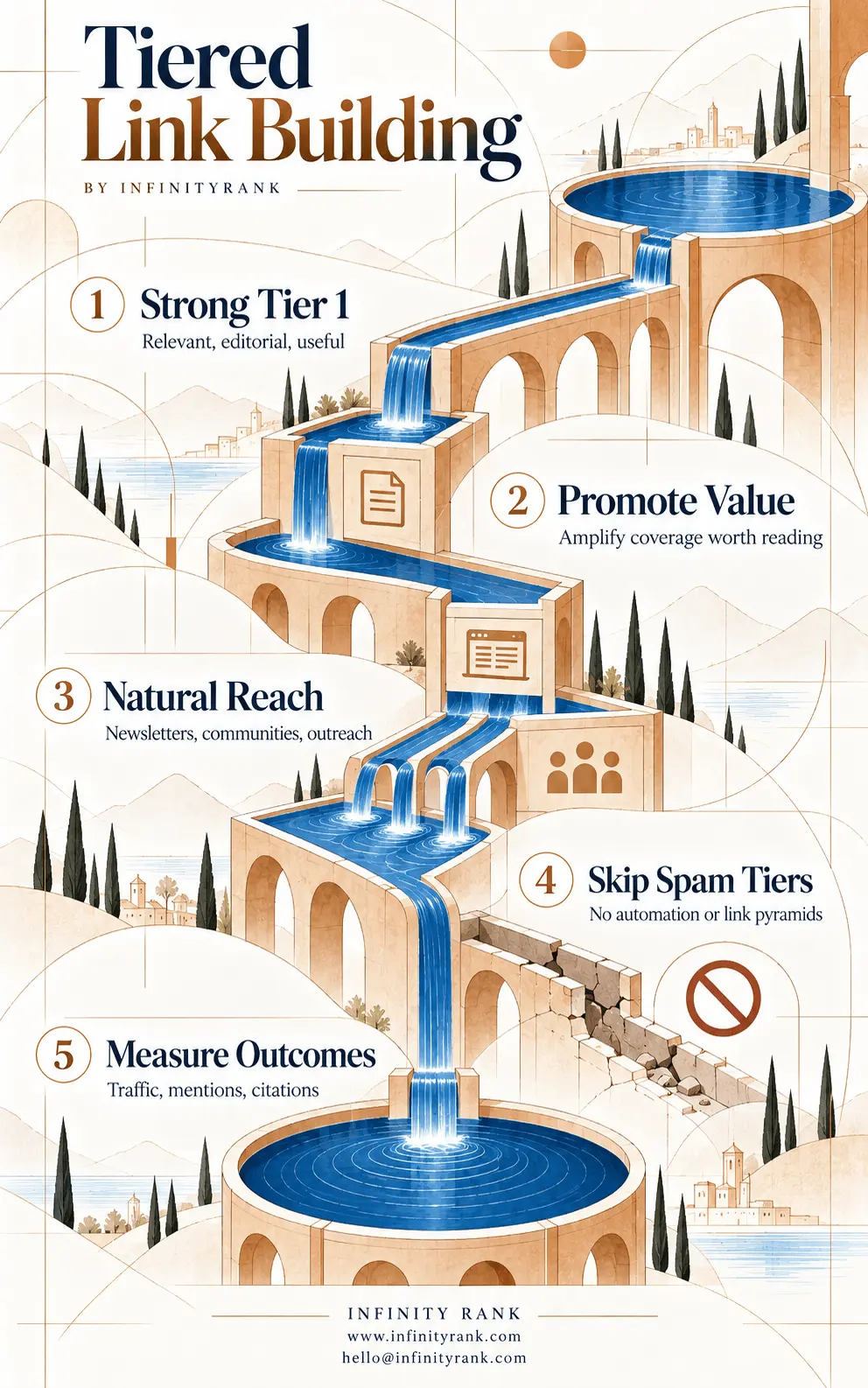
Protecting your domain from algorithmic penalties means you must skip spam tiers, completely avoiding automated backlink software or artificial link pyramids. To validate campaign performance, continuously measure outcomes by tracking referral traffic, brand mentions, and organic citations over time. Use these five core pillars as your strategic framework to build a multi-tier link architecture that passes maximum equity safely.
How the Three Link Tiers Work
Tier 1: Links Directly to Your Website
Tier 1 links matter most because they point directly to your domain.
Examples can include:
- Editorial mentions from relevant publications
- Digital PR coverage
- Industry resource pages
- Expert contributions
- Relevant guest contributions with genuine editorial value
- Chamber of commerce or professional association listings
- Citations of your original research, tools, or data
These links should have a legitimate reason to exist beyond SEO.
A strong Tier 1 link is not strong because a third-party SEO tool gives the domain a particular score.
Evaluate the actual opportunity.
Look at:
- Topical relevance
- Editorial standards
- Organic visibility
- Page quality
- Placement context
- Audience relevance
- Referral traffic potential
- Indexability
- Existing outbound-link patterns
- Whether the website appears to sell links at scale
Do not use an arbitrary rule such as “DA 50+.”
Domain Authority, Domain Rating, Authority Score, Trust Flow, and similar values are third-party metrics. They can help with comparison, but none is a Google ranking score and none proves that a backlink is valuable.
Tier 2: Links to Your Tier 1 Pages
Tier 2 links point to external pages that already link to you.
Suppose a respected industry website publishes a detailed article quoting your research.
You could promote that article through:
- Relevant editorial references
- Genuine social distribution
- Industry newsletters
- Community discussions where the article helps answer a question
- Related content that legitimately cites the article
- Outreach to people likely to find the article useful
The distinction is important.
You are promoting useful content because it deserves additional visibility—not manufacturing links merely because the page contains your backlink.
A Tier 2 link can also happen without your involvement. Other publishers may discover and reference the article naturally.
That is normal web linking.
Tier 3: Links to Tier 2 Pages
Traditional tiered-link-building strategies often use a third layer consisting of large volumes of easy-to-create links.
Common historical tactics included:
- Automated Web 2.0 pages
- Blog comments
- Social bookmarking sites
- Low-quality directories
- Forum profiles
- Mass article submissions
- Automated link-building software
This is where risk increases sharply.
Google specifically identifies automated links, low-quality directories and bookmark sites, optimized forum-comment links, and low-value content created mainly to manipulate linking signals as examples of link spam.
Distance from your website does not turn a manipulative link into a legitimate one.
For most businesses, there is little reason to deliberately build a conventional spam-heavy Tier 3 layer.
Does Tiered Link Building Still Work in 2026?
The better question is not whether tiered link building “works.”
Ask:
What exactly are you doing, and why does each link exist?
Links between useful pages are a normal part of the web. Google itself recommends using descriptive, crawlable links and linking to useful external sources where they provide context for readers.
A high-quality article that links to your research can naturally earn backlinks of its own. Those additional references may improve that article’s visibility, discovery, traffic, and broader link profile.
That is not the same as creating 500 automated links to the article so its backlink to you appears stronger.
The latter is manipulation.
The practical lesson is simple:
Backlink amplification can make sense. Manufactured link pyramids usually do not.
Does Tiered Link Building Violate Google’s Guidelines?
Google does not publish a rule saying that every multi-level link structure is prohibited.
That would make little sense because the web naturally consists of pages linking to pages that link to other pages.
Google’s concern is manipulation.
Its spam policies identify practices such as:
- Buying or selling links for ranking purposes
- Excessive link exchanges
- Automated link creation
- Low-quality directories
- Keyword-rich links in distributed content
- Manipulative forum-comment links
- Low-value content created primarily to influence linking and ranking signals
as examples of link spam.
Therefore, a Tier 2 link is not risky merely because it is Tier 2.
It becomes problematic when the link exists primarily as an artificial ranking mechanism rather than because the linking page genuinely benefits users.
The same principle applies to paid placements.
Google recommends marking advertisements and paid placements with rel="sponsored". rel="nofollow" also remains acceptable for paid links. User-generated links can use rel="ugc".
Safe Amplification vs. Manipulative Tiering
A useful way to judge a tiered strategy is to ask whether each activity would still make sense if search engines ignored the link.
More Defensible
- Promoting an article because it contains valuable research
- Sharing editorial coverage with your audience
- Pitching a strong industry report to relevant publishers
- Linking to an external source where it genuinely helps readers
- Building relationships around high-quality published content
- Earning secondary citations through original data
- Distributing useful research through newsletters or communities
High Risk
- Buying dozens of links solely to strengthen another backlink
- Automating Tier 2 or Tier 3 links
- Creating disposable Web 2.0 sites
- Spamming blog comments
- Creating forum profiles only for backlinks
- Submitting to low-quality directories at scale
- Using private blog networks
- Repeating keyword-rich anchor text
- Publishing thin content solely to host links
If the campaign depends on hiding weak links several levels away from your website, the strategy itself needs reconsideration.
How to Evaluate Tier 1 Links Before Amplifying Them
Not every backlink deserves additional effort.
Start with a backlink audit. Tools such as Ahrefs, Semrush, Majestic, and Google Search Console can help you identify pages linking to your website.
Then evaluate each opportunity manually.
1. Check Relevance
Would the publication naturally discuss your industry, product, research, or expertise?
Relevance usually matters more than chasing the highest possible third-party authority score.
2. Inspect the Linking Page
Look at the actual page rather than only the domain.
Check:
- Content quality
- Topic
- Link placement
- Anchor text
- Page indexing
- Other outbound links
- Publication date
- Signs of real readership
A strong domain can still contain weak pages.
3. Look for Real Audience Value
Could the link send relevant visitors?
A backlink capable of producing qualified referral traffic has tangible value even before you consider search visibility.
4. Check Editorial Standards
Avoid sites filled with unrelated guest posts, casino links, payday-loan pages, generic AI content, or obvious paid-link placements.
Third-party authority metrics can remain high long after a site’s editorial quality has deteriorated.
5. Prioritize Links Worth Promoting
Good candidates can include:
- Major editorial mentions
- Research citations
- Interviews
- Expert commentary
- Industry reports
- Resource pages
- High-quality guest contributions
If the original Tier 1 placement is weak, building more links around it usually compounds the problem rather than fixing it.
A Safer Tiered Link Building Strategy
If you want to use the underlying concept without building a spam pyramid, stop thinking in terms of “building tiers at scale.”
Think about amplifying valuable coverage.
Step 1: Identify Strong Tier 1 Pages
Find external pages that already link to you and genuinely deserve more visibility.
Prioritize relevance, editorial quality, useful content, audience value, and natural placement.
Step 2: Promote the Content, Not the Backlink
Do not pitch a publisher because “this page links to us.”
Pitch the page because it contains something worth reading.
That could include:
- Original research
- New statistics
- Expert insights
- Useful examples
- Industry analysis
- A valuable resource
This creates an editorial reason for secondary links.
Step 3: Use Natural Distribution Channels
Promote valuable Tier 1 content through channels such as:
- Social media
- Newsletters
- Industry communities
- Journalist outreach
- Partner networks
- Relevant editorial outreach
- Expert commentary
A social share does not automatically transfer meaningful ranking value. It can still generate exposure, referral traffic, discovery, and opportunities for additional editorial citations.
Step 4: Avoid Automated Lower Tiers
Do not use automated software to build thousands of backlinks.
Do not mass-post comments.
Do not manufacture forum profiles.
Do not create thin microsites solely to host links.
Google’s spam policies explicitly cover several of these practices.
Step 5: Measure Outcomes
Do not measure a tiered campaign by counting how many links you created.
Track whether anything useful happened.
Monitor:
- Referral traffic
- Organic traffic to the target page
- Relevant keyword visibility
- New referring domains
- Earned secondary citations
- Brand mentions
- Leads or conversions from referral traffic
- Whether important Tier 1 pages remain live and indexed
Infinity Rank’s link building metrics framework can also help distinguish useful backlink signals from vanity metrics.
Common Risks of Tiered Link Building
Link Spam
The clearest risk is creating links primarily to manipulate rankings.
If a campaign’s only justification is “passing more link juice,” reconsider it.
Low-Quality Networks
Tiered campaigns can quickly drift into link farms, private networks, disposable blogs, or domains built primarily to sell links.
These are poor foundations for a long-term SEO strategy.
Anchor Text Manipulation
Repeated exact-match anchor text across manufactured links creates an unnatural footprint and provides little value to readers.
Use anchors that make sense within the surrounding content.
Wasted Budget
A complicated three-tier campaign can consume money that could have gone toward earning another strong editorial Tier 1 backlink.
More complexity does not automatically produce better SEO.
Difficult Attribution
If you simultaneously create hundreds of Tier 2 and Tier 3 links, publish new content, change internal links, and earn new direct backlinks, identifying what caused a ranking movement becomes difficult.
Keep campaigns measurable.
When Tier 2 Amplification Can Make Sense
Selective Tier 2 promotion can be reasonable when you have an unusually valuable external page worth helping more people discover.
Examples include:
- A major publication featuring your original research
- An industry report citing your company
- An authoritative resource that references your data
- An interview containing substantial expert insights
- A strong comparison or case study featuring your product
Even then, the goal should be promoting useful content rather than manufacturing ranking signals.
When You Should Avoid Tiered Link Building
Avoid conventional tiered link building when:
- Your Tier 1 backlinks are already low quality
- You depend on automation
- Your strategy requires large numbers of disposable sites
- You plan to use comment spam
- You are buying unqualified links
- You cannot explain the editorial purpose of each link
- You are trying to disguise the source of manipulative backlinks
- Your budget would produce better results pursuing stronger direct links
A weak backlink does not become good because 100 weaker backlinks point to it.
Better Alternatives to Traditional Tiered Link Building
For most businesses, resources are better spent strengthening the first tier.
Digital PR
Create stories, research, surveys, expert commentary, or data that journalists and publishers have a genuine reason to reference.
Linkable Assets
Build resources other sites need.
Examples include:
- Original research
- Industry statistics
- Free tools
- Calculators
- Templates
- Visual explainers
- Definitive guides
- Data sets
Manual Outreach
Research relevant websites and contact them with a specific editorial reason to reference your resource.
Personalized outreach is slower than automated link generation, but it gives you better control over relevance and quality.
Unlinked Brand Mention Reclamation
Find websites already mentioning your company without linking to it.
Where a link would genuinely help readers, ask the publisher to add one.
Broken Link Building
Identify relevant dead resources and offer a useful replacement where appropriate.
Strategic Internal Linking
Backlinks are only one part of how authority moves through a website.
Use descriptive internal links to connect important pages and make your site easier for users and search engines to navigate.
Frequently Asked Questions
Is Tiered Link Building Safe?
Not inherently.
Natural links between pages are normal. Deliberately manufacturing multiple layers of links primarily to manipulate rankings can violate Google’s link-spam policies.
The risk depends on how the links are obtained, why they exist, and whether they provide legitimate value.
Do I Need All Three Tiers?
No.
There is no SEO requirement to create three tiers.
For most businesses, investing in stronger Tier 1 backlinks and selectively promoting valuable external coverage is a cleaner strategy than constructing a large Tier 3 network.
Can Tier 2 Links Help SEO?
Potentially, but there is no guaranteed result.
A Tier 1 article that earns additional exposure and genuine editorial backlinks may become a stronger and more visible resource.
That does not mean deliberately manufacturing Tier 2 links will improve your rankings.
How Long Does Tiered Link Building Take to Work?
There is no reliable 2-month, 3-month, or 4-month rule.
Search performance depends on many factors, including competition, site quality, content, existing links, technical SEO, crawl behavior, and the quality of new links.
Treat fixed timelines as estimates, not promises.
Can Tiered Link Building Be Automated?
Automation used to manufacture links for ranking purposes creates significant risk.
Google explicitly identifies automated programs or services used to create links as an example of link spam.
Do not automate link creation simply because those links point to Tier 2 pages instead of your own domain.
Does Google Allow Tiered Link Building?
Google does not define every multi-level link structure as a violation.
The issue is how and why the links were created.
Links created primarily to manipulate rankings can fall under Google’s spam policies regardless of whether they point directly to your website or support another backlink.
Should I Use DA or DR to Choose Tier 1 Links?
Use them as comparative metrics, not absolute quality scores.
There is no universal “DA 50+” rule.
Review relevance, page quality, organic visibility, editorial standards, placement, traffic potential, backlink profile, and actual audience before deciding whether a link is valuable.
Final Thoughts
Tiered link building is often sold as a clever way to multiply backlink power while keeping risky links away from your main website.
That framing is outdated.
Putting weak or manipulative links several steps away from your domain does not automatically make them safe.
The useful part of tiered link building is much simpler: good external coverage can be worth promoting.
If an industry publication, research article, interview, or authoritative resource links to your business, helping more people discover that page can create referral traffic, visibility, and opportunities for additional editorial links.
You do not need a pyramid of automated backlinks to achieve that.
Build Tier 1 links worth having. Promote genuinely useful coverage. Measure real outcomes. Avoid links that exist only because you hope an algorithm will count them.
That is a stronger foundation for link building in 2026.