Resource page link building is one of the most practical ways to earn backlinks from pages that already exist to recommend useful content.
Instead of asking a site owner to publish a guest post or add a random link, you pitch a genuinely useful resource that fits a page they already maintain. When done well, it is simple: find relevant resource pages, check whether your content deserves to be included, contact the right person, and explain why your link helps their readers.
The catch is that most people do it badly. They pitch weak blog posts, chase authority metrics without checking relevance, and send the same lazy email to hundreds of site owners.
That does not work.
This guide explains what resource page link building is, when it works, how to find qualified opportunities, how to evaluate them, and how to write outreach emails that do not look like spam.
Resource Links: Scalable or Spam?
Sending hundreds of generic emails asking webmasters to add your link to their resource lists is a quick way to get ignored or flagged as spam. However, when done correctly, targeting curated resource pages remains one of the most effective methods for acquiring contextually relevant backlinks that carry serious ranking power. The secret lies in moving away from mass automation and focusing exclusively on highly targeted, hand-vetted resource hubs where your content serves as a genuinely useful addition.
This resource page link-building strategy outlines four essential steps to help you find qualified prospects, filter for true relevance, and pitch your content in a way that makes saying yes a no-brainer for site owners.
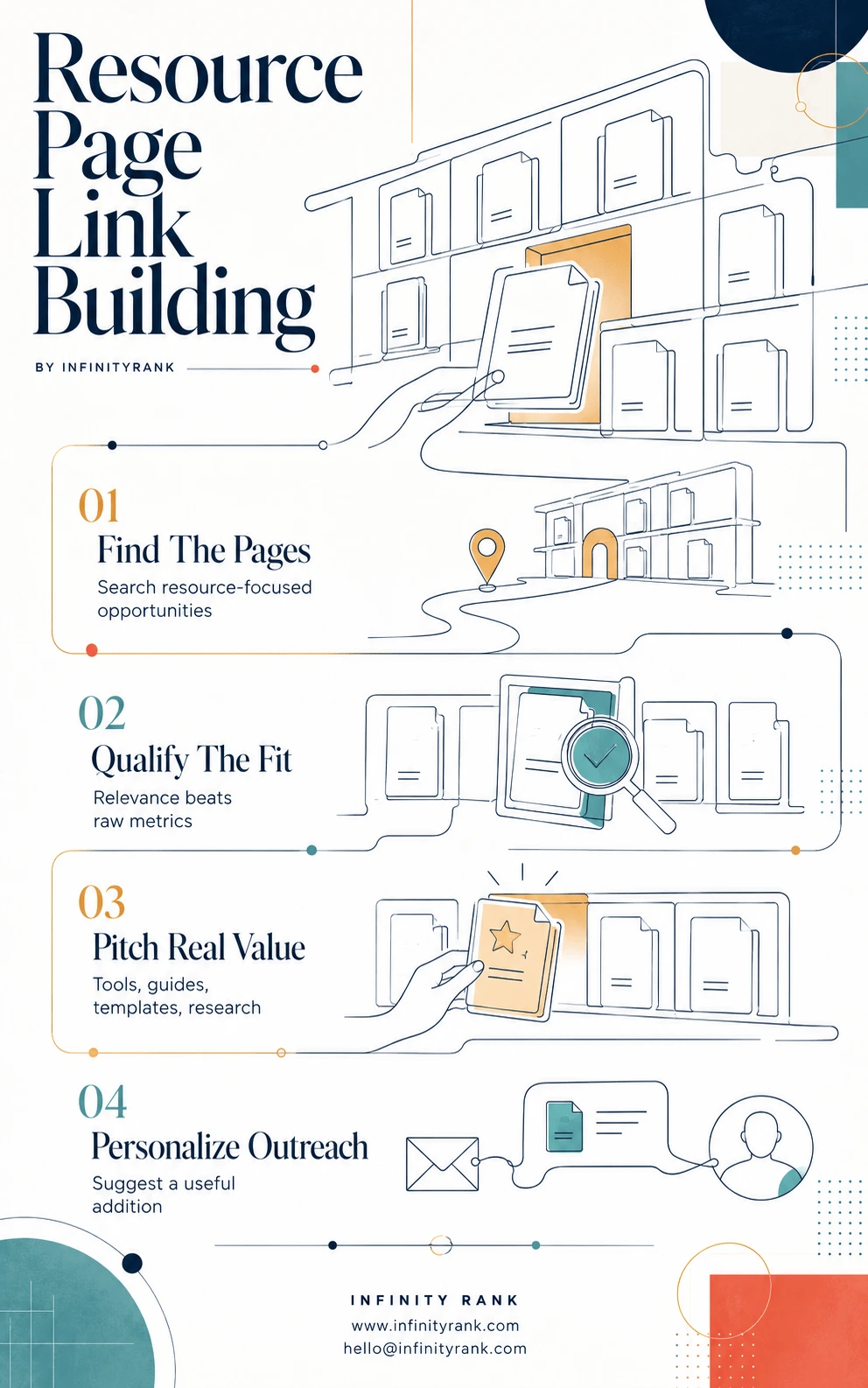
Securing placements on curated lists requires a strict commitment to adding genuine value to someone else’s platform. By prioritizing clean topical alignment and tailoring your outreach to feel human rather than automated, you transform cold pitches into highly authoritative editorial links. Use the resource-page-link-building-infographic as your operational blueprint to refine your target filtering and step up your campaign success rate.
What Is Resource Page Link Building?
Resource page link building is the process of earning backlinks from pages that curate helpful links around a specific topic.
A resource page may list guides, tools, templates, reports, organizations, government resources, calculators, or educational material. These pages exist to help readers find useful information without searching from scratch.
Examples include:
- A university page listing climate science resources.
- A nonprofit page linking to mental health support guides.
- A local business association page listing small business tools.
- A marketing blog linking to SEO templates and checklists.
- A city or council page listing public services and community resources.
The strategy works because the page already links out. You are not asking the site owner to change their editorial model. You are asking them to consider one more relevant resource.
That only works if your content deserves the link.
Why Resource Pages Work for Link Building
Resource pages are valuable because they are built around curation. Their purpose is to help readers discover useful sources, tools, and guides.
That creates a natural opening for outreach.
Here is why this tactic can work:
- The page already links to external websites
You are not trying to convince the owner to link out for the first time. External links are already part of the page’s purpose. - The link can be contextually relevant
If your content directly matches the page topic, the backlink makes sense for users and search engines. - The placement can be long-lasting
A good resource page may remain live for years, especially if it is actively maintained. - The outreach angle is clear
You are not asking for a favor. You are suggesting a useful addition that may improve the page. - It can support topical authority
Links from relevant pages in your niche can strengthen the credibility of your content cluster.
Do not confuse this with easy link building. Resource page outreach still requires good content, clean prospecting, manual review, and personalized emails.
When Resource Page Link Building Works Best
Resource page link building works best when you have something genuinely useful to promote.
Good linkable assets include:
- Original research reports.
- Free tools or calculators.
- Downloadable templates.
- Step-by-step guides.
- Industry statistics pages.
- Educational explainers.
- Checklists.
- Curated directories.
- Local resource guides.
- Data-backed comparison pages.
Weak assets include:
- Generic service pages.
- Thin blog posts.
- Sales pages.
- Affiliate-heavy content.
- AI-written pages with no original insight.
- Content that only repeats what already ranks.
A resource page owner needs a reason to add your link. “We published a blog post” is not enough. Your content must fill a gap, update outdated information, replace a broken link, or offer something better than what is already listed.
How to Find Resource Page Opportunities
Start with targeted Google search operators. Use your topic, niche, audience, or industry keyword with resource-focused phrases.
Use operators like:
keyword + "helpful resources"
keyword + "useful links"
keyword + "recommended resources"
keyword + "resources for"
keyword + "best resources"
keyword + "further reading"
keyword + "external resources"
keyword + "useful websites"
keyword + inurl:resources
keyword + inurl:links
keyword + intitle:resources
keyword + intitle:"useful links"
Example for eco-friendly packaging:
eco-friendly packaging "useful links"
eco-friendly packaging "helpful resources"
sustainable packaging inurl:resources
sustainable packaging intitle:resources
eco packaging "recommended resources"
Example for small business SEO:
small business SEO "helpful resources"
small business marketing inurl:resources
local SEO "recommended resources"
small business tools "useful links"
Example for health and wellness:
mental health "support resources"
workplace wellness "helpful resources"
nutrition guide "recommended resources"
Do not stop at the first page of Google. Many useful resource pages are not ranking in the top three results. Search broadly, test variations, and build a list before you start outreach.
How to Qualify a Resource Page Before Pitching
Not every resource page is worth your time. Some are outdated, spammy, irrelevant, abandoned, or full of low-quality links.
Before adding a prospect to your outreach list, check the following:
1. Topical Relevance
The page should closely match your content.
A page about “small business accounting resources” may be relevant for a tax checklist. It is not a good fit for a generic SEO agency homepage.
Relevance matters more than DA, DR, or any other third-party authority metric.
2. Page Quality
Look at the page manually. Ask:
- Is the page useful?
- Does it serve a real audience?
- Are the listed links relevant?
- Is the content organized clearly?
- Does the site look maintained?
- Is the page indexed in Google?
If the page looks abandoned or spammy, skip it.
3. Outbound Link Quality
Check where the page already links.
Good signs:
- Links to trusted organizations.
- Links to educational content.
- Links to government or nonprofit resources.
- Links to useful tools or guides.
- Links are grouped logically.
Bad signs:
- Casino, CBD, adult, gambling, or unrelated links.
- Exact-match anchor spam.
- Paid-link footprints.
- Random commercial links.
- No editorial standards.
A resource page surrounded by junk links will not help your brand.
4. Freshness
Check whether the page appears maintained.
Look for:
- Recent update dates.
- Working links.
- Current resources.
- Active site navigation.
- Recent blog posts or announcements on the domain.
A page last updated in 2014 is not automatically useless, but it is a weaker prospect unless the site is still active.
5. Link Placement Potential
Some pages are easy to update. Others are clearly static.
Look for clues:
- “Suggest a resource” forms.
- Contact information.
- Editor or webmaster details.
- Department email addresses.
- Recently added resources.
- Broken or outdated links.
If there is no realistic path to contact the owner, lower the priority.
6. Authority and Traffic
Use tools like Ahrefs, Moz, Semrush, or similar SEO platforms to check:
- Domain authority or domain rating.
- Estimated organic traffic.
- Referring domains.
- Page-level backlinks.
- Spam indicators.
- Organic keywords.
Do not worship these metrics. They are useful filters, not final decision-makers. A niche-relevant page with modest authority can be better than a high-authority page that has nothing to do with your topic.
What Content Should You Pitch?
Your pitch is only as strong as the resource behind it.
The best-performing assets usually solve a specific problem for a specific audience.
Strong examples:
- “Small Business SEO Checklist”
- “Free Website Migration Checklist”
- “2026 SaaS Pricing Benchmarks”
- “Local SEO Audit Template”
- “Beginner’s Guide to Technical SEO”
- “Interactive ROI Calculator”
- “Cybersecurity Checklist for Remote Teams”
- “Sustainable Packaging Supplier Directory”
Weak examples:
- “Our SEO Services”
- “Why Choose Our Agency”
- “Top Benefits of Digital Marketing”
- “Welcome to Our Blog”
- “Best Company for Link Building”
Resource page owners are not looking to promote your business. They are looking to help their readers.
Pitch the asset, not your company.
How to Find Contact Information
Once you qualify the page, find the right person to contact.
Start with:
- The page itself.
- The website contact page.
- Author bio.
- Editor profile.
- Department page.
- LinkedIn.
- WHOIS records, if appropriate.
- University or organization staff directories.
- Footer email addresses.
- “Suggest a resource” forms.
For universities, nonprofits, and local organizations, the best contact may not be a generic support inbox. Look for the person responsible for the department, library, resource hub, blog, or program.
Do not scrape blindly and blast everyone. That is how you get ignored or reported.
Resource Page Outreach Email Template
Keep your email short. Site owners do not need your life story.
Here is a clean first email:
Subject: Resource suggestion for your [Topic] page
Hi [Name],
I found your [Exact Page Name] while researching [Topic]. The page is a useful collection, especially the section on [Specific Section or Existing Resource].
I wanted to suggest one additional resource that may help your readers:
[Resource Name]
[URL]
It covers [brief explanation of what the resource helps with], and I think it could fit well under your [specific section] section.
Either way, thanks for maintaining the page.
Best,
[Your Name]
Why this works:
- It names the exact page.
- It proves you reviewed the page.
- It explains the reader benefit.
- It does not beg.
- It does not overhype the link.
Broken Link Outreach Variation
Broken links create a stronger pitch because you are helping the site owner fix a problem.
Use this version when you find a dead or outdated link:
Subject: Broken link on your [Topic] resources page
Hi [Name],
I was reading your [Exact Page Name] and noticed one of the links appears to be broken:
[Broken URL or Resource Name]
I thought you might want to update it. I also have a related resource that could be a useful replacement:
[Your Resource Name]
[Your URL]
It covers [brief benefit] and may help readers looking for [specific outcome].
Hope this helps.
Best,
[Your Name]
Do not pretend a link is broken if it is not. That is lazy and dishonest.
Follow-Up Email Template
Most outreach campaigns need follow-up, but do not overdo it.
Send one follow-up after five to seven business days. Send a second only if the prospect is highly relevant.
First follow-up:
Subject: Re: Resource suggestion for your [Topic] page
Hi [Name],
Just following up on this resource suggestion for your [Exact Page Name].
Here is the link again in case it is useful:
[URL]
No pressure either way. I thought it might be a good fit for readers looking for [specific outcome].
Best,
[Your Name]
Final follow-up:
Subject: Final follow-up on [Resource Name]
Hi [Name],
Last follow-up from me.
I suggested this resource for your [Exact Page Name]:
[URL]
If it is not a fit, no problem. Thanks again for maintaining the page.
Best,
[Your Name]
Stop after that. More follow-ups usually damage your brand.
How to Track Resource Page Outreach
Use a spreadsheet or CRM. Do not rely on memory.
Track these fields:
| Field | Purpose |
| Prospect URL | The exact resource page |
| Domain | Root domain |
| Contact name | Person responsible |
| Email address | Outreach target |
| Page topic | Main resource page theme |
| Your resource | URL you are pitching |
| Relevance score | 1–5 rating |
| Authority metric | DA, DR, or equivalent |
| Traffic estimate | Optional but useful |
| Last updated | Freshness check |
| Broken links found | Yes/no |
| Pitch angle | Standard, broken link, outdated resource, better guide |
| First email date | Outreach date |
| Follow-up 1 date | First follow-up |
| Follow-up 2 date | Final follow-up |
| Status | Not contacted, sent, replied, live, rejected |
| Live link URL | Final placement |
| Notes | Context for future outreach |
This prevents duplicate emails, messy follow-ups, and wasted effort.
Common Resource Page Link Building Mistakes
Pitching the Wrong Page
Do not pitch your homepage to every resource page you find. Most owners will ignore it.
Pitch the most useful asset for that specific page.
Prioritizing Metrics Over Relevance
A high-authority domain does not matter if the page is unrelated. Relevance comes first.
Sending Generic Outreach
“Hi, I loved your blog” is not personalization. Mention the exact page, section, or resource you reviewed.
Using Weak Content
If your resource is average, outreach will fail. Improve the asset before pitching it.
Ignoring Existing Links
Review the page’s current links. If they only include government and university sources, your commercial blog post may not fit.
Over-Following Up
One or two follow-ups are enough. Anything more starts to look desperate.
Paying for Unqualified Links
Avoid paid placements that pass PageRank. If money, goods, or services are exchanged for a link, Google expects the link to be properly qualified with rel="sponsored" or nofollow.
How to Measure Results
Resource page link building is not instant. Track performance over time.
Measure:
- Number of qualified prospects.
- Outreach emails sent.
- Reply rate.
- Positive response rate.
- Links earned.
- Link placement rate.
- Average relevance score.
- Referral traffic from placements.
- Ranking movement for the target page.
- New referring domains.
- Assisted conversions, where applicable.
Do not judge the campaign only by link count. A few relevant, editorially placed backlinks can be more valuable than dozens of weak links from irrelevant pages.
Final Thoughts
Resource page link building works because it aligns with how the web is supposed to function: useful pages linking to other useful pages.
But the tactic only works when the resource deserves the link.
Find relevant pages. Review them manually. Pitch a genuinely useful asset. Personalize your email. Follow up politely. Track every step.
Do that consistently, and resource page link building can become a reliable part of your SEO strategy.
Frequently Asked Questions
What is resource page link building?
Resource page link building is the process of earning backlinks from pages that curate helpful links, tools, guides, or references around a specific topic.
How do I find resource pages in my niche?
Use Google search operators such as keyword + "helpful resources", keyword + "useful links", keyword + inurl:resources, and keyword + intitle:resources.
Are resource page backlinks good for SEO?
They can be good for SEO when the page is relevant, editorially maintained, and links to high-quality resources. Low-quality or irrelevant resource pages are not worth chasing.
What type of content works best for resource page outreach?
Guides, templates, tools, original research, calculators, checklists, and educational resources usually work best. Generic sales pages usually do not.
How many follow-ups should I send?
Send one follow-up after five to seven business days. Send a second only for highly relevant prospects. Stop after that.
Should I pay to get listed on a resource page?
No, not if the goal is to pass SEO value. Paid links should be qualified with rel="sponsored" or nofollow to stay aligned with Google’s guidance.
What should I check before pitching a resource page?
Check topical relevance, page quality, outbound links, freshness, contact availability, traffic potential, and spam signals.
Can resource page link building work for local SEO?
Yes. Local businesses can target city pages, chamber of commerce resources, local nonprofit pages, community directories, neighborhood guides, and industry-specific local resources.