Answer Engine Optimization, or AEO, is the process of structuring your content so AI-powered search tools can understand, summarize, cite, and recommend it.
Traditional SEO focuses on ranking pages in search results. AEO focuses on getting your content selected as a reliable source inside AI-generated answers, including Google AI Overviews, Google AI Mode, ChatGPT Search, Perplexity, Bing Copilot, and other answer engines.
AEO does not replace SEO. It builds on it. If your content is vague, thin, outdated, or unsupported, AI systems have little reason to use it. If your content gives clear answers, cites reliable sources, demonstrates expertise, and is technically accessible, it has a better chance of being surfaced.
Google’s own guidance says site owners should continue following standard Search best practices for AI features such as AI Overviews and AI Mode, rather than chasing special tricks or hidden technical requirements.
What Is Answer Engine Optimization?
Answer Engine Optimization is a content and technical SEO strategy designed to help your website appear in AI-generated answers.
Answer engines do not simply list blue links. They generate direct responses. They often summarize multiple sources, extract short answers, compare options, and cite pages that seem useful, trustworthy, and easy to interpret.
AEO helps your content become easier for those systems to use.
That means your page should:
- Answer the main question clearly.
- Use simple, direct language.
- Support claims with evidence.
- Show author expertise.
- Use structured headings.
- Include valid schema where appropriate.
- Stay crawlable and indexable.
- Make entities, brands, products, and services easy to understand.
Bad AEO is stuffing keywords into generic AI-written content. Good AEO is making your page the clearest, most credible answer on the topic.
AEO vs SEO vs GEO
| Strategy | Main Goal | Focus | Best Used For |
| SEO | Rank in traditional search results | Keywords, links, technical health, content quality | Google organic rankings |
| AEO | Get cited or used in AI-generated answers | Clear answers, structured content, authority, evidence | AI Overviews, ChatGPT Search, Perplexity, Copilot |
| GEO | Improve visibility in generative engines | Brand/entity recognition, AI citations, topical authority | Broader AI search and recommendation visibility |
These strategies overlap. AEO depends on many SEO fundamentals: crawlability, page speed, helpful content, authority, internal links, and strong topical coverage.
Mastering the Shift from Search to Answers
As AI and voice search change the way we interact with the web, ranking #1 isn’t enough anymore—you need to be the definitive answer. This AEO strategy breakdown outlines the five core pillars required to move beyond traditional SEO and ensure your content is the first thing retrieved by search and answer engines alike.
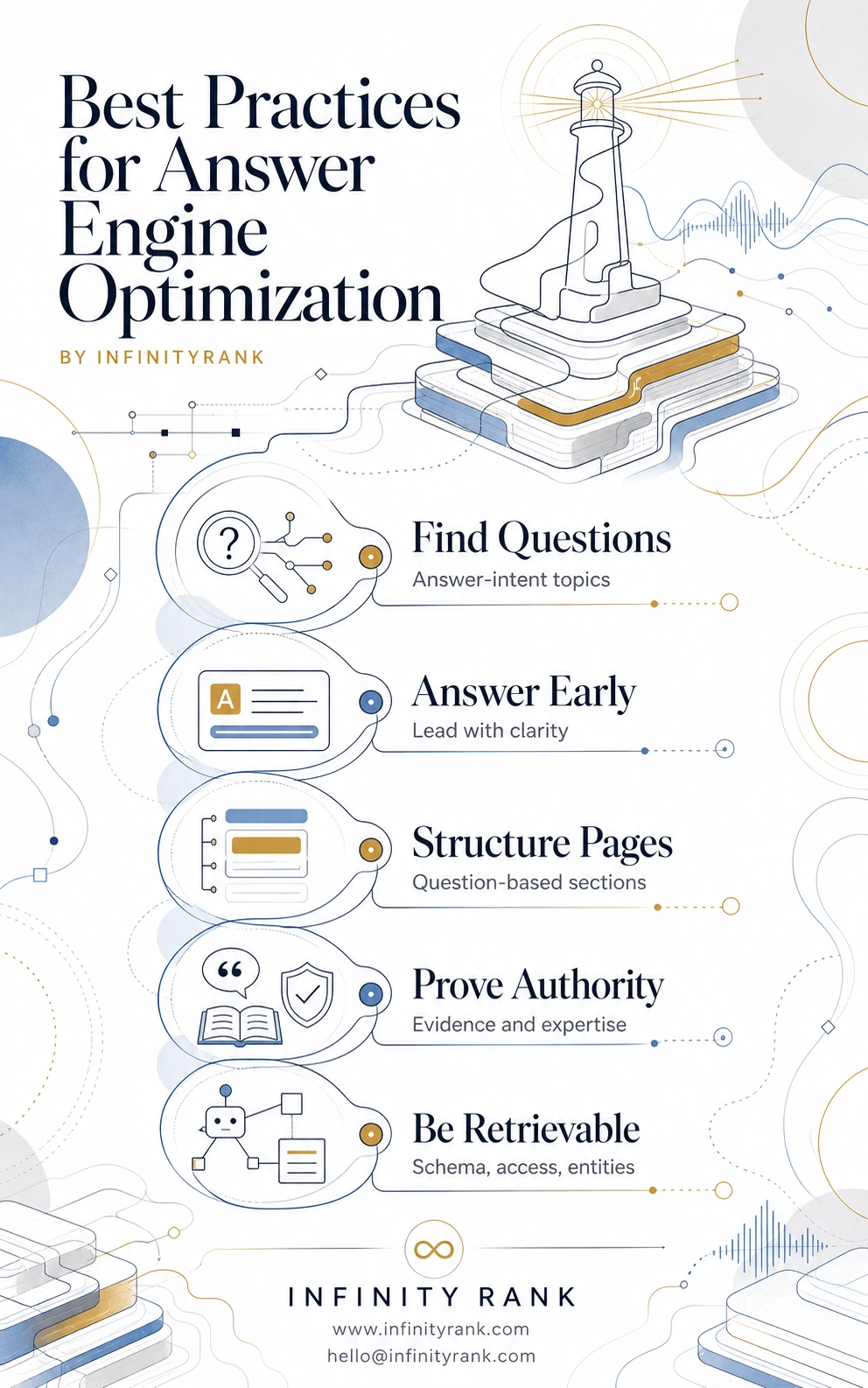
Transitioning to an answer-first strategy ensures your brand remains visible in a world of zero-click searches and AI overviews. By implementing the steps shown in this guide, you can stop fighting for clicks and start owning the conversation. Let’s dive into the specifics of how to refine your content for total retrievability.
Why AEO Matters Now
Search behavior has changed. Users increasingly ask full questions instead of typing short keyword phrases.
Instead of searching only:
best roofing company Dallas
They ask:
What is the best roofing company in Dallas for emergency roof repair after hail damage?
That changes the content requirement. A generic service page is not enough. The page needs to answer specific questions, show local relevance, explain service differences, and provide proof.
AI-powered search systems are built for these longer, more conversational queries. Google says AI experiences allow users to ask more complex questions and that AI Overviews can show links in different ways across the results page.
For businesses, this means your content must be built for both ranking and retrieval. It needs to work as a page and as a source.
1. Start With Answer-Intent Keywords
Do not build AEO content around broad keywords alone.
A keyword like “roof repair” is too broad. An answer-intent query is more specific:
- How much does roof repair cost after storm damage?
- How long does emergency roof repair take?
- Does homeowners insurance cover roof leaks?
- What should I do before calling a roofer?
- How do I know if I need roof repair or replacement?
These questions are better for AEO because they match how people ask AI tools for help.
Use your SEO tools, Google Search Console, People Also Ask results, customer support questions, sales calls, and live chat logs to find real questions. Then build pages or sections that answer them directly.
2. Put the Direct Answer Near the Top
Do not bury the answer under a long introduction.
Each important page should include a short answer block near the top. This gives AI systems and users a clean summary.
Example:
Emergency roof repair usually costs between $300 and $1,500, depending on the damage, roof type, access, and urgency. Minor leak patches cost less. Storm damage, structural issues, and after-hours service cost more. A licensed roofer should inspect the damage before quoting a final price.
That answer is useful because it is specific, qualified, and easy to extract.
Avoid intros like:
In today’s fast-moving digital world, homeowners are looking for reliable roofing solutions more than ever before.
That says nothing. Cut it.
3. Structure Every Page Around Clear Questions
AI systems need structure. Users do too.
Use headings that match the questions people ask. Do not use vague headings like “Things to Know” or “Helpful Information.”
Weak heading:
Important Details
Better heading:
How Much Does Emergency Roof Repair Cost?
Weak heading:
Our Process
Better heading:
What Happens During an Emergency Roof Repair Visit?
Strong question-based headings help answer engines identify the purpose of each section.
Recommended structure:
- H1: Main topic
- H2: Main user questions
- H3: Supporting details
- Short paragraphs
- Bullets where helpful
- Tables for comparisons
- FAQs at the end
4. Write Like an Expert, Not a Content Mill
AEO content must be clear, but it cannot be shallow.
Bad AEO content repeats obvious advice:
Choose a reputable company. Look at reviews. Ask questions.
That is filler.
Better content explains what the user should actually check:
Before hiring a roofing contractor, verify the company’s license, insurance, storm-damage experience, workmanship warranty, and local project history. Ask whether the estimate separates emergency temporary repairs from permanent repair work.
That is useful.
To improve expert quality, add:
- Specific examples.
- Real costs where available.
- Decision criteria.
- Warnings.
- Limitations.
- Firsthand experience.
- Author credentials.
- Review or update dates.
Google’s guidance on helpful content consistently emphasizes people-first content and quality over content made mainly to manipulate search performance.
5. Support Claims With Evidence
Do not make unsupported claims.
If you say “most users prefer AI search,” cite a source. If you say “AEO increases conversions,” show data or rephrase it as a reasonable business goal.
Weak claim:
AI engines prefer content with schema markup.
Better claim:
Structured data helps Google understand page content and can make a page eligible for rich results, but it does not guarantee enhanced visibility.
Use authoritative sources when possible:
- Google Search Central
- Schema.org
- OpenAI documentation
- Microsoft/Bing documentation
- Government data
- Academic research
- Original industry studies
- First-party customer or campaign data
AEO content should not sound confident unless it has earned that confidence.
6. Use Schema Markup Correctly
Schema markup can help search engines understand your content. It is not a magic ranking button.
Google’s structured data guidelines say structured data can make a page eligible for rich results, but it does not guarantee that Google will show those results.
For most article-style AEO content, start with Article schema.
Example Article schema:
<script type="application/ld+json">
{
  "@context": "https://schema.org",
  "@type": "Article",
  "headline": "Answer Engine Optimization Best Practices for 2026",
  "description": "Learn practical answer engine optimization best practices to improve AI search visibility, earn citations, structure content, and track AEO performance.",
  "author": {
    "@type": "Organization",
    "name": "Infinity Rank"
  },
  "publisher": {
    "@type": "Organization",
    "name": "Infinity Rank",
    "logo": {
      "@type": "ImageObject",
      "url": "https://infinityrank.com/path-to-logo.png"
    }
  },
  "datePublished": "2026-05-04",
  "dateModified": "2026-05-04"
}
</script>
Use FAQ schema only when the FAQ content is visible on the page and genuinely useful. Also understand the limitation: Google reduced FAQ rich results, and FAQ rich results are generally shown only for well-known authoritative government and health websites.
That does not mean FAQs are useless. It means you should write FAQs for users and clarity, not because you expect easy rich results.
7. Make Your Site Accessible to AI Crawlers
AEO depends on access. If AI search crawlers cannot reach your content, your visibility may suffer.
OpenAI documents different crawlers for different use cases. For example, OAI-SearchBot is used for ChatGPT search features, while GPTBot is associated with training use cases. OpenAI says site owners can manage these separately through robots.txt.
For AEO, review your robots.txt file and server rules. Make sure you are not accidentally blocking important crawlers such as:
- Googlebot
- Bingbot
- OAI-SearchBot
- PerplexityBot, if relevant to your strategy
- Other AI search crawlers you intentionally want to allow
Do not allow every bot blindly. Decide based on your content policy, legal position, and traffic goals.
8. Build Entity and Brand Authority
Answer engines need to understand who you are, what you do, and why you are credible.
This is entity optimization.
For a business, your brand entity should be consistent across:
- Website copy
- About page
- Author bios
- Google Business Profile
- Social profiles
- Local citations
- Industry directories
- Review platforms
- Press mentions
- Partner pages
- Schema markup
If your brand name, services, locations, and credentials are inconsistent across the web, AI systems have less reliable information to work with.
Add a strong About page. Add author or reviewer bios. Show licenses, certifications, awards, case studies, and real client proof. Do not hide trust signals in image graphics that crawlers may not understand.
9. Use Internal Links to Build Topic Clusters
AEO works better when your site has topical depth.
One article about “answer engine optimization” is not enough if the rest of the site says nothing about AI search, SEO, content structure, schema, entity optimization, or technical crawlability.
Build a topic cluster.
Example AEO cluster:
- Answer Engine Optimization Best Practices
- AEO vs SEO: What’s the Difference?
- How to Optimize for Google AI Overviews
- How to Track ChatGPT Search Traffic
- Schema Markup for AI Search Visibility
- How to Build Topical Authority for AI Search
- AI Search Optimization Checklist
Then link these pages together naturally.
Internal links help users move deeper into the topic. They also help search engines understand relationships between pages.
10. Improve Page Experience and Technical SEO
AEO still depends on technical basics.
Your content should be:
- Crawlable
- Indexable
- Mobile-friendly
- Fast enough for users
- Free of intrusive popups
- Structured with clean HTML
- Supported by descriptive title tags and meta descriptions
- Protected from broken links and redirect chains
Do not obsess over technical SEO while ignoring content quality. But do not publish strong content on a broken site either.
Use Google Search Console, PageSpeed Insights, server logs, and crawl tools to find technical problems.
11. Add Comparison Tables and Decision Frameworks
Answer engines often summarize options. Make that easier.
Tables help users and AI systems compare information quickly.
Example:
| Content Type | AEO Use Case | Example |
| Definition block | Explains a concept quickly | “AEO is…” |
| Comparison table | Helps users choose | AEO vs SEO vs GEO |
| Checklist | Gives steps | AEO audit checklist |
| FAQ | Answers common questions | “Does schema help AEO?” |
| Case study | Shows proof | Before/after traffic or citation data |
Do not add tables for decoration. Add them when they clarify the answer.
12. Track AEO Performance Realistically
AEO tracking is imperfect. Do not pretend otherwise.
Google says traffic from AI Overviews and AI Mode is included in Search Console reporting, but Search Console does not give a perfect, separate report showing every AI-generated answer where your site appeared.
OpenAI says publishers can track ChatGPT referral traffic in analytics platforms, including traffic using utm_source=chatgpt.com.
Track AEO with a mix of methods:
- Google Search Console clicks and impressions.
- Analytics referrals from ChatGPT, Perplexity, Bing, and other platforms.
- Manual prompt testing for priority queries.
- AI visibility tools, if they fit your budget.
- Brand mention monitoring.
- Conversion tracking from AI-search referral traffic.
- Server logs for AI crawler activity.
Do not rely on one metric. AI search visibility is fragmented.
AEO Checklist
Use this checklist before publishing or updating a page.
| Task | Complete |
| Main query has clear answer intent | ☐ |
| Direct answer appears near the top | ☐ |
| H2s are written as useful questions or clear subtopics | ☐ |
| Claims are supported with credible sources | ☐ |
| Article includes examples, data, or expert explanation | ☐ |
| Schema markup is valid and appropriate | ☐ |
| Page is crawlable and indexable | ☐ |
| Internal links support the topic cluster | ☐ |
| Author or reviewer expertise is visible | ☐ |
| Title tag and meta description match search intent | ☐ |
| Content has a recent update date | ☐ |
| AI referral traffic and search performance can be tracked | ☐ |
Common AEO Mistakes
Mistake 1: Treating AEO Like Keyword Stuffing
Repeating “answer engine optimization” twenty times will not make the page useful. Build clear answers, not keyword noise.
Mistake 2: Publishing Generic AI Content
AI-generated drafts are often vague. If the article sounds like every other article, it has no reason to be cited.
Mistake 3: Overusing FAQ Schema
FAQ content can help users, but FAQ schema is not a universal shortcut to rich results. Google has limited FAQ rich result visibility for most sites.
Mistake 4: Ignoring Brand Authority
AI systems need confidence. Anonymous, unsupported content from a weak brand is less persuasive than expert content from a clear, consistent entity.
Mistake 5: Not Tracking AI Referrals
If you are not monitoring ChatGPT, Perplexity, Bing, and Google Search traffic patterns, you are guessing.
FAQ
What is Answer Engine Optimization?
Answer Engine Optimization is the process of improving content so AI-powered search tools can understand, summarize, cite, and recommend it in direct answers.
Is AEO different from SEO?
Yes. SEO focuses on ranking in search engine results. AEO focuses on being selected as a useful source for AI-generated answers. The two overlap because strong AEO still depends on SEO fundamentals.
Does schema markup help with AEO?
Schema markup can help search engines understand page content, but it does not guarantee rankings, AI citations, or rich results. Use schema accurately and only where it matches the visible content.
Can Google Search Console track AI Overview traffic?
Google includes AI Overview and AI Mode activity in Search Console reporting, but it does not provide a perfect standalone report for every AI answer placement. Use Search Console alongside analytics, referral tracking, and manual monitoring.
How do I optimize for ChatGPT Search?
Make your content crawlable, useful, well-structured, and credible. Review your robots.txt settings for OAI-SearchBot if ChatGPT Search visibility matters to your business. OpenAI says OAI-SearchBot is used to surface websites in ChatGPT search features.
Final Takeaway
Answer Engine Optimization is not a trick. It is disciplined content optimization for AI-powered discovery.
The pages most likely to benefit are clear, specific, well-structured, evidence-backed, crawlable, and written by credible sources. Do that consistently, and your content has a stronger chance of appearing in AI-generated answers.
If your site still relies on thin blog posts, vague service pages, outdated schema, and unsupported claims, AEO will expose the weakness. Fix the content first. Then optimize for answer engines.