If you are asking, “How can I create backlinks for my website for free?”, the honest answer is that you can earn links without paying placement fees—but not without doing the work.
Effective free link building usually requires four things:
- A page worth linking to
- Relevant websites or journalists to contact
- Personalised outreach
- Consistent follow-up
You do not need hundreds of links from random websites. A smaller number of relevant, editorially placed links can be more useful than a large volume of directory, profile or comment links.
This guide explains eight legitimate ways to earn backlinks without buying them, how to judge whether an opportunity is worth pursuing and which tactics can create unnecessary SEO risk.
What Is a Backlink?
A backlink is a link from a page on another website to a page on your website.
Search engines use links to discover pages and understand how content across the web is connected. Links can also send referral traffic, expose your business to new audiences and strengthen the credibility of a useful resource. However, no individual backlink guarantees a ranking increase.
For example, imagine that you publish an original report on ecommerce conversion rates. A marketing publication cites one of your findings and links to the report. That is a backlink.
A link from one page of your website to another page on the same domain is an internal link, not a backlink.
What Does “Free Backlink Building” Actually Mean?
Free backlink building means you do not pay another website to publish or place the link.
It does not mean the process has no cost. You may still spend time on:
- Research
- Content creation
- Prospecting
- Email outreach
- Expert responses
- Relationship building
- Tracking and follow-up
Some tools also offer only limited free access. Do not build a campaign around a tool until you have confirmed which features are available without a paid subscription.
Standard, Nofollow, Sponsored and UGC Links
The term “dofollow link” is widely used in SEO, but there is no dofollow HTML attribute. A regular link does not need a special attribute for search engines to crawl it.
Website owners can add attributes when they need to explain the nature of a link:
rel="nofollow"may be used when the publisher does not want to associate its site with the linked page.rel="sponsored"should be used for paid advertisements, sponsorships and compensated placements.rel="ugc"is intended for links in user-generated content, such as forum posts and comments.
Google treats these attributes as qualifications or hints rather than reducing every link to a simple “valuable” or “worthless” label. A qualified link can still generate relevant traffic, brand exposure and customer enquiries.
The objective should therefore be to earn useful, relevant links—not to chase a particular attribute at any cost.
Free Backlinks: Grow Your Authority for Zero Cost
Building backlinks does not have to cost a fortune. Many people think they need a massive budget to rank on Google, but you can get great results for free. The secret is creating highly helpful content that other sites actually want to link to. This simple guide breaks down five easy steps to earn high-quality links without spending a dime.
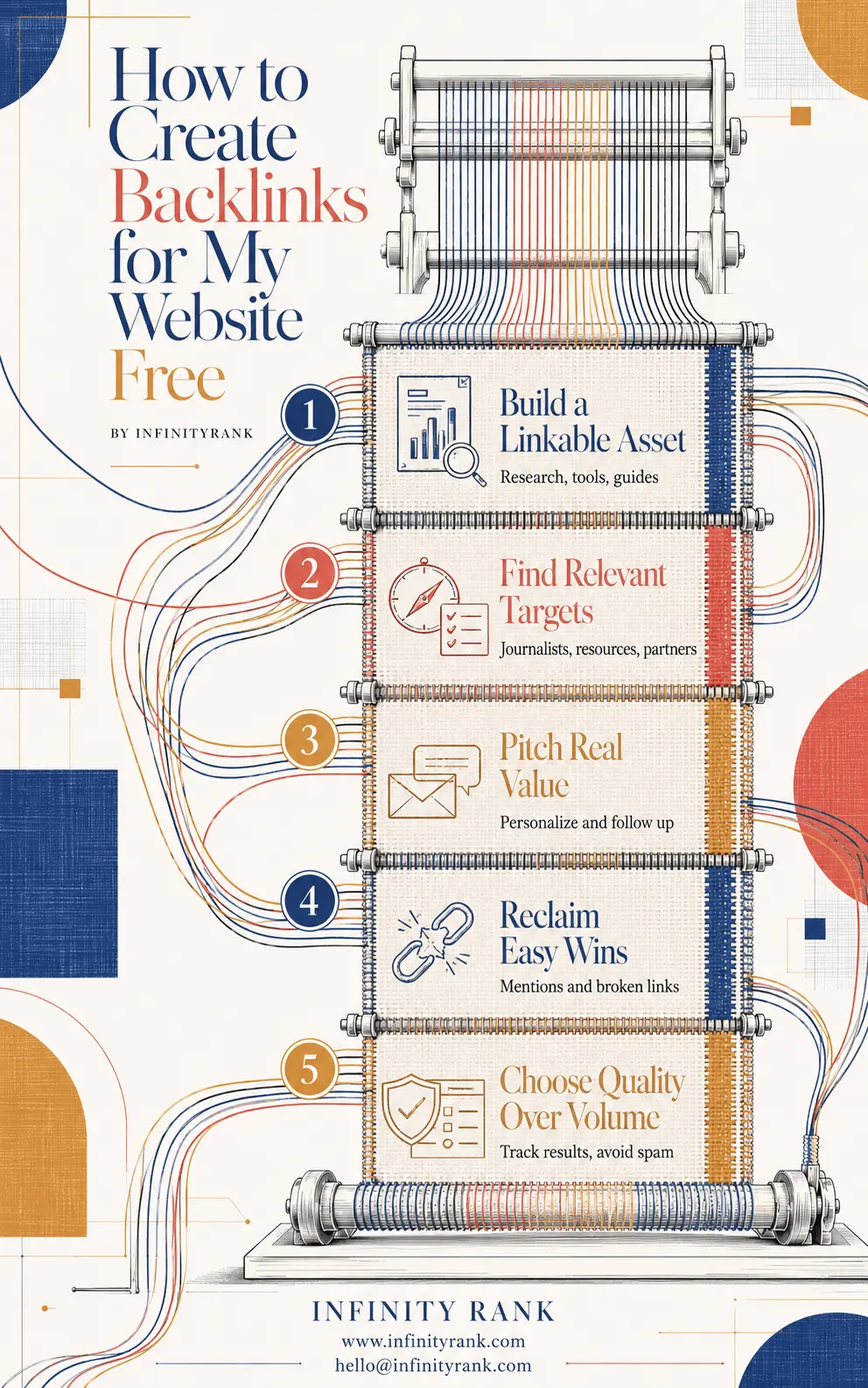
Earning free links takes regular effort, but it creates a safe foundation that lasts for a long time. When you focus on quality over volume and offer real value to other websites, your search traffic will grow naturally. Use these core steps as your everyday checklist to find easy link wins and avoid spam traps.
Before Building Backlinks, Create Something Worth Linking To
Outreach will fail if the destination page offers nothing distinctive.
A basic product page, generic service page or rewritten blog post gives publishers little reason to link. Before contacting anyone, create or improve a resource that helps their audience.
Strong linkable assets include:
- Original research
- Industry surveys
- Proprietary data
- Free calculators
- Templates and checklists
- Detailed comparison guides
- Statistics pages
- Interactive tools
- Definitive tutorials
- Expert roundups with original commentary
- Public datasets
- Maps, charts and visual resources
The asset does not need to be expensive. It does need to provide information, data or utility that is difficult to find elsewhere.
Example
A roofing company is unlikely to attract many editorial links to a standard “roof repair services” page.
It has a better chance of earning links with resources such as:
- A regional roof-replacement cost calculator
- A storm-damage inspection checklist
- An analysis of local weather and insurance claims
- A guide to planning-permission requirements
- A downloadable maintenance schedule
Build the resource first. Promote it second.
1. Create Original Research or Data
Original data gives writers a reason to cite your website as a source.
You do not need a large research budget. Depending on your industry, you could analyse:
- Anonymous customer data
- Search trends
- Public government datasets
- Product pricing
- Customer survey responses
- Industry job listings
- Review patterns
- Website performance data
- Regional demand
- Common support questions
Do not publish a list of numbers without interpretation. Explain:
- What you measured
- Where the data came from
- How you analysed it
- What the findings mean
- What limitations apply
Include clear charts, definitions and a methodology section. This makes the resource easier for journalists, bloggers and industry publications to evaluate and cite.
How to promote the research
Build a list of people who have previously written about the same subject. Contact them with the most relevant finding—not a generic request for a backlink.
A useful pitch might say:
We analysed 2,400 publicly available listings and found that prices in the category increased by 18% over the past year. The full report includes regional differences and our methodology. I thought the findings might be relevant to your coverage of [topic].
Do not lead with “Please link to our website.” Lead with the information.
2. Respond to Journalist and Media Requests
Journalists regularly need qualified sources who can provide concise comments, examples or data.
HARO currently operates as a free service that sends media queries to subscribed sources. Experts can respond to relevant requests, although publication and backlink placement are never guaranteed.
To improve your chances:
- Respond only when you have genuine expertise.
- Answer the specific question immediately.
- Keep the response concise.
- Include a useful example or defensible observation.
- State your full name, role and relevant credentials.
- Provide a short company description.
- Include your website for attribution.
- Avoid sending generic AI-generated answers.
- Meet the journalist’s deadline.
A weak response says:
I would love to contribute. Please let me know what you need.
A stronger response gives the journalist a usable answer:
The most common mistake we see is measuring campaign success by the number of links rather than whether those links reach the right audience. A relevant trade publication can generate more qualified enquiries than a larger general-interest website.
You can also find journalist requests through social media, industry communities, newsletters and direct relationships with relevant writers.
3. Reclaim Unlinked Brand Mentions
An unlinked brand mention occurs when another website names your business, product, employee, study or resource without linking to the relevant page.
These opportunities are useful because the publisher already knows who you are.
Set up alerts for:
- Your brand name
- Common misspellings
- Product names
- Founders and senior employees
- Original research titles
- Proprietary terminology
- Campaign names
When you find an unlinked mention, check whether a link would genuinely help the reader. If it would, contact the writer or editor.
Outreach template
Subject: Link for your mention of [Brand]
Hi [Name],
Thanks for mentioning [Brand] in your article about [topic].
Would you consider linking the mention to our [relevant page]? It would give readers the original source and additional context:
[Page]
Either way, thank you for including us.
Best, [Name]
Do not request a homepage link when a research report, product page or cited resource would be more useful.
4. Use Broken-Link Building
Broken-link building involves finding a dead external link on another website and suggesting a relevant live resource as a replacement.
The process is straightforward:
- Find resource pages or articles related to your subject.
- Check their outbound links.
- Identify links that lead to missing or removed pages.
- Review the former page to understand what it covered.
- Create or identify a genuinely comparable resource.
- Tell the publisher about the broken link.
- Suggest your resource as one possible replacement.
Your page must satisfy the same user need. A publisher has no reason to replace a detailed industry report with your commercial homepage.
Broken-link outreach template
Subject: Broken resource on your [page topic] page
Hi [Name],
I noticed that the link to [old resource] in your article on [topic] currently leads to a missing page.
We have an updated resource covering [brief description], including [specific useful feature]:
[Page]
It may be a suitable replacement, but I mainly wanted to flag the broken link.
Best, [Name]
Do not exaggerate. If your resource is only loosely related, do not pitch it.
5. Pitch Relevant Resource Pages
Many universities, associations, charities, companies and specialist publications maintain lists of useful resources.
These resource pages may link to:
- Guides
- Research
- Tools
- Templates
- Training materials
- Public services
- Industry organisations
Search for combinations such as:
[topic] resources[topic] useful linksintitle:resources [topic]inurl:resources [topic][topic] recommended tools[industry] guides
Before contacting the publisher, assess the page carefully.
Ask:
- Is the page actively maintained?
- Is your resource closely relevant?
- Does it add something not already listed?
- Would the link help the page’s intended audience?
- Is the website credible and editorially managed?
Resource-page outreach template
Subject: Possible addition to your [topic] resources
Hi [Name],
I found your collection of [topic] resources while researching [specific subject].
We recently published a [guide/tool/report] that helps users [specific outcome]. It includes [one or two distinctive features]:
[Page]
It appears relevant to the section on [section name], so I wanted to suggest it for consideration.
Best, [Name]
Personalisation must go beyond changing the recipient’s name. Explain why the resource belongs on that specific page.
6. Contribute Expert Content to Relevant Publications
Guest contributions can build authority, reach new audiences and earn legitimate editorial attribution.
However, guest posting becomes risky when it is scaled, paid for ranking purposes or stuffed with keyword-rich links. Google specifically lists manipulative guest-post links, low-quality directory links, automated link creation and optimised forum links among examples of link spam.
A legitimate guest contribution should:
- Serve the publication’s audience
- Offer original expertise
- Fit the site’s existing editorial standards
- Avoid recycled or mass-produced content
- Use links only when they support the reader
- Avoid exact-match commercial anchor text
- Disclose compensation where applicable
- Allow the publisher to control the final edit
Do not judge a website solely by a third-party authority score.
Review:
- Subject relevance
- Editorial quality
- Named authors
- Real readership
- Recent publication activity
- Organic visibility
- Outbound-link patterns
- Whether most articles appear to exist only to sell links
Finding legitimate opportunities
Instead of relying only on “write for us” searches:
- Identify publications already read by your customers.
- Follow editors and regular contributors.
- Study the topics they cover.
- Find gaps in their existing content.
- Pitch a specific article based on your experience or data.
The objective is to contribute something worth publishing—not to insert a link into any available domain.
7. Join Reputable Directories and Professional Listings
Relevant directories can help customers verify and discover a business. They may also provide a backlink.
Useful legitimate listings may include:
- Local chambers of commerce
- Accredited professional bodies
- Trade associations
- Supplier directories
- Industry-specific marketplaces
- Local business directories
- Alumni business directories
- Official partner programmes
- Government or municipal business portals
The key word is relevant.
Avoid:
- Bulk directory-submission packages
- Directories covering unrelated industries
- Sites with no visible editorial standards
- Pages containing thousands of keyword-rich links
- Networks created mainly to sell listings
- Claims that hundreds of links can be created automatically
Google identifies low-quality directory links and automated link creation as forms of link spam when they are used primarily to manipulate rankings.
For local businesses, keep your company name, address, phone number, website and category information consistent across legitimate listings.
8. Earn Links Through Partnerships and Existing Relationships
Businesses often overlook backlink opportunities within relationships they already have.
Potential sources include:
- Suppliers
- Manufacturers
- Distributors
- Professional associations
- Technology partners
- Charities you support
- Event organisers
- Podcast hosts
- Clients with case-study pages
- Educational institutions
- Local business groups
Examples of legitimate opportunities include:
- A supplier listing you as an authorised retailer
- A software company publishing a genuine customer case study
- An event organiser linking to a speaker biography
- A professional association adding your business to its member directory
- A charity acknowledging a documented campaign or partnership
Do not make a link a contractual condition or exchange products, services or money specifically for ranking credit. Google treats compulsory links, excessive link exchanges and goods or services exchanged for ranking links as link spam.
The link should exist because it gives users useful context.
Tactics With Limited Direct SEO Value
Some methods can create links but should not be the centre of a link-building strategy.
Social profiles
Social media backlinks help people find and verify your brand, but they are not a substitute for editorial links.
Create profiles on platforms your customers actually use. Do not create hundreds of abandoned profiles merely to place URLs.
Forums and communities
Communities can generate referral traffic and establish expertise when you answer questions properly.
Do not post promotional comments or add keyword-rich signature links. Google explicitly identifies optimised forum-comment links as a form of link spam.
Link only when the page directly answers the user’s question and the community permits it.
Blog comments
A thoughtful comment may build a relationship with an author, but mass commenting is not a serious link-building strategy.
Testimonials
Provide testimonials only for products and services you genuinely use. Do not offer a testimonial on the condition that the company gives you a backlink.
Internal Linking Still Matters—but It Is Not Backlink Building
Internal links connect pages within your own website.
They can help users discover related content and help search engines understand your site structure. Use descriptive anchor text and link from relevant pages rather than forcing links into unrelated content.
Useful internal-linking actions include:
- Linking older articles to newer resources
- Connecting supporting posts to a central guide
- Linking informational content to relevant service pages
- Fixing orphan pages
- Updating outdated anchor text
- Removing links to redirected or deleted pages
This supports your wider SEO strategy, but it does not create backlinks from other domains.
How to Evaluate a Backlink Opportunity
Do not ask only, “What is the site’s domain authority?”
Third-party authority metrics can help with initial screening, but they are not Google metrics and do not establish whether a link is relevant, editorial or safe.
Evaluate each opportunity using the following criteria.
1. Relevance
Is the website, page or audience connected to your subject?
A link from a respected niche publication is usually more defensible than a random link from a larger but unrelated website.
2. Editorial control
Was the link placed because an editor, writer or site owner decided it was useful?
Editorial review is a stronger quality signal than self-created links on unrestricted profile pages.
3. Page quality
Check whether the linking page:
- Has a clear purpose
- Contains useful original content
- Is indexed
- Is internally linked
- Receives real engagement
- Avoids excessive advertising
- Does not link indiscriminately to unrelated businesses
4. Link context
A contextual link inside a relevant explanation is generally more useful to readers than an isolated footer, sidebar or author-profile link.
5. Anchor text
Natural anchor text may use:
- Your brand name
- The title of the resource
- A plain URL
- A descriptive phrase
- An author or company name
Do not repeatedly request the same commercial exact-match keyword.
6. Traffic potential
Could a real reader click the link and benefit from the destination page?
If the answer is no, the opportunity may exist only for SEO manipulation.
7. Placement method
Ask how the link is being obtained.
Avoid opportunities based on:
- Undisclosed payment
- Automated placement
- Mandatory exchanges
- Private networks
- Bulk submissions
- Manipulated anchor text
- Republished low-value articles
Free Backlink-Building Tools
You can begin without an expensive SEO platform.
| Task | Free or Limited-Free Option | Use |
| Monitor search performance | Google Search Console | Review search queries, pages, indexing and site issues |
| Monitor brand mentions | Google Alerts | Find new web mentions of your brand or key terms |
| Find journalist requests | HARO | Receive media queries and submit expert responses |
| Check broken links | Browser link-checking extensions | Identify dead outbound links on relevant pages |
| Prospect research | Search engines | Find publications, directories and resource pages |
| Track outreach | Google Sheets | Record prospects, emails, responses and links |
| Review referral traffic | Google Analytics | See whether placements send visitors or conversions |
Google Search Console is a free tool for understanding how a site performs in Google Search and identifying crawling, indexing and search-performance issues.
Do not confuse Search Console with a complete backlink database. Different tools may discover different links, and no third-party crawler has a perfect view of the web.
A Simple Backlink Outreach Tracker
Create a spreadsheet with the following columns:
- Target website
- Target page
- Contact name
- Contact email
- Opportunity type
- Relevant asset
- Date contacted
- Follow-up date
- Response
- Link status
- Linking page
- Anchor text
- Referral traffic
- Notes
This prevents duplicate outreach and makes it easier to identify which tactics produce results.
A Practical 30-Day Free Backlink Plan
Week 1: Build the asset
- Choose one topic with clear audience demand.
- Review competing resources.
- Create something more useful, current or specific.
- Add original examples, visuals or data.
- Make sure the page is indexable and easy to navigate.
Week 2: Find qualified prospects
Build a focused list of:
- Relevant journalists
- Resource pages
- Industry publications
- Sites with broken links
- Unlinked brand mentions
- Legitimate directories
- Existing partners
Prioritise relevance and editorial quality over raw volume.
Week 3: Start outreach
Send personalised messages in manageable batches.
Do not send the same generic pitch to hundreds of websites. Reference the recipient’s page, explain the relevance and make the value clear.
Week 4: Follow up and improve
- Send one polite follow-up where appropriate.
- Record responses.
- Fix weaknesses in the asset.
- Continue responding to journalist requests.
- Monitor new links and referral traffic.
- Review which outreach messages received replies.
A lack of response does not automatically mean the tactic is ineffective. It may mean the asset, target list or pitch needs improvement.
Backlink-Building Mistakes to Avoid
Buying links that pass ranking credit
Buying links and paid advertising are legitimate in different contexts, but compensated links should always be properly qualified with sponsored or nofollow.
Using automated link-building services
Software that promises hundreds or thousands of instant links usually prioritises volume over relevance and editorial value.
Using private blog networks
Private blog networks built mainly to manufacture ranking links create substantial risk and little genuine audience value.
Overusing exact-match anchor text
Repeated commercial anchor text can make a backlink profile look manipulated. Let publishers choose natural wording.
Publishing low-quality guest posts at scale
A guest post should exist because the article benefits the publication’s readers—not because you need another link.
Submitting to every directory you can find
A directory is useful only when it serves a legitimate audience, profession, industry or location.
Measuring only the number of links
Track:
- Referring domains
- Relevance
- Target-page visibility
- Referral traffic
- Leads and conversions
- Brand mentions
- Journalist relationships
- Links earned without direct outreach
Measuring only the number of links misses the metrics that connect backlink activity to actual business outcomes.
Ten low-value links are not automatically better than one strong citation.
How Long Does Free Link Building Take?
There is no fixed timeline.
The result depends on:
- The strength of your resource
- The relevance of your prospect list
- The competitiveness of the subject
- Your credibility
- Outreach quality
- Editorial schedules
- Whether the linking page is crawled and indexed
- Whether readers actually engage with the placement
A new link may be discovered quickly or may take time to be crawled. Google also needs to recrawl and process updated pages before changes can be reflected in Search.
Do not promise that a backlink will improve rankings within a specific number of days or weeks.
Frequently Asked Questions
What is the easiest way to get a free backlink?
The easiest legitimate opportunity is usually an existing relationship or unlinked brand mention.
Check whether suppliers, associations, partners, event organisers or publications already mention your company without linking to the relevant page.
Easy does not necessarily mean valuable. Evaluate the relevance and context of every opportunity.
Can I get backlinks without writing guest posts?
Yes. You can earn links through original research, journalist responses, tools, resource pages, broken-link outreach, unlinked mentions, directories and business partnerships.
Are directory backlinks safe?
A listing on a legitimate, relevant directory can be useful. Bulk submissions to low-quality directories created primarily for SEO are not.
Review the directory’s audience, editorial standards and business purpose before submitting.
Are nofollow links useless?
No. A nofollow link can generate referral traffic, increase exposure and help users discover your business. Google also treats link attributes as qualifications or hints rather than a simplistic guarantee that a link has no value.
Should I ask websites for dofollow links?
Do not make “dofollow” placement the centre of your pitch. Ask whether your resource is useful to the publisher’s audience and allow the publisher to control its outbound links.
Can forum links improve SEO?
Forum participation can build reputation and generate relevant traffic. Posting links mainly to influence rankings is not a sustainable strategy, particularly when the links use optimised anchor text.
How many backlinks do I need?
There is no universal number.
The answer depends on the query, competitors, website, page quality, topical relevance and strength of the linking sources. Focus on earning links that make sense to users rather than reaching an arbitrary total.
Should I disavow low-quality backlinks?
Do not disavow low-quality backlinks automatically because a third-party tool labels them “toxic.” Investigate whether your site participated in manipulative link building and whether there is a genuine reason to use Google’s disavow process.
Final Thoughts
You can build backlinks without paying for placements, but there is no reliable shortcut.
The strongest free campaigns follow a simple process:
- Create a resource worth citing.
- Find websites and writers whose audiences need it.
- Explain the value in a personalised pitch.
- Avoid manipulative placements.
- Track links, traffic and business outcomes.
- Improve the campaign based on real responses.
Start with one strong asset and one relevant outreach method. That is more effective than scattering your website across hundreds of directories, profiles and comment sections.