Domain Rating and Domain Authority are often treated as interchangeable SEO metrics. They are not.
Domain Rating (DR) is an Ahrefs metric that compares the strength of websites’ backlink profiles. Domain Authority (DA) is a Moz metric designed to estimate a domain’s relative ability to rank in search results.
Both use 100-point scales. Both are calculated by third-party SEO platforms. Neither is a Google metric or a ranking factor used directly by Google.
That does not make them useless. DA and DR can help with competitor research, backlink analysis, link prospecting, and progress tracking. Problems start when marketers treat either number as a complete measure of website quality.
This guide explains what Domain Rating and Domain Authority measure, why their scores often differ, and how to use them without chasing vanity metrics.
Domain Rating vs Domain Authority at a Glance
| Feature | Domain Authority | Domain Rating |
| Created by | Moz | Ahrefs |
| Abbreviation | DA | DR |
| Main purpose | Estimate relative ranking potential | Compare backlink-profile strength |
| Main data source | Moz’s link index and machine-learning model | Ahrefs’ backlink index |
| Scale | 1–100 | 0–100 |
| Best used for | Comparing similar competing domains | Comparing backlink profiles |
| Page-level equivalent | Page Authority | URL Rating |
| Google ranking factor | No | No |
| Measures content quality directly | No | No |
| Should determine whether you pursue a link | No | No |
The simplest distinction is:
- DA is a comparative ranking-potential metric.
- DR is a comparative backlink-strength metric.
Neither score tells you whether a particular page is useful, trustworthy, relevant, or likely to rank for a specific keyword.
DR vs. DA: Which Metric Matters?
Tracking website scores like Domain Rating (DR) and Domain Authority (DA) can be confusing. These numbers do not come from Google, but many people treat them like absolute facts. One score guesses how well a site will rank in search results, while the other checks the raw power of its backlinks. This clear guide breaks down five simple facts to help you understand both metrics without getting lost in the data.
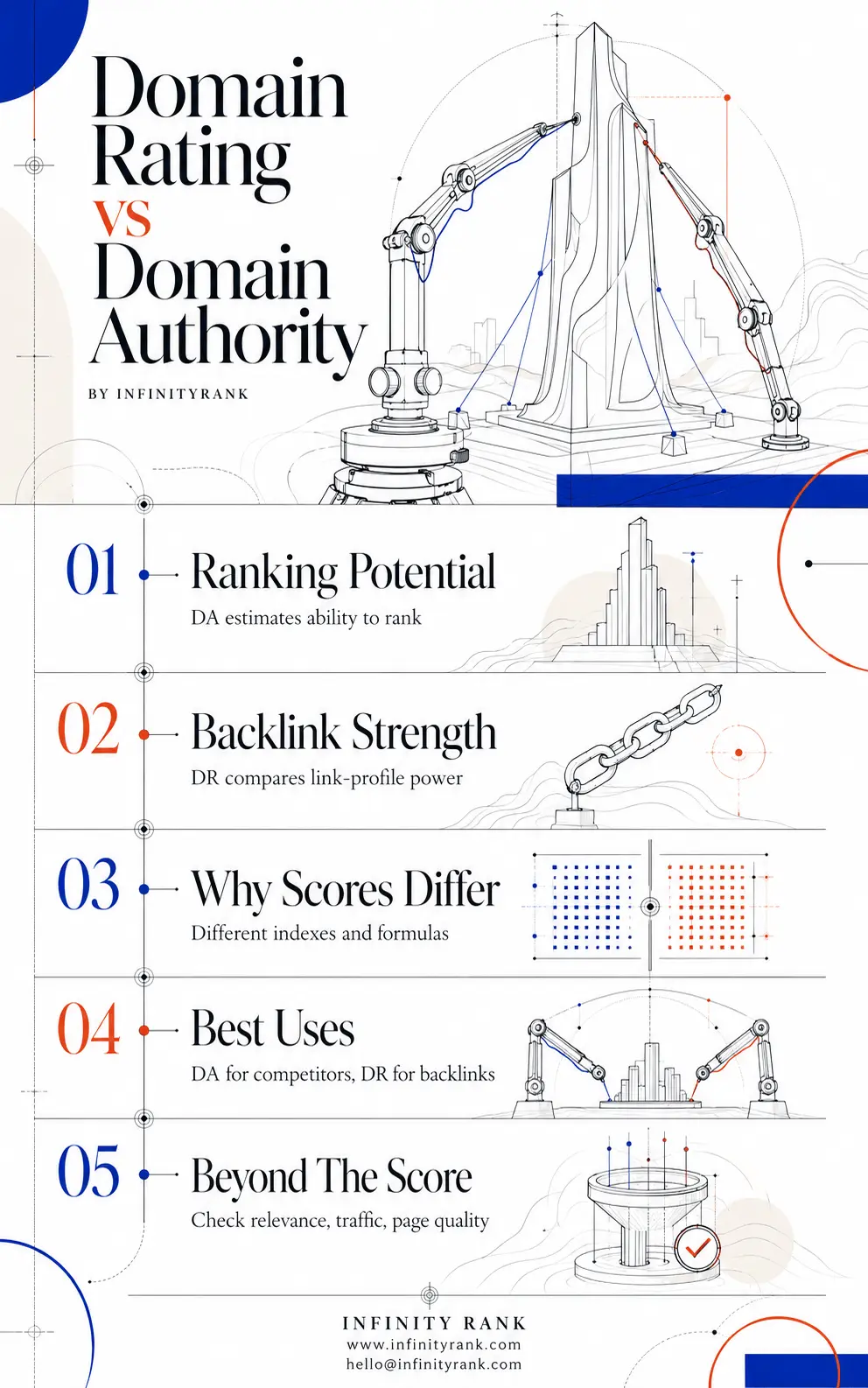
Relying on just one headline number can easily hurt your SEO plans. When you look at both ranking power and link quality together, you make much safer and smarter choices for your website. Use the infographic above as your quick checklist to see the real strength of any site before you spend time or money building a link.
What Is Domain Authority?
Domain Authority is a proprietary metric developed by Moz. It predicts how likely a domain is to rank in search results compared with other domains.
Moz calculates DA using data from its Link Explorer index and a machine-learning model. The model evaluates link-related data and attempts to identify patterns associated with domains appearing in search results.
DA is therefore a comparative prediction, not an objective grade awarded by Google.
A DA of 50 does not mean that a website is twice as authoritative as a website with a DA of 25. It also does not guarantee that the higher-DA website will outrank the lower-DA website for a particular search query.
The result of an individual search depends on factors that DA does not adequately represent, including:
- How well the page satisfies search intent
- Topical relevance
- Content quality and completeness
- Page-level backlinks
- Internal linking
- Technical accessibility
- Competition for the query
DA is most useful when comparing websites that compete in the same market. Comparing a local accounting firm with Wikipedia provides no useful benchmark.
Is Domain Authority logarithmic?
DA becomes progressively harder to increase at the higher end of its scale. Moving from 20 to 30 is generally more achievable than moving from 70 to 80.
This is another reason not to set an arbitrary DA target. A suitable benchmark depends on the websites competing in your industry—not on a universal definition of a “good” score.
What Is Domain Rating?
Domain Rating is Ahrefs’ metric for comparing the strength of a website’s backlink profile with other websites in its database.
Unlike DA, DR is explicitly focused on links.
Ahrefs considers factors including:
- The followed referring domains linking to a website
- The DR of those referring domains
- How many other domains each referring website links to
A link from a high-DR website can contribute more than a link from a weak website. However, the source domain’s outbound linking also matters. A strong domain linking to thousands of other websites distributes its influence more widely than one linking to relatively few.
This means a familiar publisher name alone does not establish how much a backlink will affect DR.
The specific linking page, link attributes, placement, outbound links, and surrounding content all require examination.
Do multiple backlinks from one website increase DR?
DR is influenced more by the diversity and strength of referring domains than by repeatedly gaining links from the same source.
One website linking to you 50 times still represents one referring domain. Fifty independent websites linking once each represent 50 referring domains.
Backlink volume and referring-domain diversity are therefore different measurements. Our guide to referring domains vs backlinks explains the distinction in more detail.
Why Do DA and DR Scores Differ?
A website can have a DR of 70 and a DA of 35 without either tool being broken.
The scores differ because Moz and Ahrefs:
- Maintain separate web indexes
- Discover and process links at different times
- Use different calculations
- Update their databases on different schedules
- Designed their metrics for different purposes
DA attempts to model relative ranking potential using Moz’s data. DR evaluates backlink-profile strength using Ahrefs’ link graph.
The numbers are not directly convertible. A DR of 60 is not equivalent to a DA of 60.
Do not compare a website’s DA with its DR and interpret the difference as improvement, decline, or inconsistency. Compare:
- DA with DA
- DR with DR
- The same tool across similar competitors
- Long-term trends rather than daily movements
Small changes may reflect database updates or movements elsewhere in the tool’s index rather than a meaningful change to your website.
Which Is More Important: DA or DR?
Neither metric is universally more important.
The better choice depends on the question you are trying to answer.
Use DR to compare backlink profiles
DR is useful when you want to:
- Compare the overall backlink strength of competing websites
- Find domains with established link profiles
- Review growth in followed referring domains
- Identify competitors that may have stronger link acquisition programs
It is still only a starting point. A high DR does not prove that a site has real traffic, editorial standards, topical relevance, or a valuable audience.
Use DA to compare search competitors
DA can help when you want to:
- Compare domains competing in the same search market
- Establish a relative competitive benchmark
- Identify websites that may be difficult to compete against
- Monitor changes in Moz’s assessment of your link profile
DA cannot determine which page will rank for a keyword. Page quality, intent, relevance, and page-level authority still need to be examined.
Use page-level metrics when evaluating a page
A backlink comes from a page, not from an abstract domain score.
For individual pages, use:
- Page Authority: Moz’s prediction of a specific page’s ranking potential
- URL Rating: Ahrefs’ measurement of a page’s backlink strength
Ahrefs states that UR and DR compare different things and are not measured on the same scale. A strong page can exist on a weak domain, and a weak page can exist on a strong domain.
This is why rejecting a link solely because the website has a low DA or DR can be a mistake.
How to Evaluate a Link Prospect Properly
DA and DR should be filters—not approval systems.
Before pursuing a backlink, examine the following factors.
1. Topical relevance
The linking website and page should have a legitimate connection to your subject.
A relevant link from a smaller specialist publication can be more useful than an unrelated link from a higher-scoring general website.
Ask:
- Does the website publish about your industry?
- Would its readers reasonably benefit from your page?
- Does the link make sense within the surrounding content?
2. Organic visibility
Check whether the website ranks for real, relevant queries and appears to receive organic traffic.
A high authority score combined with almost no search visibility may indicate:
- A repurposed or expired domain
- A declining website
- A site created primarily to sell links
- An irrelevant historical backlink profile
Estimated traffic is not perfectly accurate, but it adds context that DA or DR alone cannot provide.
3. Quality of the linking page
Review the actual page from which the link would appear.
Look for:
- Original, useful content
- Clear authorship or editorial accountability
- Relevant surrounding text
- Reasonable outbound linking
- A page that is indexed and accessible
- Natural anchor text
Ahrefs recommends evaluating page authority, outbound links, relevance, placement, and link attributes rather than relying solely on a domain-wide metric.
4. Outbound-link patterns
A website that links indiscriminately to casinos, loans, supplements, software, law firms, and unrelated local businesses is not a strong prospect merely because it has a high DR.
Check whether:
- Posts contain excessive commercial links
- Most articles appear sponsored
- Anchors are aggressively keyword-optimized
- The site accepts unrelated topics
- Links regularly point to questionable industries
Authority metrics can be manipulated. Editorial standards are harder to fake consistently.
5. Audience and referral value
A useful backlink can produce more than authority.
It may also deliver:
- Qualified referral traffic
- Brand exposure
- Industry credibility
- Partnership opportunities
- Leads or sales
A lower-scoring niche site with an engaged audience may produce more business value than a high-DR site whose readers have no interest in your offer.
Do High DA or DR Scores Guarantee Better Rankings?
No.
DA and DR correlate with link strength and competitive visibility, but they cannot guarantee rankings.
A high-DR website may still perform poorly because it has:
- Weak or irrelevant content
- Poor search-intent alignment
- Technical indexing problems
- Few links to the page being ranked
- A backlink profile unrelated to its current topic
- Significant competition
A lower-authority website can outrank a stronger domain when its page is more relevant, useful, focused, and better supported.
Neither metric replaces keyword research, SERP analysis, content quality, technical SEO, or page-level link analysis.
Can DA or DR Be Manipulated?
Yes.
Because both scores depend heavily on link data, marketers can attempt to increase them through low-quality link acquisition.
A manipulated website may display a strong score while offering little genuine SEO value. Common warning signs include:
- Sudden growth from unrelated referring domains
- Large numbers of sitewide links
- Links from redirected or expired domains
- Thin pages created to host paid links
- High authority metrics but negligible organic traffic
- Excessive exact-match anchor text
- Links from hacked or automatically generated pages
Do not assume that a high score makes a website safe.
Google classifies links created primarily to manipulate rankings as link spam. Its examples include excessive reciprocal linking, paid links that pass ranking credit, and low-quality directory or bookmark links.
Legitimate authority link building should prioritize editorial merit, relevance, and audience value rather than metric manipulation.
How to Improve DA and DR Without Chasing Scores
You cannot directly optimize DA or DR through an on-page setting.
Both scores generally improve when your website earns stronger links from a broader range of legitimate sources.
Sustainable methods include:
Create linkable resources
Publish assets that give other websites a reason to cite you, such as:
- Original research
- Industry data
- Free tools
- Templates
- Definitive guides
- Surveys
- Calculators
- Visual resources
Publishing content alone does not increase DR. The content must earn followed backlinks from external domains.
Use digital PR
Original data, expert commentary, and timely industry analysis can earn editorial coverage from relevant publications.
The goal should be genuine coverage—not placing links on any website with an acceptable score.
Reclaim legitimate lost links
Find valuable backlinks that disappeared because:
- A page moved
- A URL now returns an error
- A publisher removed or changed a citation
- The linking site used an outdated destination
Reclaiming a legitimate lost link is usually more defensible than manufacturing a new one.
Earn links to useful internal pages
Do not send every backlink to the homepage.
Links to research, tools, guides, service pages, and commercial resources can strengthen the pages that need to rank or convert.
Avoid indiscriminate link exchanges
A natural reciprocal link between two relevant organizations is not automatically a problem. Large-scale exchanges performed primarily to manipulate rankings are.
Google explicitly lists excessive link exchanges as a form of link spam.
Other Authority Metrics You May Encounter
DA and DR are not the only proprietary authority scores.
Page Authority
Moz’s Page Authority estimates the relative ranking potential of an individual page rather than an entire domain.
URL Rating
Ahrefs’ URL Rating measures the strength of a page’s backlink profile.
Authority Score
Semrush’s Authority Score is a compound metric based on link strength, estimated organic traffic, and indicators of backlink manipulation.
Trust Flow and Citation Flow
Majestic’s Trust Flow focuses on backlink quality and proximity to a manually reviewed seed set. Citation Flow focuses more heavily on link quantity. Majestic calculates its metrics at the URL level and aggregates them for domain-level reporting.
Ahrefs Rank
Ahrefs Rank orders domains in Ahrefs’ database according to the strength of their followed referring-domain profiles. A lower numerical rank indicates a stronger position.
“Domain rank” is not a standardized term. When someone uses it, ask which tool and metric they mean.
The Right Way to Use Authority Metrics
Use DA and DR to support decisions—not make them for you.
A practical workflow is:
- Compare DA or DR among genuine competitors.
- Review referring domains and backlink growth.
- Examine the authority and relevance of individual pages.
- Check organic traffic and ranking history.
- Inspect outbound links and editorial quality.
- Confirm that the website serves a real audience.
- Make the decision using the full evidence.
Do not approve a link because the site has DR 70. Do not reject one because it has DA 15.
A score provides context. It does not replace judgment.
Final Verdict: Should You Trust DA or DR?
Trust each metric only for the limited job it was designed to perform.
- Use Domain Rating to compare backlink-profile strength in Ahrefs.
- Use Domain Authority to compare relative ranking potential in Moz.
- Use URL Rating or Page Authority when evaluating individual pages.
- Use traffic, relevance, content quality, and editorial standards when judging actual websites and backlinks.
- Use rankings, qualified traffic, leads, and revenue to measure SEO results.
DA and DR are useful diagnostic metrics. They are poor business goals.
A higher score means little if rankings, visibility, traffic, and conversions do not improve with it.
Frequently Asked Questions
What is the main difference between Domain Rating and Domain Authority?
Domain Rating measures the relative strength of a website’s backlink profile in Ahrefs. Domain Authority estimates a domain’s relative ranking potential using Moz’s link data and machine-learning model.
Is DA or DR more important for SEO?
Neither is inherently more important. DR is more useful for backlink-profile comparisons, while DA is useful for comparing similar search competitors. Neither should be used alone.
Does Google use Domain Authority or Domain Rating?
No. DA and DR are proprietary metrics created by Moz and Ahrefs. There is no evidence that Google uses either score as a ranking factor.
Can a website have high DR but low DA?
Yes. Moz and Ahrefs use different indexes and calculations. A website may therefore receive substantially different scores from the two platforms.
What is a good DA or DR score?
There is no universal good score. Compare your website with legitimate competitors in the same market. A score that is competitive in one industry may be weak or unusually strong in another.
Does publishing more content increase DA or DR?
Not directly. Content can help attract backlinks, but publishing pages without earning links does not automatically increase a link-based authority score.
Should I buy a backlink from a high-DR website?
No authority score can make a paid link automatically safe or valuable. Review the website’s relevance, traffic, editorial standards, outbound-link patterns, and the proposed linking page. Paid links intended to manipulate rankings may violate Google’s spam policies unless they are appropriately qualified.
Should I remove every low-DA or low-DR backlink?
No. A low score does not automatically mean a link is harmful. Remove or disavow links only when there is a defensible reason, such as a manual action, a documented manipulative campaign, or a serious pattern of unnatural links. See our guide to disavowing toxic backlinks before taking action.