Backlinks are still one of the most important signals in SEO, but not every backlink works the same way.
Some links can pass ranking signals from one website to another. Others are marked with attributes that tell search engines not to treat the link as a normal endorsement. That is where the difference between dofollow and nofollow backlinks matters.
The short version: a dofollow backlink is a standard link without a qualifying rel attribute. A nofollow backlink uses rel="nofollow" to signal that the linking site does not want to endorse the destination or pass ranking credit in the usual way.
But the full picture is more nuanced. Google now treats nofollow, sponsored, and UGC attributes as hints, not as simple on/off switches. That means backlink quality, relevance, placement, and intent matter more than chasing a perfect dofollow-to-nofollow ratio.
What Is a Dofollow Backlink?
A dofollow backlink is the SEO industry term for a standard hyperlink that does not use a qualifying attribute such as nofollow, sponsored, or ugc.
Technically, there is no rel="dofollow" attribute. A normal link is treated as followable by default when search engines can crawl the page and access the link.
Example:
<a href="https://www.example.com">Visit Example</a>
There is no extra rel value here. This is what SEOs usually call a dofollow link.
A high-quality dofollow backlink can help SEO because it may pass link equity from the referring page to the linked page. That does not mean every dofollow link is valuable. A contextual link from a trusted, relevant website is very different from a dofollow link on a weak directory, spammy blog, or irrelevant guest post farm.
Dofollow backlinks are most valuable when they are:
- Editorially placed
- Relevant to the topic
- Located within useful body content
- From a trusted website
- Surrounded by natural context
- Pointing to a page that deserves to rank
A dofollow backlink should feel like a real recommendation, not a forced SEO placement.
What Is a Nofollow Backlink?
A nofollow backlink is a link that includes the rel="nofollow" value in its HTML.
Example:
<a href="https://www.example.com" rel="nofollow">Visit Example</a>
The nofollow value tells Google that the linking site does not want to associate itself with the linked page, crawl that page from the link, or pass ranking credit in the normal way.
That does not make nofollow links useless.
Nofollow backlinks can still drive referral traffic, build brand awareness, help content get discovered, and create secondary opportunities. A nofollow mention from a respected publication can still bring qualified visitors, searches for your brand, newsletter signups, journalist interest, and future editorial links.
The mistake is treating every nofollow link as worthless. The bigger mistake is treating every dofollow link as valuable.
Dofollow vs Nofollow Backlinks Explained Simply
Understanding the difference between dofollow and nofollow links is a massive part of building a successful website. While one link type tells Google to pass ranking power directly to your pages, the other acts as a non-endorsement sign. However, both tags play a major role in your overall search success. This simple guide breaks down five easy facts to help you build a natural link profile that ranks safely.
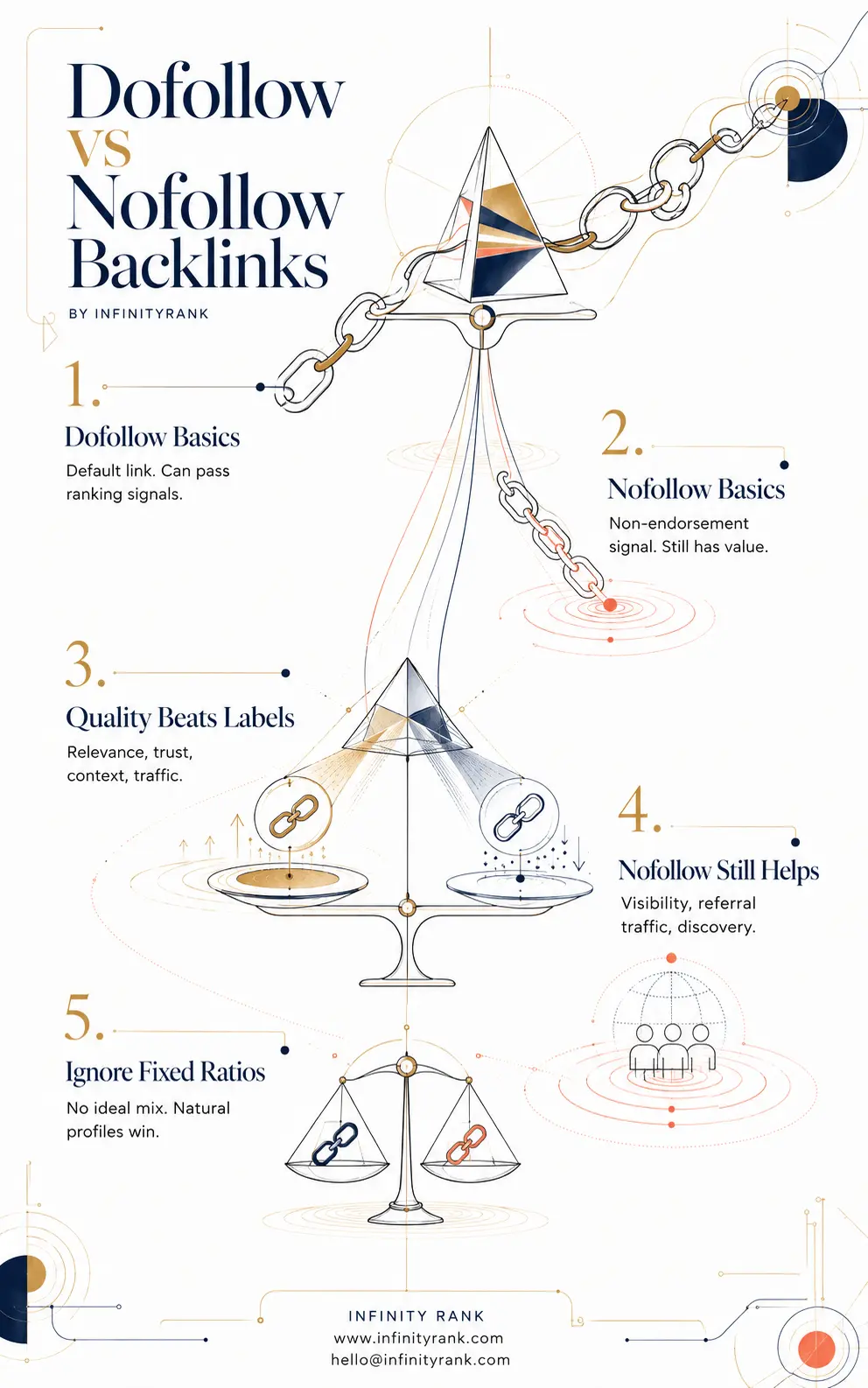
Building a powerful website means accepting that quality always beats labels. Instead of stressing over perfect math ratios, focus on getting trusted links that bring real traffic and help people discover your brand. Use these five core pillars as your daily checklist to keep your optimization strategy balanced and completely natural.
Dofollow vs Nofollow Backlinks: Side-by-Side Comparison
| Feature | Dofollow Backlinks | Nofollow Backlinks |
| HTML attribute | No qualifying rel attribute | Uses rel="nofollow" |
| Passes link equity | Can pass ranking signals | Generally not treated like a normal endorsement |
| Direct ranking value | Usually stronger when the link is high quality | Limited or indirect |
| Referral traffic | Yes | Yes |
| Brand visibility | Yes | Yes |
| Common examples | Editorial links, resource pages, guest posts, digital PR mentions | Blog comments, some news mentions, social media links, forum links |
| Best use | Building authority and topical relevance | Traffic, visibility, discovery, and non-endorsed linking |
| SEO risk | Risky if bought, spammy, irrelevant, or manipulative | Lower risk when used correctly, but still not a license to spam |
Nofollow vs Sponsored vs UGC
Modern SEO is not just about dofollow and nofollow. Google also supports sponsored and ugc link attributes.
These attributes help describe the relationship between the linking page and the destination page.
rel="sponsored"
Use rel="sponsored" for links created as part of advertising, sponsorships, paid placements, affiliate arrangements, or other compensation agreements.
Example:
<a href="https://www.example.com" rel="sponsored">Sponsored Partner</a>
This is the preferred attribute for paid links. If money, products, services, or compensation influenced the link placement, mark it as sponsored.
rel="ugc"
Use rel="ugc" for user-generated content. This includes links in blog comments, forum posts, community discussions, and other areas where users can publish links themselves.
Example:
<a href="https://www.example.com" rel="ugc">User Shared Link</a>
This helps search engines understand that the link was added by a user, not necessarily endorsed by the website owner.
rel="nofollow"
Use rel="nofollow" when you want to link to a page but do not want to imply endorsement or pass ranking credit.
Example:
<a href="https://www.example.com" rel="nofollow">Reference Link</a>
You can also combine attributes.
Example:
<a href="https://www.example.com" rel="ugc nofollow">User Comment Link</a>
That combination tells search engines the link came from user-generated content and should not be treated as a standard endorsement.
Does Google Treat Nofollow as a Hint?
Yes. Since Google’s 2019 update, nofollow, sponsored, and ugc are treated as hints for ranking purposes, not absolute directives.
This does not mean nofollow links suddenly became equal to dofollow links. They did not.
It means Google may use these attributes, along with other signals, to better understand links and decide how to handle them. In practice, you should still assume that a nofollow link will not pass the same ranking value as a clean, editorial, dofollow backlink.
The safe takeaway is simple: do not build your SEO strategy around loopholes in nofollow handling. Build links that make sense for users, publishers, and search engines.
Why Dofollow Backlinks Matter
Dofollow backlinks matter because they are the clearest type of link endorsement.
When a strong website links to your page naturally, it can help search engines understand that your content is useful, trustworthy, and relevant to a topic. Over time, strong backlinks can support better rankings, stronger topical authority, and more organic traffic.
But the word “dofollow” alone does not make a link good.
A useful dofollow backlink usually has:
- Topical relevance between both pages
- Real editorial context
- Natural anchor text
- Placement inside meaningful content
- Traffic potential
- A trustworthy referring domain
- No obvious paid-link footprint
A weak dofollow backlink usually has:
- Irrelevant surrounding content
- Exact-match anchor text abuse
- Thin or AI-spun guest post content
- Placement on a site built only to sell links
- No real audience
- Hundreds of outbound links to unrelated businesses
If the link exists only because someone paid for placement on a low-quality site, it is not a strong SEO asset. It is a liability.
Why Nofollow Backlinks Still Matter
Nofollow backlinks are not ranking magic, but they can still help your marketing.
A nofollow link can:
- Send referral traffic
- Increase brand visibility
- Put your business in front of the right audience
- Support digital PR campaigns
- Lead to natural secondary links
- Help diversify where your brand is mentioned
- Drive branded searches
- Build trust when placed on respected platforms
For example, a nofollow link from a major publication, niche community, or popular industry newsletter may not behave like a standard dofollow backlink. But it can still expose your brand to buyers, journalists, creators, and other site owners.
That exposure can lead to links that are followed later.
This is why nofollow links should not be ignored. They just should not be sold as direct link-equity wins.
Is There an Ideal Dofollow to Nofollow Ratio?
No. There is no official or universal dofollow-to-nofollow ratio.
Ignore anyone who tells you that your backlink profile must be 70% dofollow, 80% dofollow, or any other fixed number. That is fake precision.
A natural backlink profile depends on your industry, brand size, PR activity, content strategy, partnerships, and where people mention your business. A SaaS company, local service business, ecommerce store, news site, and personal brand will not attract the same link mix.
Instead of chasing a ratio, look at backlink quality.
Ask:
- Are the links relevant?
- Are they from real websites?
- Do they appear editorially placed?
- Is the anchor text natural?
- Do the referring pages have traffic potential?
- Are there signs of paid-link networks?
- Are links coming from useful content or from thin filler pages?
A backlink profile with fewer strong, relevant links will usually beat a profile filled with hundreds of low-quality dofollow links.
How to Check if a Link Is Dofollow or Nofollow
You can check a link manually or with SEO tools.
Manual Method
- Open the page containing the link.
- Right-click near the link.
- Click “Inspect.”
- Find the link’s
<a>tag. - Look for the
relattribute.
If the link has no rel="nofollow", rel="sponsored", or rel="ugc" value, SEOs usually call it a dofollow link.
Example dofollow link:
<a href="https://www.example.com">Example</a>
Example nofollow link:
<a href="https://www.example.com" rel="nofollow">Example</a>
Example sponsored link:
<a href="https://www.example.com" rel="sponsored">Example</a>
Example UGC link:
<a href="https://www.example.com" rel="ugc">Example</a>
Tool-Based Method
For larger backlink checks, use tools such as Ahrefs, Semrush, Screaming Frog, Sitebulb, or browser extensions that highlight nofollow links.
Manual checking is fine for one page. Tools are better when you need to audit hundreds or thousands of backlinks.
When Should You Use Nofollow on Your Own Website?
Use nofollow when you want to link to a page but do not want the link to act as an endorsement.
Common cases include:
- Untrusted references
- Links you need to mention but do not want to vouch for
- Certain user-submitted links
- Links added for context, not recommendation
- Pages you do not want associated with your site
For paid placements, use rel="sponsored" instead of relying only on nofollow. For user-generated content, use rel="ugc".
Do not use nofollow as your main method for controlling indexation. If you need to stop Google from indexing a page on your own site, use proper crawling and indexing controls such as robots.txt and noindex rules where appropriate.
How to Earn High-Quality Dofollow Backlinks
Strong dofollow links usually come from assets worth citing. You do not earn them by sending generic outreach emails to random blogs.
Better options include:
1. Publish Link-Worthy Content
Create original assets that other websites have a reason to reference.
Examples include:
- Industry data studies
- Original surveys
- Free tools
- Calculators
- Templates
- Comparison guides
- Statistics pages
- Expert roundups with real insight
- Visual explainers
- Case studies with evidence
Generic blog posts rarely earn strong links. Useful resources do.
2. Use Digital PR
Digital PR works when you pitch a real story, not just a link request.
Good digital PR angles include:
- New data
- Market trends
- Local insights
- Expert commentary
- Contrarian analysis
- Timely industry reactions
- Useful reports
If journalists and publishers can use your content to support their own stories, you have a better chance of earning editorial backlinks.
3. Reclaim Unlinked Brand Mentions
If websites mention your brand without linking to you, ask them to add the link.
This works best when the mention is already positive, relevant, and recent. Keep the request short. Do not overcomplicate it.
4. Build Resource Page Links
Some websites maintain curated resource pages. If your guide, tool, or research page genuinely improves their list, pitch it.
Do not pitch thin sales pages. Resource page link building works when the destination is actually useful.
5. Use Broken Link Building
Find broken outbound links on relevant websites, then suggest your content as a replacement.
This only works when your page is a close match for the missing resource. If your replacement is irrelevant, the pitch will fail.
Common Mistakes to Avoid
Chasing Only Dofollow Links
A backlink profile made only of aggressive dofollow placements can look unnatural, especially if the links come from weak guest post sites or link farms.
Focus on quality, not labels.
Treating Nofollow Links as Worthless
Nofollow links can still drive traffic, visibility, and discovery. A nofollow link from a trusted site can be more useful than a dofollow link from a dead, irrelevant blog.
Buying Dofollow Links Without Checking Quality
Paid dofollow links from obvious link-selling sites are risky. If the site publishes every niche, uses generic content, has unnatural outbound links, and exists mainly to sell placements, avoid it.
Using the Wrong Attribute for Sponsored Links
Paid links should be marked with rel="sponsored". Nofollow is still accepted in some cases, but sponsored is the clearer and preferred value for compensated links.
Using Nofollow to Block Indexing
Nofollow is not a proper indexation-control strategy. Use the right technical controls when you need to prevent crawling or indexing.
Obsessing Over Ratios
There is no magic ratio. A natural link profile is judged by quality, relevance, source diversity, and intent, not by a fixed dofollow percentage.
Which Is Better: Dofollow or Nofollow?
Dofollow backlinks are usually more valuable for direct SEO impact because they can pass link equity.
But the better link is not always the dofollow link.
A nofollow link from a respected industry site with real readers can be more valuable than a dofollow link from a low-quality site with no traffic, no standards, and no relevance.
The real question is not “Is it dofollow?”
The better question is: “Would this link still be valuable if Google ignored it?”
If the answer is yes, the link probably has real marketing value. If the answer is no, it may not be worth chasing.
Final Thoughts
Dofollow and nofollow backlinks both have a place in SEO.
Dofollow backlinks can support rankings when they come from relevant, trustworthy, editorial sources. Nofollow backlinks can support visibility, referral traffic, brand awareness, and discovery.
Do not build a backlink strategy around fake ratios or outdated rules. Build it around relevance, trust, content quality, and real placements on websites that matter.
A strong backlink profile is not just a list of dofollow links. It is a collection of credible mentions that make sense for your brand, your audience, and your market.
FAQs
Do nofollow links help SEO?
Nofollow links usually do not pass the same direct ranking value as standard dofollow links. However, they can still help through referral traffic, brand visibility, discovery, and secondary link opportunities.
Are dofollow backlinks better than nofollow backlinks?
For direct link equity, yes, dofollow backlinks are usually more valuable. But a high-quality nofollow link from a trusted website can still be more useful than a weak dofollow link from an irrelevant or spammy site.
What is the ideal dofollow-to-nofollow backlink ratio?
There is no ideal ratio. A natural backlink profile depends on your industry, content, PR activity, and brand visibility. Focus on link quality instead of trying to hit a fixed percentage.
How do I know if a backlink is dofollow?
Inspect the link’s HTML. If the link does not include rel="nofollow", rel="sponsored", or rel="ugc", SEOs usually call it a dofollow link.
Should sponsored links be nofollow?
Paid or sponsored links should be marked with rel="sponsored". Google still accepts nofollow in some cases, but sponsored is the clearer attribute for ads, sponsorships, affiliate links, and paid placements.
Do social media links count as backlinks?
Yes, social media links can count as backlinks in a broad referral sense, but they are usually nofollow or otherwise limited for direct SEO value. Their main value is visibility, traffic, and content distribution.