Link farming is one of the oldest shortcuts in SEO. It is also one of the easiest ways to damage a backlink profile.
The pitch usually sounds simple: pay a small fee and get hundreds or thousands of backlinks fast. For a business owner trying to improve rankings, that can sound attractive. The problem is that these links are usually built for search engines, not people. They come from low-quality sites, irrelevant pages, automated networks, or websites created mainly to pass ranking signals.
That is not sustainable link building. It is link spam.
In this guide, you will learn what link farming is, why it creates SEO risk, how to spot link farm backlinks, and what to do instead if you want backlinks that actually support long-term organic growth.
What Is Link Farming?
A link farm is a website, group of websites, or backlink network created primarily to generate links for SEO manipulation.
These sites usually do not exist to serve a real audience. They exist to publish links at scale. Some are obvious spam sites. Others look more polished, with blog layouts, author boxes, stock images, and inflated SEO metrics. The purpose is still the same: create artificial links to influence rankings.
Common link farm traits include:
- Thin, generic, or AI-generated content
- Large numbers of outbound links
- Links to unrelated industries on the same site
- Repetitive anchor text
- Little or no real organic traffic
- No visible editorial standards
- Anonymous ownership or fake author profiles
- Networks of sites linking to each other in patterns
A normal website may link to other websites naturally. A link farm links out because selling or exchanging links is the business model.
That difference matters.
Link Farming vs Link Building
Link farming and link building are not the same thing.
Link building is the process of earning or placing relevant backlinks through legitimate methods such as digital PR, expert contributions, editorial partnerships, resource pages, and high-quality guest content.
Link farming is the process of creating or buying links from sites built mainly to manipulate rankings.
Here is the practical difference:
| Factor | Legitimate Link Building | Link Farming |
| Main purpose | Help readers and support authority | Manipulate rankings |
| Site quality | Real audience, real content, real standards | Thin content, weak oversight, random topics |
| Relevance | Topically related to your niche | Often unrelated |
| Traffic | Usually has some organic or referral value | Often low or fake |
| Editorial review | Links are reviewed before publishing | Links are accepted mainly for payment |
| Risk | Lower when done properly | High |
Good backlinks are earned through relevance, usefulness, and editorial judgment. Link farm backlinks are manufactured.
Link Farming Destroys Your Search Rankings
Buying cheap backlinks in bulk might seem like an easy shortcut, but it usually leads straight to a severe Google penalty. Link farms are networks of low-quality websites built purely to manipulate search engines by selling links at scale. If you do not know how to spot the red flags—such as irrelevant topics, massive amounts of outbound links, and a complete lack of real traffic—you could easily ruin your website’s visibility. This simple guide breaks down the true costs of link manipulation and how to protect your business.
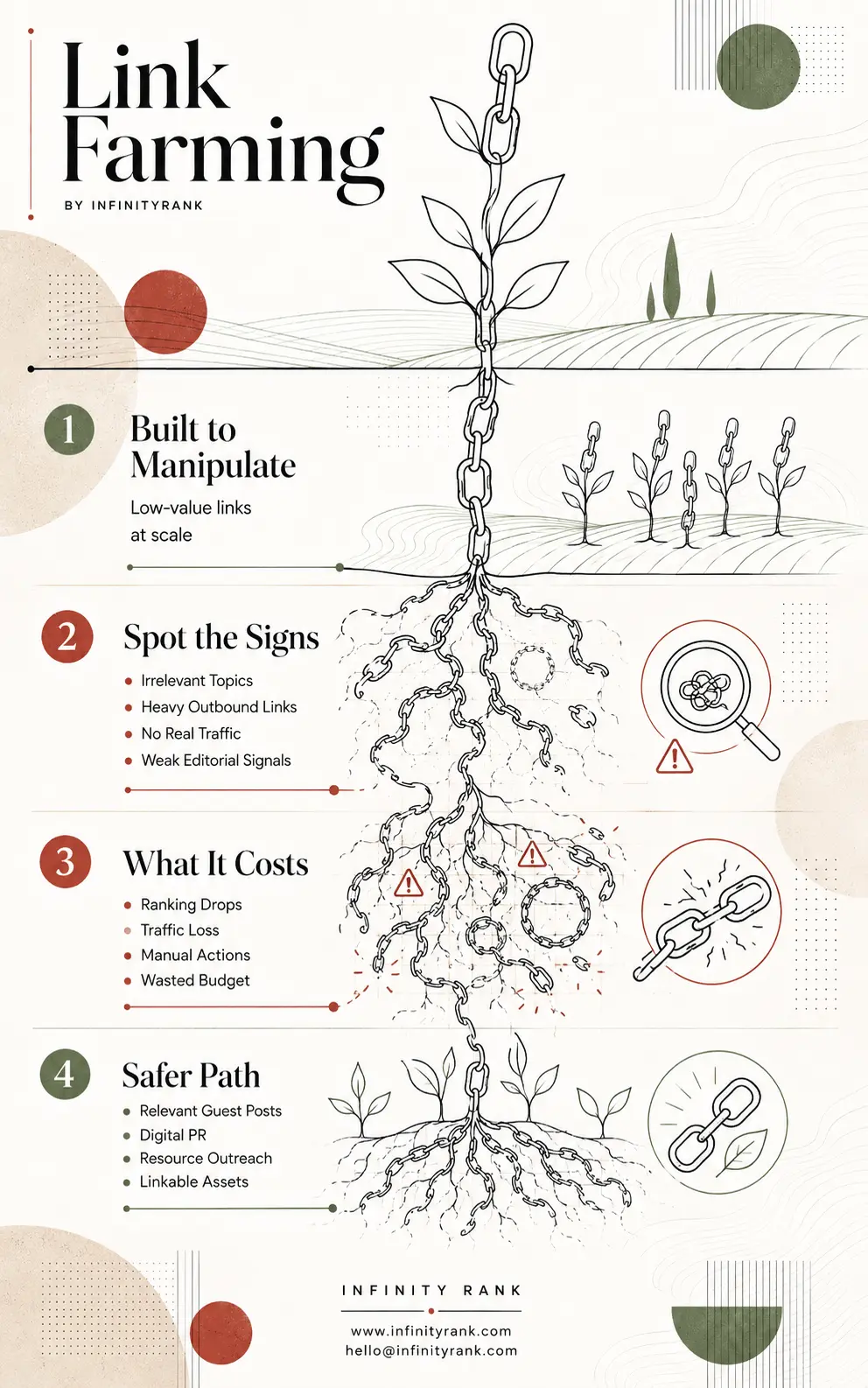
Falling for the trap of automated link networks can cost you your search rankings, your organic traffic, and your entire marketing budget. Instead of risking a permanent manual action from Google, you should always take a safer path built on genuine digital PR, resource outreach, and high-quality content. Use these four core pillars as your daily checklist to keep your optimization strategy completely clean and highly effective.
Why Do People Still Use Link Farms?
People use link farms because they want speed.
Earning quality backlinks takes work. You need useful content, outreach, relationships, assets worth citing, or genuine expertise. Link farms promise the opposite: quick links, low prices, and little effort.
You may see offers like:
- “1,000 backlinks for $50”
- “Boost your DA instantly”
- “Guaranteed SEO backlinks”
- “High-authority link package”
- “Rank faster with our private network”
The offer is usually built around volume, not quality.
That is the first warning sign. In SEO, more links do not automatically mean better rankings. Search engines evaluate link quality, relevance, context, and intent. A small number of strong, relevant backlinks can be more valuable than hundreds of artificial links from weak domains.
Why Link Farming Is Risky for SEO
Link farming creates risk because it is built around artificial link signals. Google’s spam policies classify links created primarily to manipulate rankings as link spam. That includes excessive link exchanges, automated link creation, low-quality directory links, keyword-rich links in low-value placements, and links created mainly for ranking signals.
The risk is not always a dramatic manual penalty. Sometimes Google simply ignores or neutralizes spammy links. Sometimes rankings decline because the site loses artificial link value. In more serious cases, a site can receive a manual action for unnatural links.
The outcome depends on the pattern, scale, intent, and history of the backlink profile.
What Can Happen If You Use Link Farms?
1. Rankings Can Drop
If rankings were supported by artificial links, those rankings can disappear when Google devalues the links. This can look like a sudden traffic drop, but the real issue is that the site was relying on weak signals.
2. You Can Lose Organic Traffic
Ranking drops usually lead to traffic loss. For businesses that rely on organic leads, this can hit revenue directly.
3. You Can Trigger a Manual Action
A manual action happens when a human reviewer determines that a site violates Google’s search spam policies. If link schemes are involved, the affected pages or site may lose visibility until the issue is fixed and a reconsideration request is approved.
4. You Waste SEO Budget
Cheap backlinks are not cheap if they have to be audited, removed, disavowed, or replaced later. Cleanup work often costs more than doing proper link building from the beginning.
5. You Damage Brand Trust
Spammy backlink placements can make a serious business look careless. If your company appears beside casino, crypto, adult, payday loan, or unrelated spam content, it does not help your reputation.
Why Some Link Farms Look Legitimate
Not every link farm looks like obvious spam.
Some use expired domains that already have backlinks. Some publish content across many niches to look active. Some display third-party SEO metrics such as Domain Authority, Domain Rating, Trust Flow, or traffic estimates.
Those metrics can be useful, but they are not proof of quality.
A site can have a high DR or DA and still be risky if:
- Its organic traffic is declining or nonexistent
- It ranks for irrelevant keywords
- Most posts are written for link placement
- Every article includes commercial outbound links
- Topics are scattered across unrelated industries
- The site has no real brand, audience, or editorial identity
- It links to obvious spam categories
Do not judge a backlink opportunity by one metric. A high authority score does not cancel out poor relevance, bad content, or suspicious outbound-link patterns.
How to Spot a Link Farm
Use this checklist before accepting, buying, or approving a backlink placement.
1. Check Topical Relevance
A relevant site should make sense for your industry.
If you run a SaaS company, a backlink from a SaaS, marketing, technology, business, or startup publication may be relevant. A link from a random lifestyle blog that also covers casino bonuses, CBD, locksmiths, crypto wallets, and pet food is not a strong sign.
Ask one question:
Would this site still make sense as a referral source if Google did not exist?
If the answer is no, be careful.
2. Review Outbound Links
Look at recent articles and inspect where they link.
Red flags include:
- Multiple commercial links in every post
- Links to unrelated industries
- Exact-match anchor text repeated often
- Links placed awkwardly in generic paragraphs
- Too many outbound links to client-style pages
- Obvious paid-link footprints
A normal publication links because the source supports the content. A link farm links because someone paid for the placement.
3. Look at Organic Traffic
Use tools like Google Search Console for your own site and third-party SEO tools such as Ahrefs, Semrush, Moz, or Majestic for external domains.
Be cautious if a site has:
- Thousands of referring domains but little organic traffic
- A sharp traffic decline
- Rankings only for irrelevant or low-value keywords
- No visible search presence despite high authority metrics
Traffic data is not perfect, but it helps expose sites that look stronger than they are.
4. Inspect Content Quality
Read several articles.
Weak signs include:
- Generic introductions
- No original insight
- No named experts
- No data, examples, or screenshots
- Rewritten content from other sites
- Repetitive structure across posts
- Articles that exist only to hold a link
If the content would not help a real reader, the backlink is weak.
5. Check Author and Editorial Signals
A trustworthy site usually has some visible accountability.
Look for:
- Real author names
- Author bios
- Editorial guidelines
- Contact information
- About page
- Clear niche focus
- Real social or brand presence
A site with no identity, no standards, and no audience is not a strong backlink source.
6. Watch for Network Patterns
Some link farms operate as networks.
Signs include:
- Similar website templates
- Similar author names
- Repeated hosting or ownership footprints
- Cross-linking between the same domains
- Identical content formats
- Similar “write for us” pages
- Same pricing sheets across multiple sites
One suspicious site is a risk. A connected group of suspicious sites is a bigger risk.
Link Farm Red Flag Checklist
| Red Flag | What It Usually Means | Risk Level |
| Site covers many unrelated niches | Built to sell links across industries | High |
| Every post links to commercial pages | Paid placement footprint | High |
| High DR/DA but no traffic | Inflated or expired-domain authority | High |
| Exact-match anchors everywhere | Manipulative anchor text strategy | High |
| No author or editorial information | Low accountability | Medium |
| Generic AI-style content | Thin content built for volume | Medium |
| Large outbound link count | Link-selling pattern | High |
| Sudden traffic collapse | Possible algorithmic devaluation | High |
| Links to casino, adult, payday, or spam niches | Poor neighborhood risk | High |
| No real audience or brand presence | Weak referral value | Medium |
Link Farm vs PBN vs Low-Quality Guest Post Site
These terms are related, but they are not identical.
Link Farm
A link farm is mainly built to create outbound links at scale. It may be one site or a network of sites. The content is usually thin, broad, and created around link placement.
Private Blog Network
A private blog network, or PBN, is a group of websites controlled by the same person or company and used to pass links to target sites. PBNs often use expired domains to inherit existing backlink authority.
A PBN can function like a link farm if the network exists mainly to manipulate rankings.
Low-Quality Guest Post Site
A low-quality guest post site accepts almost any article as long as payment is made. It may not be part of a formal network, but it can still create the same risks if it publishes weak content and irrelevant outbound links.
The label matters less than the pattern. If the site exists mainly to sell links, avoid it.
What to Do If You Already Have Link Farm Backlinks
Do not panic. A few spammy backlinks do not automatically destroy a site. Many websites attract junk links naturally over time.
The right response depends on scale, intent, and risk.
1. Run a Backlink Audit
Start with Google Search Console, then compare with third-party tools if available.
Review:
- Referring domains
- Anchor text
- Linked pages
- New and lost backlinks
- Spammy domain patterns
- Traffic drops around known link-building campaigns
- Manual action notifications in Search Console
Export the data and group links by domain quality, topic, anchor text, and placement type.
2. Separate Bad Links From Normal Noise
Not every weak backlink needs action.
You should be more concerned when you find:
- Paid link campaigns you or a vendor created
- Large numbers of artificial links
- Exact-match commercial anchors
- Links from obvious link networks
- Links from hacked or injected pages
- Links from irrelevant sites built for guest post sales
- A manual action warning in Google Search Console
Random scraper links, strange foreign domains, and occasional spam mentions are usually not worth overreacting to.
3. Try to Remove What You Control
If the links came from a vendor, ask for a list of placements and request removal where possible.
If you bought the links directly, contact the site owners and ask for removal or proper qualification with rel="nofollow" or rel="sponsored" where relevant.
Keep records of outreach. If a manual action exists, documentation can help support a reconsideration request.
4. Use the Disavow Tool Only When Necessary
Do not blindly disavow every link that looks weak.
Google’s disavow tool is an advanced feature. It should be used cautiously because incorrect use can harm search performance. In most cases, Google says it can assess which links to trust without extra guidance.
Disavow only when both conditions are true:
- You have a considerable number of spammy, artificial, or low-quality backlinks.
- Those links have caused, or are likely to cause, a manual action.
If you are unsure, get a proper backlink audit before uploading a disavow file.
5. Rebuild With Better Links
Cleaning up bad links is only half the job. You also need stronger positive signals.
Focus on:
- Relevant guest posting
- Digital PR
- Expert commentary
- Resource page outreach
- Original research
- Case studies
- Industry partnerships
- Linkable assets such as statistics pages, tools, calculators, and visual guides
A clean backlink profile needs quality, relevance, and consistency.
Safe Alternatives to Link Farming
Link farming is a shortcut. Real link building is a system.
Here are safer alternatives.
Guest Posting on Relevant Sites
Guest posting still works when the site is relevant, the content is useful, and the link makes editorial sense.
Avoid mass guest post vendors selling placements on any site that accepts payment. Look for publications with real audiences and clear editorial standards.
Digital PR
Digital PR earns links by giving journalists, bloggers, and publishers something worth citing.
Examples include:
- Original data
- Expert quotes
- Industry surveys
- Trend analysis
- Local business insights
- Campaigns tied to current news
This is harder than buying links, but the links are usually stronger.
Resource Page Outreach
Many websites maintain curated lists of tools, guides, suppliers, charities, or educational resources. If your page genuinely belongs on one of those lists, outreach can earn relevant backlinks.
The key is fit. Do not pitch every resource page on the internet. Pitch pages where your content improves the list.
Partnerships and Associations
Suppliers, clients, associations, podcasts, events, chambers of commerce, and industry groups can all create natural link opportunities.
These links often come from real business relationships, which makes them harder for competitors to copy.
Linkable Content Assets
Publish content people have a reason to cite.
Examples include:
- Statistics pages
- Original research
- Industry benchmarks
- Free tools
- Templates
- Calculators
- Comparison guides
- Case studies
- Visual explainers
If a page solves a real problem or contains original information, it has a much better chance of earning natural links.
What a Safe Backlink Opportunity Looks Like
A safe backlink opportunity usually has most of these signals:
- The site is topically relevant
- The page has a real reason to link to you
- The content is useful without the backlink
- The site has organic visibility
- The audience overlaps with your target market
- The link is placed naturally in context
- The anchor text is not forced
- The site does not sell links openly
- The outbound links are reasonable and relevant
- The publisher has visible editorial standards
No single signal proves a link is safe. You need to evaluate the whole site and the specific page.
Final Thoughts
Link farming is not a link-building strategy. It is a ranking manipulation tactic with poor long-term value.
The danger is not just a possible penalty. The bigger problem is that link farms create a weak foundation. They inflate backlink numbers without building trust, relevance, authority, or real referral value.
If you want rankings that last, avoid mass backlink packages and suspicious placement networks. Build links from sites that make sense for your niche, publish content worth citing, and treat backlink quality as a business asset rather than a numbers game.
A few strong, relevant backlinks are worth more than hundreds of artificial links from sites built only to sell them.
FAQs
What is link farming in SEO?
Link farming is the practice of creating or using websites mainly to generate backlinks for ranking manipulation. These sites usually publish low-value content and link to many unrelated websites.
Are link farms against Google’s guidelines?
Yes. When links are created primarily to manipulate search rankings, they fall under Google’s definition of link spam.
Can link farming cause a Google penalty?
Yes, especially if the backlink pattern is large, artificial, and intentional. In some cases, Google may ignore the links instead. In more serious cases, a site can receive a manual action.
Do link farms still work?
They may create temporary movement in some cases, but they are not reliable. Search engines are built to detect and devalue manipulative link patterns. Any short-term gain can disappear once the links are ignored or penalized.
How can I check if a backlink comes from a link farm?
Check topical relevance, outbound link patterns, organic traffic, author credibility, content quality, anchor text, and whether the site links to many unrelated industries. If the site exists mainly to publish paid links, avoid it.
Should I disavow link farm backlinks?
Only when necessary. Disavow links if you have a considerable number of spammy, artificial, or low-quality backlinks and they have caused, or are likely to cause, a manual action. Do not disavow links blindly based only on third-party toxic-link scores.
What is the difference between link farming and a PBN?
A link farm is any site or network built mainly to generate links. A PBN is a privately controlled network of sites used to link to target websites. A PBN can become a link farm when it exists mainly to manipulate rankings.
What should I do instead of link farming?
Use legitimate link-building methods: digital PR, relevant guest posting, resource page outreach, partnerships, expert commentary, original research, and linkable content assets.