Niche relevant backlinks are links from websites, pages, or publications that are closely related to your industry, audience, or topic.
They matter because relevance gives a backlink context. A link from a respected cybersecurity blog to a SaaS security platform makes sense. A link from a random coupon directory, casino blog, or general guest-post farm does not.
That does not mean every niche-related backlink is valuable. Relevance is only one part of link quality. The linking page still needs to be credible, indexed, useful, and editorially placed. A backlink can be topically relevant and still be low quality, manipulative, or risky.
This guide explains what niche relevant backlinks are, how to evaluate them, how to build them without relying on spam tactics, and which link sources should be avoided.
What Are Niche Relevant Backlinks?
A niche relevant backlink is a link from a page that has a clear topical relationship with the page it links to.
For example:
- A dental marketing guide linking to a dental SEO service page
- A SaaS integration marketplace linking to a software product
- A home renovation blog linking to a plumbing or drainage company
- A legal association resource page linking to a specialist law firm
- A cybersecurity publication linking to a threat research report
The connection can happen at different levels:
- Site-level relevance: The entire website covers your industry.
- Page-level relevance: The specific page discusses a topic related to yours.
- Audience relevance: The linking site serves the same people you want to reach.
- Contextual relevance: The link appears inside content where it naturally helps the reader.
Page-level and contextual relevance usually matter more than broad site-level relevance. A general business website can still provide a useful niche-relevant link if the specific article is about your industry and the link genuinely supports the content.
Niche Relevant Backlinks: Earn Targeted Authority and Traffic
Chasing random, high-authority links from unrelated websites is a quick way to waste your SEO budget and trigger spam penalties. To truly satisfy search engines, your link profile needs deep topical alignment. When you secure backlinks from sites that share a related topic and an overlapping target audience, you send a clear signal to Google that your content is an expert resource in your industry. This straightforward guide breaks down five essential steps to capture safe, high-performing placements that naturally elevate your rankings.
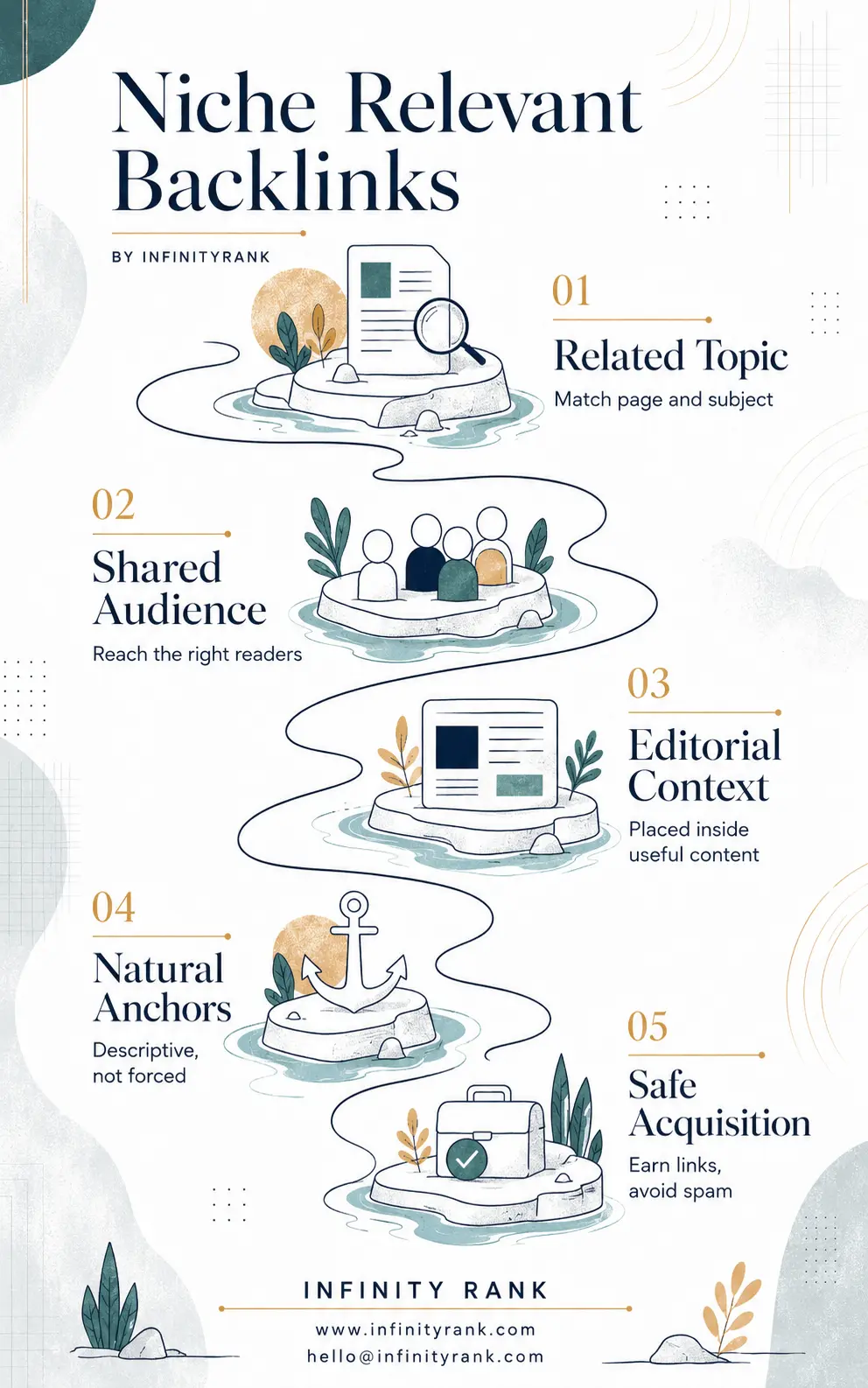
Securing the best link building results comes down to matching your subject matter with proper editorial context and completely natural, descriptive anchor text. By prioritizing a clean and safe acquisition process instead of relying on manufactured networks, you shield your website from sudden algorithm adjustments. Use these five core pillars as your strategic blueprint to build lasting organic trust and funnel qualified readers directly to your business.
Why Niche Relevant Backlinks Matter for SEO
Backlinks can help search engines discover pages, understand relationships between topics, and evaluate how pages are referenced across the web. But not all backlinks send the same signal.
A relevant link is stronger because it gives search engines and users a clearer reason for the connection.
If a page about technical SEO links to a crawlability guide, the relationship is obvious. If that same page links to an unrelated gambling page, the link looks unnatural. Relevance helps separate useful citations from forced placements.
Niche relevant backlinks can help with:
- Topical authority: They connect your site to other sources in the same subject area.
- Qualified referral traffic: Visitors from relevant pages are more likely to care about your offer.
- Better link context: The surrounding content helps clarify why the link exists.
- Safer link acquisition: Editorially earned relevant links are less risky than mass-produced links from unrelated sites.
- Stronger brand visibility: Repeated mentions across industry publications can make your business easier to recognize.
The key point: relevance does not automatically equal quality. A relevant backlink still needs to pass basic quality checks.
What Makes a Backlink Truly Niche-Relevant?
A backlink is not niche-relevant just because the site has one related keyword somewhere on the page. You need to check the full context.
Use these criteria.
1. The Linking Page Covers a Related Topic
The linking page should discuss a subject that overlaps with your page.
A link to an ecommerce SEO guide from an article about ecommerce platform migration makes sense. A link from a generic “top 100 websites” page does not offer the same context.
Ask:
- Is the page actually about my niche?
- Would a reader expect to see my page linked here?
- Does the link add useful information?
If the answer is no, the link is probably forced.
2. The Website Serves a Similar Audience
A site does not need to be a direct competitor or identical business. It should serve people with overlapping interests or needs.
For example, a B2B accounting software company could earn relevant links from:
- SaaS finance blogs
- Startup finance publications
- CFO communities
- Accounting workflow guides
- Integration partner pages
Those audiences are different, but they are connected by the same problem space.
3. The Link Is Editorially Placed
The best links appear because the page author needed a useful reference.
Editorial placement usually means the link is inside the main content, surrounded by relevant text, and useful to the reader.
Riskier placements include:
- Footer-wide links
- Sidebar blogrolls
- Paid author bio links
- Forum signatures
- Mass directory profiles
- Template links repeated across many pages
A contextual link inside a useful article is usually stronger than a sitewide link with no explanation.
4. The Anchor Text Is Natural
Anchor text is the clickable text used in a link. It should describe the destination page without looking manipulated.
Good anchor text:
- “technical SEO audit checklist”
- “study on local search behavior”
- “guide to SaaS onboarding metrics”
- “Google’s link spam policies”
Risky anchor text:
- “best SEO agency USA”
- “buy backlinks cheap”
- “top dental SEO company”
- “emergency plumber near me”
Exact-match commercial anchors can look unnatural when used too often. A healthy backlink profile usually includes a mix of branded anchors, partial-match anchors, page titles, plain URLs, and natural descriptive phrases.
5. The Linking Site Has Real Quality Signals
Do not judge a link only by Domain Authority, Domain Rating, or similar third-party metrics. These metrics can help with screening, but they are not Google ranking metrics.
Check the site manually:
- Does it have real organic traffic?
- Is the content useful or generic?
- Are authors credible?
- Are articles edited?
- Is the site overloaded with sponsored posts?
- Are outbound links relevant or random?
- Does the site rank for anything meaningful?
- Would you want your brand mentioned there even without SEO value?
If the site exists mainly to sell links, avoid it.
Niche Relevant Backlinks vs High-Authority Backlinks
A high-authority backlink is not automatically better than a relevant backlink.
A link from a very large website can be valuable, but if the page has no topical relationship with your business, the value may be limited. A smaller niche publication with a loyal audience can sometimes be more useful than a generic high-DR site.
The best backlink has both:
- Strong topical relevance
- Real authority and trust
- Editorial placement
- Natural anchor text
- Referral traffic potential
A practical rule:
A relevant link from a credible niche site is usually better than an unrelated link from a high-metric site.
Metrics help you filter prospects. They should not make the decision for you.
Safe vs Risky Niche Backlink Tactics
Niche link building can be done properly, or it can turn into link spam. The difference is intent, placement, disclosure, and quality.
Safer Tactics
These tactics are generally safer when the link is earned, useful, and editorially placed:
- Digital PR campaigns
- Original research and data studies
- Expert quotes in industry articles
- Resource page inclusion where your page genuinely helps
- Partner pages and integration pages
- Podcast appearances with show notes
- Industry association profiles
- Case studies with vendors or clients
- Broken link replacement with a genuinely relevant resource
- High-quality guest contributions on edited publications
Risky Tactics
These tactics become risky when they are scaled, paid, undisclosed, irrelevant, or created mainly to manipulate rankings:
- Paid guest posts that pass ranking signals
- Low-quality directories
- Mass forum profile links
- Private blog networks
- Link exchanges at scale
- Exact-match anchor campaigns
- Sponsored articles without proper link attributes
- Irrelevant “write for us” websites
- AI-generated guest post farms
- Comment spam
- Widget or footer links with optimized anchors
If a link exists only because money, exchange, or automation created it, treat it carefully. Sponsored or paid links should be qualified properly with the right link attribute.
How to Build Niche Relevant Backlinks
The goal is not to collect as many links as possible. The goal is to earn links from pages that make sense.
Here are the main methods that still work when done properly.
1. Create Linkable Assets for Your Niche
A linkable asset is a page worth citing.
Most businesses struggle with backlinks because they only try to build links to service pages. Service pages can earn links, but they are usually commercial. Editors are more likely to link to useful resources.
Good linkable assets include:
- Original industry data
- Benchmark reports
- Templates
- Calculators
- Comparison guides
- Checklists
- Statistics pages
- Technical explainers
- Case studies with proof
- Visual frameworks
- Free tools
- Glossaries for complex topics
Example:
A cybersecurity company could publish a report on phishing patterns across specific industries. That gives journalists, bloggers, and software reviewers a reason to cite the page.
A drainage company could publish a guide explaining local sewer responsibility rules, inspection requirements, and maintenance costs. Local property sites, estate agents, and housing blogs could reference it.
Strong assets reduce the need for forced outreach. They give people a real reason to link.
2. Use Broken Link Building
Broken link building works when you find a dead page on a relevant website and offer a useful replacement.
The process:
- Find relevant websites in your niche.
- Use a crawler or SEO tool to identify broken external links.
- Check what the dead page used to cover.
- Match it with one of your existing resources or create a better replacement.
- Contact the site owner with a short, useful message.
Do not pitch an unrelated page just because the target link is broken. The replacement must match the original intent.
A good outreach message is direct:
“Your article on ecommerce migration links to a page about technical SEO checklists that now returns a 404. We have a current checklist covering crawlability, indexation, redirects, and structured data. It may be a useful replacement.”
That is better than a generic “I loved your article” email.
3. Get Included on Real Resource Pages
Resource pages can be useful, but only if they are curated and relevant.
Good resource pages usually have:
- A clear topic
- Human editorial selection
- Useful descriptions
- Limited, relevant outbound links
- A real audience
- A reason to exist beyond selling links
Bad resource pages usually have:
- Hundreds of random links
- No editorial standards
- Thin descriptions
- Keyword-stuffed listings
- Paid inclusion with no disclosure
- Irrelevant categories
Search examples:
intitle:resources "your niche""useful resources" "your industry""recommended tools" "your niche""industry associations" "your service""helpful links" "your location" "your niche"
When pitching, explain why your page improves the list. Do not just ask for a backlink.
4. Contribute Expert Commentary
Expert commentary can earn niche-relevant links when you provide specific, useful insight.
This works well for:
- Industry roundups
- Journalist requests
- Podcast interviews
- Research articles
- Trade publications
- Niche newsletters
- B2B blogs
Generic quotes rarely earn strong links. Editors want useful detail.
Weak quote:
“SEO is very important for businesses that want to grow online.”
Better quote:
“For local service businesses, the most overlooked SEO issue is not keywords. It is inconsistent location architecture. If every city page has the same copy with only the city name changed, the site usually struggles to build durable local visibility.”
Specificity earns trust. Trust earns links.
5. Use Guest Posting Carefully
Guest posting is not automatically bad. Low-quality guest posting is the problem.
A good guest post is written for a real audience, edited by a real publication, and useful even if the link did not exist.
Before pitching a guest post, check:
- Does the site have editorial standards?
- Does it publish real experts?
- Does it reject weak submissions?
- Does the site rank for relevant keywords?
- Are outbound links natural?
- Is the content written for readers, not search engines?
- Is payment involved? If yes, are links qualified properly?
Avoid sites that accept every submission, publish thin articles, or openly sell “dofollow guest posts.” Those are not authority signals. They are link-selling footprints.
Good guest posting topics are narrow and practical:
- “How SaaS Teams Should Audit Integration Pages Before a Migration”
- “What Dental Clinics Get Wrong About Local Landing Pages”
- “A Technical SEO Checklist for Shopify Plus Replatforming”
Bad topics are generic:
- “Why SEO Is Important”
- “Top Benefits of Digital Marketing”
- “How to Grow Your Business Online”
If the article could appear on any website in any industry, it is probably too broad.
6. Build Partner and Supplier Links
Partnership links are often overlooked.
Depending on the business, relevant links may come from:
- Software integration partners
- Local suppliers
- Manufacturers
- Dealers
- Certification bodies
- Trade associations
- Event sponsors
- Training providers
- Professional networks
- Client case studies
These links work because there is a real-world relationship behind them.
Examples:
- A SaaS company gets listed in an integration partner directory.
- A plumbing company is listed on a local supplier’s certified installer page.
- A marketing agency is mentioned in a client case study.
- A legal firm is listed in a professional association directory.
These links are usually more defensible than cold guest-post placements because the relationship is legitimate.
7. Use Forums and Communities for Visibility, Not Link Manipulation
Reddit, Quora, niche forums, Slack groups, Discord communities, and industry communities can send useful traffic. But they are not reliable link equity channels.
Many community links are nofollow, UGC, removed by moderators, or ignored by users if they look promotional.
Use communities to:
- Answer real questions
- Build authority
- Learn audience pain points
- Share useful resources when relevant
- Find content ideas
- Build relationships with writers and operators
Do not use them for:
- Signature spam
- Repeated self-promotion
- Exact-match anchor links
- Fake accounts
- Copy-paste answers
- “Helpful” comments that exist only to drop a link
A community link should be useful even if it has no SEO value.
8. Run Digital PR Around Niche Data
Digital PR works best when the story is specific enough for your niche but interesting enough for publishers.
Examples:
- A SaaS company analyzes onboarding drop-off patterns across 500 signups.
- A cybersecurity firm publishes a quarterly report on phishing subject lines.
- A property services company maps the most common drainage issues by city.
- An ecommerce brand compares return rates across product categories.
- A legal firm publishes data on contract disputes by industry.
Good digital PR needs a clear angle:
- What changed?
- Why does it matter?
- Who is affected?
- What can readers do with the information?
Do not publish fake data, tiny samples, or weak surveys just to attract links. Thin data damages trust.
How to Evaluate a Niche Relevant Backlink Prospect
Before pursuing a link, score the opportunity.
| Factor | What to Check | Score |
| Topical relevance | Is the page clearly related to your niche? | 0–3 |
| Page quality | Is the page useful, indexed, and written for readers? | 0–3 |
| Site quality | Does the site have real traffic, rankings, and editorial standards? | 0–3 |
| Link placement | Will the link appear naturally inside relevant content? | 0–3 |
| Anchor text risk | Is the anchor natural, branded, or descriptive rather than forced? | 0–3 |
| Outbound link profile | Does the page avoid linking to random or spammy sites? | 0–3 |
| Referral potential | Could the link send qualified visitors? | 0–3 |
A score above 15 is usually worth reviewing seriously. A score below 10 is usually weak unless there is a strong brand or relationship reason.
This scoring model is not a ranking formula. It is a decision tool. It helps prevent bad links from entering your campaign.
Red Flags to Avoid
Avoid backlink opportunities with these signs:
- The site sells “dofollow links” publicly.
- Every article links to commercial pages.
- The content has no real audience.
- The site covers every topic: crypto, pets, law, casinos, SaaS, fashion, and plumbing.
- Authors are fake or missing.
- The site has no clear editorial policy.
- Organic traffic has collapsed.
- The link must use exact-match anchor text.
- The publisher refuses to qualify sponsored links.
- The page already links to unrelated or spammy websites.
- The article is obviously AI-generated filler.
- The site exists only for guest posts.
One strong relevant link is worth more than dozens of questionable links that create cleanup work later.
Anchor Text Guidelines for Niche Relevant Backlinks
Anchor text should help users understand what they will get after clicking.
Use a natural mix:
- Brand anchors: “Infinity Rank”
- URL anchors: infinityrank.com
- Page title anchors: “Niche Relevant Backlinks Guide”
- Descriptive anchors: “guide to evaluating backlink relevance”
- Partial-match anchors: “building relevant backlinks”
- Citation anchors: “Google’s link spam policies”
Avoid overusing exact-match commercial anchors such as:
- “best link building agency”
- “buy niche relevant backlinks”
- “SEO services USA”
- “cheap backlinks”
A few exact-match anchors across a natural profile may not be a problem. A pattern of repeated commercial anchors from guest posts, directories, and forums is a problem.
How to Build Niche Backlinks in a Small Industry
Small niches are harder because there are fewer obvious websites to target. The solution is to expand by audience, problem, and adjacent topics.
For example, a drainage company is not limited to drainage blogs. It can target:
- Property maintenance websites
- Local real estate blogs
- Landlord resources
- Construction suppliers
- Municipal information pages
- Home insurance guides
- Facility management publications
- Local business directories with editorial review
A B2B SaaS company can target:
- Integration partners
- Workflow consultants
- Industry newsletters
- Product comparison sites
- Technical documentation pages
- Developer communities
- Customer case studies
- SaaS operations blogs
A small niche usually has fewer link prospects, but the prospects are often more meaningful. The mistake is expanding into unrelated websites just to hit a link target.
How Long Do Niche Relevant Backlinks Take to Work?
There is no fixed timeline.
Some links can lead to referral traffic quickly. Ranking impact is harder to isolate because search performance depends on many factors, including content quality, technical SEO, competition, internal linking, search intent, and existing authority.
As a practical expectation, review performance over several months instead of days or weeks.
Track:
- New referring domains
- Linking-page relevance
- Whether the linking pages are indexed
- Referral traffic
- Ranking movement for the target page
- Organic traffic to linked pages
- Assisted conversions
- Anchor text distribution
- Link retention
- Changes in impressions and clicks in Google Search Console
Do not judge a link campaign only by the number of backlinks built. A campaign that earns fewer but better links can outperform a campaign that produces many weak placements.
How to Monitor Your Backlink Profile
Use Google Search Console and third-party tools to monitor backlink profile growth, but do not rely on one tool alone. Different tools discover links at different speeds and use different databases.
Monitor for:
- Sudden spikes from irrelevant domains
- Repeated exact-match anchors
- Sitewide links
- Links from foreign-language spam sites
- Links from hacked pages
- Lost high-quality links
- New links to outdated or redirected pages
- Overdependence on one link type
A natural backlink profile usually has variety. It includes branded mentions, citations, partner links, resource links, editorial links, and some nofollow or UGC links.
That is normal. A profile made only of keyword-rich guest post links is not normal.
Should You Buy Niche Relevant Backlinks?
Buying links for SEO is risky when the links are intended to pass ranking signals.
If a placement is paid, sponsored, advertorial, or part of a commercial arrangement, it should be handled transparently and qualified with the appropriate link attribute. Paying for exposure, PR, sponsorship, or advertising is not the same as buying ranking manipulation.
The problem is not payment by itself. The problem is paying for links that are presented as editorial votes when they are not.
Before paying for any placement, ask:
- Is this an advertisement or sponsorship?
- Will the link be properly qualified?
- Does the publication disclose sponsored content?
- Is the audience relevant?
- Would this placement make sense without SEO value?
- Is the content useful enough to deserve publication?
If the answer is no, skip it.
Niche Relevant Backlink Examples
Here are practical examples by industry.
SaaS
Good links:
- Integration partner pages
- API documentation references
- SaaS comparison articles
- Product-led growth blogs
- Customer case studies
- Developer tutorials
Weak links:
- Generic guest posts on unrelated business blogs
- “Top software” directories with no review process
- Forum profiles with exact-match anchors
Legal
Good links:
- Bar association resources
- Legal education articles
- Local business publications
- Specialist legal commentary
- University or nonprofit resources where relevant
Weak links:
- Paid legal directory spam
- Generic “write for us” blogs
- Keyword-rich footer links
Home Services
Good links:
- Local supplier pages
- Trade association listings
- Property maintenance guides
- Local news mentions
- Real estate and landlord resources
Weak links:
- Random coupon directories
- Mass city directory pages
- Comment spam on DIY blogs
Ecommerce
Good links:
- Product reviews
- Buying guides
- Manufacturer pages
- Gift guides
- Niche blogs
- Comparison content
Weak links:
- Thin affiliate sites
- Paid review farms
- Irrelevant lifestyle blogs with no audience fit
Common Mistakes in Niche Link Building
Mistake 1: Chasing Metrics Instead of Relevance
High DR does not fix poor topical fit. A link should make sense before metrics are considered.
Mistake 2: Using Too Many Exact-Match Anchors
Aggressive anchor text is one of the easiest ways to make a backlink profile look manipulated.
Mistake 3: Treating Every Directory as Valuable
Most directories are weak. Only use curated directories with a real audience, editorial review, and clear topical relevance.
Mistake 4: Publishing Generic Guest Posts
Generic guest posts rarely build authority. They look like filler and often appear on sites that publish anything.
Mistake 5: Ignoring Referral Traffic
A good niche backlink should have at least some chance of sending relevant visitors. If no real person would click the link, question why it exists.
Mistake 6: Building Links Before Fixing the Target Page
Do not build links to a weak page. Improve the content, search intent match, internal links, page speed, and conversion path first.
Final Checklist Before Building a Niche Relevant Backlink
Before you pursue a link, ask:
- Is the linking page relevant to my topic?
- Is the website credible in its niche?
- Is the link useful for readers?
- Is the placement editorial?
- Is the anchor text natural?
- Is the page indexed?
- Does the site have real visibility or audience value?
- Are outbound links clean and relevant?
- Is there any payment, sponsorship, or exchange involved?
- If yes, will the link be qualified properly?
- Would I still want this mention if it had no SEO value?
If the link only makes sense for manipulating rankings, do not build it.
Final Thoughts
Niche relevant backlinks are valuable because they connect your website to the right topics, audiences, and conversations. But relevance alone is not enough.
A good backlink should be relevant, editorial, useful, and defensible. It should appear on a page where the link helps the reader. It should use natural anchor text. It should come from a site that has real standards.
The safest long-term strategy is simple: create assets worth citing, build relationships in your industry, pitch pages that genuinely improve the publisher’s content, and avoid shortcuts that exist only to manufacture ranking signals.
That approach takes longer than buying bulk links. It also leaves you with a clean backlink profile and fewer problems to fix later.
FAQs
What are niche relevant backlinks?
Niche relevant backlinks are links from websites or pages that are closely related to your industry, topic, audience, or service. The strongest examples are links placed naturally inside useful content where the link helps the reader understand the subject better.
Why are niche relevant backlinks important?
They give links better context. A relevant backlink can help search engines and users understand how your page fits into a topic. It can also send more qualified referral traffic than a link from an unrelated website.
Are niche relevant backlinks always good?
No. A backlink can be relevant and still be low quality. Avoid links from spammy directories, guest-post farms, private blog networks, and pages with unnatural outbound links.
How do I find niche relevant backlink opportunities?
Start with industry blogs, resource pages, trade associations, partner pages, supplier websites, podcasts, journalist requests, broken links, and original research campaigns. Expand into adjacent audiences when your niche is small.
Is guest posting safe for niche backlinks?
Guest posting can be safe when the article is useful, editorially reviewed, and written for a real audience. It becomes risky when it is paid, scaled, low quality, or built mainly to pass ranking signals.
Should I use exact-match anchor text?
Use exact-match anchors sparingly. Natural backlink profiles usually include branded anchors, page titles, URLs, partial-match anchors, and descriptive text. Repeated commercial exact-match anchors can look manipulative.
How long does it take for niche backlinks to affect SEO?
There is no fixed timeline. Review performance over several months and track rankings, impressions, referral traffic, link retention, and organic growth. Backlinks work alongside content quality, technical SEO, internal linking, and competition.
Are directory backlinks worth it?
Some are. Curated, niche-specific directories with editorial review and real users can be useful. Generic directories that exist mainly to sell links should be avoided.
Can forum and community links help SEO?
They can help with visibility, referral traffic, and relationships. Many community links are nofollow or UGC, so they should not be treated as a reliable ranking tactic. Use communities to be useful, not to drop links.
What is the difference between niche relevant backlinks and authority backlinks?
Niche relevant backlinks are judged by topical fit. Authority backlinks are usually judged by the strength or reputation of the linking site. The best links have both relevance and authority, but relevance should not be sacrificed for vanity metrics.