Not every backlink helps SEO.
Some backlinks can support rankings, improve discovery, and send qualified referral traffic. Others do very little. Some can create risk if they are built mainly to manipulate search rankings.
That is why “types of backlinks” should not be treated as a simple list. A nofollow link, a guest post link, a directory link, and a sitewide footer link are not the same kind of thing. One describes a link attribute. One describes how the link was acquired. One describes the source. One describes the placement.
This guide breaks backlink types down properly: by attribute, placement, source, acquisition method, value, and risk. By the end, you will know which backlinks are worth building, which ones are overrated, and which ones should stay out of your link-building strategy.
What Is a Backlink?
A backlink is a link from one website to another.
If another website links to one of your pages, that link is a backlink for your site. Search engines use links to discover pages and to understand relationships between pages. Google also says links can be used as a signal when determining the relevance of pages and finding new pages to crawl.
That does not mean every backlink improves rankings. Google’s ranking systems use many factors and signals, so backlinks should be treated as one part of SEO, not a magic ranking switch.
A strong backlink usually has several qualities:
- It comes from a relevant website.
- It appears on a page that is indexed and useful.
- It is placed naturally within the content.
- It uses sensible anchor text.
- It is not part of a spam network or forced link scheme.
- It can send real users, not just “SEO value.”
Quick Comparison: Main Types of Backlinks
| Backlink Type | Main Value | SEO Value | Risk Level | Best Use |
| Editorial backlinks | Authority and trust | High | Low | Earning links through strong content, data, tools, or expertise |
| Contextual backlinks | Relevance and topical support | High | Low–Medium | Links placed naturally inside relevant content |
| Guest post backlinks | Authority, relevance, referral traffic | Medium–High | Medium | Publishing expert content on relevant sites |
| Digital PR backlinks | Authority and brand visibility | High | Low–Medium | Earning links from news, industry, and media sites |
| Resource page backlinks | Useful citation links | Medium–High | Low | Getting listed as a helpful resource |
| HARO/source quote backlinks | Authority and credibility | Medium–High | Low | Providing expert quotes to journalists and publishers |
| Broken link building links | Replacement value | Medium | Low–Medium | Replacing dead links with relevant resources |
| Directory backlinks | Local or niche discovery | Low–Medium | Medium | Legitimate local citations or industry directories |
| Citation backlinks | Local SEO consistency | Medium for local SEO | Low | Business name, address, phone, and website mentions |
| Nofollow backlinks | Referral traffic and visibility | Low–Medium | Low | Links from large platforms, communities, and editorial sites |
| Sponsored backlinks | Advertising visibility | Low for ranking | Low if qualified | Paid placements that use proper link attributes |
| UGC backlinks | Community visibility | Low | Low–Medium | Forum, comment, and user-generated links |
| Sitewide backlinks | Visibility | Low | High if manipulative | Legitimate partner/footer links used carefully |
| Image backlinks | Attribution and referral traffic | Medium | Low | Original graphics, charts, and visual assets |
| Social/profile backlinks | Discovery and trust signals | Low | Low | Brand profiles and audience navigation |
| Reciprocal backlinks | Partnership visibility | Low–Medium | Medium | Genuine partnerships, not excessive exchanges |
| PBN/link farm backlinks | Artificial ranking manipulation | Unstable | Very High | Avoid |
Essential Types of Backlinks for Search Growth
Building a high-ranking website requires a healthy mix of different link styles rather than relying on just a single source. From premium editorial links earned through high-value content to contextual placements inside trusted guest articles, each link type serves a unique purpose in your search engine optimization strategy. Getting listed in relevant industry directories and web indexes also establishes a solid foundational footprint for your brand. This simple guide breaks down five essential link varieties to help you build a balanced profile that search engines trust.
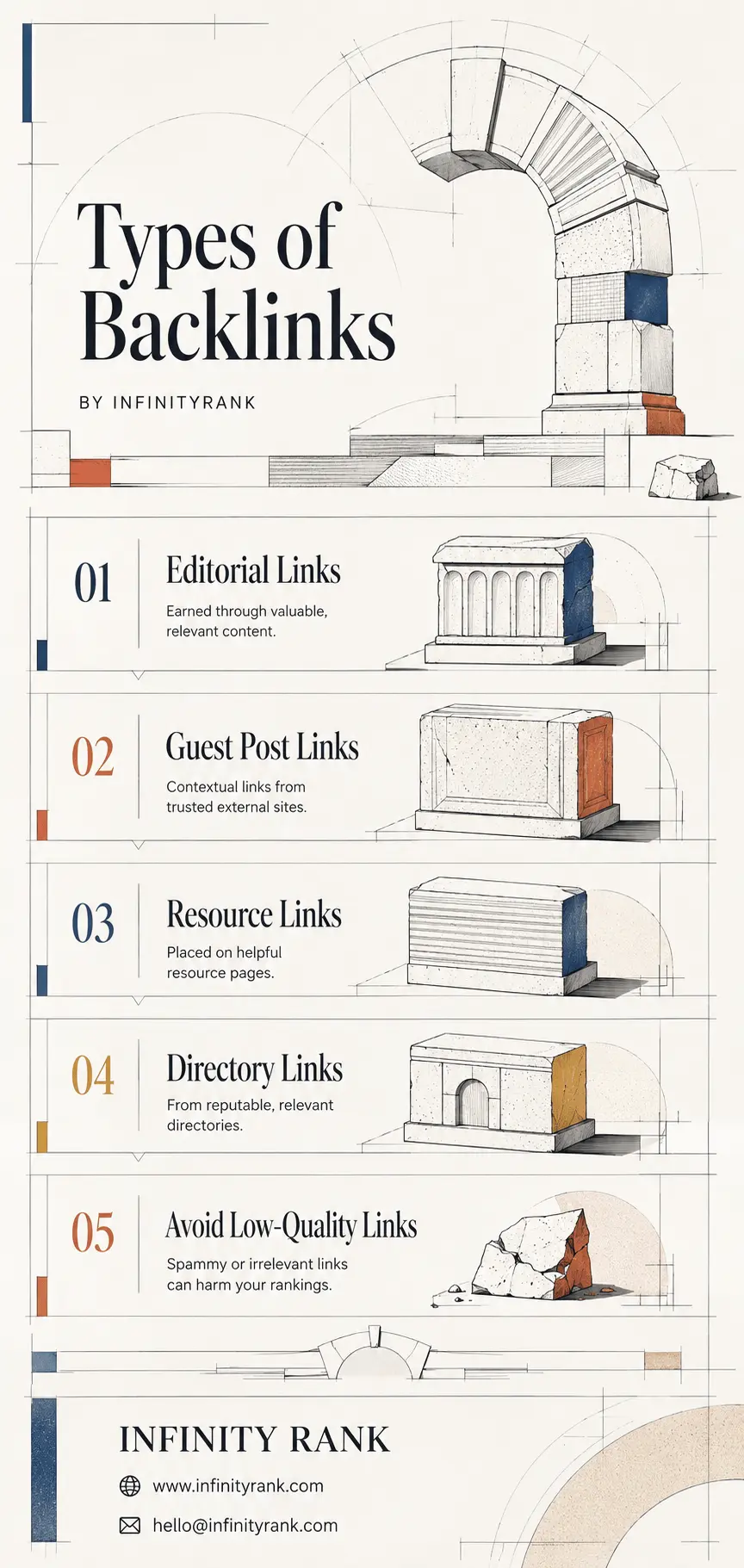
Balancing your approach with nofollow links is just as important, as it helps build broader online visibility while keeping your entire link profile looking completely natural. When you combine these with high-authority placements from reputable, high-trust platforms, your website gains the ultimate competitive edge. Use these five core categories as your strategic checklist to diversify your off-page campaigns and achieve sustainable organic rankings.
1. Editorial Backlinks
Editorial backlinks are links you earn because another site chooses to reference your content.
These links usually appear inside articles, guides, research pieces, news stories, case studies, or expert roundups. They are not forced into the page. The publisher links because your content supports the point they are making.
Example: A marketing publication writes about SaaS SEO and links to your original study on backlink quality.
Editorial backlinks are usually one of the strongest link types because they combine relevance, authority, and natural placement. They are also harder to earn, which is exactly why they matter.
Good ways to earn editorial backlinks include:
- Publishing original data.
- Creating useful tools or templates.
- Producing expert commentary.
- Building genuinely useful guides.
- Sharing case studies with clear evidence.
- Creating assets journalists or bloggers can cite.
Bad approach: publishing generic blog posts and hoping links appear. That rarely works.
2. Contextual Backlinks
A contextual backlink is a link placed within the main body of a relevant page.
This matters because placement affects usefulness. A link inside a paragraph that supports the surrounding topic is usually more valuable than a random sidebar, footer, or author bio link.
Example: An article about local SEO links naturally to your guide on local citations while explaining how business listings affect search visibility.
A good contextual backlink should make sense to the reader. If the sentence would feel incomplete or less useful without the link, that is usually a strong placement.
Contextual backlinks are valuable when they are:
- Relevant to the topic.
- Placed inside useful content.
- Supported by natural anchor text.
- Surrounded by related terms.
- Published on a site with real editorial standards.
They become risky when they are inserted into irrelevant articles, over-optimized with exact-match anchors, or bought at scale from sites that publish anything for a fee. A healthy backlink profile usually includes a mix of branded anchors, partial-match anchors, page titles, plain URLs, and natural descriptive phrases.
3. Guest Post Backlinks
Guest post backlinks come from articles you contribute to another website.
Guest posting can still be useful when the content is genuinely expert-led, relevant, and published on a site with editorial standards. It becomes risky when it turns into mass-produced article placement with optimized anchors and no real audience.
Good guest post backlink:
- Published on a relevant industry site.
- Written for the site’s audience.
- Includes useful, original insight.
- Links naturally to a relevant page.
- Does not use aggressive exact-match anchors.
Bad guest post backlink:
- Published on a site that accepts every paid submission.
- Uses thin or generic content.
- Links to a money page with forced anchor text.
- Appears on a site with hundreds of unrelated outbound links.
- Exists only to pass ranking value.
Google’s spam policies specifically mention links with optimized anchor text in guest posts or press releases when they are used to pass ranking credit.
So the rule is simple: guest posts should be built for audience, relevance, and authority first. If the only reason the article exists is the backlink, the risk goes up.
4. Digital PR Backlinks
Digital PR backlinks are earned through newsworthy stories, data campaigns, expert commentary, and media outreach.
These links often come from publishers, journalists, industry magazines, local news sites, or high-authority blogs. They are usually stronger than ordinary guest post links because they are earned through editorial interest rather than direct content placement.
Examples of digital PR campaigns:
- An original industry survey.
- A data-led trend report.
- A useful calculator or tool.
- A local market study.
- Expert commentary on a current issue.
- A visual asset journalists can reference.
Digital PR works best when the campaign has a real angle. “We launched a service” is not a story. “We analyzed 10,000 search results and found a pattern in link quality” is much stronger.
The downside: digital PR is less predictable. You cannot fully control who links, what anchor text they use, or how many links the campaign earns. That is also what makes these links look more natural.
5. Resource Page Backlinks
Resource page backlinks come from pages that list useful tools, guides, organizations, references, or educational material.
Example: A university, trade association, or industry blog has a “Useful SEO Resources” page and includes your backlink audit guide.
These links can be valuable because they are usually placed for utility. The page exists to help readers find relevant resources.
To earn resource page backlinks, your content needs to deserve inclusion. Thin commercial pages usually do not work. Strong candidates include:
- Detailed guides.
- Free templates.
- Calculators.
- Research reports.
- Checklists.
- Glossaries.
- Training resources.
Resource page link building is not about begging for links. It is about finding pages where your asset genuinely improves the list.
6. HARO and Source Quote Backlinks
Source quote backlinks come from providing expert commentary to journalists, bloggers, and publishers.
This used to be strongly associated with HARO, but the same principle applies across platforms and direct journalist outreach. A journalist needs a source. You provide a useful quote. If they use it, they may mention your name, company, and website.
These backlinks are useful because they often come from editorial publications. They can also build authority around the people behind the business.
Good source quote links require:
- Fast responses.
- Specific expertise.
- Non-generic quotes.
- Clear credentials.
- No promotional language.
Weak quote: “SEO is very important for all businesses today.”
Strong quote: “The biggest mistake businesses make with backlinks is judging them by DR alone. A link from a smaller, relevant publication can outperform a high-DR general site if the page matches the topic and sends qualified visitors.”
7. Broken Link Building Backlinks
Broken link building means finding dead links on other websites and suggesting your relevant content as a replacement.
Example: A marketing blog links to a backlink checklist that now returns a 404 error. You have an updated backlink quality checklist. You contact the editor and suggest replacing the dead link with your working resource.
This method works when the replacement is genuinely useful. It fails when outreach is lazy or the suggested page is only loosely related.
Broken link building is strongest when you have:
- A high-quality replacement page.
- A close topical match.
- A clear explanation of the broken link.
- A short, useful outreach email.
- No manipulative anchor text request.
This is not fast link building. It requires research. But it is cleaner than many paid placement tactics.
8. Directory Backlinks
Directory backlinks come from business directories, industry directories, local directories, or niche-specific listing sites.
These links are not all equal.
A legitimate directory can help with discovery, trust, and local SEO. A low-quality directory created only to sell links is not worth chasing.
Useful directory backlinks usually come from:
- Local business directories.
- Chamber of commerce sites.
- Professional associations.
- Industry-specific directories.
- Supplier or partner directories.
- Trusted review platforms.
Weak or risky directory backlinks often come from:
- Generic SEO directories.
- Auto-approval listing sites.
- Directories with no real traffic.
- Sites with thousands of unrelated categories.
- Directories created only to sell links.
For local businesses, citation consistency matters. Your business name, address, phone number, and website should be accurate across important listings.
Also, use the current name: Google Business Profile, not Google My Business.
9. Citation Backlinks
Citation backlinks are listings or mentions that include business information, usually for local SEO.
A citation may include:
- Business name.
- Address.
- Phone number.
- Website.
- Opening hours.
- Service area.
- Business category.
Some citations include followed links. Many do not. That is fine. Their value is not only about link equity. For local SEO, citations help reinforce business legitimacy and consistency across the web.
Citation links are useful for:
- plumbers
- dentists
- lawyers
- restaurants
- clinics
- contractors
- local service businesses
- multi-location businesses
They are less important for purely national or SaaS businesses unless the directory is relevant to the industry.
10. Nofollow Backlinks
Nofollow backlinks use the rel="nofollow" attribute.
Example:
<a href="https://example.com" rel="nofollow">Example</a>
Google says nofollow can be used when you do not want Google to associate your site with the linked page or crawl it from your site. Links with these attributes generally are not followed, though the linked pages may still be discovered in other ways.
That means nofollow links should not be described as “useless.” They can still provide:
- referral traffic
- brand visibility
- audience exposure
- discovery from large platforms
- a more realistic backlink profile
- trust when they come from respected publications
A nofollow link from a major industry publication can still be valuable if it sends qualified visitors or puts your brand in front of the right audience.
Do not build nofollow links just to “balance” your backlink profile. Build them when the placement has real visibility or relevance.
11. Sponsored Backlinks
A sponsored backlink is a paid or advertising-related link marked with rel="sponsored".
Example:
<a href="https://example.com" rel="sponsored">Example</a>
Google recommends using rel="sponsored" for advertisements or paid placements. nofollow is still acceptable, but sponsored is preferred for paid links.
Sponsored links are not automatically bad. Advertising is normal. The problem is paying for links that are intended to pass ranking credit without proper qualification.
Safe sponsored link:
- Clearly paid or sponsored.
- Uses
rel="sponsored"ornofollow. - Exists for advertising, traffic, or brand visibility.
- Does not pretend to be organic editorial coverage.
Risky sponsored link:
- Paid placement with followed link.
- Exact-match commercial anchor text.
- Published on a site selling links at scale.
- Hidden as “editorial” when it is really paid.
Google’s spam policies state that buying or selling links for ranking purposes can be link spam, but paid advertising links are not a violation when properly qualified with rel="nofollow" or rel="sponsored".
12. UGC Backlinks
UGC stands for user-generated content.
UGC backlinks appear in places where users can add links themselves, such as:
- blog comments
- forums
- Q&A sites
- community platforms
- user profiles
- discussion threads
Google recommends marking user-generated content links, such as comments and forum posts, with rel="ugc".
Example:
<a href="https://example.com" rel="ugc">Example</a>
This is where many backlink articles get it wrong. Forum and community backlinks are not “typically dofollow” in any useful strategic sense. Many platforms nofollow or UGC-tag these links because user-generated links are easy to abuse.
UGC links can still be useful when they bring real users. They are weak when they are dropped into comments or signatures purely for SEO.
Good use:
- Answering a real question.
- Linking only when the resource genuinely helps.
- Participating under a real identity.
- Prioritizing traffic and reputation, not ranking value.
Bad use:
- Spam comments.
- Forum signature links with keyword anchors.
- Posting the same answer across multiple sites.
- Dropping links into unrelated discussions.
Google’s link spam examples include forum comments with optimized links in posts or signatures.
13. Sitewide Backlinks
Sitewide backlinks appear across many pages of a website, often in the footer, sidebar, blogroll, template, or partner section.
Example: A web design agency gets a “Website by…” footer link from every client site.
Sitewide backlinks are not automatically harmful, but they are easy to misuse. A single footer link can turn into hundreds or thousands of links from the same domain. That can look unnatural when the anchor text is commercial or the site is unrelated.
Use sitewide links carefully.
Acceptable cases:
- Brand-name footer credit.
- Legitimate partner link.
- Parent company or subsidiary link.
- Navigation between owned properties where relevant.
Risky cases:
- Keyword-rich anchor text.
- Links hidden in templates.
- Widely distributed widget links.
- Links placed across unrelated sites.
- Footer links sold for ranking value.
Google’s link spam policies specifically mention widely distributed links in footers or templates and low-quality embedded widget links as examples of link spam.
14. Image Backlinks
Image backlinks happen when another site uses your image, chart, infographic, screenshot, or visual asset and links back to you as the source.
These links can be useful because visual assets are naturally referenceable. Original graphics often earn links from bloggers, journalists, and educators who need supporting visuals.
Good image link assets include:
- diagrams
- data charts
- maps
- infographics
- process visuals
- comparison graphics
- screenshots with annotations
To make image backlinks easier to earn, publish visuals with clear attribution instructions. Use descriptive file names and alt text. Make the image useful enough that other sites would want to cite it.
Do not rely on generic stock images. Nobody needs to credit you for those.
15. Social and Profile Backlinks
Social and profile backlinks come from platforms such as LinkedIn, YouTube, Facebook, X, directories, author profiles, podcast pages, and business profiles.
Most of these links are nofollow or low-impact for direct SEO. That does not make them pointless.
They help users verify your brand, move between your channels, and discover your content. They can also support entity consistency: your business name, website, people, and profiles appear connected across the web.
Useful profile backlinks include:
- company LinkedIn profile
- founder profile
- YouTube channel
- podcast guest page
- author bio page
- trusted industry profile
- local business profile
Do not waste time creating hundreds of fake profiles on random sites. That is not strategy. That is clutter.
16. Reciprocal Backlinks
A reciprocal backlink happens when two websites link to each other.
Some reciprocal links are normal. Businesses, partners, suppliers, clients, associations, and collaborators often link to each other naturally.
The problem is scale and intent.
Normal reciprocal link:
- A software company links to an integration partner.
- A local business links to a sponsor page.
- A consultant links to a client case study.
- Two related industry sites reference each other’s useful resources.
Risky reciprocal link:
- “You link to me and I’ll link to you” at scale.
- Partner pages created only for cross-linking.
- Excessive exchanges between unrelated websites.
- Keyword-rich anchors swapped for ranking manipulation.
Google lists excessive link exchanges as an example of link spam.
Use reciprocal links only where they make sense for users.
17. PBN and Link Farm Backlinks
Private blog networks and link farms exist mainly to place backlinks.
They may look like real sites at a glance, but the pattern is usually obvious:
- thin content
- unrelated topics
- fake author profiles
- no real audience
- excessive outbound links
- repeated templates
- expired domains reused for link selling
- articles written only to hold backlinks
PBN and link farm backlinks are high-risk. They may produce movement in some cases, but they are not a stable long-term strategy. The risk is not just one bad link. The risk is building a backlink profile that depends on assets designed to manipulate rankings.
Avoid them.
A serious link-building campaign should not need fake publications, recycled domains, or networks created only to pass authority.
Dofollow vs Nofollow vs Sponsored vs UGC
These are not all “types” in the same way as guest posts or directories. They are link attributes.
A normal link does not need a special attribute for Google to fetch and parse it. For paid, sponsored, user-generated, or untrusted links, Google provides specific rel values.
| Attribute | What It Means | Best Use |
| No attribute | Standard link | Normal editorial links |
rel="nofollow" | You do not want Google to associate your site with, or crawl from, that link | Untrusted or non-endorsed links |
rel="sponsored" | Paid, sponsored, or advertising-related link | Sponsored posts, ads, paid placements |
rel="ugc" | User-generated content link | Comments, forums, community links |
rel="ugc nofollow" | UGC link with extra nofollow qualification | User links you do not want to endorse |
The important point: do not call every normal link “dofollow” as if it is an official attribute. A normal link is simply a standard link. “Dofollow” is SEO shorthand, not an HTML attribute.
Which Backlinks Are Best for SEO?
The best backlinks are usually relevant, editorial, contextual, and placed on pages that real people might read.
In most campaigns, prioritize these first:
- Editorial backlinks from relevant websites.
- Contextual backlinks inside strong topical content.
- Digital PR links from credible publications.
- Resource page links to genuinely useful assets.
- Niche-relevant guest post links with editorial standards.
- Source quote links from expert commentary.
- Local citations for local businesses.
Do not judge backlinks by domain metrics alone. DR, DA, AS, and similar third-party metrics can be useful filters, but they are not Google metrics. A smaller relevant site can be more valuable than a large generic site with no topical connection.
A good backlink should pass this basic test:
Would this link still be useful if Google did not exist?
If the answer is no, inspect it carefully.
Which Backlinks Should You Avoid?
Avoid backlinks that exist mainly to manipulate rankings.
That includes:
- PBN links.
- Link farm links.
- Spam comment links.
- Mass forum signature links.
- Automated profile links.
- Low-quality directory links.
- Irrelevant guest post links.
- Paid followed links with exact-match anchors.
- Sitewide footer links from unrelated sites.
- Excessive reciprocal link exchanges.
- Widget links distributed at scale.
- Press release links with optimized commercial anchors.
Google defines link spam as links created to or from a site primarily to manipulate search rankings. Its examples include paid ranking links, excessive exchanges, automated link creation, low-quality directory links, and forum comments with optimized links.
That is the line. If the link is built for users, relevance, and citation value, it may be useful. If it is built mainly to pass ranking credit, it is risky.
How to Evaluate Backlink Quality
Before building or buying any backlink, check these factors.
Relevance
Is the linking page topically related to your site or page?
A backlink from a relevant niche site is usually better than a random link from a high-metric general site.
Page Quality
Is the linking page useful, indexed, and written for humans?
A link buried in thin content has limited value.
Site Quality
Does the site have real traffic, real authors, real topics, and editorial standards?
Avoid sites that publish unrelated paid posts all day.
Placement
Is the link in the main content, or is it hidden in a footer, sidebar, author bio, or template?
Contextual placement is usually stronger.
Anchor Text
Is the anchor text natural?
A few descriptive anchors are fine. Repeated exact-match commercial anchors are a problem.
Outbound Link Pattern
Does the page link out to many unrelated commercial sites?
That is a warning sign.
Indexability
Can Google crawl and index the page?
A link on a blocked, noindexed, or orphaned page is unlikely to help much.
Referral Potential
Could real users click the link?
This is underrated. A backlink that sends qualified traffic has value beyond rankings.
What a Natural Backlink Profile Looks Like
A natural backlink profile is not made from one link type.
It usually includes a mix of:
- editorial mentions
- branded links
- homepage links
- deep page links
- nofollow links
- citation links
- relevant guest posts
- resource links
- social/profile links
- occasional partner links
- varied anchor text
That does not mean you should build random links just to “look natural.” It means real brands attract links from different sources for different reasons.
The wrong move is trying to manufacture diversity with low-quality links. Ten weak directory links do not balance one risky PBN link. They just add more noise.
Backlink Types by Business Goal
Different businesses need different backlink profiles.
Local Businesses
Prioritize:
- Google Business Profile website link
- local citations
- local directories
- chamber of commerce links
- local sponsorship links
- local news mentions
- service-area resource links
Local businesses do not need hundreds of guest posts before their citations are clean.
SaaS Companies
Prioritize:
- product comparison links
- integration partner links
- digital PR links
- software review links
- guest posts on niche SaaS blogs
- original data studies
- template and tool backlinks
SaaS link building should support product category visibility, not just blog traffic.
Ecommerce Sites
Prioritize:
- product review links
- gift guide placements
- digital PR campaigns
- image backlinks
- supplier or stockist links
- niche editorial links
- buying guide links
Avoid low-quality coupon directories and thin affiliate-style placements.
Service Businesses
Prioritize:
- niche guest posts
- expert quotes
- local citations
- case study links
- partner links
- industry directories
- resource page links
For services, relevance and trust matter more than volume.
Common Backlink Mistakes
Mistake 1: Chasing Metrics Instead of Relevance
A high-DR site is not automatically a good link source. If the site is irrelevant, has no audience, or sells links openly, the metric is not enough. Building topical authority through relevant links is more durable than chasing domain scores.
Mistake 2: Overusing Exact-Match Anchors
Exact-match anchors can help search engines understand context, but repeated commercial anchors look unnatural. Use branded, partial-match, URL, and natural anchors.
Mistake 3: Buying Links Without Checking the Site
If a site publishes casino, crypto, CBD, essay writing, plumbing, SaaS, and pet food articles in the same week, that is not editorial quality. That is a link marketplace.
Mistake 4: Treating Nofollow Links as Worthless
A nofollow link from a respected publication can still send traffic, build trust, and put your brand in front of the right audience.
Mistake 5: Ignoring Link Risk
Bad links do not always cause immediate damage. Understanding link risk is important: the bigger issue is wasting budget and building a profile that cannot survive scrutiny.
Final Thoughts
The best backlinks are not just “dofollow links from high-authority sites.”
That is too simple.
The best backlinks are relevant, editorial, contextual, and useful to real readers. They come from pages that make sense for your business and support your authority in a specific topic or market.
Build links that would still matter without Google: citations from relevant sources, mentions from real publications, useful placements in strong content, and references earned by assets worth citing.
Avoid shortcuts that depend on fake sites, forced anchors, mass placement, or paid links pretending to be editorial. Those links may look good in a spreadsheet, but they rarely build a durable search presence.
FAQs
What are the main types of backlinks?
The main backlink types include editorial backlinks, contextual backlinks, guest post backlinks, digital PR backlinks, resource page links, directory links, citation links, nofollow links, sponsored links, UGC links, sitewide links, image links, social/profile links, reciprocal links, and PBN or link farm links.
Which type of backlink is best for SEO?
Editorial contextual backlinks from relevant, trusted websites are usually the strongest. They are valuable because they are naturally placed, useful to readers, and topically connected to the linked page.
Are nofollow backlinks useless?
No. Nofollow backlinks generally do not work like standard followed links, but they can still send referral traffic, improve brand visibility, and appear on trusted sites. A nofollow link from a relevant publication can still be worth having.
What is the difference between nofollow, sponsored, and UGC links?
nofollow is used when a site does not want to associate itself with or crawl the linked page from that link. sponsored is used for paid or advertising links. ugc is used for user-generated links such as comments and forum posts. Google explains these attributes in its outbound link guidance.
Are paid backlinks safe?
Paid links used for advertising can be safe when they are properly qualified with rel="sponsored" or nofollow. Paid links intended to pass ranking credit are risky and may fall under Google’s link spam policies.
Are directory backlinks still useful?
Yes, but only when the directory is legitimate, relevant, or locally important. Local citations, industry directories, and professional associations can be useful. Generic low-quality directories created only for link building are not worth it.
Are forum backlinks good for SEO?
Forum backlinks are usually better for referral traffic and community visibility than direct SEO value. Many forum links are nofollow or UGC-tagged. Spammy forum signatures and optimized comment links should be avoided.
Are sitewide backlinks bad?
Not always. A branded footer credit or legitimate partner link can be fine. Sitewide links become risky when they use keyword-rich anchors, appear across unrelated sites, or are distributed mainly to manipulate rankings.
How long do backlinks take to work?
There is no fixed timeline. Results depend on crawl frequency, competition, link quality, content quality, technical SEO, and the strength of the target page. In many campaigns, meaningful movement may take several months, but weak links may never move the needle.
How do I check my backlinks?
Use tools such as Google Search Console, Ahrefs, Semrush, Moz, or Majestic to review referring domains, linked pages, anchors, new links, lost links, and potential spam patterns. Do not rely on one metric. Review relevance and quality manually.