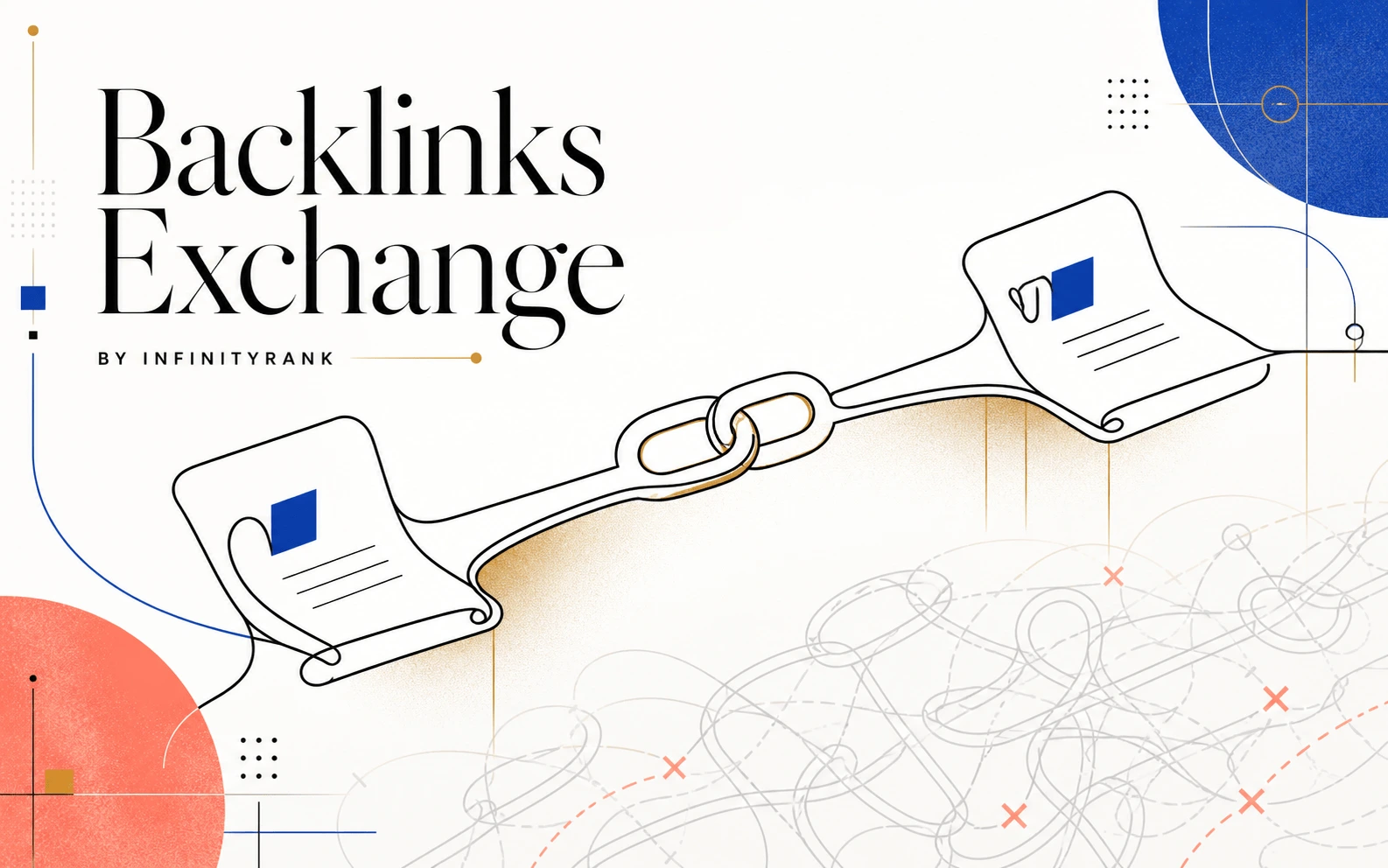
Backlink exchange is one of the most debated link-building tactics in SEO. Done naturally, reciprocal links can make sense. Done aggressively, they can become link spam.
That distinction matters. Google lists excessive link exchanges, including “link to me and I’ll link to you” schemes and partner pages created only for cross-linking, as examples of link spam. Google also says links created primarily to manipulate search rankings can violate its spam policies.
So the real question is not: “Can I exchange backlinks?”
The better question is: “Would this link still make sense if Google did not exist?”
If the answer is yes, the link may be editorially useful. If the answer is no, you are probably building risk into your backlink profile.
What Is Backlink Exchange?
Backlink exchange is an arrangement where two or more websites agree to link to each other.
The simplest version is a direct reciprocal link:
- Site A links to Site B.
- Site B links back to Site A.
A more complex version is a three-way backlink exchange:
- Site A links to Site B.
- Site B links to Site C.
- Site C links back to Site A.
Some SEOs use three-way exchanges to make the link pattern look less obvious. That does not make the tactic automatically safe. If the purpose is to manipulate rankings, it can still create risk.
Backlink exchanges usually happen through outreach, partnerships, guest posts, resource pages, directories, or private SEO groups. Some are harmless. Many are low-quality. The difference comes down to relevance, intent, scale, and editorial value.
Building Links Without Breaking the Rules
Link building is all about finding the right balance. Simple link exchanges may seem easy, but search engines can quickly detect unnatural patterns. If links are not based on real value, they can hurt your site instead of helping it.
To grow safely, focus on genuine partnerships and natural backlinks that benefit users. Avoid overdoing link swaps or creating links just for SEO. A healthy backlink profile should look natural and provide real value, not manipulation.
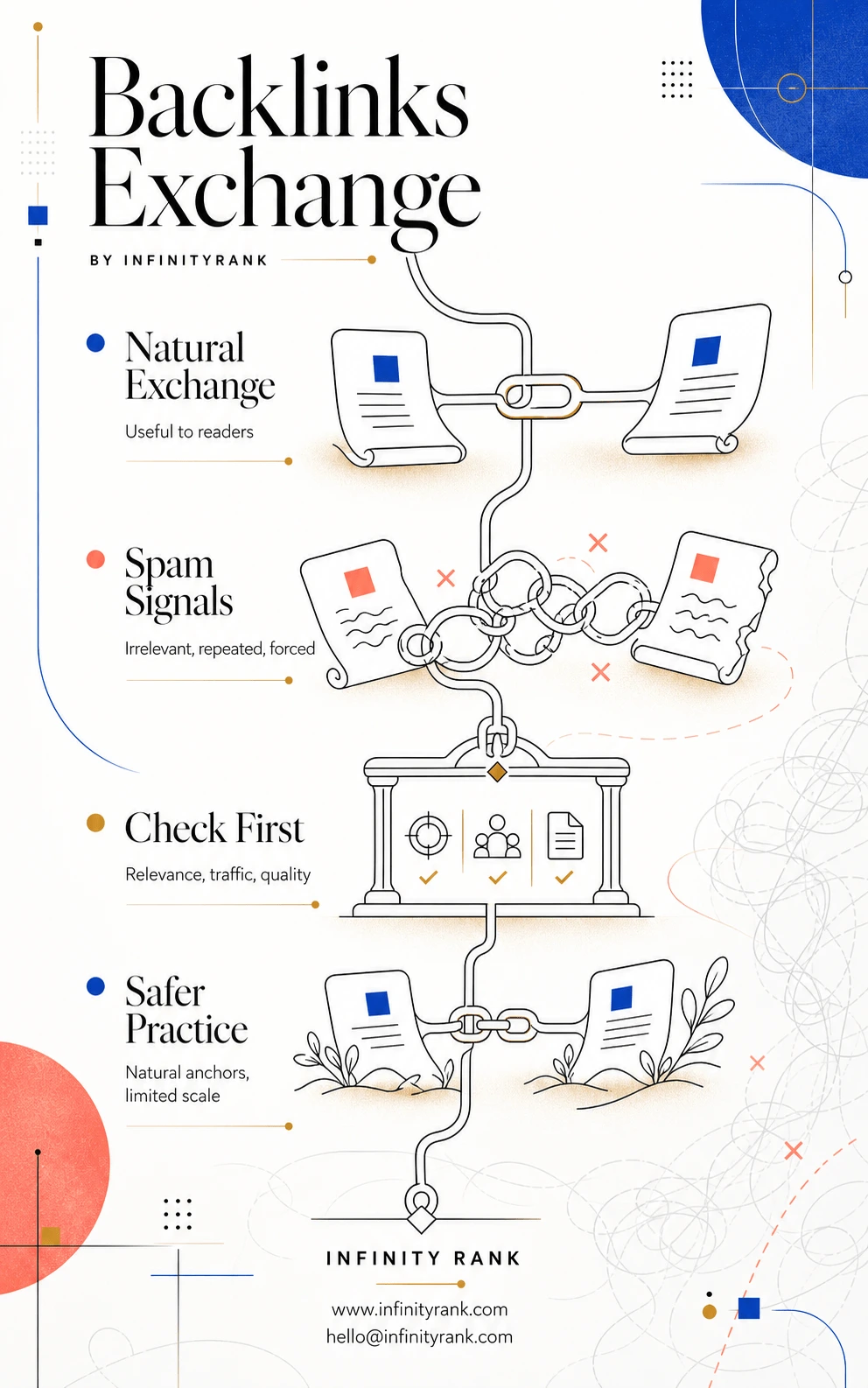
Focusing on relevance and human value is the only way to ensure your link-building efforts stand the test of time. When you prioritize partnerships that actually make sense for your audience, the search rankings tend to follow naturally. Use the framework from the backlinks-exchange-infographic as your checklist for every new outreach opportunity.
Is Backlink Exchange Safe for SEO?
Backlink exchange is not automatically bad. The web naturally contains reciprocal links. Businesses link to partners. Publications cite each other. Vendors link to clients. Industry sites reference useful resources.
That is normal.
The problem starts when links are exchanged mainly to pass ranking signals.
A backlink exchange becomes risky when:
- The sites are not topically related.
- The links use keyword-stuffed anchor text.
- The same pattern repeats across many sites.
- The link appears on a generic “partners” or “resources” page with no real editorial purpose.
- The exchange is required as part of a deal.
- The page exists only to place outbound links.
- The site has thin content, poor traffic, or obvious link-selling behavior.
Google’s spam policies specifically call out excessive link exchanges and partner pages made only for cross-linking. That means backlink exchange should never be treated as a bulk link-building strategy.
When Reciprocal Links Are Natural
Some reciprocal links are completely normal. The link has to make sense for users first.
A natural reciprocal link may happen when:
- Two companies have a real business relationship.
- A software company links to an integration partner.
- A case study links to the client and the client links back to the case study.
- A podcast guest links to the episode and the host links to the guest’s website.
- Two industry experts cite each other’s research.
- A local business association lists its members and members link back to the association.
These links are not created only for SEO. They support the reader, explain a relationship, or point users to something useful.
That is the standard you should use.
When Backlink Exchange Becomes Link Spam
A backlink exchange becomes dangerous when it is systematic, irrelevant, or manipulative.
Common red flags include:
| Risky Pattern | Why It’s a Problem |
| Exact-match anchor text | Looks engineered for rankings |
| Irrelevant websites | No real user value |
| Sitewide footer links | Easy to detect and often unnatural |
| Bulk exchange groups | Creates obvious link patterns |
| “Write for us” farms | Often low editorial standards |
| Partner pages with dozens of unrelated links | Looks like cross-linking for SEO |
| No traffic or poor content quality | Weak signal and higher risk |
| Required dofollow links | Suggests ranking manipulation |
A single relevant reciprocal link is unlikely to be a problem. A repeated pattern of low-quality exchanges is the issue.
Types of Backlink Exchanges
1. Direct Reciprocal Link Exchange
This is the basic “you link to me, I’ll link to you” model.
Example:
- A marketing agency links to a SaaS tool.
- The SaaS tool links back to the agency.
This can be fine if the relationship is real and the links are useful. It becomes risky when done repeatedly across unrelated sites.
2. Three-Way Link Exchange
A three-way exchange uses three websites to avoid a direct A-to-B backlink pattern.
Example:
- Site A links to Site B.
- Site B links to Site C.
- Site C links to Site A.
This is often promoted as “safer” because it looks less obvious than direct exchange. That is misleading. If the goal is to hide manipulation, the tactic is already risky.
3. Partner Page Exchange
This happens when websites create a “partners,” “friends,” or “resources” page and list each other.
This is acceptable when the page has real value and lists legitimate partners. It becomes spammy when the page exists only to trade links.
4. Guest Post Exchange
Two websites agree to publish guest posts for each other, usually with backlinks included.
This can work if the content is original, useful, and editorially reviewed. It becomes risky when the content is thin, duplicated, AI-spun, or created only to insert links.
Potential SEO Benefits of Backlink Exchange
Backlink exchange can have limited SEO value when used carefully. The benefits usually come from relevance and visibility, not from the exchange itself.
Referral Traffic
A relevant link from a page with real visitors can send qualified traffic. This is the cleanest benefit because it does not depend only on ranking signals.
Relationship Building
Linking to useful partners, tools, research, or collaborators can strengthen business relationships. That can lead to interviews, mentions, co-marketing, and earned links.
Better Resource Pages
If your page genuinely helps another site’s audience, being included as a resource can improve visibility and trust.
Faster Discovery
Links help search engines discover pages. A legitimate link from a relevant page can support crawling and indexing.
Still, backlink exchange should not be your main link-building strategy. It is too easy to overdo and too easy to abuse.
Main Risks of Backlink Exchange
1. Google Spam Policy Violations
Google treats links created primarily to manipulate rankings as link spam. Excessive exchanges are specifically named in its policy.
2. Unnatural Anchor Text
If every exchanged backlink uses commercial anchor text like “best SEO agency,” “buy backlinks,” or “link building services,” the pattern looks unnatural.
Use branded, natural, or descriptive anchors instead.
Bad anchor:
best link building agency
Better anchors:
Infinity Rankthis link-building guidetheir SEO team
3. Low-Quality Link Neighborhoods
If you exchange links with websites that sell links, publish thin guest posts, or link to unrelated industries, your site may become associated with poor-quality link networks.
4. Wasted Crawl and Editorial Value
A page filled with random outbound links is not useful. It weakens user trust and makes your site look careless.
5. Manual or Algorithmic Impact
Google says sites that violate spam policies may rank lower or may not appear in search results. Link spam can also lead to manual action in some cases.
Backlink Exchange Checklist
Before agreeing to any backlink exchange, check these points.
Relevance
Would the link make sense to a real reader?
If your site is about SEO and the other site is about casino bonuses, plumbing, crypto trading, or pet food, skip it.
Traffic
Does the page or website have real organic visibility?
Third-party metrics are useful, but they are not enough. Check traffic estimates, ranking keywords, and whether the site has an actual audience.
Content Quality
Is the site publishing original, useful content?
Avoid websites with thin posts, AI-spam, copied content, or hundreds of generic guest posts.
Link Placement
Contextual links inside useful content are stronger than random sidebar, footer, or directory links.
Anchor Text
Avoid exact-match commercial anchors. Use natural anchors that fit the sentence.
Outbound Link Profile
Look at who the site links to. If it links to unrelated, spammy, or suspicious domains, do not exchange links.
Scale
One or two natural reciprocal links are not the issue. Dozens of exchanges across unrelated sites are.
Best Practices for Safer Backlink Exchange
Keep It Relevant
Only exchange links with websites in your industry, niche, location, or business ecosystem.
A link should help the reader understand a topic, find a resource, or verify a claim.
Prioritize Editorial Value
Do not add links just because someone asked.
Ask:
- Does this improve the page?
- Does this source support the point?
- Would I link to this page without getting a link back?
If the answer is no, reject it.
Avoid Exact-Match Anchor Text
Use natural anchors. Branded anchors are usually safer than keyword-heavy anchors.
Avoid patterns like:
- “best backlinks service”
- “cheap SEO services”
- “buy guest posts”
- “top link building company”
These look engineered.
Do Not Use Bulk Exchange Groups
Avoid Facebook groups, Slack groups, spreadsheets, and marketplaces built around mass link swaps. These patterns are easy to abuse and often filled with weak sites.
Avoid Required Dofollow Exchanges
If someone demands a dofollow backlink as a condition, treat that as a warning sign.
Google says paid or sponsored links should be qualified with attributes such as rel="sponsored" or rel="nofollow". For links where you do not want Google to associate your site with the target page, nofollow is appropriate.
Review Existing Links Regularly
Audit your outbound and inbound links. Remove or qualify links that no longer make sense.
Watch for:
- broken pages
- redirected domains
- expired domains
- changed ownership
- spammy outbound links
- irrelevant partner pages
A link that was safe two years ago may not be safe today.
Backlink Exchange vs. Better Link-Building Methods
Backlink exchange is not the strongest way to build authority. Safer methods usually produce better long-term results.
| Method | Risk | Value |
| Digital PR | Low to medium | High |
| Original research | Low | High |
| Expert quotes | Low | Medium |
| Guest posting on relevant sites | Medium | Medium to high |
| Resource page outreach | Medium | Medium |
| Direct backlink exchange | Medium to high | Low to medium |
| Bulk link swaps | High | Low |
| Paid link networks | Very high | Low |
Better link-building strategies include:
- publishing original data
- creating linkable assets
- earning press mentions
- contributing expert commentary
- building useful tools
- writing high-quality guest posts for relevant publications
- reclaiming unlinked brand mentions
- fixing broken backlinks
- promoting research-led content
These methods take more work, but they build a cleaner backlink profile.
Should You Use Nofollow or Sponsored Tags?
Use the right link attribute when needed.
Use rel="sponsored" for paid placements, advertisements, sponsorships, or links that exist because of compensation.
Use rel="nofollow" when you do not want to pass ranking signals or when the link is not fully editorial.
Use normal followed links only when the link is editorial, relevant, and not part of a paid or manipulative arrangement.
Google says sponsored links should be marked with rel="sponsored", while nofollow remains an acceptable way to flag certain links.
Should You Do Backlink Exchange?
Use backlink exchange only in limited, relevant, editorial cases.
Do not use it as your main SEO strategy.
A backlink exchange may be acceptable if:
- the websites are genuinely related
- the link helps users
- the content is useful
- the anchor text is natural
- the relationship is real
- the exchange is not part of a bulk pattern
Avoid it if:
- the site is unrelated
- the link is required
- the anchor text is keyword-heavy
- the page exists only for links
- the site sells backlinks
- the offer comes from a mass exchange group
The safest rule is simple: earn links because your content deserves them, not because you traded for them.
FAQ
Is backlink exchange bad for SEO?
Not always. Natural reciprocal links are common. The risk comes from excessive, irrelevant, or manipulative exchanges created mainly to influence rankings.
Does Google allow backlink exchanges?
Google does not ban every reciprocal link. But Google’s spam policies list excessive link exchanges and partner pages made only for cross-linking as examples of link spam.
Are three-way link exchanges safer?
Not automatically. Three-way exchanges can still be manipulative if they are designed to hide a link scheme. Relevance and editorial value matter more than the exchange structure.
How many reciprocal links are too many?
There is no fixed number. The risk depends on pattern, scale, relevance, anchor text, and intent. A few natural reciprocal links are normal. A large network of repeated swaps is risky.
What anchor text should I use in a backlink exchange?
Use natural anchors. Branded anchors, page titles, and descriptive phrases are safer than exact-match commercial keywords.
Should exchanged backlinks be nofollow?
If the link is not editorial or exists because of a deal, use rel="nofollow” or rel="sponsored" where appropriate. Do not force followed links in exchange agreements.
Final Takeaway
Backlink exchange is not a shortcut. It is a tactic with limited upside and real risk when abused.
Use it only when the link is relevant, editorial, and useful to readers. Avoid bulk swaps, irrelevant sites, exact-match anchor text, and partner pages built only for SEO.
For long-term rankings, invest in better assets: original research, expert content, digital PR, and useful resources that earn links naturally.