Not all backlinks are equal.
A link from a relevant article usually carries more value than a random footer link, directory listing, sidebar placement, or spammy blog comment. The reason is simple: context helps both users and search engines understand why the link exists.
That is where contextual backlinks matter.
A contextual backlink is an inbound link placed inside the main content of a relevant page. It is surrounded by text that supports the topic of the linked page. When done properly, it feels like a useful reference, not a forced SEO placement.
This guide explains what contextual backlinks are, why they matter, how to evaluate link quality, and how to build them without creating unnecessary SEO risk.
What Is a Contextual Backlink?
A contextual backlink is a link from another website to your website that appears within the body content of a relevant page.
For example, if a blog post about technical SEO links naturally to your guide on crawl budget optimization, that is a contextual backlink. The link appears inside relevant content, and the surrounding text helps explain why your page is useful.
A contextual backlink is different from a link placed in:
- A website footer
- A sidebar
- A directory profile
- A comment section
- A forum signature
- An author bio
- A random sponsored post with no topical connection
The strongest contextual backlinks usually have three things in common: topical relevance, editorial placement, and a natural reason to exist.
Contextual Backlinks vs Other Types of Links
| Link Type | Where It Appears | SEO Value | Risk Level |
| Contextual backlink | Inside relevant body content | High when editorial and relevant | Low to medium |
| Footer link | Sitewide footer or template area | Usually low | Medium to high if manipulative |
| Sidebar link | Blogroll, widget, or sidebar block | Usually low to moderate | Medium |
| Directory link | Business profile or listing page | Low to moderate | Low if legitimate; high if spammy |
| Comment/forum link | User-generated content | Usually low | High if spammed |
| Sponsored link | Paid placement or advertorial | Must be qualified | High if used to pass ranking credit |
A contextual backlink is not automatically good just because it appears inside an article. A bad link inside bad content is still a bad link.
Contextual Backlinks Build Real Search Authority
Getting a link placed naturally inside a relevant piece of text is the gold standard for search engine optimization. Google values these in-content links because they flow naturally within a topic, signaling true trust and relevance while driving real human traffic. To get the best results, you need to focus on key quality signs like a perfect topical fit, a natural anchor text, and proper paragraph placement. This simple guide breaks down how to earn these powerful links safely to improve your overall search rankings.
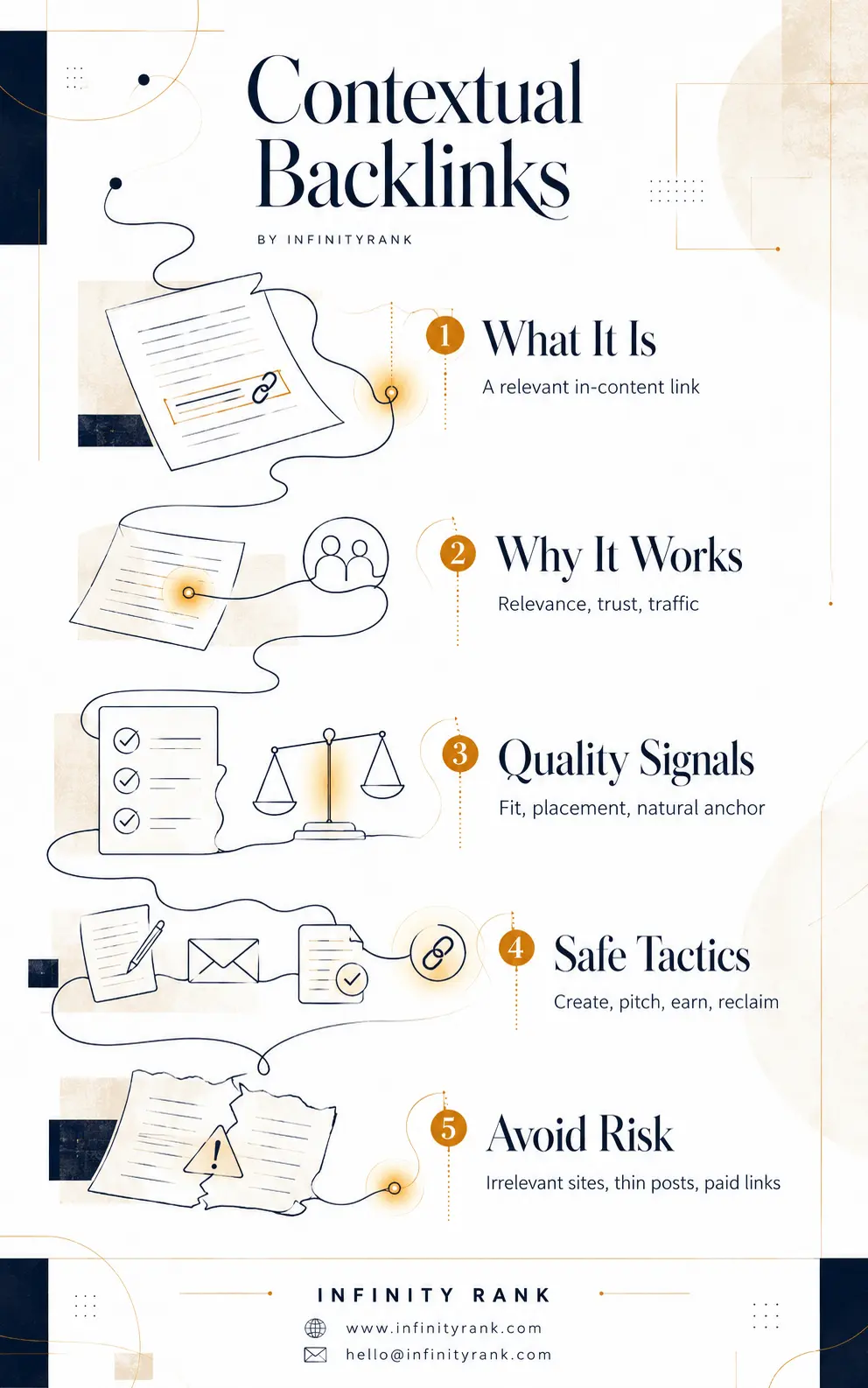
Earning natural in-content links requires a smart approach focused on creating great assets, pitching real value, and reclaiming missed opportunities. Staying away from risky traps like irrelevant platforms, thin articles, or obvious paid networks protects your website from sudden algorithm penalties. Use these five core pillars as your daily checklist to keep your optimization strategy safe and highly effective.
Why Contextual Backlinks Matter for SEO
Contextual backlinks matter because they help connect related pages across the web.
When a relevant website links to your page from within useful content, that link can support your SEO in several ways.
1. They Help Search Engines Understand Relevance
Search engines use links to discover pages and understand relationships between content. The text around a link can help clarify what the linked page is about.
For example, a link to an SEO agency from an article about local search strategy is more relevant than the same link from an unrelated article about fitness equipment.
Relevance does not guarantee rankings. But a relevant link is usually a stronger signal than a random link with no topical connection.
2. They Can Pass Stronger Authority Signals
A contextual backlink from a trusted, relevant page can send stronger authority signals than a low-quality link placed in a sidebar, footer, or directory.
But the link still has to be evaluated properly. Page quality, domain trust, organic traffic, link placement, anchor text, and indexability all matter.
A contextual link from a thin guest-post farm is not better than a legitimate business citation just because it sits inside a paragraph.
3. They Can Drive Qualified Referral Traffic
The best contextual backlinks are useful for people, not just crawlers.
If readers are already consuming content related to your topic, they are more likely to click a link that gives them the next useful resource. That means contextual links can send referral traffic who already understand the problem you solve.
Referral traffic from a relevant article can also expose your brand to the right audience, even when the link does not immediately move rankings.
4. They Support Brand Authority
Being cited inside relevant industry content helps position your brand as a useful resource.
This matters especially in competitive SEO, SaaS, finance, healthcare, legal, ecommerce, and local-service niches where trust is a ranking and conversion issue.
A contextual link from a credible page can do more than pass authority. It can also show readers that your content is worth referencing.
5. They Help Search Engines Discover Content
Links from crawlable, indexed pages can help search engines discover your pages. That does not guarantee indexing or ranking, but it gives search engines another path to find your content.
Do not oversell this. Contextual backlinks can support discovery. They do not force Google to index weak, duplicate, or low-value pages.
What Makes a Contextual Backlink High Quality?
A contextual backlink is only valuable when the page, placement, and intent make sense.
Use this checklist before you pursue or approve a link.
Topical Relevance
The linking page should be related to your topic, audience, industry, or problem space.
A link building agency getting mentioned in an article about SEO strategy makes sense. The same agency getting linked from a random recipe blog does not.
Topical relevance is the first filter. If the context is fake, the link is weak.
Editorial Placement
The link should appear because it helps the reader.
Good contextual links usually support a point, cite a source, recommend a useful resource, or give readers a logical next step.
Bad contextual links feel inserted after the article was already written.
Page Quality
Check the actual page, not just the domain.
A strong contextual backlink should come from a page that is indexed, readable, useful, and relevant. Avoid pages that are thin, AI-spun, overloaded with outbound links, or built only to sell placements.
Domain Trust
The linking website should have a real audience, real content standards, and a clean topical profile.
Do not judge a domain only by DR, DA, or traffic estimates. Third-party metrics are useful filters, not proof of quality.
Organic Traffic
A website with organic traffic is usually more valuable than a site that exists only to publish paid guest posts.
Traffic is not the only quality signal, but zero-traffic domains with hundreds of outgoing commercial links are usually a bad sign.
Anchor Text
Anchor text should be natural.
A mix of branded, partial-match, URL, and natural anchors is safer than repeatedly forcing exact-match commercial keywords.
Bad anchor: “best cheap contextual backlinks agency”
Better anchor: “Infinity Rank’s link building team”
Best anchor depends on the sentence and context. The link should read naturally.
Link Attribute
Check whether the link is dofollow, nofollow, sponsored, or UGC.
Google says paid links and advertisements should be marked with rel="sponsored" or rel="nofollow". Google also recommends rel="ugc" for user-generated links such as comments and forum posts.
For regular editorial links that do not need qualification, Google says no rel attribute is required.
Indexability
The linking page should be crawlable and indexable.
A link from a noindexed page, blocked section, orphaned post, or hidden archive page has limited SEO value.
Before valuing a link, check whether the page can actually be discovered and indexed.
Contextual Backlink Red Flags
Avoid links that show any of these patterns.
- The article is unrelated to your niche.
- The content is thin, generic, or obviously mass-produced.
- The same website publishes guest posts about every topic imaginable.
- The page has too many outbound commercial links.
- The anchor text is aggressively exact-match.
- The website has no visible editorial standards.
- The site has no real audience or organic visibility.
- The link is hidden, forced, or irrelevant.
- The surrounding content looks written only to justify the backlink.
- The site links to gambling, adult, crypto, payday loan, or pharma pages from unrelated content.
- The publisher refuses to mark paid placements as sponsored or nofollow.
Contextual placement cannot save a bad backlink. If the page exists only to manipulate search rankings, the link is not worth chasing.
Are Paid Contextual Backlinks Safe?
This is where most SEO articles become dishonest.
You can pay for advertising, sponsorships, placements, and PR exposure. That is normal. But paid links intended to pass ranking credit create risk.
Google’s spam policies list text ads or text links that do not block ranking credit, advertorials or native advertising with links that pass ranking credit, and optimized anchor text links in articles, guest posts, or press releases as examples of link spam.
Google also says buying and selling links is not a violation when those links are properly qualified with rel="nofollow" or rel="sponsored".
So the practical rule is simple:
If a link is paid, sponsored, or part of a compensation agreement, it should be qualified.
If the link is genuinely editorial and earned because your page is useful, it does not need a sponsored or nofollow attribute.
Do not build a campaign around pretending paid links are editorial links. That is short-term thinking and long-term risk.
How to Build Contextual Backlinks Safely
The safest contextual backlink campaigns are built around useful content, relevant outreach, and editorial fit.
Here is the process.
1. Create Content Worth Referencing
You cannot earn strong contextual backlinks with weak content.
Before outreach, create assets that give publishers a reason to link. Strong linkable assets include:
- Original research
- Industry statistics
- Expert guides
- Data studies
- Case studies
- Templates
- Calculators
- Checklists
- Comparison pages
- Visual explainers
- Useful definitions with examples
Generic blog posts are harder to pitch. Publishers already have enough generic content.
If you want better links, create something worth citing.
2. Find Relevant Link Prospects
Do not build prospect lists based only on domain metrics.
Start with topical relevance. Search for websites that already cover your niche, mention related competitors, cite similar resources, or publish content for your target audience.
Useful prospect types include:
- Industry blogs
- SaaS blogs
- Local business publications
- Trade associations
- Niche resource pages
- Journalists covering your topic
- Podcast websites
- Research roundups
- Comparison articles
- Existing articles with outdated references
The goal is not to get a link from any website. The goal is to get mentioned where your audience and topic already fit.
3. Use Guest Posting Carefully
Guest posting can still work when the article is useful, relevant, and editorially reviewed.
Bad guest posting is mass-produced content placed on weak websites for the sole purpose of inserting anchor text.
Good guest posting looks different:
- The host site is relevant.
- The article is genuinely useful.
- The topic fits the publication.
- The link supports the reader.
- The anchor text is natural.
- The content is not recycled.
- The site has real editorial standards.
One relevant contextual link is usually enough. Do not stuff multiple links to your own pages unless each link clearly helps the reader.
4. Use Digital PR
Digital PR is one of the strongest ways to earn contextual backlinks because it focuses on newsworthy assets, not forced placements.
You can pitch:
- Original data
- Industry surveys
- Expert commentary
- Trend analysis
- Local business insights
- Product data
- Case studies
- Contrarian opinions backed by evidence
For example, a SaaS company could publish a study on how small businesses use AI tools. If the data is strong, tech blogs, business publications, and industry newsletters may cite it naturally.
The link appears because the source is useful. That is the point.
5. Reclaim Unlinked Brand Mentions
If websites already reference your company without linking to you, ask them to add a link where it helps readers.
This is one of the cleanest contextual link building tactics. Reclaiming unlinked brand mentions works best when the publisher has already positively referenced your business.
Look for mentions of:
- Your brand name
- Founder names
- Product names
- Reports or studies you published
- Quotes from your team
- Original images or data
Keep the request simple. Do not demand exact-match anchor text. Ask for a useful link to the most relevant page.
6. Use Broken Link Building
Broken link building works when you find a dead link on a relevant page and offer a useful replacement.
The process is straightforward:
- Find relevant pages in your niche.
- Identify broken outbound links.
- Check what the dead page used to cover.
- Create or identify a better replacement resource.
- Contact the site owner with a specific fix.
This tactic works best when your replacement page genuinely improves the article.
Do not use broken link building as a lazy excuse to pitch unrelated pages.
7. Build Resource Page Links
Many websites maintain resource pages for tools, guides, vendors, templates, or educational content.
These can be useful if the page is relevant and curated.
Avoid low-quality resource pages that list hundreds of unrelated links. A strong resource page has a clear topic, editorial selection, and a real reason to include your content.
8. Create Expert Contributions
Expert quotes can earn contextual backlinks when they add substance to an article.
You can contribute to:
- Journalist requests
- Industry roundups
- Podcast show notes
- Partner articles
- Research pieces
- Niche newsletters
- Expert commentary posts
The mistake is giving generic quotes. Say something specific, useful, and hard to replace. That increases the chance of earning a proper citation.
9. Build Internal Contextual Links Too
External contextual backlinks matter, but internal contextual links also matter.
When you publish a new article, link to it from relevant existing pages on your own website. Internal contextual links help users navigate your content and help search engines understand relationships between your pages.
For example, a page about link building strategy should internally link to related pages about:
- Dofollow vs nofollow backlinks
- Guest posting
- Digital PR
- Link building metrics
- Toxic backlinks
- Anchor text strategy
Internal links are fully under your control. Use them properly.
10. Use Multilingual Link Building Only When It Makes Sense
Multilingual contextual backlinks can help when your business genuinely targets multiple languages or regions.
But do not build foreign-language links just because they are cheaper.
A multilingual backlink should match:
- The language of the audience
- The location or market you serve
- The topic of the linked page
- The search intent of that region
- The localized version of your content, where relevant
For example, if your website has a Spanish landing page targeting Spanish-speaking customers, a relevant Spanish article may make sense. If your website only serves English-speaking customers in one country, random foreign-language links are usually weak.
How Many Contextual Backlinks Do You Need?
There is no fixed number.
The number of contextual backlinks you need depends on:
- Keyword difficulty
- Competitor authority
- Content quality
- Search intent
- Existing backlink profile
- Internal linking
- Website authority
- Technical SEO
- Brand demand
- SERP volatility
A handful of strong, relevant contextual backlinks can outperform dozens of weak links. But in competitive SERPs, you usually need consistent link acquisition over time.
Do not chase volume first. Chase relevance, quality, and consistency.
How to Measure Contextual Backlink Quality
Track more than the number of links built.
Use these metrics:
- Linking page relevance
- Linking domain relevance
- Organic traffic estimate
- Indexed status
- Anchor text
- Link attribute
- Placement inside the article
- Referral traffic
- Keyword movement
- Assisted conversions
- Brand mentions
- Link retention over time
The best links should support rankings, referral traffic, brand trust, or all three.
If a campaign only reports “number of links built,” it is not enough.
Contextual Backlink Checklist
Before approving a contextual backlink, ask:
- Is the linking page relevant to our topic?
- Does the link help the reader?
- Is the content indexed?
- Is the page useful, not thin or spammy?
- Does the website have a real audience?
- Is the anchor text natural?
- Is the link placed inside the main content?
- Is the link surrounded by relevant copy?
- Is the site free from obvious link-selling footprints?
- Is the link qualified properly if it is paid or sponsored?
- Would we still want this mention if Google ignored the link?
That last question is important. If the answer is no, the link is probably too risky or too weak.
Common Mistakes to Avoid
Chasing DA or DR Only
Domain metrics are useful, but they are not quality guarantees.
A high-DR website can still publish irrelevant, low-quality, paid content. A lower-authority niche site can sometimes provide a more relevant and useful contextual backlink.
Use metrics as filters, not final proof.
Overusing Exact-Match Anchor Text
Exact-match anchors can look manipulative when repeated across multiple websites.
Use natural anchors that fit the sentence. Branded, partial-match, and descriptive anchors are usually safer than forcing the same keyword again and again.
Publishing Thin Guest Posts
A guest post written only to place a link is not a strong asset.
If the article would not be worth reading without the backlink, it probably should not be part of your campaign.
Ignoring Link Attributes
Paid, sponsored, affiliate, and user-generated links need proper treatment.
Google treats nofollow, sponsored, and ugc as hints, not as absolute directives, but the attributes still help explain the nature of the link.
Ignoring link attributes creates unnecessary risk.
Building Links on Irrelevant Sites
Relevance beats random authority.
A link from a topically aligned website with a real audience is usually more useful than a link from an unrelated site with inflated metrics.
Final Thoughts
Contextual backlinks can be powerful when they are relevant, editorial, and useful.
They help search engines understand relationships between pages. They can drive qualified referral traffic. They can strengthen brand authority. But they are not magic, and they are not safe by default.
Bad contextual links still create risk. Paid links that pass ranking credit still violate Google’s spam policies. Thin guest posts still look weak. Exact-match anchor stuffing still leaves a footprint.
The right approach is simple: build content worth citing, pitch relevant publishers, keep anchor text natural, avoid manipulative placements, and qualify sponsored links correctly.
Need contextual backlinks from relevant, vetted websites? Infinity Rank builds link campaigns focused on topical relevance, editorial quality, and long-term SEO value.
FAQs
What is a contextual backlink?
A contextual backlink is a link from another website to your website that appears inside the main body content of a relevant page. It is surrounded by related text that helps explain why the link is useful.
Are contextual backlinks better than footer or sidebar links?
Usually, yes. A relevant in-content link is generally more useful than a random footer or sidebar link because it has clearer context and is more likely to help readers. But quality still depends on the linking page, website, anchor text, and intent behind the link.
Do contextual backlinks help rankings?
They can help rankings when they come from relevant, trustworthy, crawlable pages and fit naturally inside useful content. They do not guarantee rankings on their own.
Can I buy contextual backlinks?
You can pay for sponsored placements, advertising, or PR exposure. But paid links intended to pass ranking credit create risk. Google says paid links should be qualified with rel="sponsored" or rel="nofollow".
How many contextual backlinks do I need?
There is no fixed number. It depends on your niche, competition, keyword difficulty, content quality, and existing authority. Quality and relevance matter more than raw link count.
What is the best anchor text for contextual backlinks?
The best anchor text is natural and relevant to the sentence. Branded, partial-match, URL, and descriptive anchors are usually safer than repeatedly using exact-match commercial keywords.
What is multilingual contextual link building?
Multilingual contextual link building means earning relevant in-content backlinks from websites in other languages. It only makes sense when your business targets that language, country, or audience.
Are nofollow contextual backlinks useless?
No. Nofollow links may not pass the same ranking signals as regular editorial links, but they can still drive referral traffic, build brand visibility, and support a natural backlink profile.