Guest posting and niche edits are two of the most common link-building tactics in SEO. Both can help you earn backlinks, improve topical authority, and support organic rankings.
But they are not the same.
Guest posting means creating a new article on another website and placing your link inside that content. Niche edits, also called link insertions, involve adding your link to an existing page that is already published and indexed.
The better choice depends on your goal. If you want brand visibility, fresh content, and more control over the topic, guest posting is usually stronger. If you want faster placement on an aged, indexed page, niche edits can be useful when handled carefully.
The wrong choice can waste money. Worse, poor-quality placements can damage your backlink profile.
Here is the practical breakdown.
What Is Guest Posting?
Guest posting is the process of writing and publishing an article on another website in your industry or a related niche. The article usually includes a backlink to your site, either in the body content or author bio.
A good guest post should do more than place a link. It should provide useful information for the host site’s audience, fit naturally into the site’s editorial standards, and support your brand’s authority.
Example:
A cybersecurity company publishes an article on a SaaS blog about passwordless authentication. Inside the article, it links to its own guide on enterprise identity management.
That is a relevant guest post.
A bad guest post would be a generic 700-word article published on a random site with no real audience, no topical relevance, and obvious paid-link footprints.
That is not authority. That is noise.
What Are Niche Edits?
Niche edits are backlinks added to existing content on another website. Instead of publishing a new article, your link is inserted into a page that already exists.
Example:
A published article about “best project management tools” already ranks and gets traffic. A project management SaaS company gets a relevant link added to a section discussing workflow automation.
That is a niche edit.
The main appeal is speed. The page may already be indexed, aged, and attracting organic traffic. If the link is relevant and editorially placed, it can be useful.
But niche edits also carry risk. Many are sold through low-quality link networks, hacked pages, irrelevant sites, or articles stuffed with unrelated outbound links. Those placements are not worth buying.
Guest Posting vs Niche Edits: Quick Comparison
| Factor | Guest Posting | Niche Edits |
| Content type | New article | Existing article |
| Speed | Slower | Faster |
| Control | More control over topic and context | Less control over existing content |
| Brand visibility | Stronger | Usually weaker |
| Cost | Often higher because content is created | Often lower, but high-quality edits can still be expensive |
| Best use | Brand authority, thought leadership, topical expansion | Strengthening specific pages with relevant existing content |
| Main risk | Low-quality guest post farms | Spammy link insertions and irrelevant placements |
| SEO value | Strong when site quality and relevance are high | Strong when the page is relevant, indexed, and has real traffic |
Balancing Authority and Speed in Your Link Strategy
Guest posts and niche edits serve different purposes in a strong SEO strategy, and the right choice depends on what you want to achieve. Guest posting helps you publish fresh, original content that builds brand authority and positions your business in front of a new audience.
Niche edits work differently by placing links into existing pages that already have search engine trust, often leading to faster SEO movement. This guide to Guest Posts vs. Niche Edits explains the key principles behind both methods, helping you understand when to invest in long-term authority and when quicker ranking improvements make more sense.
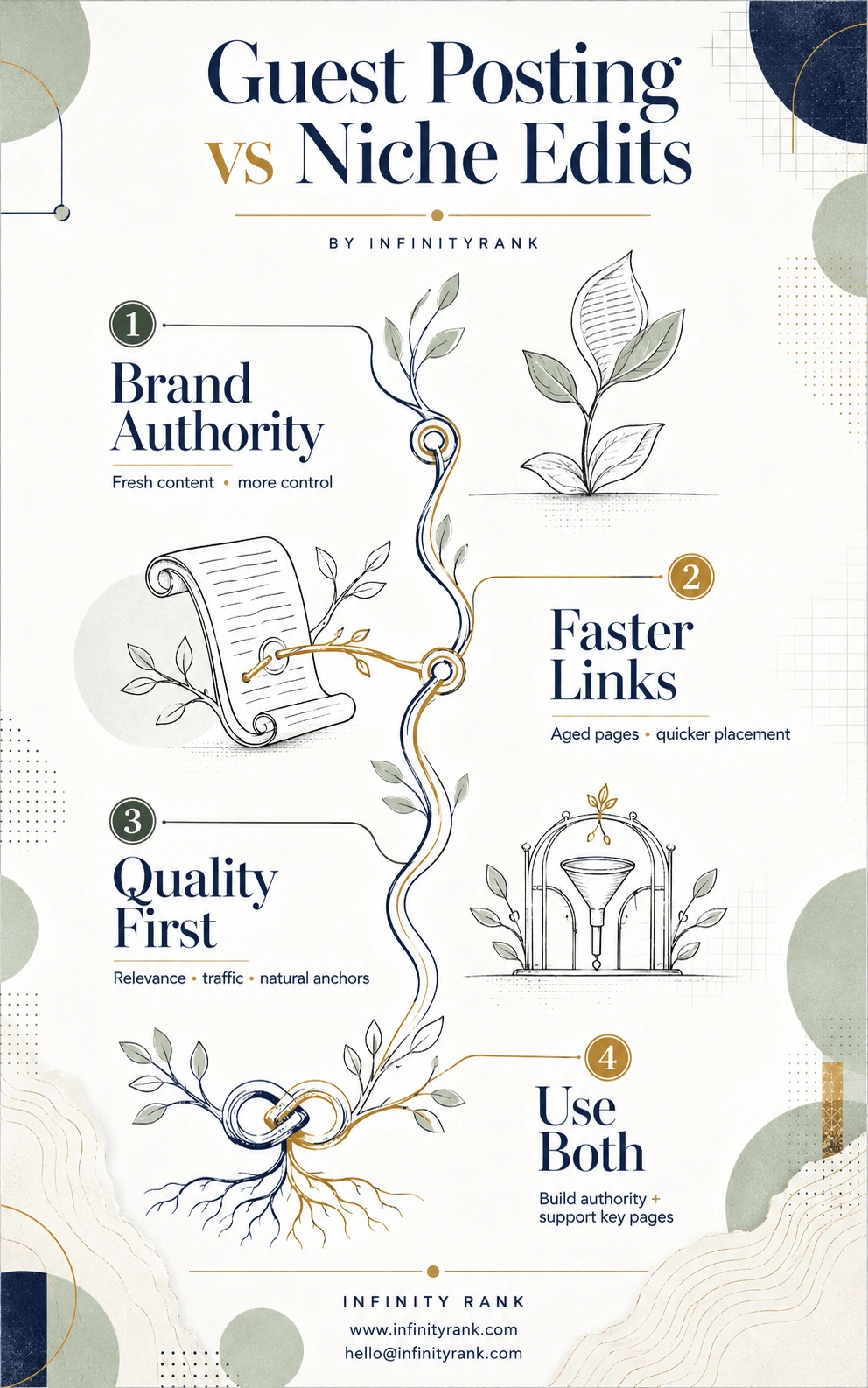
The most effective SEO campaigns don’t choose sides; they use both methods to build a diverse and resilient link profile. By prioritizing quality and relevance above all else, you ensure that every placement—whether a new guest post or a strategic niche edit—contributes to long-term growth. Use this framework to audit your current outreach and start building a more authoritative digital footprint today.
Which One Is Better for SEO?
Neither tactic is automatically better.
Guest posting is better when you need:
- Brand exposure
- New topical coverage
- More control over anchor context
- Thought leadership
- Referral traffic
- Relationships with relevant publishers
Niche edits are better when you need:
- Faster placement
- Links from aged pages
- Support for existing money pages or blog posts
- Page-level relevance from content that already ranks
- A lower-content-production workload
The strongest SEO campaigns often use both. Guest posts help build brand and topical authority. Niche edits can support specific pages that need authority, relevance, and stronger internal ranking signals.
But quality matters more than the tactic.
A strong niche edit on a relevant, indexed, traffic-driving page is better than a guest post on a dead site. A well-written guest post on a respected industry blog is better than a random link insertion on a page nobody reads.
Are Guest Posts Safe?
Guest posts are safe only when they are editorial, relevant, and useful.
They become risky when they exist only to manipulate rankings. Google’s spam policies warn against links created mainly to pass ranking credit, especially paid links that are not properly qualified with attributes like rel=”sponsored” or rel=”nofollow”.
That means you should avoid:
- Mass guest posting on irrelevant sites
- Exact-match anchor abuse
- Sites that openly sell links to anyone
- Thin AI-generated articles with no editorial review
- Publishers with no real organic traffic
- Reused templates across dozens of sites
- Private blog networks pretending to be real publishers
A guest post should read like a legitimate article. If it looks like it was created only to carry a backlink, it is a weak placement.
Are Niche Edits Safe?
Niche edits can be safe, but only under strict conditions.
A good niche edit is:
- Added to a relevant article
- Useful to the reader
- Placed naturally in the content
- On an indexed page
- On a site with real traffic
- Surrounded by context that supports the link
- Not part of an obvious link-selling network
A bad niche edit is:
- Inserted into unrelated content
- Placed with exact-match anchor text
- Added to a page with dozens of outbound paid links
- Hidden in old content nobody reads
- Placed on hacked or compromised pages
- Sold by a broker with no editorial standards
The biggest problem with niche edits is quality control. Many cheap link insertions are spam. They may look attractive because they are fast, but speed does not equal value.
Cost: Guest Posting vs Niche Edits
Pricing varies widely.
Guest posts usually cost more because they require content creation, outreach, editorial approval, and publication. Quality placements on real sites often cost more than low-end guest posts because the site has standards and an actual audience.
Niche edits can be cheaper because no new article is required. But high-quality niche edits on strong, relevant, traffic-driving pages are not always cheap.
Typical pricing depends on:
- Website authority
- Organic traffic
- Niche difficulty
- Editorial standards
- Page relevance
- Link placement quality
- Whether content writing is included
- Whether the link is sponsored, nofollow, or editorial
Do not buy based on DR or DA alone. Those metrics can be inflated. A site with high authority metrics but no real organic traffic is not a strong link opportunity.
When to Use Guest Posting
Use guest posting when your goal is broader authority.
It works best for:
- New brands that need visibility
- Companies building topical authority
- SaaS, B2B, finance, marketing, and technology brands
- Campaigns where referral traffic matters
- Sites that need more branded search presence
- Businesses that want relationships with publishers
Guest posting also gives you more control. You can choose the angle, topic, examples, supporting data, and surrounding context. That makes it useful when you need to introduce a new idea or explain a complex product.
Best example:
A fintech startup publishes a guest article on a respected finance blog explaining how embedded payments reduce checkout friction. The article links to a relevant guide on its own site.
That builds authority and sends qualified readers.
When to Use Niche Edits
Use niche edits when you want to strengthen specific existing pages.
They work best for:
- Pages already ranking on page two or three
- Commercial pages needing more authority
- Blog posts that target competitive keywords
- Campaigns where speed matters
- Sites that already have solid content but need stronger backlinks
- Brands that want links from aged, indexed articles
Niche edits are especially useful when the existing article is already relevant to your topic.
Best example:
You have a guide on “CRM implementation checklist.” A relevant article about CRM migration already ranks and mentions implementation planning. A natural link to your checklist makes sense.
That is a useful niche edit.
How to Vet a Guest Post Opportunity
Before accepting or buying a guest post placement, check:
1. Topical Relevance
The site should cover your industry or a closely related topic. A link from a relevant smaller site is often better than a link from a random high-metric site.
2. Organic Traffic
Use SEO tools to check whether the site gets real search traffic. Avoid sites with inflated authority metrics but no rankings.
3. Editorial Standards
The site should reject bad content. If anyone can publish anything for a fee, the site is weak.
4. Outbound Link Profile
Check recent posts. If every article links to random casinos, crypto offers, CBD brands, payday loans, and unrelated SaaS tools, avoid it.
5. Content Quality
The article should be useful, original, and written for humans. Thin filler content is a bad signal.
6. Anchor Text
Avoid aggressive exact-match anchors. Use branded, partial-match, or natural anchors.
How to Vet a Niche Edit Opportunity
Before placing a niche edit, check:
1. Is the Page Indexed?
If the page is not indexed, the link has limited SEO value.
2. Does the Page Get Traffic?
Aged does not mean valuable. An old page with no traffic and no rankings is not impressive.
3. Is the Link Context Natural?
The sentence should make sense. The link should help the reader. Forced insertions are obvious.
4. Are There Too Many Outbound Links?
If the article already contains a long list of unrelated commercial links, skip it.
5. Is the Site Legitimate?
Check the site’s real audience, content history, author pages, contact details, and traffic trends.
6. Is the Anchor Text Safe?
Do not overuse exact-match commercial keywords. A natural anchor profile is safer and more believable.
Common Mistakes to Avoid
Buying the Cheapest Links
Cheap links are usually cheap for a reason. They often come from link farms, expired domains, fake blogs, or irrelevant sites.
Judging Only by DR or DA
Authority metrics are useful, but they are not enough. Always check traffic, relevance, ranking keywords, outbound links, and content quality.
Using Exact-Match Anchors Too Often
If every backlink uses commercial anchor text like “best SEO agency” or “buy CRM software,” your profile looks manipulated.
Ignoring Link Attributes
Paid or sponsored links should be properly qualified. Do not pretend every paid placement is editorial.
Mixing Irrelevant Niches
A backlink from an unrelated site is weak. Relevance matters.
Sending Links Only to Money Pages
A natural backlink profile includes links to guides, resources, tools, studies, homepage pages, and brand assets — not just sales pages.
Best Strategy: Use Both, But Carefully
The smartest approach is not “guest posting vs niche edits.” It is knowing when each one fits.
Use guest posting to build authority, visibility, and topical relevance.
Use niche edits to support important existing pages with relevant, contextual links.
A balanced campaign might look like this:
- 50% guest posts for authority and brand visibility
- 30% niche edits for specific ranking targets
- 20% digital PR, resource links, partnerships, and organic mentions
That split is not universal. Competitive industries may need more digital PR. New websites may need more guest posting first. Established websites with strong content may benefit more from selective niche edits.
The rule is simple: every link should make sense to a human reader.
If the link only exists because someone paid for it, and it adds no value to the page, it is a bad link.
Final Verdict: Which One Should You Choose?
Choose guest posting if you want brand authority, fresh content, and long-term visibility.
Choose niche edits if you want faster contextual links from existing relevant pages.
Use both if you want a balanced backlink strategy.
But do not chase volume. Chase relevance, quality, and editorial credibility.
One strong link from a relevant, trusted page is better than 20 weak links from generic sites. That is true for guest posts. It is true for niche edits. And it is true for SEO in general.
FAQs
Are niche edits better than guest posts?
Not always. Niche edits can be faster because the page already exists, but guest posts usually give you more control over the topic, context, and brand positioning.
Do guest posts still work?
Yes, but only when they are high quality, relevant, and editorially sound. Low-quality guest post farms are not a serious SEO strategy.
Are niche edits risky?
They can be. Niche edits are risky when they are placed on irrelevant pages, link farms, hacked sites, or pages overloaded with paid outbound links.
Which is cheaper: guest posting or niche edits?
Niche edits are often cheaper because they do not require new content. However, strong niche edits on relevant, traffic-driving pages can still be expensive.
Should I use exact-match anchor text?
Use exact-match anchors sparingly. Branded, partial-match, and natural anchors are safer and usually more sustainable.
What is the best link-building strategy?
The best strategy combines relevant guest posts, selective niche edits, digital PR, internal linking, and high-quality content. No single tactic should carry the whole campaign.