Publishing strong content does not automatically earn backlinks.
People need to discover it. Publishers need a reason to cite it. Editors need to see value in sending readers to your page.
That is where link acquisition comes in.
Effective link acquisition combines useful content, smart prospecting, outreach, digital PR, partnerships, and editorial opportunities. Goal is not collecting maximum number of links. Goal is earning links that make sense for users, publishers, and your brand.
This guide covers 10 practical link acquisition strategies, how to judge link quality, how to vet prospects, and how to measure results without relying on backlink count alone.
What Is Link Acquisition?
Link acquisition is process of earning backlinks from other websites.
Google uses links alongside many other signals to discover pages and understand relationships between content. Links can also send referral traffic, expose your brand to new audiences, and show that other publishers consider your content worth referencing.
But backlink value varies.
A relevant editorial citation inside a useful article can carry far more value than dozens of links from unrelated directories, thin websites, or pages created mainly to sell links.
Good link acquisition focuses on:
- Topical relevance
- Editorial value
- Real audiences
- Useful destination pages
- Natural anchor text
- Sustainable acquisition methods
- Compliance with search-engine spam policies
Link acquisition and link building largely overlap. Industry professionals often use both terms for strategies designed to earn or secure backlinks.
Link Acquisition Visual Blueprint
Building long-term domain authority starts when you create value through original research, interactive tools, and compelling visual assets. To maximize backlink impact, you must find relevance by aligning each outreach campaign with the right topic, audience, and platform fit. The ultimate goal of modern link building is to earn editorial links that sit within natural context and reach real readers. This simple guide breaks down five essential stages to scale high-quality link acquisition safely and predictably.
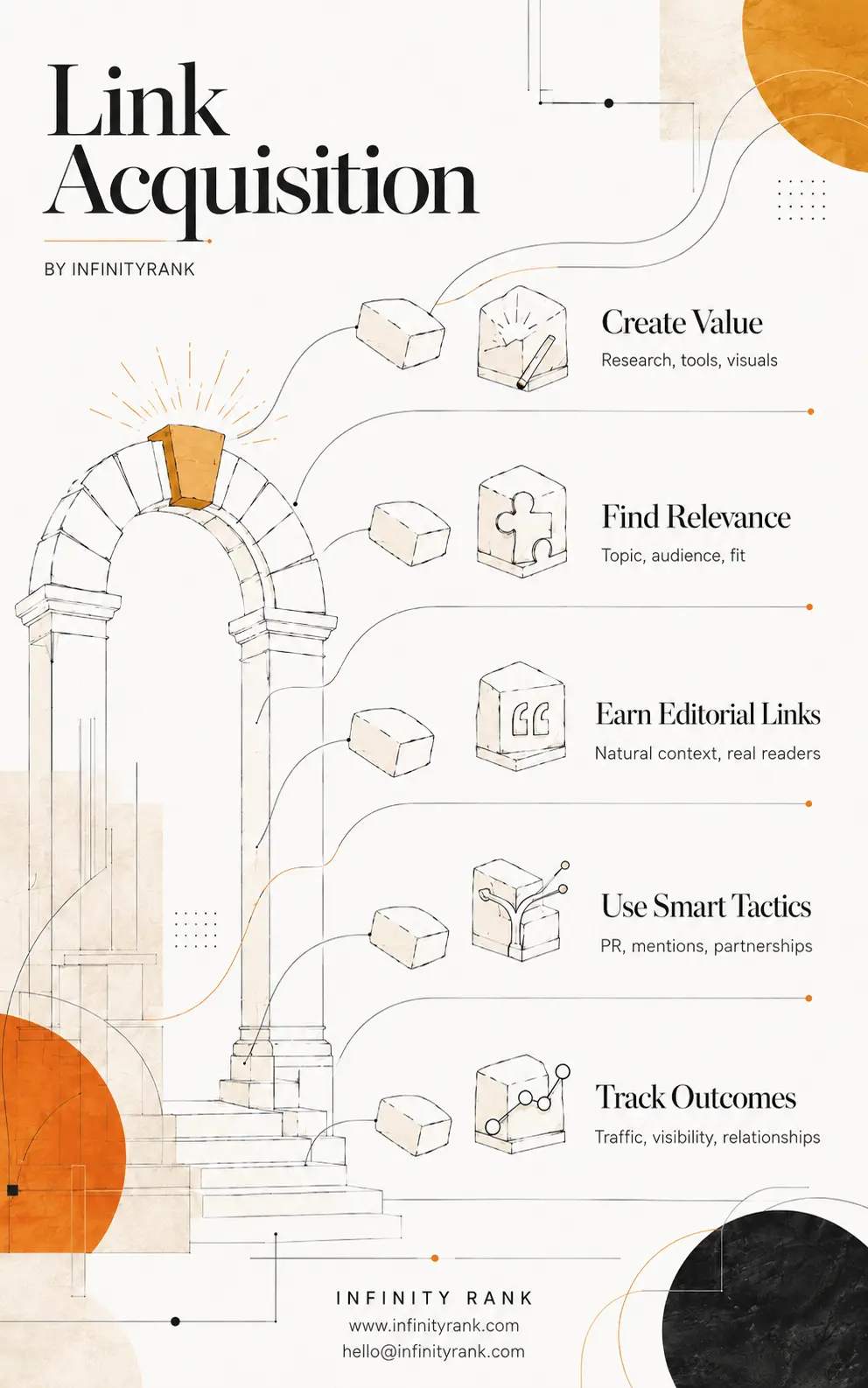
Accelerating acquisition momentum requires you to use smart tactics such as digital PR, brand mention reclamation, and strategic industry partnerships. Beyond securing placements, establishing robust analytics allows you to track outcomes like referral traffic growth, organic search visibility, and valuable industry relationships. Use these five core pillars as your operational blueprint to build a scalable, sustainable link acquisition engine.
Why Link Acquisition Still Matters in 2026
Links remain useful, but they should not be treated as magic ranking votes.
Google uses many systems and signals to rank pages. Modern SEO also depends on content quality, intent satisfaction, technical accessibility, site structure, user experience, and broader authority signals.
Link acquisition can still support SEO in several ways.
Search Visibility
Relevant links can help search engines discover content and understand how pages relate to topics across web.
Referral Traffic
A link on right page can send qualified visitors directly to your website, even if rankings never change.
Brand Visibility
Being cited by respected publications, industry sites, researchers, associations, or specialists puts your brand in front of relevant audiences.
Content Discovery
Links give crawlers additional paths to discover pages that might otherwise receive little external exposure.
Relationships
Outreach, digital PR, collaborations, and expert contributions can create relationships that generate future mentions beyond one backlink.
Best link campaigns therefore optimize for more than domain metrics.
What Makes a Good Backlink?
Before pursuing any prospect, ask why site should link to you.
Strong links normally have several qualities.
Topical Relevance
Linking page should have clear contextual relationship with your business, expertise, or destination content.
A cybersecurity company receiving a citation from a technical security publication makes sense. Same company receiving dozens of links from unrelated lifestyle blogs raises harder questions.
Editorial Reason
Link should help reader.
Publisher may cite:
- Original research
- Useful statistics
- Expert commentary
- Detailed guides
- Tools
- Templates
- Visual resources
- Definitions
- Primary sources
If only reason for link is SEO value, opportunity deserves closer scrutiny.
Real Audience
Good sites publish for people, not link buyers.
Look for signs of active readership, useful content, recognizable authors, legitimate business activity, and sustained organic visibility.
Contextual Placement
Links placed naturally inside relevant editorial content usually make more sense than unrelated footer, sidebar, profile, or boilerplate links.
Natural Anchor Text
Anchor text should describe destination naturally.
Do not force exact-match commercial keywords into every placement. Repeated manipulated anchors can create unnatural patterns.
Useful Destination
Link acquisition gets easier when target page deserves citation.
Do not expect publishers to link enthusiastically to thin sales pages with no unique value.
10 Proven Link Acquisition Strategies for 2026
Different businesses need different tactics. Choose methods based on assets, expertise, audience, competition, and available resources.
1. Build Linkable Assets
Create resources other publishers have reason to reference.
Examples include:
- Original research
- Surveys
- Industry reports
- Statistics pages
- Calculators
- Free tools
- Templates
- Checklists
- Data visualizations
- Maps
- Glossaries
- Benchmark studies
- Detailed technical guides
Best linkable assets provide something difficult to replace with another generic article.
Original data works well because journalists and writers often need evidence for claims. Tools and templates can earn links because they solve recurring problems.
Publishing asset is only first step.
Promote it to journalists, bloggers, industry publications, newsletter writers, resource-page owners, and businesses already discussing related subjects.
2. Target Relevant Resource Pages
Resource pages collect useful guides, tools, organizations, or references around one subject.
Find pages already recommending resources related to yours.
Search queries can include:
“best [topic] resources”
“[topic] useful links”
inurl:resources “[topic]”
intitle:resources “[topic]”
Then check whether your resource fills genuine gap.
Do not send generic message asking for backlink. Explain:
- Which resource you found
- Where your page fits
- Why it helps their audience
- What makes your resource different
Relevance matters more than sending hundreds of requests.
3. Reclaim Unlinked Brand Mentions
Sometimes websites mention your company, product, research, employee, or content without linking to source.
Those mentions can be good outreach opportunities because publisher already knows your brand.
Find them through:
- Search engines
- Brand-monitoring tools
- Backlink platforms
- News monitoring
- Manual searches for brand names and key people
Check page before contacting publisher. Not every mention needs link.
When link would genuinely help readers find original company, report, study, or resource, send short request.
Example:
Thanks for mentioning us. Would you mind linking to original resource so readers can find it easily?
Keep request useful and low-pressure.
4. Guest Blogging With Editorial Purpose
Guest posting can still make sense when primary purpose is reaching relevant audience and contributing useful expertise.
Good opportunities usually involve:
- Strong topical fit
- Genuine editorial review
- Real readership
- Original content
- Qualified authors
- Useful subject matter
- Natural citations
Avoid large-scale campaigns built around thin articles, identical templates, keyword-rich anchors, or sites publishing guest posts mainly for links.
Google’s spam policies target links created primarily to manipulate rankings. Guest content should therefore stand on its own as useful editorial material.
Pitch expertise, not backlink.
5. Use Broken Link Building
Broken link building finds dead external links on relevant pages and suggests working replacement.
Process:
- Find relevant resource or article pages.
- Identify broken outbound links.
- Check what dead resource originally covered.
- Find or create suitable replacement.
- Contact publisher.
- Explain broken link.
- Suggest replacement only when it genuinely matches original need.
This works because outreach solves publisher problem first.
Weak replacements fail. If dead link pointed to detailed industry research, replacing it with generic service page makes little sense.
6. Earn Links With Visual Assets
Original visual resources can earn citations when they make complex information easier to understand.
Useful formats include:
- Charts
- Diagrams
- Flowcharts
- Maps
- Timelines
- Original illustrations
- Comparison graphics
- Infographics
Make source easy to identify and link back to original data or explanation.
Avoid distributing keyword-heavy embed codes designed mainly to manufacture anchor-text links.
Better approach: create visual worth referencing, publish supporting context, and provide simple attribution instructions.
7. Run Digital PR Campaigns
Digital PR earns coverage by turning useful information into story journalists want to cover.
Campaign ideas include:
- Original datasets
- Surveys
- Trend analysis
- Regional comparisons
- Expert commentary
- Industry forecasts
- Data-driven rankings
- Timely research
- Responses to breaking industry stories
Strong campaign starts with story, not backlink target.
Ask:
- Why would journalist care?
- Why would readers care now?
- What data or expertise makes story credible?
- Can claim be verified?
- Does campaign offer something competitors have not already published?
Relevant editorial coverage can generate links, brand searches, referral traffic, mentions, and future media relationships.
8. Build Strategic Partnerships
Businesses already work with suppliers, software providers, associations, customers, complementary companies, and industry partners.
Those relationships can create legitimate link opportunities.
Examples:
- Joint research
- Co-authored whitepapers
- Webinars
- Case studies
- Partner directories
- Integration pages
- Expert interviews
- Industry events
- Collaborative guides
Do not turn every partnership into reciprocal-link exchange.
Link should exist because relationship or resource deserves reference, not because both sites agreed to trade ranking signals.
9. Pursue Contextual Link Opportunities Carefully
Existing articles sometimes contain natural places where new resource would improve page.
Often called niche edits or contextual link insertions.
Legitimate example:
Publisher maintains guide about technical SEO. Your original crawl-data study provides new evidence for one section. Editor reviews resource and chooses to cite it.
Risk rises when placements are purchased across unrelated sites solely to influence rankings.
Before pursuing contextual placement, check:
- Is page relevant?
- Does new source improve content?
- Would editor add link without SEO incentive?
- Is placement transparently commercial if payment is involved?
- Does publisher sell large numbers of inserted links?
- Is anchor text natural?
Treat editorial relevance as requirement.
10. Participate in Communities Without Spamming
Forums, Q&A platforms, professional groups, and industry communities can generate visibility and occasional natural links.
Wrong approach:
Find every discussion mentioning keyword and drop URL.
Better approach:
Answer question completely. Share useful experience. Add source only when it genuinely helps.
Community activity can generate:
- Referral traffic
- Brand recognition
- Relationships
- Content ideas
- Mentions
- Secondary links from people who discover your resource
Do not measure community participation by number of links created.
How to Vet Link Prospects
Poor prospect selection wastes outreach and increases risk.
Use consistent review process.
Check Relevance
Would linking site realistically discuss your topic?
Review Content Quality
Look at several recent pages.
Check whether content is useful, original, edited, and written for real readers.
Inspect Organic Visibility
Traffic estimates are imperfect, but severe visibility decline or almost no indexed presence can justify closer investigation.
Check Outbound-Link Patterns
Warning signs include:
- Large numbers of unrelated commercial links
- Repeated exact-match anchors
- Articles built around link placements
- Sudden subject changes
- Casino, crypto, loans, supplements, and unrelated SaaS links mixed together
- “Write for us” sections clearly designed around paid placements
One signal alone does not prove site is bad. Look at whole pattern.
Check Editorial Standards
Does publisher identify authors? Edit submissions? Cite sources? Maintain clear subject focus?
Check Destination Page
Ask whether your proposed page deserves link before sending outreach.
Simple Link Acquisition Process
Good campaigns need repeatable workflow.
1. Define Goal
Possible goals:
- Build links to important content
- Earn media coverage
- Increase referral traffic
- Strengthen topic visibility
- Promote research
- Support product launch
- Build industry relationships
2. Choose Target Pages
Do not send every link to homepage.
Choose pages with clear strategic value and enough substance to earn citations.
3. Study Competitor Links
Review which pages attract links to competing sites.
Look for patterns:
- Research
- Tools
- Statistics
- Guides
- PR stories
- Partnerships
- Resource pages
Do not copy links mechanically. Use patterns to identify opportunities.
4. Build Prospect List
Collect sites and pages relevant to chosen strategy.
5. Qualify Prospects
Remove irrelevant, low-quality, or suspicious opportunities before outreach.
6. Find Right Contact
Editor, journalist, content manager, resource-page owner, or subject expert usually works better than generic inbox.
7. Personalize Outreach
Show why your resource matters to their page and audience.
Avoid fake compliments and long introductions.
8. Follow Up
One or two useful follow-ups can recover missed emails. Endless automated chasing hurts reputation.
9. Verify Placements
Check:
- Correct destination
- Correct anchor
- Page indexability
- Link attributes where relevant
- Context around link
- Whether page remains live
10. Measure Results
Judge campaign against original goal.
Link Acquisition Metrics Worth Tracking
Raw backlink count tells little by itself.
Track:
- New referring domains
- Relevant referring domains
- Links to priority pages
- Referral traffic
- Outreach response rate
- Positive-response rate
- Placement rate
- Media mentions
- Brand searches
- Organic visibility of target pages
- Assisted conversions
Avoid treating Domain Rating, Domain Authority, or similar third-party metrics as Google ranking scores.
They are useful comparative metrics, not Google metrics.
Common Link Acquisition Mistakes
Chasing Metrics Instead of Relevance
High third-party authority score does not make unrelated link useful.
Buying Any Link Available
Easy availability often signals weak editorial standards.
Overusing Exact-Match Anchor Text
Natural link profiles contain varied anchors: brand names, page titles, URLs, descriptive phrases, and generic references.
Sending Generic Outreach
Mass templates make it obvious sender never reviewed page.
Building Links to Weak Content
Outreach cannot permanently compensate for thin, outdated, or unhelpful destination page.
Ignoring Referral Value
Relevant link that sends qualified visitors can be valuable even if SEO effect cannot be isolated.
Expecting Immediate Ranking Changes
There is no fixed timeline.
Search performance depends on many factors beyond backlinks, including crawl frequency, competition, content quality, technical condition, search intent, and broader ranking systems.
Final Thoughts
Link acquisition works best when link is outcome of something useful.
Publish original resources. Build relationships. Help publishers improve content. Give journalists credible stories. Contribute expertise where audience needs it.
Do not chase arbitrary backlink totals.
Build links that make sense even if SEO metrics disappeared tomorrow.
That approach gives campaign more ways to win: referral traffic, discovery, brand visibility, relationships, citations, and potential search benefits.
FAQs
Is link acquisition same as link building?
Terms largely overlap. Both describe work used to earn or secure backlinks. Some marketers use “link acquisition” to emphasize earned editorial links, but there is no universal industry distinction.
How long does link acquisition take to affect SEO?
No fixed timeline exists. Search engines need to discover and process links, and ranking changes depend on many other signals. Results can take weeks or months and should not be attributed to one backlink without evidence.
Do all backlinks help SEO?
No. Search engines may value, ignore, or neutralize links depending on context. Links created mainly to manipulate rankings can also violate spam policies.
Can small businesses run link acquisition themselves?
Yes. Start with tactics using existing relationships and expertise: brand-mention reclamation, partnerships, resource outreach, expert contributions, and useful local or industry resources. Outsource when prospecting, content production, or outreach exceeds internal capacity.
Are paid links against Google’s rules?
Payment itself is not automatically forbidden, but links involving advertising, sponsorship, or other commercial arrangements should be qualified appropriately. Links bought primarily to manipulate rankings can violate Google’s spam policies.
Are niche edits safe?
Depends on how placement is earned. Legitimate editorial update that adds useful source can be reasonable. Purchased insertions across unrelated or low-quality pages mainly intended to influence rankings carry greater risk.
Should I use Domain Authority or Domain Rating to choose sites?
Use them as secondary comparative metrics only. They are third-party scores, not Google ranking metrics. Relevance, editorial quality, real audience, content quality, and placement context matter more.
Is link acquisition future-proof?
No SEO tactic is future-proof. Earning legitimate citations, useful referral traffic, brand exposure, and genuine editorial coverage is more defensible than strategies designed mainly to manipulate ranking signals.