
A backlink count tells you almost nothing by itself.
One website can acquire 100 links and see no meaningful improvement. Another can earn five relevant editorial links and increase rankings, referral traffic and qualified leads.
The difference is link quality, campaign targeting and measurement.
Link building metrics help you answer two separate questions:
- Is this backlink worth acquiring?
- Is the link-building campaign producing business results?
Those questions require different metrics. Domain Authority, Domain Rating and similar scores can help evaluate prospects, but they do not prove that a campaign succeeded. Campaign success must be measured through referring domains, search visibility, traffic, conversions, link retention and return on investment.
This guide explains the 12 link building metrics that matter, what each one measures and how to use them without being misled by vanity scores.
What Are Link Building Metrics?
Link building metrics are measurements used to evaluate the quality of backlinks, monitor the growth of a backlink profile and determine whether link acquisition is improving search performance or business outcomes.
They generally fall into two categories:
| Metric Category | What It Answers | Examples |
| Backlink quality metrics | Is this website, page or link worth pursuing? | Relevance, page strength, authority scores, organic visibility, placement and anchor text |
| Campaign performance metrics | Is link building producing measurable results? | New referring domains, rankings, organic traffic, conversions, cost per link and ROI |
Do not mix the two.
A higher Domain Rating may indicate that a website has a stronger backlink profile. It does not prove that a link from that website will improve your rankings, generate traffic or produce revenue.
Why Link Building Metrics Matter
Google’s documented ranking systems still include link analysis systems and PageRank. However, Google evaluates links alongside many other signals, including relevance, content quality and user intent.
That means link building cannot be reduced to acquiring the highest possible number of backlinks.
The right metrics help you:
- Reject irrelevant or manipulated link prospects.
- Compare opportunities consistently.
- Prioritise pages that need stronger external support.
- Monitor whether acquired links remain live.
- Connect link acquisition with rankings and organic traffic.
- Calculate campaign costs and financial returns.
- Report results without relying on third-party authority scores.
No single metric can determine whether a backlink is good. Strong link evaluation requires a combination of quantitative data and manual review.
Link Building Metrics: Real Success vs. Vanity Numbers
Tracking the success of your link building can be tough if you only look at basic website scores. To get real results, you need to understand two different types of data: the numbers that measure the quality of a target site, and the numbers that track your actual campaign results. By focusing first on true relevance and looking past surface-level scores, you can make sure every link you build actually helps your website grow.
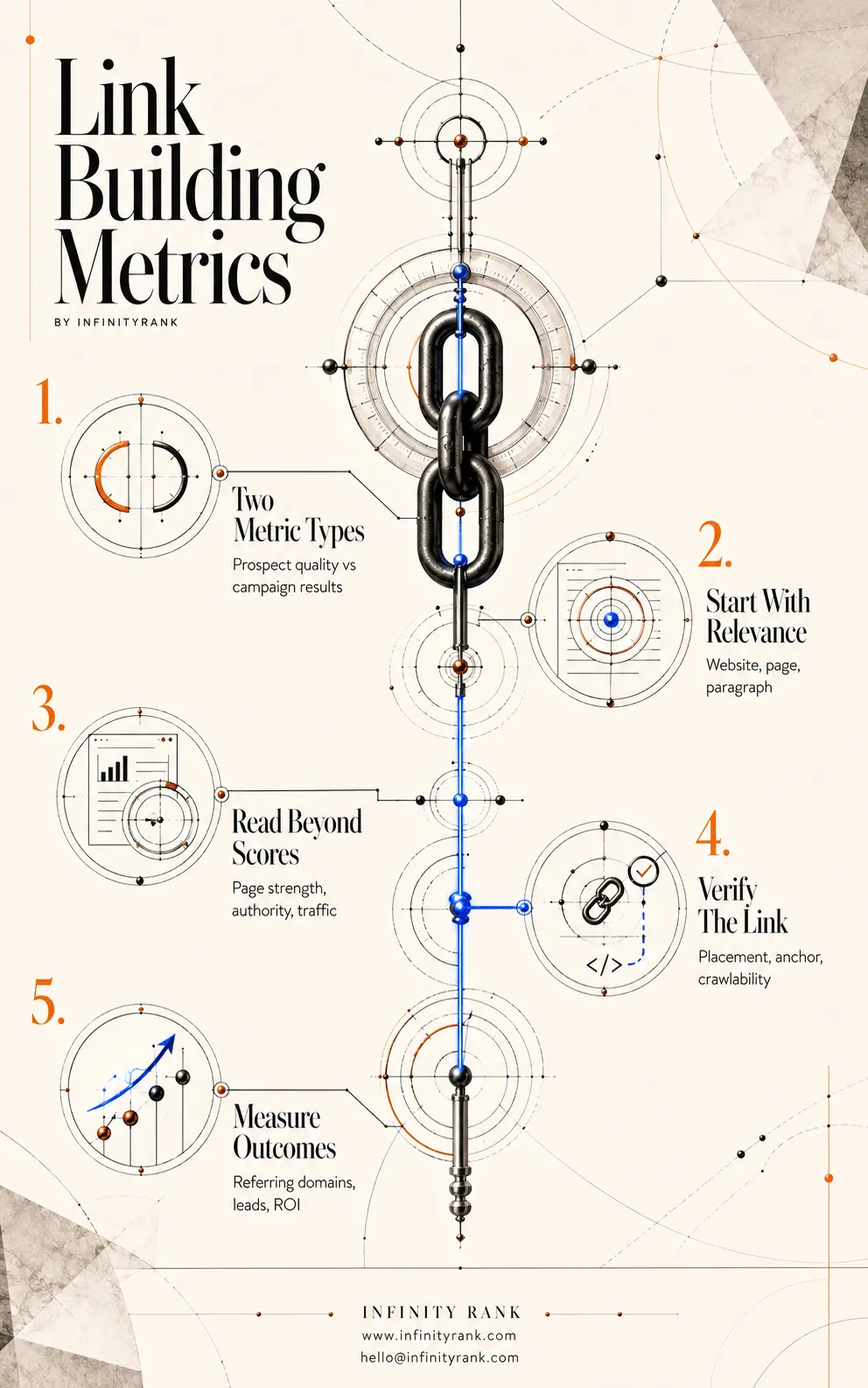
At the end of the day, a great backlink strategy comes down to tracking real business outcomes like new leads, referring domains, and a higher return on investment. Verifying your link placement, anchor text, and crawlability guarantees your hard work pays off safely. Use these five core steps as your daily checklist to measure what truly matters and scale your search rankings safely.
Backlink Quality Metrics
The first eight metrics help you evaluate a website, a linking page and the link itself before or after acquisition.
1. Topical and Contextual Relevance
Relevance is the first filter, not an optional extra.
A backlink should make sense to the reader encountering it. The linking page does not need to cover exactly the same topic as your website, but there should be a clear editorial reason for the link.
For example:
- A digital marketing publication linking to an SEO pricing study is directly relevant.
- A business publication linking to the same study within an article about customer acquisition is contextually relevant.
- An unrelated coupon, gambling or general-directory page linking to the study without a logical reason is weak or suspicious.
Evaluate relevance at three levels:
Website relevance
Does the website regularly publish content connected to your industry, audience or subject area?
Page relevance
Is the specific linking page related to the page receiving the backlink?
Paragraph relevance
Does the surrounding text explain why the link is useful?
Page and paragraph relevance are often more informative than the website’s broad category. A large publication may cover hundreds of topics, while the specific article linking to you may be highly relevant.
What to check:
- The website’s core editorial focus
- The topic of the linking page
- The text surrounding the link
- Whether the destination adds useful evidence or detail
- Whether a real editor would reasonably include the link
Do not approve a prospect solely because its authority score is high.
2. Source-Page Strength
Backlinks come from pages, not abstract domain scores.
A website may have a powerful homepage while the specific article offering the link has no external backlinks, no internal links and no organic visibility. That page-level weakness matters.
Common page-level metrics include:
- Page Authority: Moz’s prediction of how likely a specific page is to rank.
- URL Rating: Ahrefs’ measurement of the strength of a page’s link profile.
According to Ahrefs’ official URL Rating documentation, URL Rating is calculated at page level and considers both internal and external links.
Use page-level metrics to compare similar opportunities, but inspect the page manually as well.
Check whether the linking page:
- Is indexed by Google.
- Receives internal links from important parts of the website.
- Has acquired legitimate external backlinks.
- Ranks for relevant search queries.
- Is likely to remain live.
- Contains useful, original content.
- Is accessible without redirects, canonical conflicts or noindex instructions.
A link from a useful, well-connected internal page may be more valuable than a link buried on an abandoned article within a stronger domain.
3. Domain-Level Authority Metrics
Domain-level authority scores summarise aspects of an entire website’s backlink profile or SEO strength.
The most common are:
| Metric | Provider | Scope | What It Measures | Best Use |
| Domain Authority | Moz | Domain | Predicted ranking potential based primarily on link data | Comparing websites within a relevant competitive set |
| Domain Rating | Ahrefs | Domain | Relative strength of a domain’s backlink profile | Comparing referring-domain strength |
| Authority Score | Semrush | Domain or page | Compound estimate based on link power, organic traffic and profile signals | Comparing overall website quality within Semrush |
| Trust Flow | Majestic | Domain or URL | Proximity to Majestic’s trusted seed set | Reviewing link-profile trust signals |
| Citation Flow | Majestic | Domain or URL | Estimated link equity or influence | Comparing link strength alongside Trust Flow |
These are proprietary vendor metrics. They are not Google ranking scores.
Domain Authority
Moz’s Domain Authority uses data from its own link index and machine-learning model to estimate how likely a domain is to rank.
Use DA comparatively. A DA of 40 may be strong within one market and weak within another.
Do not assume:
- A DA 70 link is automatically better than a DA 30 link.
- Increasing DA guarantees higher Google rankings.
- A low-DA website is necessarily spam.
- Every page on a high-DA website is powerful.
For a deeper comparison, read our guide to Domain Rating versus Domain Authority.
Domain Rating
Ahrefs defines Domain Rating as the relative strength of a website’s backlink profile on a 100-point scale.
DR is logarithmic and relative. There is no universal “good” DR score.
Ahrefs explicitly recommends comparing a website with similar sites rather than judging the number in isolation.
A high DR does not prove that:
- The website receives organic traffic.
- Its content is relevant.
- The linking page is indexed.
- The website has a legitimate audience.
- The link will improve your rankings.
- The website does not sell links at scale.
Semrush Authority Score
Semrush Authority Score is a compound metric that evaluates a domain or page using factors such as link power, estimated organic traffic and signs of an unnatural backlink profile.
Because it includes more than backlink volume, it may differ significantly from Moz DA or Ahrefs DR.
That does not make one score correct and the others wrong. Each tool uses its own index, formula and update schedule.
Trust Flow and Citation Flow
Majestic’s Trust Flow and Citation Flow should be interpreted together.
Majestic describes Citation Flow as a score intended to estimate the link equity or influence carried by a URL or website. Trust Flow focuses on the quality of links and proximity to Majestic’s trusted seed set.
A large difference between the two scores can justify further investigation, but fixed ratios and universal thresholds are unreliable.
Majestic also states that its Flow Metric scores do not directly influence search engines.
How to use authority metrics correctly
Use authority metrics to:
- Compare similar prospects.
- Identify websites that require deeper review.
- Benchmark your site against direct competitors.
- Segment prospect lists.
- Detect unusual differences between tools.
Do not use them as:
- Google ranking factors.
- Guarantees of backlink value.
- Standalone definitions of spam.
- Primary campaign KPIs.
- Contractual targets without additional quality requirements.
4. Organic Visibility and Traffic
A website with genuine search visibility is generally easier to validate than one with impressive authority scores but no ranking footprint.
Review:
- Estimated monthly organic traffic.
- Organic traffic trends.
- Ranking keywords.
- Branded versus non-branded visibility.
- The countries generating traffic.
- The relevance of its ranking topics.
- Whether traffic is concentrated on legitimate pages.
Traffic estimates from Ahrefs, Semrush and similar platforms are not exact analytics data. They are modelling tools.
Use them to identify patterns, not to declare that one website receives precisely 25,000 monthly visits.
Warning signs
Investigate further when a website has:
- High DA or DR but almost no organic keywords.
- A severe and unexplained traffic decline.
- Traffic generated by unrelated or low-quality topics.
- Most rankings in countries irrelevant to its stated audience.
- Hundreds of newly published pages targeting unrelated commercial keywords.
- A backlink profile that appears much stronger than its content or audience.
A high-traffic website is not automatically a good prospect either. The linking page and audience must still be relevant.
5. Referring-Domain Quality and Diversity
Ten backlinks from ten independent, credible websites generally tell you more than 100 links from one domain.
That is why referring domains are usually more useful than raw backlink counts.
Review:
- Total referring domains.
- Followed and non-followed referring domains.
- New and lost referring domains.
- The topical relevance of referring sites.
- Geographic and market diversity.
- Repeated links from the same site network.
- Concentration across IP addresses or subnets.
- The proportion of links pointing to the homepage versus internal pages.
A natural backlink profile usually includes different publications, organisations, resource pages, partners, citations and editorial contexts.
However, diversity should not become a mechanical target. Ten irrelevant referring domains are not better than three highly relevant ones.
Focus on legitimate editorial independence and audience fit.
6. Link Attributes, Crawlability and Indexability
Before counting a backlink as successfully acquired, verify that search engines can access the linking page and understand the link.
Check:
- The page returns a successful HTTP status.
- The page is not blocked by robots.txt.
- The page does not contain a noindex directive.
- The page’s canonical tag points to itself or an appropriate canonical URL.
- The link uses a standard HTML anchor with an href.
- The destination URL is correct.
- The link does not pass through an unnecessary redirect chain.
- The link has not been inserted through inaccessible scripts or widgets.
You should also inspect its rel attributes.
Google’s outbound-link guidance explains the main attributes:
rel="sponsored"identifies advertising, sponsorships and other compensated placements.rel="ugc"identifies links within user-generated content.rel="nofollow"can be used when the other values do not apply and the publisher does not want Google to associate the sites through the link.
A nofollow link is not automatically worthless. It may still generate referral traffic, brand exposure, citations or future link opportunities.
The attribute does, however, affect how you classify and report the link.
7. Link Placement and Editorial Context
Where a link appears can reveal whether it was included to help readers or merely inserted to manipulate rankings.
Stronger editorial placements usually appear:
- Within the main body content.
- Near relevant supporting text.
- On a page with a clear purpose.
- Where readers are likely to notice and use the link.
- As a natural citation, recommendation or source.
Weaker placements commonly appear:
- In sitewide footers or sidebars.
- In unrelated author biographies.
- Inside large lists of paid links.
- On thin pages created only to host outbound links.
- In existing articles where the sentence has clearly been rewritten around an unnatural keyword.
- On pages with dozens or hundreds of unrelated commercial destinations.
Also review how many external domains the page links to. A page can legitimately cite several sources, but a pattern of indiscriminate commercial links warrants scrutiny.
Do not judge placement from a screenshot alone. Inspect the live HTML and surrounding article.
8. Anchor Text
Anchor text is the clickable text used for a link.
Common types include:
- Branded: Infinity Rank
- URL: infinityrank.com
- Topical: link building metrics
- Exact-match commercial: link building services
- Partial-match: professional link building support
- Generic: learn more
- Image anchor: determined through the image’s alternative text
Anchor text helps users and search engines understand the destination. Google recommends using descriptive, concise and contextually relevant anchor text in its link best-practice documentation.
There is no safe universal percentage for branded, exact-match or generic anchors.
Your profile should reflect how independent publishers naturally describe your brand, research, products and content.
What to avoid
Do not force every publisher to use the same keyword-rich anchor.
Google’s spam policies identify links created primarily to manipulate rankings as link spam. The examples include paid articles that pass ranking credit and optimised anchor text distributed through articles, guest posts or press releases.
Evaluate anchor text across the entire backlink profile rather than panicking over one isolated link.
Campaign Performance Metrics
The next four metrics determine whether your campaign is creating durable links and improving commercial performance.
9. New Referring Domains and Link Retention
Report new referring domains, not just the total number of new backlinks.
Also track whether acquired links remain live.
A campaign that reports 50 placements but loses 20 of them within three months has a quality or fulfilment problem.
Track:
- New live links.
- New referring domains.
- Links lost during the reporting period.
- Links reclaimed or restored.
- Followed, nofollow, sponsored and UGC links.
- Destination pages.
- Link acquisition method.
- Publication date.
- Last verified date.
- Link retention rate.
Use this formula:
Link retention rate = active links from an acquisition cohort ÷ total links originally acquired × 100
Measure retention by cohort. For example, review all links acquired in January after 30, 90 and 180 days.
This prevents recent links from hiding the loss of older placements.
Do not count a link as delivered until you have verified that:
- The correct destination is used.
- The page is live.
- The link appears in the agreed context.
- The page is crawlable.
- The link is not hidden.
- Any agreed attribute has been applied.
- The placement meets your quality criteria.
10. Target-Page Search Performance
The purpose of most SEO-led link campaigns is not to increase an authority score. It is to improve the visibility and performance of selected pages.
Track target-page changes in:
- Search impressions.
- Organic clicks.
- Click-through rate.
- Average position.
- Number of ranking queries.
- Number of keywords in priority position ranges.
- Non-branded organic traffic.
- Visibility for strategically important queries.
Google Search Console explains how it calculates clicks, impressions and position. Use page and query filters to isolate the URLs supported by the campaign.
Record a baseline before link acquisition begins.
Compare:
- The 28 or 90 days before the campaign.
- The equivalent period after links are discovered and indexed.
- Year-over-year results where seasonality matters.
- Supported pages against similar unsupported pages where possible.
Do not claim that one backlink caused a ranking increase simply because the two events occurred near each other.
Rankings can change because of:
- Content updates.
- Internal linking.
- technical fixes.
- Search algorithm changes.
- Competitor activity.
- Search demand.
- SERP-layout changes.
- Other backlinks discovered during the same period.
Report the relationship honestly. Link building contributes to performance; attribution is rarely perfectly isolated.
11. Referral Traffic, Leads and Conversions
Some links generate direct visitors even when their SEO effect cannot be isolated.
Google Analytics 4 records the website that sent a visitor as a referral source when that source can be identified. Review referral traffic from each acquired domain.
Track:
- Referral users and sessions.
- Engaged sessions.
- Engagement rate.
- Key events.
- Newsletter sign-ups.
- Enquiries.
- Demo requests.
- Purchases.
- Assisted conversions.
- Revenue or qualified pipeline.
A relevant industry article that sends ten qualified prospects may be commercially stronger than a higher-scoring link that sends no visitors.
However, referral traffic should not be required from every backlink. Citations in research, news articles and resource pages may support authority or discovery without producing significant direct traffic.
Evaluate each link according to its intended role.
For cleaner attribution:
- Add annotations to your campaign reporting.
- Record publication dates.
- Use appropriate campaign parameters only when editorially acceptable.
- Compare referral-source data with CRM records.
- Ask leads how they discovered the business.
- Track assisted journeys rather than only last-click conversions.
12. Cost per Link and Link-Building ROI
Link building has costs even when no placement fee is paid.
Include:
- Prospecting time.
- Outreach labour.
- Content creation.
- Design and data production.
- Digital PR tools.
- Subscriptions.
- Agency or freelancer fees.
- Placement or sponsorship costs where applicable.
- Management and reporting time.
Calculate cost per acquired qualifying link:
Cost per acquired link = total campaign cost ÷ number of live links meeting the agreed quality criteria
You can also calculate cost per new referring domain:
Cost per referring domain = total campaign cost ÷ new qualifying referring domains
Do not minimise the cost-per-link figure by counting:
- Duplicate links from the same placement.
- Links that were removed.
- Links that point to the wrong URL.
- Placements that fail the agreed criteria.
- Automatically generated profile or scraper links.
- Links discovered naturally but not created by the campaign.
For financial return, use:
Link-building ROI = attributable incremental return − campaign cost ÷ campaign cost × 100
Where possible, use incremental gross profit rather than top-line revenue.
Attribution will not always be exact. A realistic report can present:
- Direct referral revenue.
- Organic conversions from supported landing pages.
- Assisted conversion value.
- Estimated incremental profit.
- Pipeline generated.
- Cost savings compared with paid acquisition.
Read our full guide to measuring link-building ROI for a more detailed reporting model.
How to Evaluate a Backlink
Use this process instead of approving or rejecting opportunities from one score.
Step 1: Confirm editorial relevance
Ask whether the website, page and paragraph have a logical reason to reference your content.
Reject placements where the connection is manufactured.
Step 2: Inspect the website manually
Review the site’s editorial standards, ownership, audience, publishing patterns and commercial behaviour.
Look for:
- Real authors or editorial accountability.
- Original articles.
- Clear subject focus.
- Reasonable advertising.
- Legitimate business information.
- Consistent quality.
- A genuine readership.
Step 3: Review domain and page data
Compare DA, DR, Authority Score, Trust Flow, Citation Flow, organic traffic and referring-domain data.
Treat inconsistencies as investigation prompts, not automatic rejection rules.
Step 4: Inspect the linking page
Check indexability, internal links, external backlinks, organic visibility, outbound links and content quality.
The source page matters more than the domain score alone.
Step 5: Review the exact link
Confirm its anchor text, destination, attributes, surrounding text and page placement.
Step 6: Record the reason for acquisition
Classify the link by purpose:
- Ranking support.
- Referral traffic.
- Brand exposure.
- Citation or credibility.
- Digital PR.
- Partnership.
- Resource-page inclusion.
This gives the campaign a measurable objective beyond “increase DR.”
Backlink Quality Checklist
Before approving a link prospect, answer these questions:
| Check | Pass Condition |
| Relevance | The website or page has a legitimate editorial reason to link |
| Content quality | The page is original, useful and written for readers |
| Indexability | The page can be crawled and indexed |
| Page strength | The source page has internal or external authority |
| Organic visibility | The website shows credible, relevant search activity |
| Link placement | The link appears naturally within the main content |
| Anchor text | The anchor is descriptive and not forced |
| Link attributes | Attributes match the nature of the placement |
| Outbound-link pattern | The page is not an indiscriminate collection of commercial links |
| Stability | The website and page are likely to remain live |
| Audience value | The placement reaches a relevant audience |
| Risk | The link does not appear designed primarily to manipulate rankings |
A prospect does not need to be perfect in every category. The final decision should reflect the campaign’s goals, market and risk tolerance.
How to Measure a Link-Building Campaign
A reliable reporting process should follow five stages.
1. Establish the baseline
Before outreach begins, record:
- Current target-page rankings.
- Search Console impressions and clicks.
- Organic sessions and conversions.
- Existing referring domains.
- Current backlinks to each target page.
- Conversion rate and commercial value.
- Campaign costs.
Without a baseline, later reporting becomes guesswork.
2. Define qualifying-link criteria
Document what the campaign will and will not count.
Criteria may include:
- Relevant website or page.
- Minimum editorial standard.
- Indexed and crawlable placement.
- Correct destination URL.
- Contextual placement.
- Agreed market or audience.
- No prohibited site categories.
- No obvious link-network participation.
- Minimum retention period.
Do not make one authority score the entire specification.
3. Verify every placement
Record each link in a central campaign sheet or database.
Recommended fields include:
| Field | Purpose |
| Referring domain | Identifies the source website |
| Linking URL | Enables manual verification |
| Target URL | Shows which page receives support |
| Anchor text | Monitors context and profile distribution |
| Link attribute | Separates followed, nofollow, sponsored and UGC links |
| Publication date | Establishes the campaign timeline |
| Acquisition method | Distinguishes outreach, PR, partnerships and organic links |
| Cost | Supports cost and ROI calculations |
| Last checked | Enables retention monitoring |
| Status | Live, changed, lost, redirected or removed |
4. Monitor leading indicators
Leading indicators show whether campaign execution is moving in the right direction.
Examples include:
- Outreach response rate.
- Placement conversion rate.
- New referring domains.
- Link quality.
- Link retention.
- Distribution across target pages.
- Time from outreach to publication.
These metrics diagnose the campaign. They are not the final business outcome.
5. Report outcome metrics
Outcome metrics include:
- Search visibility.
- Organic clicks.
- Non-branded traffic.
- Referral traffic.
- Leads.
- Revenue.
- Cost per acquisition.
- ROI.
A useful report connects execution with outcomes without pretending that every ranking change came from one link.
Common Link Building Measurement Mistakes
Reporting Domain Rating as the main result
DR measures the relative strength of a backlink profile within Ahrefs. It is not a revenue, traffic or Google ranking metric.
Report it as supporting context, not the main result.
Counting backlinks instead of referring domains
A website can create hundreds of links through navigation, archives or duplicated pages. That does not equal hundreds of independent endorsements.
Ignoring the source page
A strong domain can publish weak, isolated or non-indexed pages. Always evaluate the actual page containing the link.
Setting universal authority thresholds
A mandatory DR 50 rule may exclude legitimate specialist publications in smaller industries while accepting irrelevant websites with inflated profiles.
Benchmark prospects within the relevant market.
Treating estimated traffic as exact
Third-party traffic tools estimate performance. Use trends and comparisons rather than reporting estimates as analytics facts.
Ignoring lost links
A campaign cannot be judged only by placements secured. Links that disappear, change destinations or become inaccessible must be included in performance reporting.
Assuming correlation proves causation
Ranking increases after link acquisition are encouraging, but multiple SEO and market variables may have contributed.
Disavowing links because a tool gives them a low score
A low DA, DR or Authority Score is not a reason to disavow a link.
Google states that most websites do not need to use the disavow tool. It is intended for situations involving a considerable number of artificial or low-quality links that have caused, or are likely to cause, a manual action.
Read our guide to disavowing toxic backlinks before submitting a disavow file.
Final Thoughts
The best link building metrics do more than rank websites from 1 to 100.
They help you determine:
- Whether a link is relevant.
- Whether the source page is credible and accessible.
- Whether the referring domain has a legitimate audience.
- Whether acquired links remain live.
- Whether target pages gain search visibility.
- Whether the campaign generates traffic, leads or revenue.
- Whether the financial return justifies the cost.
Use DA, DR, Authority Score, Page Authority, URL Rating and Flow Metrics as comparative diagnostic tools.
Use referring domains, link retention, search performance, conversions and ROI to measure campaign success.
The objective is not to collect higher scores. It is to acquire defensible links that support measurable business growth.
Frequently Asked Questions
What is the most important link building metric?
There is no single most important metric. For prospect evaluation, relevance and source-page quality should come first. For campaign reporting, focus on new qualifying referring domains, target-page search performance, conversions and ROI.
Which is better: Domain Authority or Domain Rating?
Neither is universally better. Moz Domain Authority and Ahrefs Domain Rating use different backlink indexes and formulas. Use them to compare similar websites within the same tool rather than comparing the numbers directly.
What is a good Domain Rating?
There is no universal good DR. Ahrefs describes DR as a relative metric and recommends comparing it with similar websites. A strong score in a local niche may be weak in a highly competitive international market.
Can a low-DA or low-DR website provide a valuable backlink?
Yes. A specialist publication may have a modest authority score but a highly relevant audience, strong editorial standards and a useful linking page. Low authority is not the same as low quality.
Are nofollow links worth acquiring?
They can be. Nofollow links may generate referral traffic, citations, brand exposure and secondary link opportunities. Classify them accurately rather than treating them as identical to standard followed links.
How often should link building metrics be checked?
Verify new placements when they go live and monitor link retention regularly. Monthly reporting is common, while large or fast-moving campaigns may require weekly operational checks. Rankings and commercial outcomes should be evaluated over longer periods rather than through daily fluctuations.
Should low-quality backlinks be disavowed?
Not automatically. Do not disavow links solely because a third-party tool labels them toxic or gives them a low score. Google says most websites do not need the disavow tool. Use it cautiously when there is a substantial pattern of artificial links associated with a manual action or a credible risk of one.
How long does it take for a backlink to affect rankings?
There is no fixed period. The linking page must be discovered and processed, and rankings depend on many other signals. Evaluate campaign performance over meaningful reporting periods rather than expecting an immediate movement from every link.