
Link building can improve search visibility, referral traffic, and organic conversions. But those outcomes do not automatically make a campaign profitable.
To determine whether the investment was worthwhile, you need to calculate link building ROI using:
- The campaign’s total cost
- The performance you would have achieved without it
- The incremental conversions or revenue it helped generate
- Your contribution margin
- A consistent attribution and reporting period
That is harder than counting backlinks or comparing traffic before and after a campaign. Rankings can change because of content updates, technical improvements, competitor activity, seasonality, algorithm changes, and growing brand demand.
This guide explains how to measure link building ROI without claiming more certainty than the data supports.
What Is Link Building ROI?
Link building ROI measures the financial return generated by a link-building campaign relative to its total cost.
The basic formula is:
Link Building ROI (%) = [(Incremental Contribution Profit − Campaign Cost) ÷ Campaign Cost] × 100
The important term is incremental contribution profit.
It is not total revenue from organic search. It is the additional profit generated above the expected baseline and reasonably attributable to the campaign.
A positive ROI means the estimated profit exceeded the campaign cost. A negative ROI means the campaign had not recovered its cost during the reporting period.
Why Link Building ROI Is Difficult to Measure
Links do not produce a predictable return immediately after acquisition.
Google uses links as one signal when assessing and discovering pages, but its ranking systems consider many signals. A ranking improvement that happens after a link campaign does not prove that the links caused the improvement.
A link may contribute value in several ways:
- Sending referral traffic directly
- Supporting the organic visibility of a target page
- Helping Google discover a page
- Increasing assisted conversions
- Strengthening visibility for multiple related queries
- Continuing to send traffic after the acquisition work ends
The effect may also appear across several pages and over a longer period than the original campaign.
Attribution creates another problem. A customer may discover a business through organic search, return through a branded query, click an email, and convert later. Google Analytics assigns credit according to the selected attribution model, meaning the reported value can change depending on how credit is distributed across touchpoints.
The objective is therefore not to produce a falsely exact number. It is to create a defensible estimate based on documented assumptions.
SEO Budgets: Waste or Investment?
Pouring thousands of dollars into acquisition campaigns without tracking hard financial returns is a fast track to burned marketing budgets and stakeholder skepticism. Many brands rely on vague vanity metrics like organic traffic charts or keyword movements, but these numbers never prove real business growth.
Connecting acquisition costs directly to bottom-line profit margins is the only way to justify ongoing investment and scale your campaigns securely. This performance evaluation framework outlines five essential steps to capture hidden expenses, calculate incremental revenue lifts, and accurately measure your campaign’s financial return.
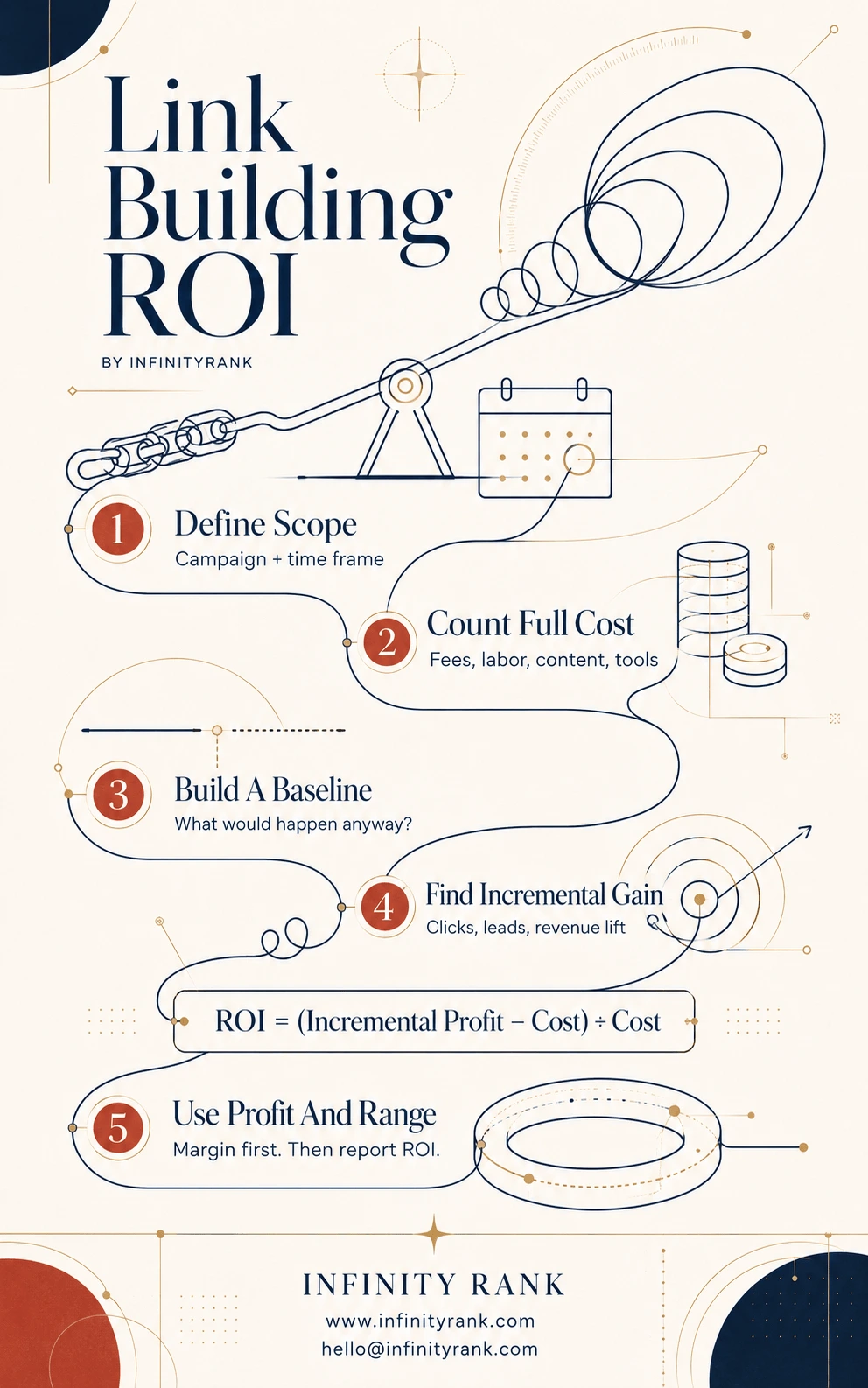
Proving performance requires looking past surface-level search volume and focusing purely on business profitability. By tracking full operational costs and isolating actual profit increases from your organic baseline, you turn your marketing costs into a predictable growth channel. Use the link-building-roi-infographic as your financial auditing template to calculate and protect your acquisition budgets today.
Link Building ROI, Traffic Value, and Cost per Link Are Different
These metrics are often confused, but they answer different questions.
| Metric | What It Measures | What It Does Not Prove |
| Cost per acquired link | Campaign cost divided by links secured | Whether the links generated profit |
| Referral value | Conversions or revenue from direct referral visits | The link’s wider effect on organic visibility |
| Organic traffic value | Estimated cost of buying similar clicks through ads | Actual revenue or profit |
| Attributed revenue | Revenue assigned to organic search under an attribution model | The campaign’s isolated causal effect |
| Link building ROI | Estimated incremental contribution profit relative to campaign cost | A perfectly controlled causal result |
Use traffic value as a supporting metric, not as a substitute for financial ROI.
How to Calculate Link Building ROI in 7 Steps
1. Define the Campaign and Measurement Period
Start by deciding exactly what you are measuring.
Document:
- The target pages
- The campaign start and end dates
- The links acquired
- The primary keywords or topics
- The campaign objective
- The baseline period
- The post-campaign reporting period
- The conversion or revenue metric
- The attribution model
For example:
- Campaign period: January to March
- Target: one product-category page
- Baseline period: previous 90 days
- Reporting period: April to September
- Primary objective: incremental sales from organic search
Do not compare one month of revenue with the cost of a six-month campaign unless both figures are adjusted to the same period.
2. Calculate the Full Campaign Cost
Include every material cost required to secure the links.
Typical costs include:
- Agency or freelancer fees
- Outreach staff time
- Prospecting and contact research
- Content writing
- Design and development
- Digital PR production
- SEO and outreach software
- Management and reporting time
- Placement or sponsorship costs, where applicable
Use the actual cost whenever possible.
For internal staff, calculate:
Hours worked × fully loaded hourly cost
A campaign that appears profitable after excluding salaries, content production, and software costs is not being measured properly.
You should also account for risk. Google defines links created primarily to manipulate rankings as link spam and lists paid ranking links, excessive exchanges, and automated link creation among the practices that can violate its policies.
3. Establish a Performance Baseline
You cannot calculate incremental growth without estimating what would have happened without the campaign.
Record the target page’s performance before link acquisition:
- Organic clicks
- Impressions
- Average position
- Ranking keywords
- Organic sessions
- Leads or purchases
- Conversion rate
- Revenue
- Contribution profit
Use a long enough baseline to account for normal variation. For seasonal businesses, comparing the campaign period only with the immediately preceding month can produce a misleading result.
Where possible, compare the target page with similar pages that did not receive links. These pages are not perfect control groups, but they can help identify site-wide growth or decline unrelated to the campaign.
For example, suppose:
- The linked page’s organic clicks increased by 45%
- Similar unlinked pages increased by 15%
The campaign-adjusted increase may be closer to 30% than 45%, assuming the pages were otherwise comparable.
4. Measure Link and Search Performance
Next, track the campaign’s leading indicators.
These show whether the campaign produced the intended SEO activity, but they are not ROI by themselves.
Measure:
- New referring domains
- Links still live
- Target-page relevance
- Referring-page relevance
- Referral visits
- Search impressions
- Organic clicks
- Keyword visibility
- Non-branded search growth
- Target-page conversions
Do not judge link quality using a third-party authority score alone.
Check whether each link:
- Appears on a legitimate, indexed page
- Is editorially relevant
- Has a sensible anchor
- Could send qualified visitors
- Remains live
- Was acquired without violating search-engine policies
A campaign that secures 30 irrelevant links may produce less value than one that secures five highly relevant editorial links.
5. Estimate Incremental Conversions and Revenue
Identify the conversions associated with the target page and organic search during the reporting period.
For ecommerce, use:
- Purchases
- Revenue
- Refund-adjusted revenue
- Gross or contribution margin
For lead-generation businesses, use:
- Qualified leads
- Sales-qualified leads
- Closed customers
- Average contribution profit per customer
A simple lead-generation calculation is:
Incremental Profit = Incremental Leads × Close Rate × Average Contribution Profit per Customer
For example:
- 40 incremental qualified leads
- 20% close rate
- $1,500 contribution profit per customer
40 × 20% × $1,500 = $12,000 incremental contribution profit
Review GA4’s attribution reports and conversion paths rather than relying only on last-click organic conversions. Different models distribute credit differently across the interactions that precede a conversion.
Even then, describe the result as attributed or estimated. Analytics data does not isolate link building from every other factor.
6. Convert Revenue Into Contribution Profit
Revenue is not profit.
If a campaign produces $15,000 in additional sales, the business does not necessarily gain $15,000. It may still need to pay for inventory, payment processing, fulfilment, commissions, customer support, or service delivery.
Calculate:
Incremental Contribution Profit = Incremental Revenue × Contribution Margin
Suppose the campaign generated:
- Incremental revenue: $15,000
- Contribution margin: 60%
The contribution profit would be:
$15,000 × 60% = $9,000
That $9,000—not the full $15,000—is the appropriate return figure for the ROI calculation.
7. Calculate and Report the ROI
Assume the campaign produced the following results over a defined six-month reporting period:
- Total link-building cost: $6,000
- Estimated incremental revenue: $15,000
- Contribution margin: 60%
- Incremental contribution profit: $9,000
Apply the formula:
ROI = [($9,000 − $6,000) ÷ $6,000] × 100
ROI = 50%
The campaign generated an estimated 50% return during the reporting period.
That is materially different from claiming a 150% ROI by subtracting the campaign cost directly from gross revenue.
How to Estimate Traffic Value
Some businesses cannot connect organic traffic directly to revenue. In that case, advertising-equivalent traffic value can provide a secondary estimate.
Use:
Estimated Traffic Value = Incremental Organic Clicks × Representative Paid-Search CPC
Suppose:
- Incremental organic clicks: 2,000
- Representative CPC: $4
The estimated traffic value would be:
2,000 × $4 = $8,000
This means buying a comparable number of clicks through paid search might cost approximately $8,000.
It does not mean the backlinks generated $8,000 in revenue or profit.
The estimate can also be distorted by:
- Inflated third-party CPC data
- Differences between paid and organic search intent
- Branded queries
- Low-converting informational traffic
- Keywords that were already generating traffic
- Growth caused by factors unrelated to the links
Label the figure estimated traffic value, not ROI.
Use Conservative, Base, and Optimistic Estimates
Link building attribution is rarely precise enough to justify one absolute result.
A better report provides a range.
| Scenario | Attributed Share of Growth | Estimated ROI |
| Conservative | 30% | -10% |
| Base | 50% | 50% |
| Optimistic | 70% | 110% |
Each scenario should explain:
- How much growth was attributed to the campaign
- Which margin was used
- Which reporting period was measured
- Whether assisted conversions were included
- Whether branded traffic was excluded
- Which other SEO changes occurred
This makes the calculation easier to audit and harder to misrepresent.
How to Account for Long-Term Value
A relevant earned link may remain live and continue sending referral traffic or supporting organic visibility after the initial campaign ends. That can improve long-term economics because acquisition work is usually paid for upfront while potential returns continue.
However, long-term value is not guaranteed.
Links can:
- Be removed
- Move to weaker pages
- Lose referral traffic
- Become irrelevant
- Be ignored by search systems
- Lose any previous benefit after spam-related changes
Google states that when its systems neutralize spammy links, the ranking benefit previously associated with those links can be lost.
Track link retention and campaign performance at regular intervals, such as:
- 3 months
- 6 months
- 12 months
Do not assume that the first year’s return will continue indefinitely.
A Simple Link Building ROI Report
A useful campaign report should include the following.
Investment
- Agency and outreach fees
- Internal labor
- Content and creative costs
- Software costs
- Total campaign cost
Link Performance
- Links acquired
- New referring domains
- Links retained
- Referral sessions
- Relevant target-page links
Organic Performance
- Baseline clicks
- Current clicks
- Adjusted incremental clicks
- Non-branded visibility
- Target-page conversions
Financial Performance
- Incremental qualified leads or sales
- Attributed revenue
- Contribution margin
- Incremental contribution profit
- Net return
- ROI range
Assumptions and Limitations
- Attribution model
- Reporting period
- Seasonality
- Concurrent SEO work
- Site-wide changes
- Competitor movement
- Confidence level
A report without its assumptions is incomplete.
When Does Outsourcing Link Building Make Sense?
Outsourcing can make sense when the provider can achieve relevant, compliant placements more efficiently than an internal team.
Compare the agency’s cost with the real internal cost of:
- Hiring and training outreach staff
- Prospect research
- Content production
- Relationship management
- Quality control
- Tool subscriptions
- Reporting
- Campaign management
Do not choose a provider based only on the number of links promised.
Evaluate:
- Relevance standards
- Prospecting process
- Editorial controls
- Link transparency
- Replacement policy
- Reporting quality
- Compliance with Google’s spam policies
- Ability to connect activity with business outcomes
Cheap links that provide no qualified traffic, visibility, or revenue do not create a better ROI simply because their acquisition cost was low.
Frequently Asked Questions
How long does link building take to produce ROI?
There is no universal timeframe.
Results depend on the site’s existing visibility, crawl frequency, competition, target pages, link quality, campaign scale, sales cycle, and other SEO work.
Use predetermined reporting checkpoints rather than promising a fixed three- or six-month result.
Should ROI be calculated for each backlink?
Usually not.
Measure ROI at the campaign, topic, or target-page level. The independent effect of one link is generally too difficult to isolate reliably.
You can still evaluate individual links using referral traffic, conversions, relevance, retention, and placement quality.
Is link building more profitable than paid search?
Neither channel is automatically more profitable.
Compare them using the same:
- Reporting period
- Attribution method
- Contribution margin
- Customer value
- Acquisition-cost definition
Paid search can produce faster and more controllable traffic. Link building may produce value over a longer period, but results are slower and less predictable.
What should I measure when revenue is unavailable?
Use a hierarchy of increasingly indirect metrics:
- Contribution profit
- Revenue
- Closed customers
- Qualified leads
- Conversions
- Incremental organic clicks
- Estimated traffic value
- Rankings and referring domains
Be explicit when the calculation is based on a proxy rather than financial return.
Can backlinks guarantee higher rankings?
No.
Links can contribute to discovery and relevance, but Google evaluates pages using many systems and signals. No individual backlink or campaign can guarantee a ranking outcome.
Final Thoughts
Link building ROI is not calculated by counting links, multiplying traffic by CPC, or assigning every organic gain to a campaign.
A credible calculation requires you to:
- Define the campaign and reporting period.
- Calculate the full investment.
- Establish a realistic baseline.
- Measure incremental performance.
- account for attribution.
- Convert revenue into contribution profit.
- Report the result with clear assumptions and limitations.
The final number may still be an estimate. That is acceptable.
A transparent estimate built from consistent data is more useful than an impressive ROI figure that cannot survive basic scrutiny.