Footer links can help users navigate your website and help search engines discover important pages. But their SEO value is often exaggerated.
A useful footer supports site structure. A bloated footer stuffed with keyword-rich links does not become an SEO advantage simply because those links appear on every page.
There is another distinction many SEO guides miss: internal footer links and external sitewide footer backlinks are not the same thing.
Internal footer links connect pages within your own website. External footer backlinks point from one domain to another, often across every page of a site. Those external sitewide links can create spam risks when used to manipulate rankings.
This guide explains where footer links help, where they do not, and how to use them without creating unnecessary SEO problems.
What Are Footer Links?
Footer links are hyperlinks placed near the bottom of a webpage, usually inside the site’s global footer.
Common footer links include:
- About
- Contact
- Services
- Privacy Policy
- Terms and Conditions
- Refund Policy
- Careers
- Locations
- Help or support pages
- Social profiles
Because a global footer normally appears across many or all pages, links placed there may also appear sitewide.
That makes footer links useful for consistent navigation, but it also means they should be chosen carefully.
Footer Link Architecture: Visual Blueprint for Internal Routing
A well-planned footer is a quiet routing system that guides crawlers, supports navigation, and strengthens the pages that matter. Optimization begins when you link with purpose, ensuring only important and relevant URLs earn a permanent place. Supporting key paths helps both human visitors and search engines reach essential content effortlessly. By using sitewide footer placements, you can distribute authority effectively and pass internal link equity to high-value pages. This simple guide breaks down five essential steps to turn your footer into a clean routing engine.
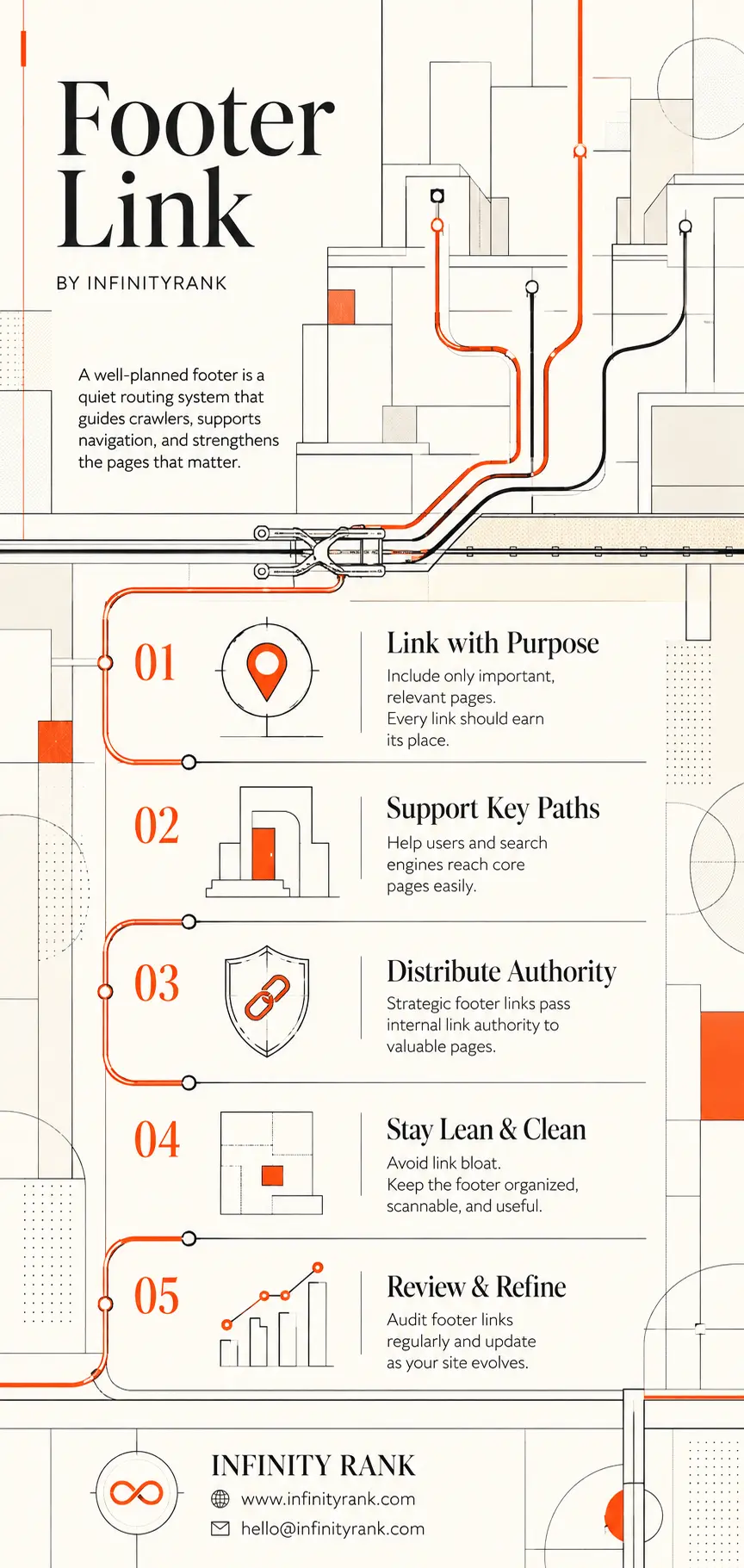
Sustaining an optimized architecture requires you to stay lean and clean by avoiding link bloat and keeping your footer organized, scannable, and useful. As your platform expands, committing to review and refine your navigation links ensures your internal structure evolves naturally alongside your site. Use these five core pillars as your operational blueprint to build a high-performing footer that enhances crawlability and user experience.
Internal Footer Links vs. External Footer Backlinks
This distinction matters.
Internal Footer Links
Internal footer links point to another page on the same website.
For example:
<a href="/contact/">Contact</a>
These links can help users reach important pages and can help crawlers discover URLs.
They also contribute to internal linking, although adding a page to the footer does not automatically make that page rank better.
External Footer Backlinks
External footer backlinks point to another domain.
For example:
<a href="https://example.com/">Example Company</a>
A legitimate external footer link can make sense for reasons such as:
- Website attribution
- Parent or subsidiary relationships
- Regulatory organizations
- Technology providers
- Genuine business partners
Problem starts when sitewide footer backlinks are deliberately created to manipulate rankings.
Google’s spam policies specifically identify widely distributed links placed in footers or templates across multiple websites as potential link spam.
That makes sitewide footer backlink campaigns very different from normal internal footer navigation.
Do Footer Links Help SEO?
Footer links can support SEO, but mostly through practical site architecture rather than some special ranking bonus attached to footer placement.
They Help Search Engines Discover Pages
Google uses links to discover URLs.
If an important page is linked from your footer using a crawlable HTML <a> element with an href attribute, Googlebot has another route to find it.
This can be useful for pages users expect to access from anywhere on the site.
But footer links should not replace:
- Main navigation
- Contextual internal links
- XML sitemaps
- Logical category structures
If a page is genuinely important to a topic, relevant links from other content usually provide more context than a generic sitewide footer link.
They Improve Navigation
Users commonly look to the footer for company information, contact details, policies, support pages, and secondary navigation.
A clean footer can make these pages easier to reach without overcrowding the main menu.
That is primarily a usability benefit.
Do not turn it into an unsupported claim that adding footer links directly improves rankings.
They Support Internal Site Structure
Internal links help search engines understand relationships between pages.
Footer links can contribute to that structure, particularly for important utility or business pages.
But repeating a link across hundreds of pages does not mean it receives hundreds of times more SEO value.
Sitewide placement alone is not a substitute for strong content, useful contextual internal links, or earned backlinks.
Which Pages Should You Link From Your Footer?
There is no universal list.
Choose pages based on what users need and what belongs in persistent site navigation.
Common choices include:
Company
- About
- Contact
- Careers
- Locations
- Team
Important Services or Products
A small number of major commercial categories can make sense.
Avoid turning the footer into a complete list of every service, city, product, or keyword-targeted landing page.
Support
- FAQ
- Help center
- Customer support
- Returns
- Shipping information
Legal and Policy Pages
Depending on your business, jurisdiction, and data practices:
- Privacy Policy
- Terms and Conditions
- Cookie Policy
- Refund Policy
- Accessibility information
Legal requirements vary. Do not assume every business must publish exactly the same legal pages.
Social Profiles
Links to legitimate brand profiles can also fit naturally in a footer.
How Many Footer Links Should You Have?
There is no Google-approved number.
Rules such as “keep your footer below 10 links” or “use a maximum of 12 links” are invented limits.
Google’s own link guidance says there is no magical ideal number of links on a page.
Use as many footer links as users genuinely need, while keeping the section organized and usable.
Ask:
- Does each link serve a clear purpose?
- Can users scan the footer quickly?
- Are links grouped logically?
- Are important pages easy to distinguish?
- Does the footer become excessive on mobile?
- Are you adding links because users need them, or because you want more keyword-rich internal links?
If the footer looks like an SEO sitemap rather than navigation, cut it back.
Use Descriptive Anchor Text
Anchor text should tell users what they will find after clicking.
Good:
- SEO Services
- Contact
- Case Studies
- Privacy Policy
Weak:
- Click here
- Read more
- Learn more here
Spammy:
- Best Affordable SEO Agency USA
- Buy Cheap Backlinks Online
- Best Local SEO Company Near Me
Footer anchors should remain concise because they appear repeatedly throughout the site.
Avoid stuffing exact-match keywords into sitewide navigation.
Should You Put External Links in Your Footer?
Only when they belong there.
Citations to research, statistics, studies, or industry publications usually make more sense inside the relevant article where readers can understand why the source is being cited.
Do not fill a footer with external authority links because you think linking to well-known websites will increase your own “domain authority.”
Google does not use third-party Domain Authority metrics as ranking metrics.
External links can make content more useful and trustworthy when they support what you are discussing. That does not mean placing unrelated authority links across every page improves SEO.
Are Sitewide Footer Backlinks Bad for SEO?
Not automatically.
Context matters.
A branded attribution link between genuinely connected websites can be legitimate.
A sitewide backlink becomes riskier when it exists primarily to influence search rankings.
Examples of higher-risk patterns include:
- Paying websites to place keyword-rich footer backlinks
- Distributing website templates containing optimized backlinks
- Requiring clients to keep ranking-focused footer links
- Creating hundreds of sitewide footer links across unrelated domains
- Repeating exact-match commercial anchor text in every footer
Google’s spam policies specifically call out widely distributed footer or template links in its examples of link spam.
If compensation is involved, qualify the link appropriately.
nofollow, sponsored, and ugc: What Should Footer Links Use?
Most ordinary links do not need a rel attribute.
A standard link can look like this:
<a href="https://example.com/">Example</a>
Paid or Sponsored Links
Google recommends rel="sponsored" for advertisements, sponsorships, and other paid placements.
<a href="https://example.com/" rel="sponsored">Example</a>
nofollow remains acceptable for paid links, but Google prefers sponsored.
User-Generated Links
Links added through comments, forums, or other user-generated content can use:
<a href="https://example.com/" rel="ugc">Example</a>
nofollow
Use rel="nofollow" when other values do not apply and you do not want to associate your site with the linked page in the normal way.
<a href="https://example.com/" rel="nofollow">Example</a>
Do not describe ordinary links as requiring a “DoFollow” attribute.
There is no rel="dofollow" requirement. A normal crawlable link simply does not need nofollow, sponsored, or ugc unless one of those qualifications applies.
Common Footer Link Mistakes
1. Turning the Footer Into a Keyword Dump
Adding dozens of keyword-targeted links does not create a stronger internal-link strategy.
It creates clutter and can look manipulative.
Keep navigation written for humans.
2. Linking Every Location or Service Page
Large sites sometimes add hundreds of city-service combinations to every footer.
Example:
- SEO Agency New York
- SEO Agency Chicago
- SEO Agency Miami
- SEO Agency Dallas
- SEO Agency Boston
- SEO Agency Seattle
If users genuinely need location navigation, build a proper locations hub instead of forcing every location into every page footer.
3. Buying Sitewide Footer Backlinks
One purchased footer placement can create hundreds or thousands of identical backlinks because the link appears across an entire site.
That does not mean you earned hundreds or thousands of independent editorial endorsements.
Use editorially justified links and follow Google’s rules for paid placements.
4. Using Over-Optimized Anchor Text
A footer link repeated across every page has wide distribution.
Making that anchor aggressively keyword-rich increases manipulation risk, especially across external sites.
Use natural or branded wording.
5. Using nofollow as an Internal SEO Control
Do not use nofollow to sculpt PageRank across ordinary internal navigation.
If an internal page should not appear in Google, use the proper crawling or indexing controls for that purpose rather than trying to solve the problem through footer link attributes.
6. Ignoring Mobile Usability
A footer that looks reasonable on desktop can become an enormous wall of links on mobile.
Use:
- Clear headings
- Logical groups
- Adequate tap spacing
- Readable text
- Accessible contrast
- Sensible collapsible sections where appropriate
Test footer navigation on real mobile layouts.
7. Hiding Links
Do not hide ranking-focused links using tiny text, CSS tricks, off-screen positioning, or colors designed to make them invisible.
Links should exist because users may reasonably use them.
Footer Links vs. Contextual Internal Links
Footer links and contextual links serve different purposes.
Footer links provide persistent navigation.
Contextual links appear inside relevant content and can explain a relationship between two pages more clearly.
For example, a paragraph discussing technical SEO can naturally link to a technical SEO service or guide using descriptive anchor text.
That context helps both users and search engines understand why the linked page matters.
For important SEO pages, use a broader internal-linking strategy rather than relying only on footer placement.
Footer Link SEO Checklist
Before adding a link to a global footer, ask:
- Does user reasonably expect to find this page here?
- Is link useful across most pages?
- Is anchor text clear and natural?
- Is this internal navigation or an external backlink?
- If external, is there genuine reason for sitewide placement?
- Was money, sponsorship, or another benefit exchanged?
- If paid, is link qualified with
rel="sponsored"ornofollow? - Is footer usable on mobile?
- Are we duplicating links unnecessarily?
- Would contextual link make more sense?
- Are we adding this because it helps users or because we expect artificial ranking value?
If last answer is “ranking value,” reconsider placement.
Final Thoughts
Footer links remain useful in 2026, but they are not an SEO shortcut.
Use them to create predictable navigation, expose important utility pages, and support a logical site structure.
Do not treat footer placement as a way to manufacture authority.
Internal footer links can support crawl discovery and navigation. External sitewide footer backlinks require more caution, especially when money, optimized anchor text, templates, or large-scale distribution are involved.
Best rule: build footer for users first, keep anchors descriptive, and avoid patterns designed primarily to manipulate ranking signals.
Frequently Asked Questions
Are footer links bad for SEO?
No. Normal internal footer links are not inherently bad for SEO. They can support navigation, URL discovery, and site structure. Problems arise when footers become overloaded with keyword-rich links or when sitewide external footer backlinks are created primarily to manipulate rankings.
How many links should a footer contain?
There is no fixed SEO limit. Google does not specify an ideal number of links per page. Include links users genuinely need, organize them clearly, and avoid turning the footer into a large keyword-focused directory.
Do footer links pass PageRank?
Normal crawlable links can participate in Google’s link analysis, but footer placement does not guarantee a ranking improvement. Search engines evaluate links within a much broader set of signals. Do not rely on sitewide footer links as your primary internal-linking strategy.
Can I link to external websites from my footer?
Yes, when there is a legitimate reason for persistent placement. Partner, parent-company, attribution, social, or regulatory links may make sense. Research citations generally belong within the relevant content instead of the global footer.
Should footer links use nofollow?
Ordinary links normally do not need nofollow. Paid or sponsored links should use rel="sponsored" or nofollow. User-generated links can use rel="ugc". Do not add nofollow to important internal navigation simply because links appear in the footer.
Are website design credits in footers safe?
A genuine branded credit can be legitimate. Risk rises when agencies or template providers distribute keyword-rich links across many client sites to influence rankings. Keep attribution natural and avoid optimized commercial anchors or compulsory ranking-focused links.
Are sitewide footer backlinks good for link building?
They should not be treated as a scalable link-building tactic. Google explicitly lists widely distributed footer or template links among examples of link spam when they are created to manipulate rankings. Editorial, contextual backlinks are generally a safer and more useful target.