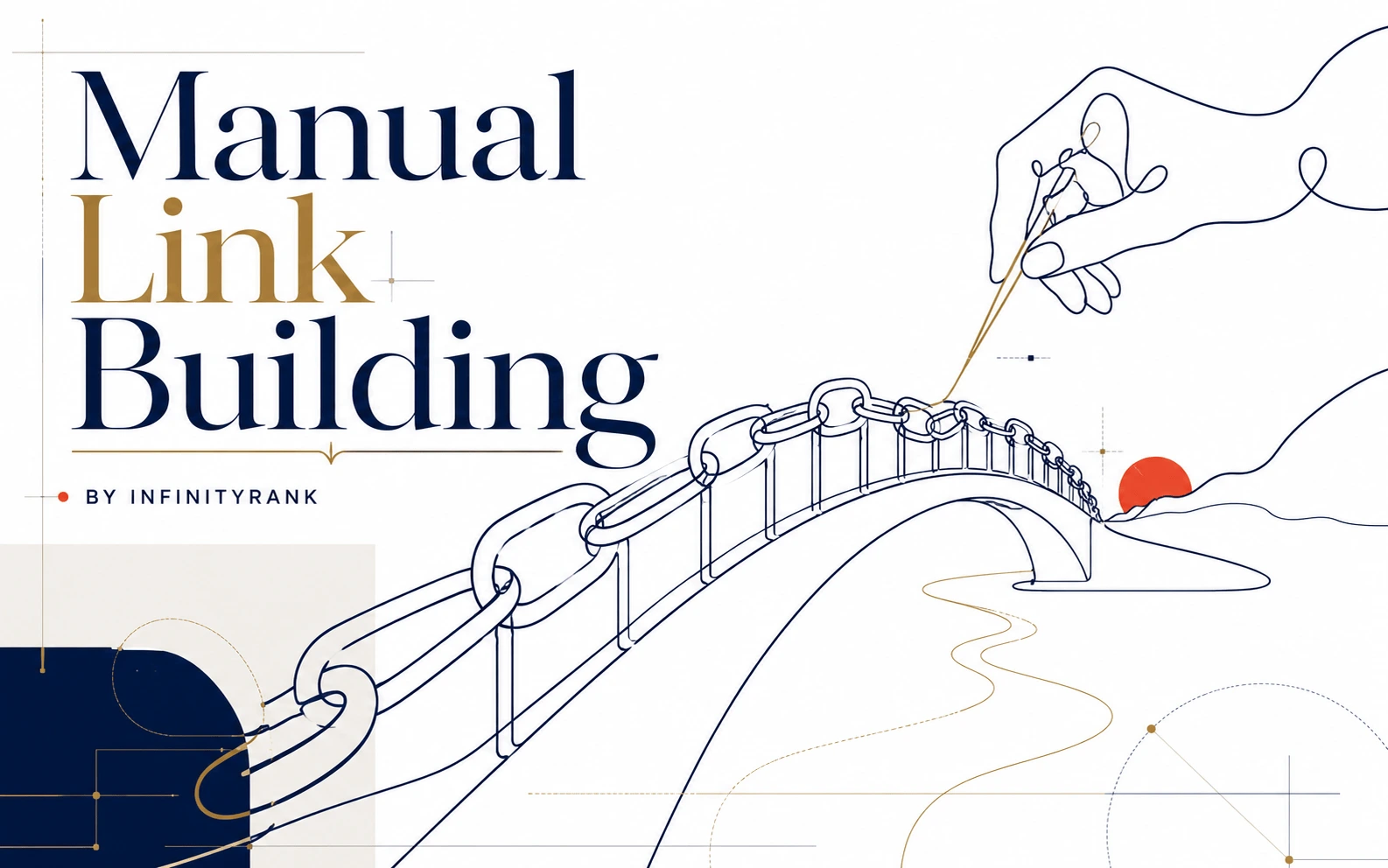
Manual link building is the process of earning backlinks through human research, personalized outreach, and genuine editorial value.
It is not mass emailing.
It is not buying random placements.
It is not pushing your URL into every website that will accept it.
Done properly, manual link building helps you build a cleaner, safer, and more relevant backlink profile. Done badly, it becomes spam with extra steps.
Google’s spam policies are clear: tactics designed to deceive users or manipulate search systems can lead to lower rankings or removal from search results. That includes link practices created mainly to manipulate rankings, not help users.
This guide explains what manual link building is, why it still matters, how to do it properly, and how to avoid the shortcuts that damage SEO.
Manual Link Building: Full Control Over Your Backlink Profile
Automating your outreach might save time, but it often blasts generic pitches to thousands of irrelevant sites, destroying potential industry relationships and putting your domain at risk. True authority requires a hands-on approach where you handpick every target, customize every pitch, and directly control your anchor text distribution.
When you switch to execution that prioritizes precision over raw volume, your links carry significantly more ranking power. This manual link building workflow covers the foundational pillars needed to run highly targeted, human-driven outreach campaigns that search engines naturally reward.
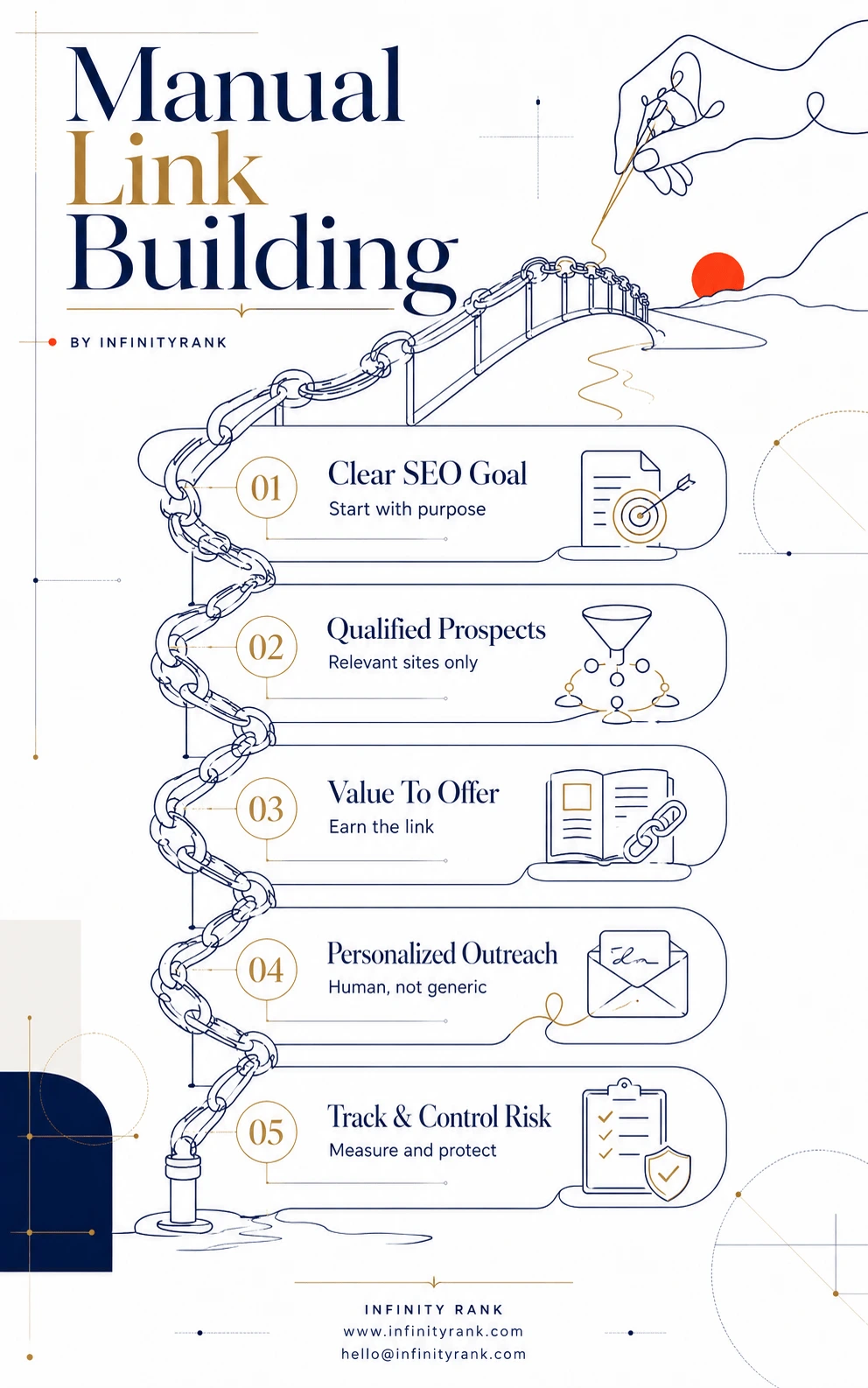
Taking complete control of your outreach ensures you only secure links that genuinely pass authority and protect your brand reputation. By focusing on personalized connections and strict placement criteria, you build a resilient backlink profile that holds its value over time. Use the manual-link-building-infographic as your team’s quality checklist before launching your next campaign.
What Is Manual Link Building?
Manual link building is a hands-on SEO process where you identify relevant websites, qualify them, contact real people, and earn backlinks through value-based outreach.
That value might be:
- A guest article
- A useful resource
- Original data
- Expert commentary
- A broken link replacement
- A testimonial
- A digital PR asset
- A partnership opportunity
The key difference is control.
With manual link building, you control the prospect list, the relevance checks, the outreach message, the anchor text strategy, and the quality threshold. You are not relying on automated spam tools or low-quality link marketplaces.
Manual Link Building vs. Automated Link Building
Automated link building usually focuses on volume. Manual link building focuses on fit.
That difference matters.
Automated campaigns often send generic emails to large lists with little concern for relevance, editorial standards, or audience value. This creates low response rates and increases the risk of spammy placements.
Manual outreach takes longer, but it gives you better control over:
- Website relevance
- Link placement quality
- Anchor text
- Content context
- Publisher relationship
- Risk management
- Long-term link value
The goal is not to get as many links as possible. The goal is to earn links that make sense.
A backlink from a relevant industry website with real traffic is usually more valuable than ten links from unrelated blogs with thin content and no audience.
Why Manual Link Building Still Works
Manual link building still works because backlinks are not just technical signals. They are also trust signals.
A good link tells search engines and users that another website found your content, service, product, or expertise worth referencing.
Manual link building gives you a better chance of earning links that are:
- Topically relevant
- Editorially placed
- Supported by useful content
- More likely to drive referral traffic
- Less likely to look manipulative
- More likely to survive future quality updates
That does not mean every manual link is safe. A paid guest post network is still risky, even if a human placed the link. A low-quality “write for us” farm is still weak, even if you manually emailed the editor.
Manual does not automatically mean good. Quality control is what makes it work.
What Google Considers Risky Link Building
Before building links, understand the line between legitimate outreach and link spam.
Google’s spam policies apply to tactics that try to manipulate search visibility instead of helping users. Sites that violate these policies may rank lower or disappear from search results.
For link building, the biggest risk areas include:
- Paid links that pass ranking value
- Excessive link exchanges
- Large-scale guest posting with keyword-heavy anchors
- Low-quality directories
- Private blog networks
- Automated comment links
- Forum profile spam
- Irrelevant link placements
- Hidden links
- Links inserted into hacked or expired domains
If a link is paid, sponsored, or part of an ad placement, it should be qualified properly. Google recommends using rel="sponsored” for paid links, rel="ugc" for user-generated content links, and rel="nofollow" when you do not want Google to associate your site with the linked page.
That is why serious manual link building needs a compliance process, not just an outreach process.
The Manual Link Building Process
1. Define the Campaign Goal
Do not start by collecting emails. Start by defining the purpose of the campaign.
Common goals include:
- Building authority for a service page
- Supporting a new blog post
- Improving topical authority in a niche
- Earning links to a data asset
- Building brand mentions
- Increasing referral traffic
- Supporting a digital PR campaign
Each goal needs a different tactic.
For example, a SaaS company may use guest posting and expert commentary to build authority. An ecommerce brand may use product guides, statistics pages, or gift guides. A local business may focus on local directories, associations, sponsorships, and community mentions.
Bad campaigns start with “we need backlinks.”
Good campaigns start with “we need relevant links to support this specific SEO goal.”
2. Build a Relevant Prospect List
Prospecting is where most campaigns succeed or fail.
You are not looking for every website that accepts guest posts. You are looking for websites that make sense for your audience and topic.
Good prospect sources include:
- Industry blogs
- Niche publications
- Resource pages
- Partner websites
- Vendor websites
- Podcasts
- Local associations
- Trade organizations
- Journalist request platforms
- Competitor backlink profiles
- Broken link opportunities
- Existing brand mentions
Use SEO tools like Ahrefs, Semrush, Moz, or Google Search operators to find opportunities. Tools help with discovery, but they should not replace manual review.
Useful Google search operators include:
keyword + “write for us”
keyword + “guest post”
keyword + “resources”
keyword + “recommended tools”
keyword + “useful links”
keyword + “expert roundup”
keyword + “statistics”
keyword + “case study”
keyword + “podcast”
Do not blindly pitch every result. Build a list first, then qualify it.
3. Qualify Every Website
A bad prospect wastes time. A risky prospect can hurt your brand.
Before contacting a website, check:
- Is the site relevant to your niche?
- Does it publish real editorial content?
- Does it have organic traffic?
- Does the content look human-edited?
- Are outbound links natural or spammy?
- Does it link to gambling, adult, crypto spam, pills, or unrelated niches?
- Does it have an actual audience?
- Are recent posts indexed?
- Does it have clear authorship or editorial standards?
- Does the site exist only to sell guest posts?
Metrics help, but they are not enough.
Domain Authority, Domain Rating, Authority Score, and traffic estimates are useful screening indicators. They are not guarantees of quality. A site can have a decent authority score and still be a link farm.
Use this simple rule: if you would be embarrassed to show the placement to a customer, do not build the link.
4. Choose the Right Link Building Tactic
The tactic should match the website and the campaign goal.
Here are the safest and most useful manual link building tactics.
Guest Posting
Guest posting works when the article is genuinely useful, relevant, and written for the host site’s audience.
Bad guest posting: thin content written only to insert a backlink.
Good guest posting: expert content that solves a real problem and includes a natural contextual link.
Use guest posting for:
- Thought leadership
- Niche authority
- Service page support
- Brand visibility
- Relationship building
Avoid sites that publish hundreds of unrelated guest posts with obvious paid-link footprints.
Resource Page Link Building
Resource pages list helpful tools, guides, companies, or references.
This tactic works best when you already have something worth adding, such as:
- A complete guide
- A calculator
- A checklist
- A template
- Original research
- A comparison page
- A free tool
Your pitch should explain why the resource improves the page, not just why you want a link.
Broken Link Building
Broken link building means finding dead links on relevant pages and suggesting your content as a replacement.
The process is simple:
- Find a relevant page with broken external links.
- Check what the dead page used to cover.
- Create or identify a strong replacement.
- Email the site owner with the broken link details.
- Suggest your page as a useful replacement.
This works because you are helping the publisher fix a real issue.
Digital PR
Digital PR earns links through newsworthy stories, data, expert insights, and media outreach.
This is not the same as blasting a generic press release. It works when you have something journalists or industry publications can use.
Strong digital PR assets include:
- Original surveys
- Industry trend reports
- Data studies
- Expert commentary
- Company milestones
- Local business stories
- Controversial or timely insights
Digital PR is harder than basic outreach, but it can earn stronger links from higher-authority publications.
Testimonials and Partner Links
If you use a tool, vendor, consultant, or platform, you may be able to provide a testimonial.
This can earn a link from a relevant partner page. Keep it honest. Do not write fake reviews just to get backlinks.
Unlinked Brand Mentions
If another website mentions your brand without linking to you, ask them to add a link.
This is one of the cleanest manual link building tactics because the publisher already knows your brand.
The pitch should be short:
Hi [Name],
Thanks for mentioning [Brand] in your article on [Topic].
Would you be open to linking the mention to our homepage so readers can find the source directly?
Here’s the page: [URL]
Thanks,
[Name]
5. Write Personalized Outreach
Your outreach email should prove three things:
- You know who you are contacting.
- You understand their audience.
- You have something useful to offer.
Generic outreach gets ignored because editors receive lazy pitches every day.
Bad outreach:
Hi,
I loved your blog. I want to publish a guest post. Please let me know your price.
Thanks.
Better outreach:
Subject: Content idea for [Site Name]
Hi [Name],
I read your article on [specific topic] and noticed you cover practical SEO advice for [audience].
I’d like to contribute a detailed guide on [proposed topic]. It would cover [point 1], [point 2], and [point 3], with examples your readers can apply directly.
Suggested title:
[Title]
I can send over an outline first if useful.
Best,
[Name]
Keep it direct. Do not fake flattery. Do not pretend to be a long-time reader if you are not.
6. Follow Up Without Being Annoying
Most responses come after a follow-up. But there is a line between persistence and spam.
A simple follow-up after 4–7 business days is enough.
Example:
Hi [Name],
Just checking whether the topic below would be useful for [Site Name].
Happy to send a short outline if you’re open to reviewing it.
Best,
[Name]
If there is no response after one or two follow-ups, move on.
Do not send five reminders. Do not guilt-trip the editor. Do not use fake urgency.
7. Track Every Campaign
Manual link building needs clean tracking. Otherwise, you lose opportunities, duplicate outreach, and fail to measure results.
Track:
- Prospect URL
- Contact name
- Email address
- Website category
- Relevance score
- Authority metric
- Estimated organic traffic
- Outreach date
- Follow-up date
- Response status
- Placement URL
- Anchor text
- Target URL
- Link attribute
- Publication date
- Cost, if any
- Notes
Also track performance after links go live:
- Referral traffic
- Keyword movement
- Indexed status
- Link retention
- Target page organic traffic
- Assisted conversions
- New brand mentions
Do not judge success after one week. Link building usually supports SEO over months, not days.
Manual Link Building Checklist
Use this checklist before approving a prospect.
Website Quality
- The site is relevant to your niche.
- The site has real content and real readers.
- The site is not overloaded with guest posts.
- The site does not link out to spam-heavy niches.
- The content is indexed.
- The site has signs of editorial review.
- The site has a clear audience.
Page Quality
- The linking page is topically relevant.
- The link placement makes sense in context.
- The anchor text is natural.
- The page is not stuffed with outbound links.
- The content is useful enough to stand alone.
- The page is crawlable and indexable.
Compliance
- Paid or sponsored placements are properly qualified.
- User-generated links use the correct attribute when needed.
- Anchor text is not over-optimized.
- The link is not hidden.
- The link is not part of a manipulative exchange.
- The campaign does not depend on automation or spam.
Common Manual Link Building Mistakes
Chasing Metrics Instead of Relevance
A high authority score does not matter if the website has nothing to do with your industry.
Relevance comes first. Metrics come second.
Using Exact-Match Anchor Text Too Often
If every link says “best link building agency,” the pattern looks unnatural.
Use a mix of:
- Branded anchors
- URL anchors
- Partial-match anchors
- Natural phrase anchors
- Contextual anchors
Sending Generic Emails
“Dear webmaster” outreach is dead. Editors can spot mass outreach instantly.
Personalize the first line, the topic idea, and the reason your pitch fits their audience.
Publishing Thin Guest Posts
A weak guest post can get accepted, but that does not make it valuable.
If the article is generic, poorly written, or irrelevant, the link is weak. Worse, it can damage brand perception.
Ignoring Link Attributes
Not every link should be followed. Paid placements, sponsored content, and user-generated links need correct handling. Google recommends rel="sponsored" for paid links and rel="ugc" for user-generated links.
Not Tracking Link Retention
Some links disappear after publication. Others get changed to nofollow. Some pages get deindexed.
Check live placements regularly.
How Long Does Manual Link Building Take?
Manual link building is not instant.
A realistic campaign timeline looks like this:
- Week 1: Strategy, target pages, prospecting criteria
- Week 2: Prospect list building and qualification
- Week 3: Outreach and follow-ups
- Week 4 onward: Content creation, approvals, publication, tracking
SEO impact depends on the strength of your site, competition, link quality, target page quality, and search intent. Some campaigns show movement within weeks. Competitive niches usually need several months of consistent work.
Do not expect one or two backlinks to carry a weak page. Links work best when the target page already deserves to rank.
What Makes a Manual Link Building Campaign Successful?
A strong campaign has five things:
- A clear SEO goal
- A qualified prospect list
- A valuable reason to earn the link
- Personalized outreach
- Clean tracking and risk control
The best campaigns do not look like “link building” from the publisher’s side. They look like useful contributions, credible resources, expert insights, or relevant partnerships.
That is the standard.
Should You Do Manual Link Building Yourself?
You can do manual link building yourself if you have time, tools, and strong editorial judgment.
You need to be able to:
- Research prospects
- Evaluate link quality
- Write outreach emails
- Create link-worthy content
- Negotiate placements
- Track campaign performance
- Avoid risky opportunities
If you do not have the time or experience, hiring a specialist can help. But be careful. A bad agency can build the same spammy links you were trying to avoid.
Before hiring anyone, ask:
- How do you qualify websites?
- Do you disclose paid placements?
- What link attributes are used?
- Can I approve prospects before outreach?
- Do you provide placement reports?
- Do you avoid PBNs and link farms?
- How do you handle anchor text?
- What happens if a link is removed?
If the answers are vague, walk away.
Final Thoughts
Manual link building is slower than automated link building. That is the point.
The value comes from better targeting, stronger relevance, real relationships, and lower risk. You are not trying to trick search engines with bulk links. You are earning references from websites that make sense for your brand and audience.
Start small. Pick one target page. Build a list of 50 relevant prospects. Qualify them properly. Send personalized outreach. Track every response.
That process will outperform lazy mass outreach almost every time.
If you want safer, relevance-first backlinks, Infinity Rank can help you build a manual link building campaign that focuses on quality, not shortcuts.
FAQs
What is manual link building?
Manual link building is the process of earning backlinks through human research, prospect qualification, personalized outreach, and value-based content or partnerships.
Is manual link building better than automated link building?
Manual link building is usually safer and more controlled because every prospect, pitch, and placement is reviewed by a human. Automated link building often creates lower-quality links and higher spam risk.
Is manual link building allowed by Google?
Manual outreach itself is not the issue. The risk depends on how the link is earned, placed, and qualified. Links created mainly to manipulate rankings can violate Google’s spam policies.
How many backlinks do I need?
There is no fixed number. It depends on your competition, current authority, target keyword difficulty, content quality, and the strength of the links you earn.
How long does manual link building take to work?
Most campaigns need consistent work over several months. Stronger sites in less competitive niches may see movement sooner, while competitive keywords usually need longer.
What is a good manual link building tactic for beginners?
Start with unlinked brand mentions, resource pages, and guest posting on relevant niche websites. These are easier to manage than large digital PR campaigns.
Should I pay for backlinks?
Be careful. Paid links that pass ranking value can create risk. If a link is sponsored or paid, it should be properly qualified with the correct link attribute, such as rel="sponsored".