Backlinks remain important to SEO, but not for reason many outdated guides suggest.
Google does not simply count how many websites link to you. Links are one part of much larger ranking system. Google confirms that PageRank uses links, while also making clear that Search relies on many other ranking signals.
That distinction matters.
A relevant editorial link can help search engines discover pages, provide context about your content, contribute ranking signals, send referral traffic, and expose your brand to new audiences. Hundreds of low-quality or manipulative links may provide little value and can create SEO risk instead.
Understanding importance of backlinks therefore means understanding which links matter, why they matter, and how to earn them without crossing into link spam.
What Is a Backlink?
A backlink is a link from another website to yours.
For example, if an industry publication cites research on your website and links to source page, your site receives a backlink from that publication.
Backlinks can appear in:
Editorial articles News coverage Research citations Resource pages Business directories Guest contributions Product reviews Partner pages Forums and user-generated content Sponsored placements
These links are not automatically equal.
Context, relevance, placement, source quality, link attributes, and reason link exists all affect how useful it may be.
Importance of Backlinks Strategy for SEO Authority
Building organic search authority requires focusing on quality over quantity, as a few strong links consistently beat many weak ones. Ensuring relevance counts by acquiring topical, editorial, and contextual links guarantees search engines accurately calculate your site’s niche authority. The real impact of off-page optimization goes beyond rankings, accelerating content discovery, driving referral traffic, and boosting brand credibility. This simple guide breaks down five essential principles to understand backlink value and elevate your domain standing.
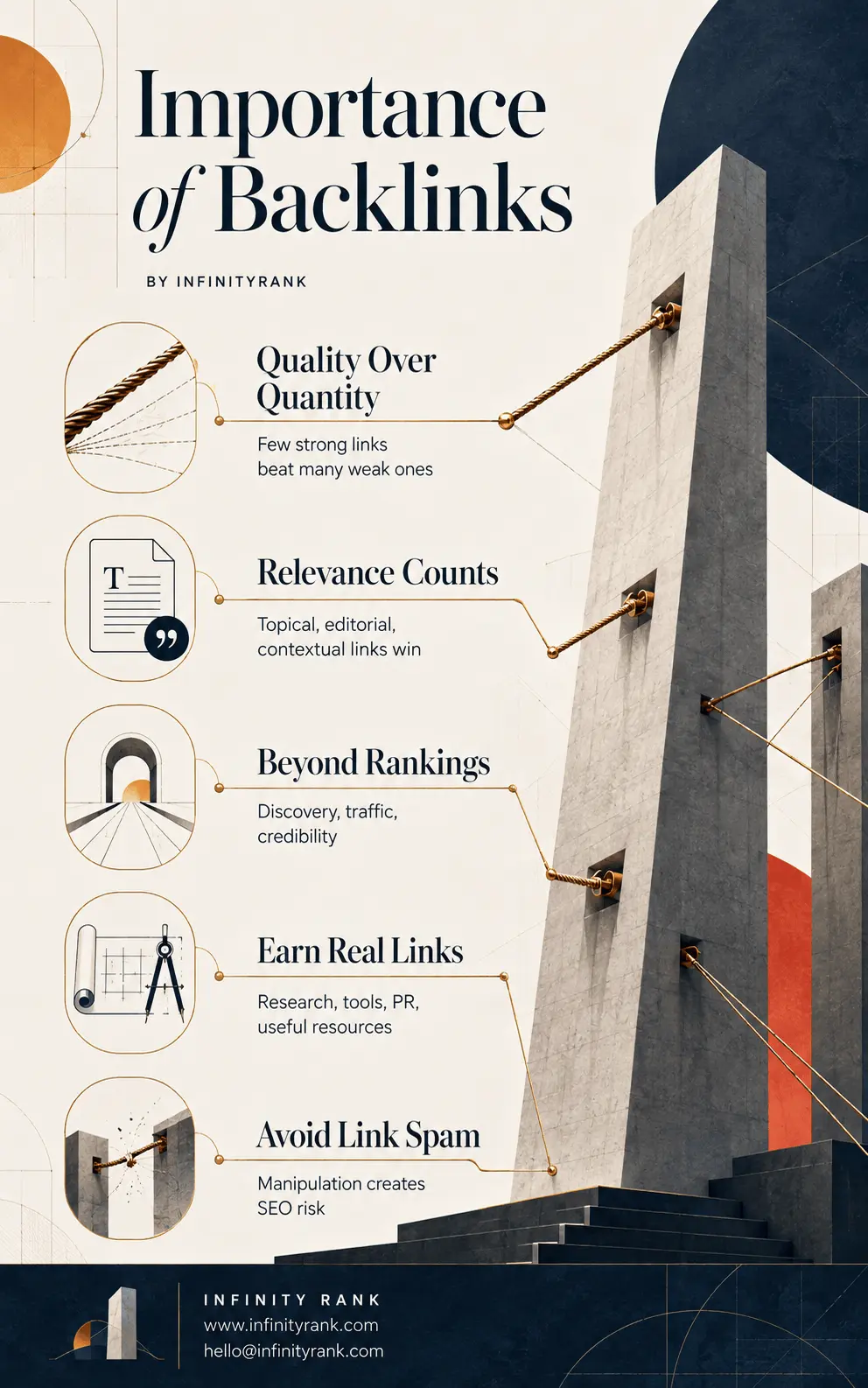
Sustaining long-term organic growth depends on creating natural link magnets to earn real links through original research, custom tools, PR outreach, and useful resources. Protecting your domain equity requires maintaining strict standards to avoid link spam, understanding that artificial manipulation creates severe SEO risk and penalty vulnerability. Use these five core pillars as your strategic blueprint to build a clean, high-authority backlink profile that drives lasting traffic.
How Do Backlinks Work in SEO?
Google’s original PageRank system uses links to help evaluate pages. Links remain part of Google’s search systems today, but PageRank is only one component among many ranking signals.
This means backlink strategy should not revolve around collecting largest possible number of links.
Useful backlinks tend to have legitimate reason to exist.
For example, imagine two links pointing to cybersecurity software company:
A cybersecurity publication cites company’s original security research inside relevant article. An unrelated general directory lists company among hundreds of random websites.
Both are technically backlinks. They do not carry same context or likely value.
Strong backlink usually comes from page where link makes sense to reader, supports surrounding content, and connects two genuinely related resources.
Why Backlinks Still Matter for SEO
1. Backlinks Can Contribute Ranking Signals
Links can help Google understand relationships between pages and websites.
A relevant editorial citation may provide useful signals about page being referenced, particularly when link appears naturally within content related to same subject.
This does not mean every backlink improves rankings. Nor does it mean gaining one link will cause measurable ranking increase.
Links work alongside content quality, relevance, technical accessibility, search intent, internal linking, page experience, and many other signals.
2. Backlinks Help Search Engines Discover Content
Search engines discover URLs partly by following links.
When another crawlable page links to new page on your website, that creates another path through which search engines may discover it.
Your own internal linking and XML sitemap remain important, so backlinks should never be treated as substitute for sound site architecture.
3. Backlinks Can Send Referral Traffic
Backlinks have value beyond rankings.
A useful link placed in front of right audience can send qualified visitors directly to your site.
Consider link from respected industry newsletter, trade publication, or resource guide. Readers may click because they want more information about subject being discussed.
That traffic exists independently of any SEO benefit.
For businesses, this is often better way to judge link than simply looking at third-party authority score.
Ask:
Would we still want this link if Google did not exist?
If answer is yes because link can generate awareness, credibility, referrals, or customers, link probably has genuine business value.
4. Editorial Links Can Strengthen Credibility
Being cited by recognized publications, organizations, experts, and industry resources can strengthen how people perceive brand.
This is different from claiming that Google gives every website fixed “authority” score.
Metrics such as Domain Authority, Domain Rating, and similar scores are created by third-party SEO platforms. They can be useful for comparison and research, but they are not Google ranking metrics.
Use them as indicators, not proof that backlink will improve rankings.
5. Backlinks Can Expand Brand Visibility
Links often come with something equally useful: mentions.
Digital PR coverage, interviews, expert commentary, research citations, and industry articles can expose brand to audiences that may never have found it through search.
For that reason, strong link-building strategy overlaps with PR, content marketing, brand building, and audience development.
What Makes a Backlink Valuable?
No single metric determines backlink quality.
Evaluate links using several factors together.
Topical Relevance
Link from website or page connected to your subject usually makes more sense than link from unrelated source.
Accounting software company receiving citation from finance publication has clear topical relationship. Same company receiving random link from pet-care blog does not.
Editorial Reason for Link
Best links exist because publisher genuinely wants to reference source.
Maybe your page contains:
Original research Statistics Expert analysis Useful tool Unique dataset Detailed tutorial Primary-source information Strong visual resource
Editorial justification makes link more defensible and more useful to readers.
Context and Placement
Link inside relevant paragraph usually provides more context than unexplained link buried in footer, template, author bio, or giant directory.
Anchor text and surrounding words can also help users and search engines understand destination.
Anchor text should describe linked page naturally. Repeatedly forcing exact-match commercial keywords into backlinks can look manipulative.
Source Quality
Look beyond domain-level SEO metrics.
Check whether website:
Publishes legitimate content Has real topical focus Appears maintained Has identifiable authors or organization Attracts real visitors Ranks for relevant subjects Avoids obvious link-selling patterns Links externally for editorial reasons
A smaller niche publication with real audience may be more valuable than higher-metric website filled with unrelated sponsored posts.
Referral Potential
Ask whether real users might click link.
Links placed where relevant audience can actually see them have value even if direct ranking impact cannot be measured.
Regular, Nofollow, Sponsored, and UGC Links
Calling backlinks simply “dofollow versus nofollow” is outdated.
There is no rel="dofollow" attribute required for normal links.
Standard crawlable link can appear like this:
<a href=”https://example.com/”>Example</a>
Google says regular links that need no qualification do not require a rel attribute.
Other links may use specific values.
rel="sponsored"
Use for advertisements, sponsorships, or other paid placements.
<a href=”https://example.com/” rel=”sponsored”>Example</a>
rel="ugc"
Used for links within user-generated content such as forum posts or comments.
<a href=”https://example.com/” rel=”ugc”>Example</a>
rel="nofollow"
Used when other values do not apply and publisher does not want Google to associate its site with linked page in normal way.
<a href=”https://example.com/” rel=”nofollow”>Example</a>
These attributes describe relationship around link. They should not be reduced to old idea that one category automatically “passes link juice” while another has no value.
Nofollow, sponsored, and UGC links can still produce referral traffic, brand exposure, citations, and discovery through other channels.
How to Build Backlinks That Have Real Value
Create Assets Worth Citing
Generic blog posts rarely earn links simply because they exist.
Create something that gives other writers reason to cite you.
Examples include:
Original surveys Industry statistics Proprietary datasets Free tools Calculators Templates Detailed reference guides Original experiments Expert commentary Visual assets Research reports
Link earning becomes easier when outreach points to something genuinely useful.
Use Digital PR
Digital PR can earn coverage by connecting useful data, expertise, stories, or research with journalists and publications.
Instead of asking publisher to “give you a backlink,” provide something worth covering.
Strong campaigns often start with:
New data Timely analysis Industry trends Expert reactions Local insights Newsworthy research
Links then become result of coverage rather than sole purpose of content.
Conduct Targeted Outreach
Outreach works better when there is clear editorial reason for recipient to care.
Bad outreach:
We published a great article. Please link to it.
Better approach:
Explain what resource adds, why it is relevant to specific page or audience, and what information publisher would gain by referencing it.
Personalization matters because mass outreach without relevance usually produces poor results.
Reclaim Relevant Brand Mentions
Sometimes websites mention brand, product, research, or executive without linking to original source.
When link would genuinely help readers find source being discussed, contacting publisher and requesting attribution can make sense.
Not every unlinked mention needs link.
Prioritize mentions where link adds useful context.
Contribute Expertise, Not Link Placements
Guest contributions can still be legitimate when primary purpose is serving publication’s audience.
Problem starts when guest posting becomes scaled method for inserting keyword-rich links into articles.
Google’s spam policies specifically identify optimized links in guest posts, advertorials, and distributed articles as potential link spam when created for ranking manipulation.
Write for audience first. Treat any backlink as secondary outcome.
Backlink Tactics That Can Create SEO Risk
Google defines link spam as links created primarily to manipulate search rankings.
Examples include:
Buying or selling links for ranking purposes Automated link creation Excessive reciprocal linking Low-quality directory links Keyword-rich links distributed through widgets Widely distributed footer or template links Optimized links in paid advertorials Scaled guest posting designed around backlinks Low-value content created mainly to generate links
This does not mean all paid links are prohibited.
Advertising and sponsorship are normal parts of web. Google says paid links should be appropriately qualified, preferably with rel="sponsored" or, where suitable, rel="nofollow".
Problem is paying for links specifically to pass ranking credit or manipulate search results.
Are Reciprocal Links Bad?
Not automatically.
Websites naturally link to organizations they work with, partners, suppliers, associations, clients, and useful resources.
Risk comes from excessive link exchanges performed primarily for SEO.
A legitimate partnership page is different from joining network where dozens of sites agree to link to each other solely to increase rankings.
Use same test as before: would link make sense to user even without SEO benefit?
How Many Backlinks Do You Need?
There is no universal number.
You cannot say that website needs 50, 500, or 5,000 backlinks to rank.
Required link profile depends on:
Search query Competitors Industry Quality of your content Existing brand recognition Website history Search intent Strength of competing pages Relevance and quality of referring sources
One useful approach is comparing pages already ranking for target query.
Study their referring domains, but do not blindly copy them. Determine what types of sites cite competitors and why those links exist.
How Should You Measure Backlink Performance?
Google Search Console and third-party tools such as Ahrefs, Semrush, or Moz can help identify backlinks and referring domains.
New referring domains Lost links Linked pages Anchor-text patterns Relevant versus irrelevant sources Suspicious link spikes Competitor link opportunities
Also measure business outcomes.
Check referral traffic, assisted conversions, branded search growth, PR coverage, and visibility of pages attracting links.
Do not assume SEO tool can prove that individual backlink caused ranking change. Rankings move for many reasons, and isolating effect of single link is usually impossible.
Do Backlinks Still Matter in 2026?
Yes, but backlinks should be viewed as part of broader SEO system rather than shortcut to rankings.
Google confirms that PageRank still uses links while emphasizing that Search relies on many ranking signals.
Modern backlink strategy therefore focuses less on collecting links and more on earning relevant, editorially justified citations from real websites with real audiences.
Strong link should make sense for publisher, reader, and linked website.
That is much better standard than simply asking whether domain has high metric or whether link is “dofollow.”
Final Thoughts
Importance of backlinks in SEO has not disappeared. What has changed is how carefully links need to be evaluated.
Good backlinks can contribute ranking signals, improve discovery, send referral traffic, strengthen credibility, and put your brand in front of relevant audiences.
Poor link building does opposite. Scaled guest posts, paid ranking links, excessive exchanges, automated links, and low-quality placements can waste budget or create unnecessary risk.
Focus on assets people have reason to cite. Build relationships with relevant publishers. Use digital PR where story warrants coverage. Measure links alongside traffic, visibility, and business outcomes.
Most importantly, build links for people first.
If link provides genuine value without needing search rankings to justify its existence, you are starting from much stronger position.
FAQs
What are main types of backlinks?
Normal crawlable links do not require special rel attribute. Publishers can also qualify links using rel="sponsored" for paid placements, rel="ugc" for user-generated content, or rel="nofollow" when other values do not apply and they do not want normal association with destination.
Do backlinks directly improve rankings?
Backlinks can contribute signals used by Google’s search systems, but there is no guarantee that individual link will improve ranking. Google uses many ranking signals, and impact depends on link’s relevance, context, quality, and other factors surrounding page and query.
Can I buy backlinks?
You can pay for advertising, sponsorships, and promotional placements, but paid links should be appropriately qualified. Buying links specifically to pass ranking credit or manipulate rankings can violate Google’s spam policies.
Is guest posting bad for SEO?
No. Legitimate guest contributions created for publication’s audience are not inherently bad. Risk comes from scaled guest posting designed primarily to insert optimized backlinks and manipulate rankings.
Are nofollow backlinks useless?
No. They can still generate referral traffic, brand visibility, citations, and audience exposure. They should not be treated as worthless simply because publisher qualified link with nofollow.
How many backlinks do I need to rank?
There is no fixed number. Requirements vary by query, competition, content, industry, and quality of referring sources. Relevant links from genuine sources matter more than hitting arbitrary backlink target.
How can I check my backlinks?
Use Google Search Console for Google’s available link reporting and third-party tools such as Ahrefs, Semrush, or Moz for additional backlink discovery and competitive analysis. Remember that these tools cannot prove exact ranking impact of individual link.
What makes a backlink high quality?
Strong backlink usually comes from relevant, legitimate source, appears where it helps reader, has natural editorial reason to exist, uses sensible anchor text, and is not part of manipulative link scheme.