Basic local SEO gets business listed. Advanced local SEO helps turn visibility into calls, bookings, store visits, and revenue.
That distinction matters in 2026.
Claiming Google Business Profile, entering business hours, and collecting few reviews no longer counts as serious local strategy. Strong local campaigns connect Google Business Profile optimization, website content, reputation, local authority, structured data, conversion rate optimization, AI search visibility, and revenue tracking.
Google’s own documentation still centers local visibility around relevance, distance, and prominence. Businesses cannot control every part of that equation, especially searcher location, but they can improve how clearly Google understands business, how authoritative business appears, and how effectively search visibility converts into customers.
Advanced Local SEO Concepts for Market Dominance
Dominating local search results requires mastering the core algorithms that govern map packs and localized rankings. Success starts with optimizing for key ranking signals, balancing relevance, distance, and prominence across every campaign. Establishing absolute entity clarity ensures search engines maintain a consistent understanding of your business identity across the web. When you combine strong local entity signals with a website and Google Business Profile built to convert, you turn routine map searches into steady customer inquiries. This simple guide breaks down five advanced concepts to elevate your local search presence.
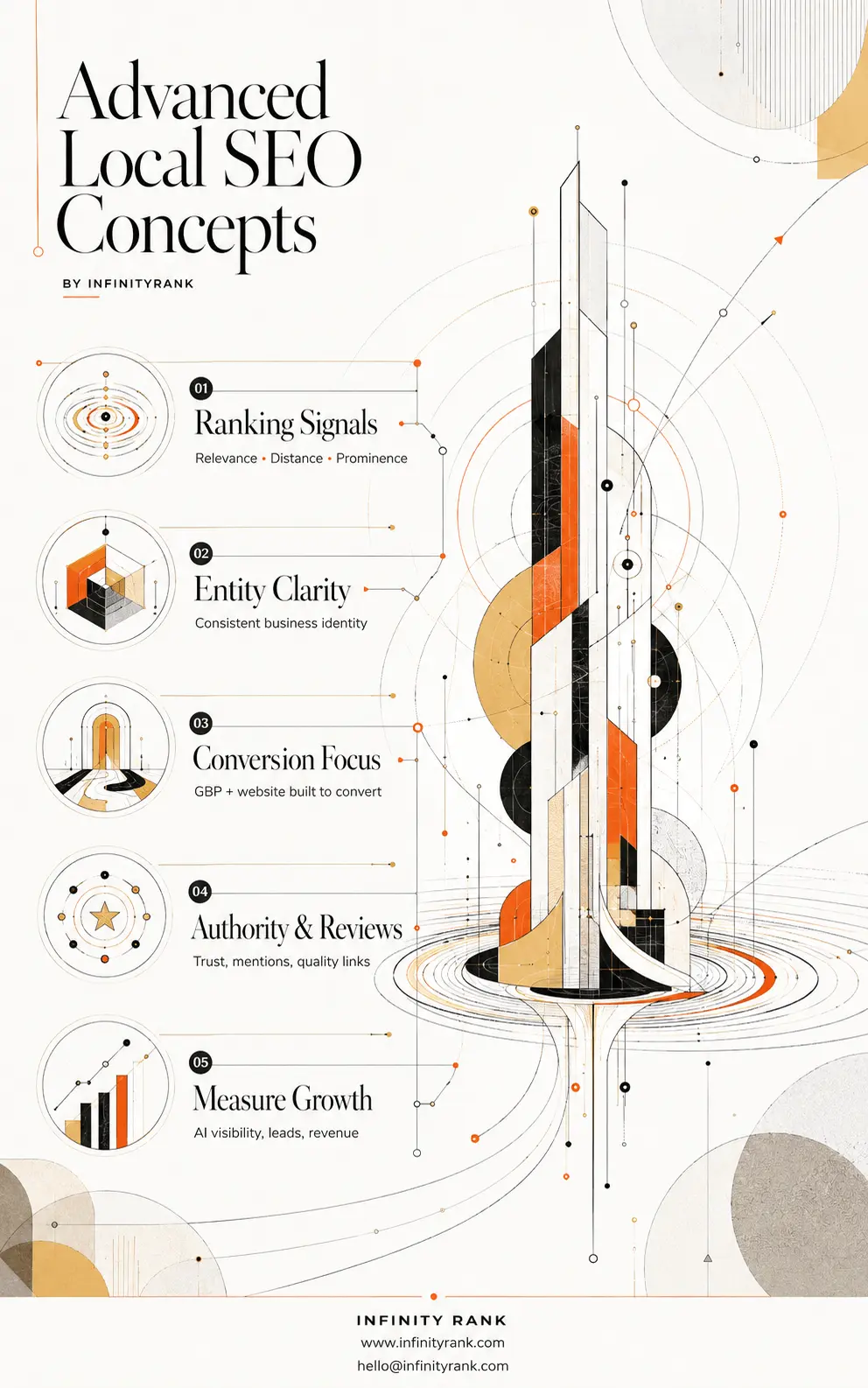
Building lasting market authority relies on strengthening trust through verified customer reviews, brand mentions, and high-quality local backlinks. Expanding your focus to track modern growth metrics, including AI search visibility, inbound leads, and real revenue, ensures your SEO efforts directly impact your bottom line. Use these five core pillars as your strategic roadmap to outrank local competitors and dominate your target service areas.
Here are advanced local SEO concepts worth using in 2026.
1. Build Around Google’s Real Local Ranking Model
Local SEO gets easier to prioritize when every tactic answers one question: does this improve relevance, prominence, or ability to convert visibility?
Relevance is how closely business matches what someone searches for. Strong categories, accurate services, useful service pages, complete profile data, and clear website content help search engines understand that match.
Distance depends heavily on searcher’s location. You cannot reliably optimize business into every map pack across city simply by adding more service areas or repeating city names across pages.
Prominence reflects how well known and credible business appears. Google specifically references factors such as websites linking to business, review volume, and positive ratings when explaining local prominence.
This means advanced local SEO should not be built around isolated tricks. Build stronger business entity, stronger website, stronger reputation, and stronger local authority.
For service-area businesses, service areas should accurately describe where business operates. Do not treat adding more areas inside Google Business Profile as substitute for actual local relevance or proximity. Google describes service areas as way to show customers where business provides products or services.
2. Treat Business as Entity, Not Collection of Keywords
Local SEO increasingly depends on making business identity clear and consistent across web.
Google should be able to determine who business is, what it offers, where it operates, and which other trusted sources refer to it without running into conflicting information.
Start with core identity: business name, primary category, secondary categories, address or service-area model, phone number, opening hours, services, products, attributes, website, and relevant profiles.
Categories deserve extra attention. Google explicitly states categories can affect local ranking, so primary category should describe core business as precisely as possible. Secondary categories should represent real additional services rather than every vaguely related category available.
Website should reinforce same business model.
If Google Business Profile says “HVAC contractor” but site mostly talks about generic home improvement, relevance stays weak. If profile lists boiler repair, heat-pump installation, and emergency HVAC service, site should contain useful pages or sections supporting those services.
Consistency matters more than keyword stuffing.
3. Strengthen Local Relevance Across Profile and Website
Google sometimes adds contextual information to local results to explain why particular result may match query. Local SEOs often call these local justifications.
Do not optimize for justifications by forcing exact keywords everywhere.
Build enough useful supporting information that Google has clear evidence to work with.
For example, plumbing business targeting “emergency plumber” should not rely on business name or description alone. Emergency service should appear naturally within relevant service pages, Google Business Profile services, customer-facing information, opening-hour details where applicable, and internal linking.
Same principle applies to city and neighborhood relevance.
Location page should answer real local questions: whether business serves area, what services are available there, typical response or booking process, relevant local proof, and how customer can take next step.
Avoid producing dozens of near-identical pages where only city name changes. That creates weak pages for users and can drift toward doorway-page behavior.
4. Optimize Google Business Profile for Conversion, Not Activity
Ranking is only useful when searcher takes action.
Advanced Google Business Profile optimization therefore needs two layers: helping Google understand business and helping customer choose it.
Primary category should reflect main commercial service. Supporting categories should represent real secondary offerings. Services should be complete, accurate, and aligned with site. Retail businesses should use supported product features where relevant.
Photos should show actual business wherever possible: team, premises, vehicles, completed work, products, environment, and service process.
Use current photos because they answer trust questions stock photography cannot answer. Google also recommends adding photos and videos so customers can understand what business offers.
Business Profile Posts can support promotions, events, updates, seasonal information, and useful customer communication. Treat them as conversion and communication assets—not as proven direct ranking hack.
Most important test remains simple:
Can searcher understand what business does, trust it, and contact or book it without unnecessary friction?
5. Build Review System That Follows Google’s Policy
Reviews remain central to local decision-making.
BrightLocal’s 2026 US consumer survey found 97% of respondents read reviews for local businesses, while average consumer used six different review sites when choosing businesses. That makes reputation broader than one star rating on Google.
But review generation needs tighter controls than many older local SEO guides suggest.
Google permits businesses to encourage genuine reviews. It does not permit incentives, selective solicitation of positive reviews, pressure to leave review on premises, or requests that customers include specific content in their review. That last rule matters because older SEO advice often tells staff to ask customers to mention service names, locations, or employee names. Do not do that.
Best process is neutral.
Ask eligible customers for honest feedback after genuine experience. Make review link easy to access. Do not tell customer what rating to leave. Do not supply keywords. Do not gate unhappy customers away from public review platforms.
Respond to reviews because replies show customers that business values feedback and can help future prospects assess how business handles praise and complaints. Google itself recommends responding to reviews for this reason.
Do not turn replies into SEO copy. “Thank you for choosing our emergency plumbing service in Brooklyn for your burst pipe repair” reads badly when repeated across dozens of responses.
Write for customer first.
6. Build Local Authority Instead of Chasing Citation Volume
Old-school local SEO often treated citations as checklist: submit business to 100 directories and call job finished.
That approach wastes time when directories have no audience, no local importance, and no meaningful authority.
Citations still matter where people or search engines genuinely use source. Core business listings should remain accurate. But stronger local authority usually comes from harder-to-copy relationships and mentions.
Think local news coverage, chambers of commerce, trade associations, suppliers, professional organizations, community groups, event sponsorships, useful local resources, universities, charities, local blogs, and industry publications.
Google says links to business contribute to prominence. That makes quality and relevance more useful strategic targets than arbitrary citation count.
Strong local link campaign might publish original local data, contribute expert commentary to regional journalist, sponsor legitimate community initiative, create resource local organizations want to reference, or uncover relevant sites already linking to competitors.
Link should make sense even before thinking about SEO.
7. Prepare Local SEO for AI Overviews and AI Mode
AI search is now part of local search strategy.
Google’s guidance for generative AI search does not introduce separate secret optimization system. Google recommends same foundations that support regular Search: useful original content, clear technical structure, accessible pages, accurate business information, and strong user experience. Google specifically includes local business information within its guidance for AI search visibility.
That changes what local businesses should publish.
Generic pages repeating “best plumber in [city]” add little information. Useful pages can provide original pricing context, local regulations, service-area details, comparison criteria, first-hand experience, real project examples, expert answers, and evidence customers cannot get from hundreds of interchangeable pages.
Measurement has changed too.
In June 2026, Google introduced dedicated Search Console reporting for visibility within generative AI features, including AI Overviews and AI Mode. Businesses now have better first-party data for understanding whether their content appears within Google’s generative search experiences.
Do not measure AI visibility using rankings alone.
Track generative-AI visibility alongside non-branded search demand, local organic traffic, Google Business Profile actions, assisted conversions, leads, and revenue.
8. Expand Beyond Google With Apple Business
Google dominates local SEO conversations, but Google is not entire local discovery market.
Apple consolidated Apple Business Connect into Apple Business in 2026. Apple Business now combines previous Apple Business Connect, Apple Business Manager, and Apple Business Essentials capabilities.
For marketers, important part is customer-facing business presence.
Apple says businesses can manage how brands appear across Apple features including Maps, Wallet, Siri, and other parts of Apple ecosystem. Availability varies by country and feature.
Claim and maintain Apple presence where relevant. Keep business identity, locations, brand information, and customer-facing details accurate.
Do not optimize Google while leaving major alternative discovery platform with outdated business data.
9. Use Structured Data to Clarify Business Information
LocalBusiness structured data helps search engines understand details about business, including information such as business type, address, opening hours, and other properties.
It is useful technical layer. It is not magic local ranking switch.
Google says structured data can help it understand page content and can make pages eligible for supported search features. Google also makes clear that correct structured data does not guarantee special search appearance or higher rankings.
Use JSON-LD that reflects visible, real information on page.
<script type="application/ld+json">
{
  "@context": "https://schema.org",
  "@type": "HVACBusiness",
  "name": "Example HVAC Company",
  "url": "https://www.example.com/",
  "telephone": "+1-555-555-5555",
  "address": {
    "@type": "PostalAddress",
    "streetAddress": "123 Example Road",
    "addressLocality": "Example City",
    "addressRegion": "NY",
    "postalCode": "10001",
    "addressCountry": "US"
  },
  "openingHoursSpecification": {
    "@type": "OpeningHoursSpecification",
    "dayOfWeek": [
      "Monday",
      "Tuesday",
      "Wednesday",
      "Thursday",
      "Friday"
    ],
    "opens": "08:00",
    "closes": "18:00"
  }
}
</script>
Use most specific valid Schema.org business type available. Keep markup consistent with visible page information. Test implementation with Google’s Rich Results Test and Schema.org Validator.
Do not stuff schema with services, locations, ratings, or claims that page itself does not support.
10. Connect Local SEO Data to Revenue
Many local SEO reports stop at rankings.
That is weak measurement.
Business cares about qualified calls, bookings, purchases, appointments, store visits, and revenue.
Add UTM parameters to supported Google Business Profile links so website sessions can be segmented properly in analytics. Track phone leads where call tracking can be implemented without creating inconsistent public business data. Connect forms and booking systems to CRM when possible.
Measure visibility by location using geo-grid rank tracking where useful, but do not confuse map rank with business outcome.
Track local landing-page traffic, conversions, direction requests, calls, bookings, appointment actions, and CRM-qualified leads.
Do not build reporting around old Google Business Profile chat data. Google removed Business Profile chat and call-history features on July 31, 2024. Customers can still contact businesses through other supported profile actions, and eligible accounts may have newer contact options such as text or WhatsApp depending on region.
Best report answers:
Which local search activity generated business?
11. Respect Proximity Instead of Promising Impossible Coverage
Local rankings vary by search location.
Business that ranks first near its office may rank much lower several miles away. Dense markets make this especially obvious.
Do not sell fantasy that more keywords, more service areas, or more backlinks can completely erase proximity.
Better strategy is to dominate strongest realistic service radius, improve prominence, build relevant location content, and increase conversion rate from visibility already earned.
If business genuinely expands, additional physical locations can expand reach—but locations must be legitimate operations that comply with Google Business Profile rules.
For service-area businesses, build pages around places business actually serves when those pages provide unique local value. Do not create fake offices or mass-produced city pages to manufacture proximity.
Advanced Local SEO Checklist for 2026
- Keep Google Business Profile complete, accurate, verified, and aligned with website.
- Choose primary and secondary categories based on real business activities.
- Build useful service and location content around actual search intent.
- Maintain consistent business identity across Google, Apple Business, website, and important third-party platforms.
- Generate honest reviews without incentives, review gating, pressure, or scripted review content.
- Earn relevant local and industry links instead of chasing directory volume.
- Add accurate LocalBusiness structured data where appropriate.
- Track Google Business Profile traffic, calls, bookings, leads, and revenue.
- Measure visibility across traditional Search, Maps, AI Overviews, and AI Mode where data is available.
- Improve conversion experience so rankings turn into customers.
Example: Advanced Local SEO in Practice
Imagine HVAC company serving several neighborhoods around one office.
Weak strategy creates 30 copied city pages, adds every neighborhood as service area, buys hundreds of directory citations, posts generic Google updates every week, and asks customers to mention “AC repair + city name” in reviews.
Advanced strategy looks different.
Business chooses accurate primary category, fully documents real services, builds detailed service pages, creates useful location pages only for meaningful service areas, adds authentic project photography, collects neutral customer reviews, earns links through local partnerships and useful regional content, maintains Apple Business presence, implements accurate schema, and tracks leads from search through CRM.
It also checks Search Console’s generative AI reporting to see whether useful local content is gaining visibility in AI Overviews or AI Mode.
One approach manufactures signals.
Other builds evidence.
Final Thoughts
Advanced local SEO in 2026 is not about finding one ranking trick Google has not noticed yet.
It is about making business easier to understand, easier to trust, easier to discover, and easier to choose.
Build relevance through accurate business information and useful content. Build prominence through genuine reputation, links, and local authority. Accept proximity limits instead of trying to fake them. Optimize Google Business Profile for customers as well as search engines. Keep Apple Business accurate. Use structured data to clarify real information. Measure AI search alongside traditional local visibility.
Then connect all of it to leads and revenue.
That is stronger local SEO strategy and much harder for competitors to copy.
FAQs
What are most important local SEO ranking factors in 2026?
Google’s local ranking documentation focuses on relevance, distance, and prominence. Complete business information, accurate categories, reviews, links, website relevance, and searcher’s location all play roles in local visibility.
Do Google Business Profile service areas improve rankings?
Service areas tell customers where business operates, but adding more service areas should not be treated as way to manufacture rankings across those locations. Proximity and other local-ranking factors still apply.
What kind of reviews should businesses ask for?
Ask customers for honest reviews based on genuine experience. Do not offer incentives, selectively request positive reviews, pressure customers to review business, or tell them what specific content to include.
Does LocalBusiness schema improve local rankings?
Do not treat structured data as direct ranking boost. It helps Google understand business information and can support eligibility for certain search features, but Google does not guarantee enhanced visibility simply because markup is present.
Is Apple Business worth using for local SEO?
Yes, where relevant to market. Apple Business lets organizations manage customer-facing brand and location information across Apple ecosystem, including Maps and Siri. Feature availability varies by region.
How should local businesses optimize for AI search?
Use same fundamentals Google recommends for Search: helpful original content, clear technical structure, crawlable pages, strong user experience, and accurate business information. In 2026, Search Console also provides dedicated reporting for visibility in Google’s generative AI features.