
Testimonial link building is a simple idea: you provide an honest testimonial to a company whose product or service you have genuinely used. If the company publishes your testimonial, it may credit you with your name, business, and a link to your website.
The direction matters.
You are not asking your customers to review your business. You are giving feedback to another company based on your own experience.
For example, an SEO agency might provide a testimonial to:
- A reporting platform it uses
- Its website hosting provider
- A project management tool
- A specialist consultant
- A training company
- A software supplier
The supplier receives credible marketing material. The agency may receive a relevant brand mention, referral traffic, and an editorial backlink.
However, the backlink is never guaranteed. The publisher controls whether it includes a link, where the link points, and which link attributes it uses.
This guide explains how testimonial link building works, how to find legitimate opportunities, and how to avoid turning a straightforward outreach tactic into a manipulative link exchange.
What Is Testimonial Link Building?
Testimonial link building is the process of giving a genuine testimonial to a company you have worked with or bought from, with the possibility that the company will publish the testimonial and credit your business with a backlink.
A typical placement may include:
- Your testimonial
- Your name
- Your job title
- Your company name
- Your company logo
- A link to your homepage or profile
The testimonial usually appears on a customer page, homepage, landing page, case study, partner page, or “What Our Customers Say” section.
The link exists because the company wants to identify the person or business behind the endorsement. That makes the attribution useful to readers, rather than an unrelated link inserted only for SEO.
A Simple Testimonial Backlink Example
Suppose your agency has used an SEO reporting platform for twelve months.
You send the provider this testimonial:
“The platform reduced the time we spend preparing monthly client reports and made it easier for account managers to identify ranking changes before calls. We now use it across every active SEO campaign.”
The provider publishes the quote on its customer page and identifies the source as:
Alex Morgan, Operations Director at Example Agency
The company name links to the agency’s homepage.
That is a testimonial backlink.
The statement is based on a real experience, the attribution confirms who provided it, and the link helps readers learn more about the customer.
Testimonial Links, Reviews, and Onsite Testimonials Are Different
These activities are often confused, but they serve different purposes.
| Activity | Who provides the statement? | Where is it published? | Main purpose |
| Testimonial link building | Your business | Another company’s website | Attribution, visibility, referral traffic, and a possible backlink |
| Customer testimonial collection | Your customer | Your own website | Trust and conversion support |
| Third-party review generation | Your customer | Google, Trustpilot, Clutch, Yelp, or another platform | Reputation and customer decision-making |
| Case study participation | Your business and the supplier | The supplier’s website | A detailed account of the relationship and results |
Customer reviews can support your reputation. Testimonials on your own website can support conversions. Neither should be described as testimonial link building unless another website publishes your endorsement and credits you with a link.
You should also avoid asking customers to insert promotional links into third-party reviews. Review platforms have their own rules, and review text is not a dependable source of backlinks.
Testimonial Link Building Strategy for Organic Growth
Providing genuine testimonials for products and services your business actually uses is one of the most effective, underutilized ways to earn high-authority backlinks. The strategy starts by delivering great results or being an active customer, then submitting real, detailed feedback to vendor partners, industry tools, and reputable review platforms. When vendors publish your endorsement on their website or case study pages, you secure contextual backlinks pointing directly to your domain. This simple guide breaks down five essential steps to turn authentic business feedback into powerful search signals.
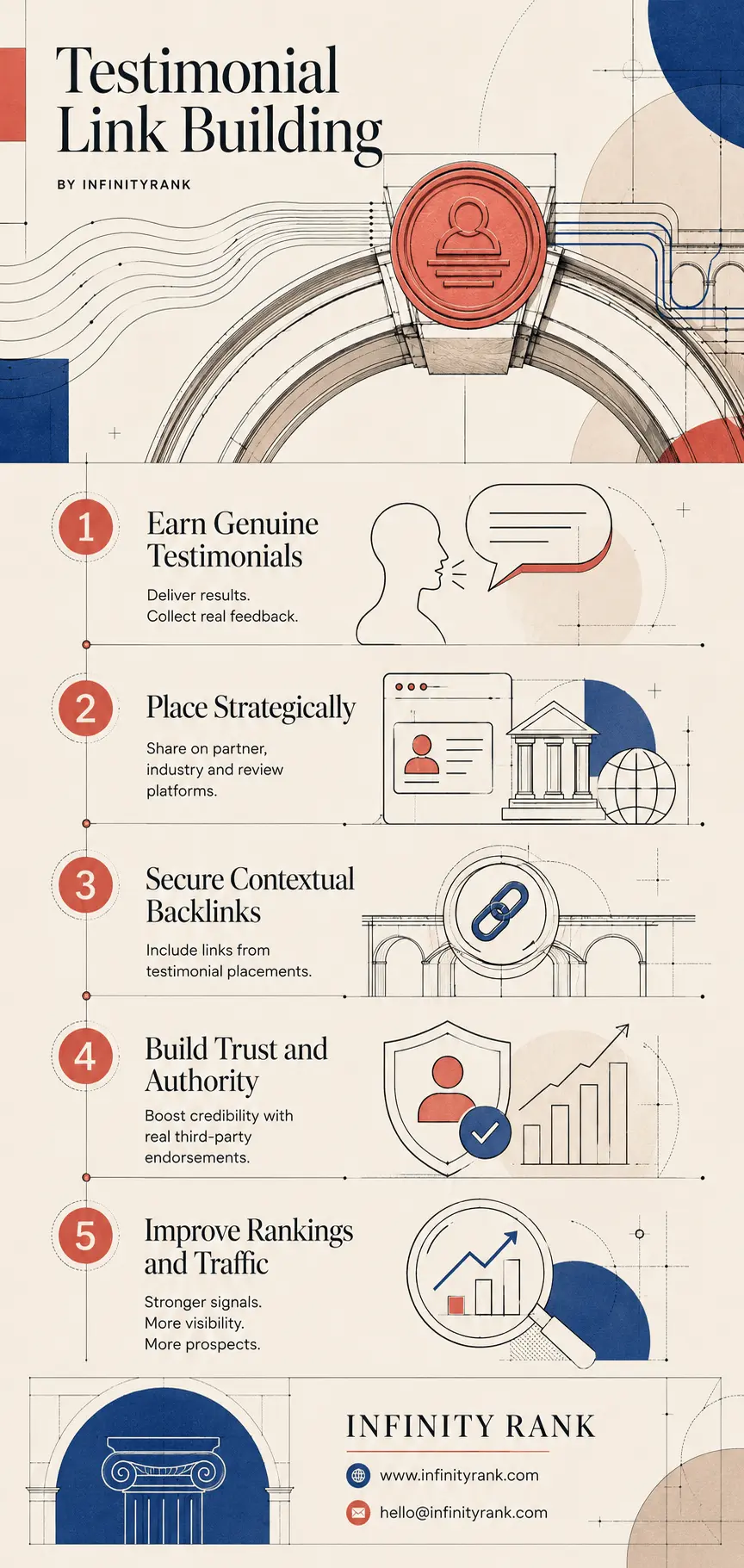
Earning links through testimonials does more than just transfer page authority—it builds brand trust and credibility by highlighting real third-party endorsements across industry platforms. As these high-trust signals compound over time, your website gains improved search rankings, greater online visibility, and a steady stream of qualified prospects. Use these five core pillars as your strategic framework to turn vendor relationships into sustainable organic search performance.
Does Testimonial Link Building Help SEO?
It can, but testimonial backlinks do not receive a special ranking value simply because they appear beside an endorsement.
Their usefulness depends on the same factors that apply to other backlinks.
Relevance
The relationship between the two businesses should make sense.
A link from a project management platform to an agency that uses the software has a clear commercial connection. A testimonial link from an unrelated website with no genuine relationship is harder to justify.
Referring-Page Quality
Evaluate the actual page where the testimonial will appear.
A strong domain can still contain weak, abandoned, or unindexed pages. Check whether the page:
- Contains useful original content
- Is accessible to search engines
- Appears maintained
- Has a clear purpose
- Receives relevant visibility
- Identifies real customers
- Avoids excessive or irrelevant outbound links
Do not approve an opportunity based only on Domain Rating, Domain Authority, or another third-party score.
Placement
A testimonial placed prominently on a customer page or product page is more likely to be seen than one buried in a rotating widget containing hundreds of quotes.
Placement also affects referral value. A visible attribution may send qualified visitors even when its direct ranking impact cannot be isolated.
Link Attributes
A normal editorial link may not require a special rel attribute.
However, Google recommends qualifying paid placements with rel="sponsored". nofollow also remains acceptable for links that should not be treated as ordinary editorial recommendations.
Do not reject a legitimate testimonial placement simply because the publisher uses nofollow. The mention may still provide credibility, discovery, referral traffic, and relationship value.
Target Page
The homepage is often the most natural destination because the testimonial identifies your company.
A deeper page may be appropriate when it gives readers more relevant information. For example, a testimonial from a web design agency using a hosting platform might link to the agency’s hosting-management service page.
Do not request an unrelated commercial page simply because you want that page to rank.
Benefits Beyond Rankings
Treating testimonial links only as ranking assets misses much of their value.
A good placement can produce:
Brand Exposure
Your company appears in front of people already researching a relevant product or service.
Referral Traffic
Prospective customers may click the attribution to understand who provided the testimonial.
Commercial Credibility
Being identified as a customer of a respected supplier can reinforce the legitimacy of your business.
Stronger Supplier Relationships
A useful testimonial supports a company you already work with. That can lead to future collaborations, case studies, interviews, partner listings, or event opportunities.
Content Opportunities
A short testimonial can develop into a detailed customer story or case study containing more context, stronger visibility, and several relevant brand references.
None of these outcomes guarantees higher rankings. They can still make the placement worthwhile.
How to Find Testimonial Link-Building Opportunities
The best prospects are usually already inside your company.
1. List the Products and Services You Use
Start with a simple inventory.
Include:
- Software subscriptions
- Hosting providers
- Business consultants
- Agencies
- Freelancers
- Professional services
- Equipment suppliers
- Training providers
- Industry memberships
- Payment processors
- Communication tools
- Data providers
Ask different departments what they use. Your finance, sales, marketing, operations, and development teams may have supplier relationships you do not know about.
Prioritize companies you have used long enough to describe the experience honestly.
2. Look for Existing Customer Pages
Visit each supplier’s website and search for sections such as:
- Testimonials
- Customers
- Customer stories
- Case studies
- Success stories
- Trusted by
- Client results
- What customers say
- Partner directory
You can also use searches such as:
site:example.com testimonialssite:example.com customerssite:example.com "customer story"site:example.com "what our customers say"site:example.com "trusted by"
Check whether existing testimonials include customer names, companies, logos, and external links.
A company that already credits customers is a stronger prospect than one that publishes anonymous quotes without attribution.
3. Check Whether You Have Something Useful to Say
Do not offer a testimonial merely because a backlink may be available.
You should be able to explain:
- What problem you had
- Why you chose the product or service
- Which feature or part of the service helped
- How your process changed
- What result you observed
- Who would benefit from the product
Specific experience gives the supplier something worth publishing.
Generic praise does not.
4. Evaluate the Potential Placement
Before contacting the company, review the likely page.
Check:
- Whether the business is legitimate
- Whether the website is relevant to your company
- Whether the page is indexed
- Whether existing customers are credited
- Whether customer names link to their websites
- Whether the page receives estimated organic traffic
- Whether the page is buried or easy to reach
- Whether the site publishes excessive sponsored content
- Whether the link would help a real reader
For a broader evaluation process, use the same relevance, placement, traffic, anchor-text, and link-attribute checks you would apply when reviewing other backlink opportunities.
5. Find the Right Contact
The best contact depends on the company.
Try:
- Customer success manager
- Account manager
- Partnership manager
- Marketing manager
- Content manager
- Founder
- Public relations contact
Start with the person who already knows your account. A customer success manager can often forward the testimonial to the correct marketing contact.
How to Write a Testimonial Worth Publishing
A publishable testimonial is specific, believable, and easy to understand.
It does not need to be long. In many cases, 50 to 120 words is enough.
Use This Structure
- Context: What were you trying to do?
- Experience: Which part of the product or service helped?
- Outcome: What changed?
- Recommendation: Who would you recommend it to?
Weak Example
“This is an amazing company with excellent service. We highly recommend them to everyone.”
This says almost nothing. It could apply to any company.
Stronger Example
“Before using the platform, our account managers built monthly SEO reports manually across several tools. Its automated dashboards reduced repetitive reporting work and gave clients a clearer view of ranking, traffic, and backlink changes. It is particularly useful for agencies managing several campaigns at once.”
The second version gives the supplier useful marketing material because it explains the problem, the experience, and the type of customer who may benefit.
Keep Claims Accurate
Do not invent performance figures.
If you state that a product reduced reporting time by 40%, you should have a reasonable basis for that number. When you cannot substantiate a precise result, describe the change without manufacturing a statistic.
For example:
“The platform reduced the time required to prepare monthly reports.”
This is safer than claiming:
“The platform increased our productivity by 73%.”
Testimonial Outreach Template
Keep the message short. The company already has your business details, so you do not need to send a long pitch.
Subject: Testimonial for [Company Name]
Hi [Name],
We have been using [product or service] for [period], and it has helped us [specific outcome].
I noticed that you feature customer feedback on your website. I would be happy to provide a short testimonial based on our experience.
Here is a draft:
“[Insert testimonial.]”
You may credit it to:
[Name] [Job title] [Company]
I can also send a logo or headshot if useful.
Best, [Name]
Do not make the backlink the condition of providing the testimonial.
You may include your preferred company URL with the attribution details, but avoid language such as:
“We will only provide the testimonial if you give us a dofollow link.”
That turns a genuine endorsement into an explicit link transaction.
Should You Ask for a Backlink?
You can provide the correct company URL as part of your attribution information.
For example:
- Name
- Job title
- Company name
- Company website
- Logo file
This gives the publisher everything needed to credit you accurately.
There is no need to demand a backlink or specify a keyword-rich anchor. Most legitimate placements will use your company name as the anchor, which is usually the most natural choice.
If the company publishes the testimonial without a link, you may send one polite message:
“Thank you for publishing the testimonial. Would you be able to link our company name to our website so readers can identify the business behind the quote?”
Accept the publisher’s decision if it declines.
Follow Up Without Becoming a Nuisance
A testimonial may need approval from marketing, legal, design, or customer success teams.
Send one follow-up after approximately seven business days. A second follow-up may be appropriate when you already have an active supplier relationship.
Do not send a long automated sequence.
A simple follow-up is enough:
Hi [Name],
I wanted to check whether the testimonial below would be useful for your customer page. I am happy to shorten it or provide a logo if needed.
Best, [Name]
If there is no response after that, move on.
Testimonial Link-Building Risks
The tactic is relatively straightforward when the endorsement is genuine. Problems begin when the testimonial is created mainly to disguise a link arrangement.
Excessive Reciprocal Exchanges
Do not run campaigns based on:
“You write a testimonial for us, and we will write one for you.”
Google identifies excessive link exchanges and partner pages created primarily for cross-linking as examples of link spam.
Two companies can legitimately endorse each other when both have genuine experience. The risk comes from making reciprocal links the purpose or condition of the arrangement.
Paid or Incentivized Testimonials
Payment, free access, discounts, gifts, or other benefits can create a material relationship.
For U.S. marketing, the FTC states that endorsements must be truthful and not misleading. Connections that may affect how people evaluate an endorsement should be disclosed clearly.
Other countries have their own advertising and consumer-protection requirements. Check the rules that apply to the audience and companies involved.
Fake Testimonials
Never provide a testimonial for a product you have not used.
Do not:
- Invent a customer identity
- Use an employee without disclosing the connection
- Publish AI-generated praise as a real customer statement
- Misrepresent the results achieved
- Attribute a quote to someone who did not approve it
The FTC’s Consumer Reviews and Testimonials Rule, effective since October 21, 2024, prohibits several deceptive practices involving fake or false reviews and testimonials.
Keyword-Rich Anchors
Do not request anchors such as:
A company-name attribution is clearer and more credible.
Scaled, Identical Testimonials
Do not send the same testimonial to dozens of companies.
Each statement should reflect your actual experience with that supplier. Repeating vague praise across unrelated websites makes the campaign look manufactured and gives publishers little reason to accept it.
Low-Quality Testimonial Pages
A testimonial link is not automatically good.
Avoid pages that:
- Contain hundreds of unrelated outbound links
- Publish anonymous or unverifiable quotes
- Exist mainly to exchange links
- Have no visible relationship with the companies listed
- Are not indexed
- Are abandoned
- Use copied content
- Appear on a private blog network
The label “testimonial” does not make a weak link safe or useful.
How to Track Testimonial Backlinks
Create a simple spreadsheet containing:
- Supplier
- Product or service used
- Contact name
- Contact email
- Date contacted
- Follow-up date
- Response
- Testimonial supplied
- Publication URL
- Target URL
- Link anchor
- Link attribute
- Placement status
- Referral traffic
- Notes
After publication, verify that:
- The testimonial appears correctly.
- Your name and title are accurate.
- The company attribution is correct.
- The link points to the intended page.
- The link works.
- The page is accessible to search engines.
Monitor referral traffic in Google Analytics and track the backlink through your preferred SEO platform.
Do not claim that one testimonial link caused a ranking increase. Search performance changes for many reasons, including content updates, new links, technical changes, competitor activity, and search-result changes.
Evaluate the campaign using several outcomes:
- Relevant links earned
- New referring domains
- Referral visits
- Assisted conversions
- Brand visibility
- Supplier relationships
- Case-study opportunities
Common Testimonial Link-Building Mistakes
Avoid these errors:
- Confusing testimonial backlinks with customer reviews
- Providing testimonials for products you have not used
- Demanding a followed link
- Arranging large reciprocal exchanges
- Using exact-match commercial anchor text
- Targeting irrelevant companies
- Judging opportunities using only DA or DR
- Writing vague, generic praise
- Inventing results
- Ignoring disclosure requirements
- Treating
nofollowlinks as worthless - Failing to verify the published link
- Sending aggressive follow-up sequences
- Expecting immediate ranking changes
Testimonial outreach works best as a small, targeted part of a broader manual link-building strategy. It is not a replacement for digital PR, content-led outreach, resource promotion, partnerships, or other legitimate methods of earning relevant links.
Frequently Asked Questions
What is testimonial link building?
Testimonial link building involves providing an honest testimonial to a company whose product or service you have used. If the company publishes it, it may credit you or your business with a backlink.
Are testimonial backlinks safe?
They can be safe when the testimonial reflects a real experience and the link exists as natural attribution.
Risk increases when businesses fabricate testimonials, arrange excessive reciprocal exchanges, pay for unqualified links, or use the tactic mainly to manipulate rankings.
Is a backlink guaranteed?
No.
The company receiving the testimonial decides whether to publish it, whether to credit your business, and whether to include a link.
Provide the testimonial because it is accurate and useful, not because a backlink has been promised.
Should I ask for a dofollow link?
“Dofollow” is not an official link attribute. It usually means a normal link without nofollow, sponsored, or another qualifying value.
You may provide your company URL, but you should not make a followed link a condition of the testimonial.
Are reciprocal testimonial links risky?
They can be.
Two businesses may legitimately use and recommend each other’s services. However, organized exchanges created primarily so both parties receive ranking links can resemble the excessive reciprocal-link arrangements described in Google’s spam policies.
Can I provide a testimonial for a free product?
Yes, provided you genuinely used the product and the statement accurately represents your experience.
However, free access may be a material connection that should be disclosed, depending on the circumstances and applicable advertising rules.
The publisher may also decide to qualify the link as sponsored or nofollowed.
What page should the testimonial backlink point to?
The homepage is often the most natural destination because the attribution identifies your company.
A relevant service page, profile, or case study may be suitable when it gives readers better context. Do not request an unrelated page solely to target a commercial keyword.
How many testimonial links should I build?
There is no fixed target.
The number of genuine suppliers you can endorse will usually be limited. Prioritize relevant, credible relationships rather than trying to scale the tactic across hundreds of websites.
Can testimonial links replace other link-building strategies?
No.
Testimonial link building is a supporting tactic. A balanced campaign may also include digital PR, original research, expert contributions, resource outreach, link reclamation, partnerships, and other methods that give publishers a legitimate reason to link.
Final Takeaway
Testimonial link building works when the endorsement comes first and the backlink comes second.
Start with products and services your company already uses. Find suppliers that publish customer feedback. Offer a specific and honest account of your experience. Provide accurate attribution details, but let the publisher decide how the testimonial is presented.
Do not exchange praise for links, fabricate results, demand followed backlinks, or treat third-party reviews as link placements.
A genuine testimonial may earn a relevant backlink. It may also generate referral traffic, strengthen a supplier relationship, or lead to a larger customer story.
Those are legitimate business outcomes even when the link does not produce an immediate ranking change.