Brand mentions happen whenever another website, publication, social account, forum, or online community refers to your brand, product, executive, or campaign.
Some mentions include a backlink. Others mention your name without linking anywhere.
Both can matter, but not for identical reasons.
Linked mentions can send referral traffic, help search engines discover pages, and provide backlinks. Google confirms that it uses links as one signal when determining page relevance and discovering pages to crawl.
Unlinked mentions do not provide those same link benefits. Their value comes from brand exposure, reputation, discovery, and potential link-reclamation opportunities.
Mentions also matter beyond traditional search. Google says its generative AI features can surface what people say about products and services across blogs, videos, forums, and other web sources. Google also explicitly warns that chasing inauthentic mentions is not a useful shortcut to AI Search visibility.
This guide covers how to track brand mentions, decide which ones matter, earn more credible coverage, turn suitable unlinked mentions into links, and measure results.
What Is a Brand Mention?
Brand mention is any online reference to your:
- Company name
- Product or service
- Founder or executive
- Branded research
- Campaign
- Event
- Proprietary tool or methodology
Mentions generally fall into two groups.
Linked Brand Mentions
Linked mention includes clickable link pointing to your website.
Example:
“Infinity Rank published a new analysis of link-building costs.”
If publication links “Infinity Rank” or “analysis of link-building costs” to relevant page, mention also functions as backlink.
Benefits can include:
- Referral traffic
- Search-engine discovery
- Backlink acquisition
- Brand exposure
- Qualified leads
- Easier attribution
Unlinked Brand Mentions
Unlinked mention names brand without linking to its website.
Example:
“Infinity Rank was one of agencies included in comparison.”
You still gain exposure, but no direct referral path or crawlable backlink exists.
That makes strong unlinked mentions useful candidates for link reclamation.
Brand Mentions Strategy for SEO Authority
Tracking where your business is referenced online is one of the most efficient ways to build digital trust and capture unlinked authority. The process begins when you find mentions across the web, search engine results, and active online communities. Once discovered, you need to score what matters by evaluating domain quality, topical relevance, and referral potential. Consistently earning real coverage through original research, industry expertise, and active participation ensures your brand builds genuine web presence. This simple guide breaks down five essential steps to monitor, earn, and convert brand references into ranking power.
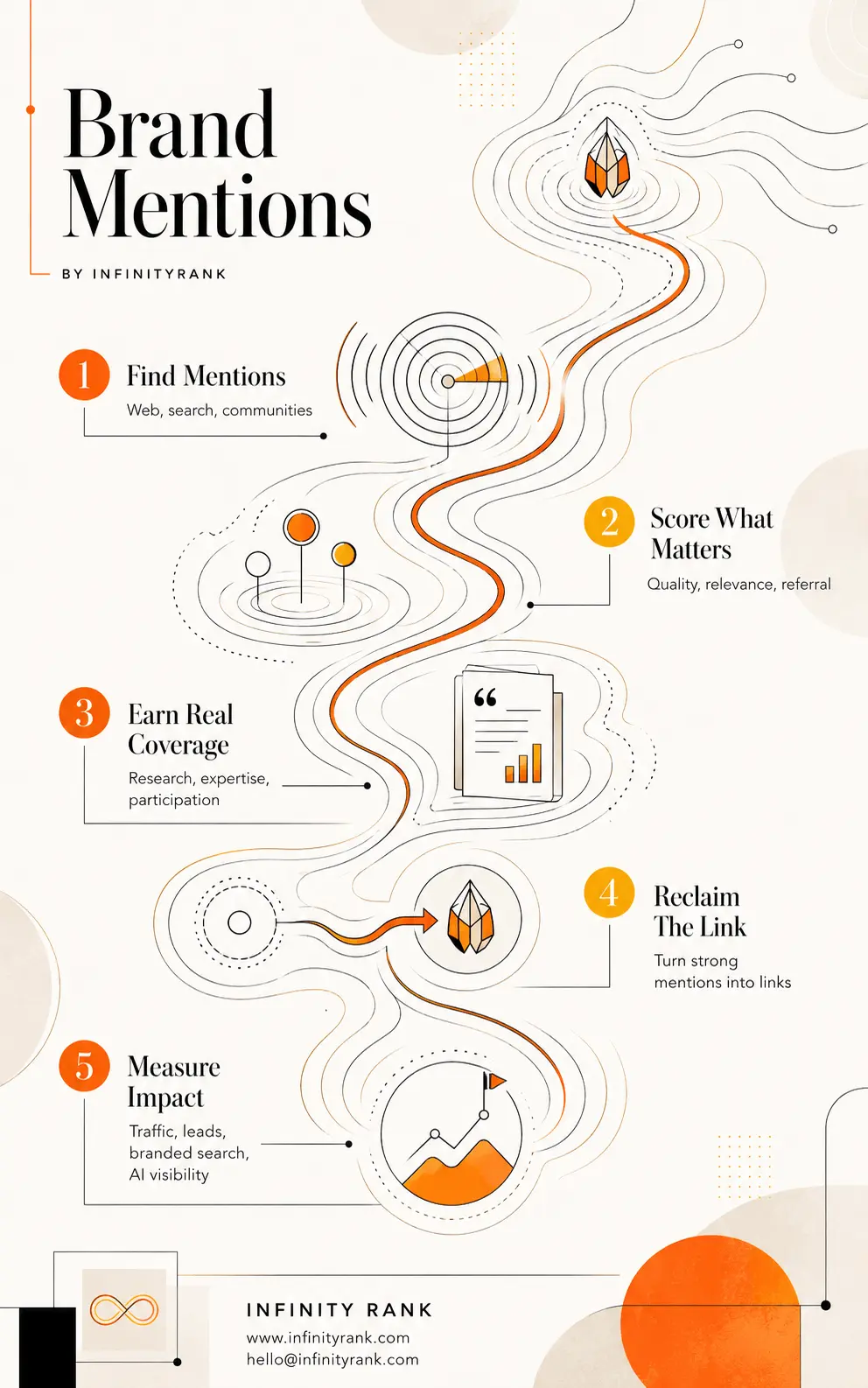
Converting established brand awareness into technical SEO equity requires reaching out to webmasters to reclaim the link, turning strong unlinked mentions into active backlinks. Tracking your results over time allows you to measure impact by monitoring referral traffic, inbound leads, branded search volume, and AI visibility. Use these five core pillars as your strategic framework to transform online brand references into lasting search engine authority and measurable growth.
Why Brand Mentions Matter
Brand mentions sit between PR, reputation management, content marketing, and link building.
Their value depends heavily on who mentions you, where mention appears, why you were mentioned, and whether audience cares.
1. Earn Backlinks and Referral Traffic
Linked editorial mentions can send readers directly to your site.
They also create crawlable links. Google states that links help it discover pages and serve as one signal when assessing relevance.
This does not mean every brand mention or backlink improves rankings. Context, relevance, page quality, placement, and link attributes matter.
2. Expand Brand Discovery
Potential customers do not discover companies only through standard Google results.
They may encounter brands through:
- News articles
- Industry blogs
- YouTube
- Podcasts
- Reviews
- Comparison pages
- Expert roundups
- AI-generated search experiences
Credible mentions increase number of places where your brand can be discovered.
3. Support Visibility in AI Search
Claims about unlinked mentions being direct AI or Google ranking factors should be treated carefully.
Google does confirm that its generative AI Search features can reflect discussions from blogs, videos, forums, and other sources across web. It does not say that collecting unlinked mentions is a standalone ranking tactic.
Better strategy: earn genuine coverage by publishing useful information, contributing expertise, producing original research, and participating where your audience already spends time.
4. Build Reputation
Mention from respected trade publication can carry more business value than dozens of references from irrelevant sites.
Quality beats raw volume.
Ask:
- Is publication trusted by target audience?
- Is mention relevant to your business?
- Is context positive or neutral?
- Does page receive relevant traffic?
- Does mention create referral or link opportunity?
- Would potential customer consider this source credible?
That is better framework than counting every occurrence of brand name.
How to Track Brand Mentions
Tracking should cover more than Google results.
Useful monitoring stack combines web mentions, search performance, referral traffic, social discussion, and manual qualification.
1. Monitor Web Mentions
Use Google Alerts or dedicated brand-monitoring platform to watch:
- Exact brand name
- Common misspellings
- Product names
- Founder names
- Executive names
- Branded research
- Campaign names
For brands with generic names, combine brand with industry terms to reduce noise.
Example:
"Brand Name" + SEO
Do not automatically treat every result as valuable. Monitoring finds mentions. Human review decides whether they matter.
2. Track Branded Search Demand
Use Google Search Console to monitor queries containing:
- Brand name
- Product names
- Founder names
- Brand + review
- Brand + pricing
- Brand + alternatives
- Brand + service
Search Console reports impressions, clicks, queries, and other Google Search performance data.
Large media placements can sometimes coincide with increased branded searches. Do not automatically claim causation, but track changes before and after major coverage.
3. Track AI Search Visibility
Google introduced dedicated Search Console reporting for visibility in generative AI Search features in June 2026.
That reporting can help measure impressions from features such as AI Overviews and AI Mode rather than relying on manual checks alone.
Use it alongside normal organic-search reporting.
4. Track Referral Traffic
In analytics platform, check visits from sites that mention your brand.
Track:
- Referral sessions
- Engaged sessions
- Leads
- Signups
- Purchases
- Assisted conversions
Small niche publication may produce fewer visits than national outlet but send more qualified prospects.
Traffic volume alone is weak measure.
5. Monitor Communities and Social Platforms
Track relevant conversations on platforms where customers spend time.
Depending on business, that could include:
- YouTube
- Industry forums
- Slack communities
- Discord communities
- Review platforms
Focus on meaningful conversations, not raw mention count.
Build Simple Mention Tracker
For each useful mention, record:
- Date found
- Publication
- Page URL
- Mention type
- Linked or unlinked
- Sentiment
- Audience relevance
- Publication quality
- Estimated referral potential
- Contact person
- Outreach status
- Link added?
- Referral traffic
- Leads or conversions
This turns brand monitoring into measurable workflow.
How to Prioritize Brand Mentions
Not every unlinked mention deserves outreach.
Use simple internal scoring model.
Publication Quality: 0–4
Consider:
- Editorial standards
- Reputation
- Genuine audience
- Organic visibility
- Spam level
Avoid relying on Domain Authority or Domain Rating alone. Third-party authority metrics can help with prospecting, but they are not Google ranking scores.
Audience Relevance: 0–3
Ask how closely publication and article match people you want to reach.
- 0: irrelevant
- 1: weak connection
- 2: relevant
- 3: highly relevant
Referral Potential: 0–3
Consider:
- Placement prominence
- Page traffic
- Commercial relevance
- Reader intent
- Likelihood readers would click
Total possible score: 10.
For example, treat mentions scoring 7+ as priority outreach candidates.
This is internal prioritization framework, not search-engine formula.
7 Repeatable Ways to Earn High-Quality Brand Mentions
1. Publish Original, Quotable Data
Journalists, bloggers, and industry writers need evidence.
Original research gives them something worth citing.
Start with one narrow question your market cares about.
Example:
Which acquisition channel produces fastest first purchase for small ecommerce stores?
Collect data using appropriate sample and methodology.
Do not choose arbitrary sample size because “50 sounds enough.” Required sample depends on population, research design, recruitment method, confidence requirements, and intended claims.
When publishing research, disclose:
- Sample size
- Respondent profile
- Collection dates
- Recruitment method
- Survey questions where appropriate
- Analysis method
- Important limitations
Then turn research into several assets:
- Main research article
- 2–4 charts
- Short methodology section
- Press summary
- Social posts
- Journalist pitch
- Downloadable report if useful
Strong pitch leads with finding, not company.
Subject: Data: [Specific Finding] — New Research From [Brand]
Pitch:
Hi [Name],
We analyzed [dataset/respondents] and found [specific result].
Most relevant finding for your audience: [one sentence].
Full methodology and data are here: [link].
Happy to provide additional numbers or expert context if useful.
[Name] [Role]
Give journalist something worth reporting.
2. Use HARO and Targeted Journalist Requests
Help a Reporter Out (HARO) currently connects journalists with expert sources and sends media queries to registered sources.
Use journalist-request platforms selectively.
Do not answer every query.
Respond when:
- Topic matches genuine expertise
- You can provide specific evidence or experience
- Publication reaches useful audience
- Journalist request is legitimate
- Deadline is realistic
Prepare:
- 25-word bio
- 50-word bio
- Headshot
- Company boilerplate
- Credentials
- Relevant statistics
- Short examples
Keep response compact.
Response format:
[Direct answer or quote.]
[Supporting fact, example, or experience.]
— [Name], [Role], [Company]
Respond promptly when suitable query appears, but do not sacrifice answer quality for arbitrary response-time target.
Track:
- Query
- Publication
- Journalist
- Date
- Response
- Result
- Mention
- Link
- Referral traffic
3. Contribute Expert Commentary
Expert commentary works when expertise is specific.
Bad pitch:
“Our CEO can comment on marketing trends.”
Better:
“Our link-building team analyzed 430 outreach campaigns and can explain which prospecting signals produced highest reply rates.”
Create shortlist of publications covering your market.
Then prepare several angles tied to:
- Current industry changes
- Proprietary data
- Common misconceptions
- Customer behavior
- Technical changes
- First-hand operating experience
Keep pitches focused on information editor can use.
Subject: Expert comment for [topic]
Hi [Editor],
For your coverage of [topic], [Name], [Role] at [Company], can provide data-backed commentary on [specific issue].
One useful angle:
“[Short, quotable insight.]”
Can send supporting data or additional context if useful.
[Name]
No biography dump. No company sales pitch.
4. Host or Sponsor Relevant Events
Events create natural reasons for partners, speakers, attendees, associations, and publications to mention your brand.
Formats can include:
- Webinar
- Workshop
- Roundtable
- Conference session
- Industry meetup
- Research briefing
- Partner event
Choose business goal first.
Possible goals:
- Brand awareness
- Lead generation
- Partner relationships
- Media coverage
- Expert positioning
Then make event easy to reference.
Prepare:
- Event landing page
- Speaker bios
- Shareable graphics
- Short event description
- Partner copy
- Recording
- Key takeaways
- Post-event summary
After event, send speakers and partners useful follow-up pack containing recording, important findings, approved images, and links.
You are reducing work required for other people to mention event.
5. Encourage Authentic User-Generated Content
Customers can create powerful brand mentions because content comes from real use rather than company messaging.
Possible UGC formats:
- Product photos
- Reviews
- Before-and-after examples
- Customer stories
- Tutorials
- Community challenges
- Case studies
Keep campaigns simple.
Example:
Share how you use [product] with #[Campaign] for chance to be featured.
If incentives, sponsorships, free products, or other material relationships exist, disclosure rules may apply.
FTC guidance says people endorsing products should clearly disclose relevant material relationships with brands.
Do not disguise paid endorsements as organic mentions.
For UGC campaigns, define:
- Eligibility
- Entry method
- Dates
- Prize
- Selection process
- Content rights
- Privacy terms
- Disclosure requirements
Authenticity matters more than mention count.
6. Participate in Niche Communities
Brands often approach communities backwards.
They join Reddit, Slack, Discord, or industry forums and immediately promote themselves.
That usually fails.
Start by finding communities where target audience already asks questions your team can answer.
Then:
- Read rules.
- Observe discussions.
- Answer useful questions.
- Share first-hand examples.
- Link only when resource genuinely helps.
- Disclose affiliation when discussing your company.
Useful contribution might be:
We tested this across 60 campaigns. Biggest difference came from [specific observation]. Here is how we approached it…
That earns more trust than:
Check out our service.
Google’s current AI Search guidance also warns against seeking inauthentic mentions across web.
Participate because community is relevant, not because you want manufactured citations.
7. Convert Strong Unlinked Mentions Into Links
Existing unlinked mentions are often easiest opportunities because writer already knows your brand.
Step 1: Find Mention
Use monitoring system or search manually.
Search examples:
"Your Brand"
"Your Product Name"
"Founder Name" "Company"
For specific publication:
site:example.com "Your Brand"
Step 2: Check Whether Link Makes Sense
Do not request link automatically.
Link should improve article for reader.
Good candidates:
- Brand referenced as source
- Research cited
- Product discussed
- Tool recommended
- Company profiled
- Executive quoted
- Statistic attributed to your company
Weak candidates:
- Passing reference
- Negative coverage
- Old irrelevant page
- Spam site
- Page where link adds no reader value
Step 3: Prioritize
Use quality/relevance/referral framework above.
Start with strongest opportunities.
Step 4: Send Short Request
Subject: Quick question about [Article Title]
Hi [Name],
Thanks for mentioning [Brand] in your article on [topic].
Would you be open to linking mention to [relevant page] so readers can find source/additional context?
Happy to send any supporting information you need.
Thanks, [Name]
Do not demand link.
Do not pretend article contains error when it does not.
Do not force keyword-rich anchor text.
If no reply, send one polite follow-up and move on.
30-Day Brand Mention Plan
Need system, not random outreach.
Days 1–5: Establish Baseline
Set up monitoring for:
- Brand
- Products
- Executives
- Campaigns
- Common misspellings
Create tracker.
Record:
- Current linked mentions
- Current unlinked mentions
- Branded search performance
- Referral traffic
- Existing media coverage
This becomes baseline.
Days 6–10: Audit Existing Mentions
Review discovered mentions.
Separate them into:
- Linked
- Unlinked
- Positive
- Neutral
- Negative
- High priority
- Low priority
Score worthwhile unlinked mentions.
Build outreach list from strongest opportunities.
Days 11–15: Run Link-Reclamation Outreach
Contact top unlinked-mention opportunities.
Keep request contextual.
Track:
- Emails sent
- Replies
- Links earned
- Declines
- No response
Do not mass-email every site mentioning your brand.
Days 16–20: Build Mention-Worthy Asset
Create one asset people have reason to reference.
Examples:
- Original dataset
- Survey
- Industry benchmark
- Calculator
- Interactive tool
- Expert analysis
- Case study
- Visual resource
- Statistics page
Asset should answer question publishers already cover.
Days 21–25: Run Targeted PR Outreach
Build small relevant list of:
- Journalists
- Bloggers
- Newsletter writers
- Podcast hosts
- Industry publications
- Community operators
Pitch useful finding, story, or expert—not “please mention our brand.”
Also monitor HARO and similar journalist requests for relevant opportunities.
Days 26–30: Measure and Improve
Review:
- New mentions
- New linked mentions
- Reclaimed links
- Referral traffic
- Leads
- Branded search changes
- AI Search visibility where measurable
- Outreach replies
- Best-performing topics
Then identify what produced strongest results.
Repeat what worked.
Drop what did not.
How to Measure Brand Mention ROI
Raw mention count tells little.
Measure business impact.
Earned Mentions
Track number of legitimate editorial or community references earned during period.
Separate linked from unlinked.
Link-Reclamation Rate
Formula:
links added ÷ qualified unlinked mentions contacted × 100
Do not use arbitrary “good” conversion benchmark without your own historical data.
Establish baseline, then improve it.
Referral Traffic
Measure visits coming directly from mentioning pages.
Compare:
- Sessions
- Engagement
- Conversion rate
- Leads
- Revenue where available
Branded Search
Track branded queries in Google Search Console.
Look for changes in:
- Impressions
- Clicks
- Query variety
- Brand + product searches
- Brand + service searches
Treat correlation carefully. Major coverage may contribute to increased demand, but other marketing activity can influence same metrics.
AI Search Visibility
Use Search Console’s generative AI reporting where available to monitor visibility from Google’s AI Search experiences.
Avoid manually searching your brand a few times and calling that reliable measurement.
Assisted Conversions
Some mentions introduce prospect who converts later through:
- Organic search
- Direct visit
- Paid search
- Sales outreach
Where analytics stack allows it, review assisted journeys instead of judging placements only by last-click conversions.
Common Brand Mention Mistakes
Chasing Volume
100 irrelevant mentions can be less useful than one respected industry publication.
Measure quality and relevance.
Treating Unlinked Mentions as Confirmed Ranking Signals
Evidence does not support making this claim as certainty.
Unlinked mentions can provide exposure, reputation, discovery, and link opportunities.
Keep SEO claims precise.
Buying Fake Mentions
Do not manufacture forum posts, reviews, endorsements, or editorial-looking coverage to manipulate visibility.
Google explicitly warns against pursuing inauthentic mentions for generative AI Search.
Pitching Without Value
“Please write about our company” gives journalist no story.
Lead with:
- New data
- Strong opinion backed by experience
- Useful expert
- Customer trend
- Timely development
- Original analysis
Automating Every Outreach Email
Automation helps with monitoring, prospect management, reminders, and reporting.
High-value outreach still needs context.
Reference actual article and explain why requested link or contribution helps readers.
Ignoring Negative Mentions
Not all mentions are positive.
Monitor criticism and factual inaccuracies.
When criticism is legitimate, fix underlying problem.
When statement is factually wrong, respond calmly with evidence.
Do not attack reviewer or demand removal simply because coverage is negative.
Conclusion
Brand mentions work best when treated as part of broader visibility strategy, not shortcut.
Track where brand appears.
Prioritize credible, relevant coverage.
Publish information worth referencing.
Contribute expertise where audience already pays attention.
Convert suitable unlinked mentions into useful links.
Then measure referral traffic, links, branded search, leads, and AI Search visibility rather than counting mentions alone.
Goal is not to make internet repeat brand name as often as possible.
Goal is to make brand appear in right places, in right context, for people who matter.
FAQs
Do Unlinked Brand Mentions Help SEO?
Not in same measurable way as crawlable backlinks.
Google confirms links are used as relevance and discovery signals, but it does not publicly state that ordinary unlinked brand mentions operate as equivalent ranking signals.
Unlinked mentions can still create brand exposure, reputation, discovery, and link-reclamation opportunities.
Do Brand Mentions Matter for AI Search?
They can matter for visibility and discovery, but avoid simplistic ranking claims.
Google says its generative AI Search features can surface discussion about products and services from blogs, videos, forums, and other web sources. Google also warns against seeking inauthentic mentions.
Focus on genuine coverage and useful content.
How Many Brand Mentions Do I Need?
No universal number.
Five highly relevant mentions from publications your customers trust may be more useful than hundreds of low-quality references.
Track quality, context, traffic, links, and conversions instead of setting arbitrary mention quota.
Which Brand Mentions Should I Prioritize?
Prioritize mentions with strongest combination of:
- Publication quality
- Audience relevance
- Referral potential
- Link opportunity
- Commercial relevance
Do not prioritize solely by Domain Authority or Domain Rating.
How Do I Find Unlinked Brand Mentions?
Use brand-monitoring tools, Google searches, social listening, and manual checks.
Search company name, products, executives, and common spelling variations.
Then verify whether each mention already contains link before contacting publisher.
How Do I Measure ROI?
Track:
- Earned mentions
- Linked vs. unlinked mentions
- Reclaimed backlinks
- Referral traffic
- Leads
- Conversions
- Branded Search Console performance
- AI Search visibility where measurable
Tie placements to business outcomes whenever possible.
Can I Automate Brand Mention Outreach?
Automate discovery, logging, reminders, and low-risk workflow steps.
Personalize high-value outreach.
Mention actual article, explain why link or contribution helps readers, and make request easy to evaluate.
Are Paid Brand Mentions Allowed?
Paid partnerships can be legitimate, but material relationships and endorsements may require clear disclosure.
FTC guidance requires appropriate disclosure of relevant relationships between brands and endorsers in applicable US contexts.
Do not disguise paid promotion as independent editorial endorsement.
Should I Ask Every Unlinked Mention for a Backlink?
No.
Ask only when link gives readers useful source, context, product page, research, or additional information.
Bad link request wastes relationship.
Good link request improves page.