Podcast backlinks are links from podcast websites, episode pages, show notes, transcripts or related editorial coverage to your website.
The most useful podcast backlinks usually come from relevant, indexable episode pages that explain who you are, what you discussed and why the linked resource is useful. A profile on a podcast directory may increase visibility, but it should not be treated as equivalent to an editorial link from a podcast’s own website.
You do not need to launch a podcast to use this strategy. Appearing as a guest is usually the simpler route. The difficult part is not finding podcasts. It is identifying shows that publish proper episode pages, pitching a useful topic and making sure the resulting link is worth having.
This guide explains how podcast link building works, how to evaluate opportunities and what to track after an episode is published.
What Are Podcast Backlinks?
A podcast backlink is an external link from a podcast-related website or page to your website.
Common sources include:
- Episode show notes
- Guest biographies
- Podcast transcripts
- Articles based on podcast interviews
- Host resource pages
- Podcast newsletters
- Partner or guest websites promoting an episode
- Podcast directory profiles
These links do not all have the same value.
| Link source | Typical value | Main limitation |
| Detailed show-notes page | Strongest opportunity | The page must be indexable and the link must be visible |
| Podcast transcript | Useful contextual link | Many transcripts are thin, automated or poorly formatted |
| Guest biography | Useful for attribution and referral traffic | The link may appear in a repeated author box |
| Host newsletter | Can produce qualified traffic | The issue may not remain publicly accessible |
| Podcast directory | Primarily useful for discovery | Links may be nofollow, redirected or limited to the RSS feed |
| Your own episode page | Useful internal link | It is not a backlink when it links to another page on your own site |
| Guest promotion of your episode | Potential secondary backlink | Guests are not guaranteed to link from their websites |
The distinction matters. A link you add from your own podcast page to your own service page is an internal link. It can help users navigate your website, but it is not an external backlink.
Do Podcast Backlinks Help SEO?
They can, but the podcast format itself does not make a backlink valuable.
A podcast backlink is worth pursuing when several conditions are met:
- The podcast is relevant to your market or audience.
- The episode has a permanent page on a legitimate website.
- Search engines can crawl and index that page.
- The link uses a standard HTML anchor.
- The surrounding text explains why the destination is useful.
- The website has a real audience or credible search visibility.
- The page is internally linked and likely to remain available.
- The placement was earned editorially rather than inserted only to manipulate rankings.
Google uses links to discover pages and understand relationships between content. However, links created primarily to manipulate search rankings may be treated as link spam. Relevance, editorial purpose and page quality matter more than simply obtaining a link from something labelled a podcast.
Podcast Backlinks Strategy for Lasting SEO Growth
Appearing as a guest on podcasts is one of the most effective and natural ways to earn high-authority backlinks. To get the best results, you need to target relevant shows where audience fit matters far more than simple reach, and focus on teaching valuable insights rather than pitching your services. By delivering genuine value, you naturally earn contextual editorial links inside show notes and episode transcripts. This simple guide outlines five practical steps to turn podcast guesting into a powerful engine for organic search traffic.
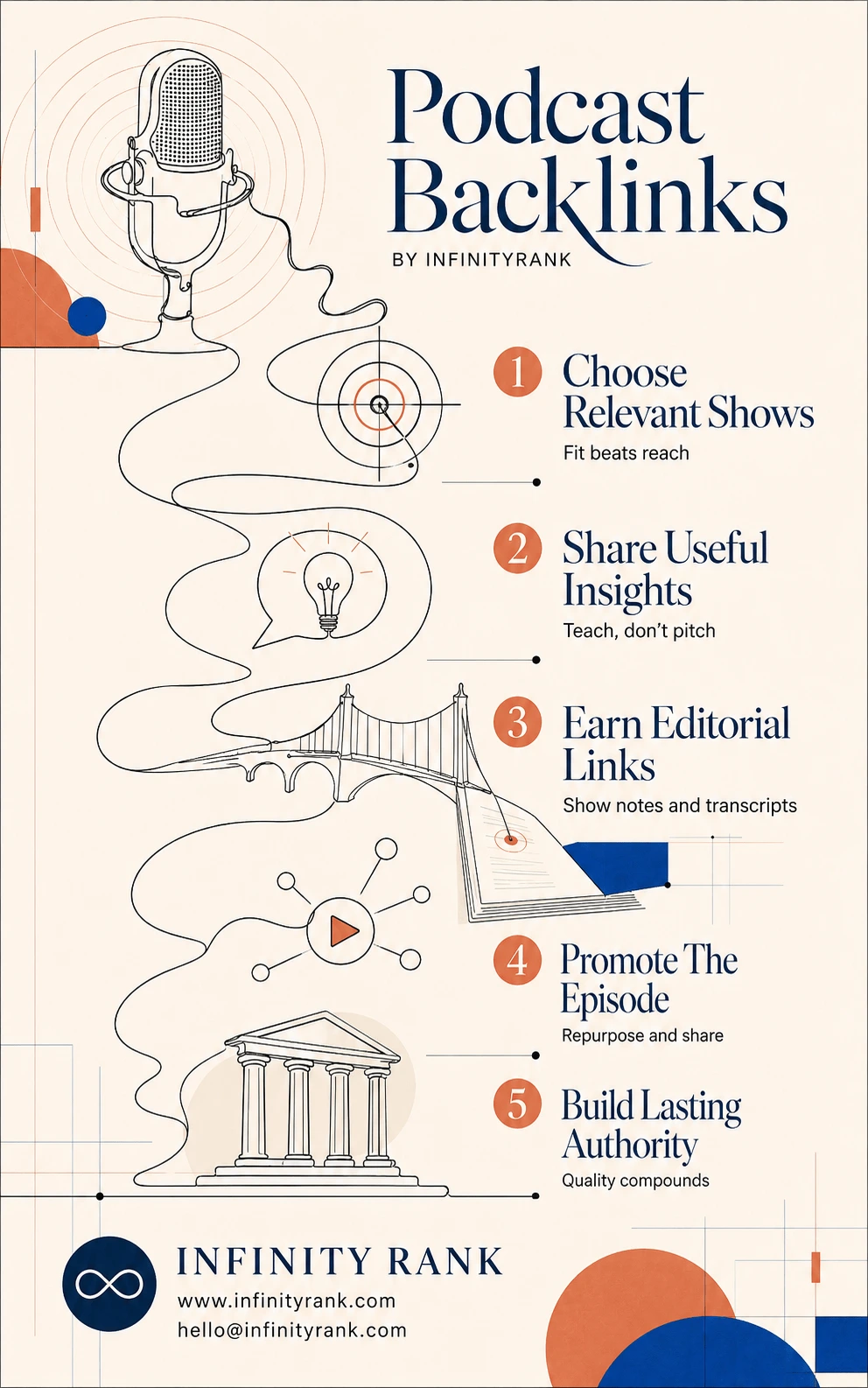
Maximizing the impact of every appearance means co-promoting the episode, repurposing content across your channels, and letting quality media mentions compound over time. As your catalog of guest spots grows, you build deep brand credibility and sustainable search authority that competitors cannot easily duplicate. Use these five core pillars as your daily checklist to streamline your podcast outreach and scale your backlink strategy safely.
Potential SEO and Marketing Benefits
A new referring domain
A podcast appearance may earn a link from a website that has not linked to you before. New, relevant referring domains are usually more useful to track than repeatedly collecting links from the same website.
Relevant referral traffic
Someone who has listened to a full interview already understands the topic and has spent time with the guest. That can make the resulting traffic more informed than traffic from an unrelated directory or generic list page.
It does not guarantee conversions. The result still depends on audience fit, the strength of the call to action and the page receiving the traffic.
Brand and expert visibility
A relevant interview can introduce the guest to an established audience and associate their name with a specific area of expertise.
That benefit exists even when the resulting link is marked nofollow. A non-followed link may still send visitors, support discovery and lead to later mentions from other websites.
Additional content opportunities
One interview can produce:
- A transcript
- A written article
- Short video clips
- Quotes for social media
- A newsletter feature
- A resource page
- A follow-up interview
- A jointly promoted guide
These secondary assets can generate more useful coverage than the original episode alone.
How to Find Podcast Backlink Opportunities
Do not build a list based only on podcast popularity.
A smaller specialist show with a proper website and a relevant audience may be a better opportunity than a large general show that publishes no show notes and provides no external links.
1. Search by audience and topic
Start with the subjects your customers already care about.
A link-building agency, for example, could look for podcasts covering:
- SEO
- Content marketing
- Digital PR
- SaaS growth
- Agency management
- Ecommerce
- B2B lead generation
- Entrepreneurship
Useful discovery methods include podcast search platforms, industry newsletters, competitor appearances and standard search queries such as:
best SEO podcastsdigital PR podcast guestlink building podcast interviewsite:podcasts.apple.com SEO link building"show notes" "your topic""your competitor" podcast
The goal is not to collect hundreds of show names. It is to find podcasts where you can contribute something useful and obtain a legitimate editorial mention.
2. Review previous episode pages
Before contacting a host, inspect several recent guest episodes.
Check whether the podcast:
- Publishes a separate page for each episode
- Includes detailed show notes
- Links to guest websites
- Links to resources mentioned during the discussion
- Publishes transcripts
- Keeps old episodes available
- Uses descriptive episode titles
- Links to episode pages from category or archive pages
- Has active social profiles and recent episodes
Do not assume that an audio appearance includes a website backlink. Some shows publish only to listening platforms. Others include a guest’s name but no clickable website link.
3. Evaluate the website and linking page
Third-party scores such as Domain Authority or Domain Rating can help compare similar prospects, but they are not Google metrics and do not prove that a particular link is valuable.
Review the actual website and page.
Ask:
- Is the website topically relevant?
- Does it receive legitimate organic traffic?
- Is the episode page indexed?
- Is the content original?
- Does the site publish unrelated sponsored material at scale?
- Is the page connected to the rest of the website?
- Does the link appear in the main content?
- Is the anchor text natural?
- Are there excessive commercial links?
- Is the website likely to keep the page live?
Our guide to link-building metrics explains how to assess relevance, page quality, organic visibility, link attributes and campaign performance without relying on one authority score.
How to Earn Podcast Backlinks
1. Pitch Yourself as a Guest
Guest appearances are the most direct way to earn podcast backlinks without producing your own show.
Your pitch should answer three questions:
- Why are you relevant to this podcast?
- What can its listeners learn from you?
- Why are you qualified to discuss the subject?
Do not lead with your desire for exposure or a backlink. That gives the host no reason to respond.
Lead with a specific topic that fits the show.
Weak topic:
I would like to discuss SEO and share my experience.
Stronger topic:
I can explain why companies waste money judging backlinks by Domain Rating alone, then give your listeners a five-step process for evaluating a placement before paying for it.
The stronger version identifies a problem, promises a useful outcome and gives the host a clear episode angle.
Podcast Guest Pitch Example
Subject: Episode idea: Why high-DR backlinks still fail
Hi [Name],
I listened to your episode about content-led customer acquisition. Your discussion about distribution gaps was particularly relevant to the link-building work we do.
A related episode your audience may find useful is why companies buy apparently strong backlinks that produce no traffic or ranking improvement.
I could cover:
- Why domain-level scores are often misused
- How to assess the actual linking page
- Warning signs that a website sells links at scale
- The metrics businesses should track after placement
I run Infinity Rank, where we plan and manage relevance-led link-building campaigns. I can keep the discussion practical and avoid turning it into a sales pitch.
Would this fit your upcoming schedule?
Best, [Name]
Keep the pitch short. A host does not need your full biography, every service you offer or a list of generic subjects.
2. Offer Specific Episode Topics
Prepare three to five topics for each audience segment.
A founder podcast and a technical SEO podcast should not receive the same pitch.
For a founder audience:
- When link building is worth the cost
- How to avoid paying for fake authority
- Why traffic does not automatically produce revenue
For an SEO audience:
- How to qualify linking pages
- When nofollow links are still useful
- How to measure link retention
- Why referring domains matter more than raw backlink totals
Specific topics make it easier for the host to imagine the episode.
3. Give the Host Useful Linkable Resources
Do not ask a host to link repeatedly to commercial pages.
Provide a short list of resources that genuinely support the discussion:
- A relevant research report
- A detailed guide
- A checklist
- A case study
- An original dataset
- A calculator
- A glossary page
- Your main biography or company page
The host should decide which resources belong in the show notes. Forcing an exact-match commercial anchor into the page can make the placement look unnatural.
Google recommends concise, descriptive anchor text that helps users understand the destination. It also identifies links created mainly to manipulate rankings as link spam.
4. Make the Host’s Work Easier
After recording, send a simple media pack containing:
- Your correct name and title
- A short biography
- Your preferred website URL
- Two or three relevant resources
- Social profile links
- A professional headshot
- Correct spellings of any companies or products mentioned
- A brief summary of the main discussion points
Do not send ten URLs and expect all of them to appear in the show notes.
One useful destination is better than a list of unrelated pages.
5. Promote the Published Episode
Promotion is not only a courtesy. It can increase the chance that the episode earns secondary links and mentions.
After publication:
- Share the episode with useful commentary.
- Add it to your media or press page.
- Mention it in a relevant newsletter.
- Link to it from a related article.
- Tag the host where appropriate.
- Send it to people who would genuinely benefit from the discussion.
- Reuse one strong idea as a written article or video.
Do not manufacture reciprocal links purely for SEO. Promote the episode because it is useful to the audience.
6. Maintain the Relationship
One relevant appearance can lead to:
- A follow-up episode
- A newsletter contribution
- A quote in an article
- A conference invitation
- A joint webinar
- A resource-page link
- An introduction to another host
Send a genuine thank-you message after publication. Continue engaging when the host publishes something relevant. Do not disappear until you need another link.
Relationship-building works when the relationship has value beyond a single SEO placement.
Should You Launch Your Own Podcast for Backlinks?
Launching a podcast can support content marketing, partnerships and brand visibility. It is not a shortcut to external backlinks.
Links from your own episode pages to other pages on your own domain are internal links. They may improve navigation and help search engines understand your site structure, but they do not create new referring domains.
External backlinks may develop when:
- Guests link to their episode from their own websites.
- Industry publications reference a discussion.
- Other writers cite your transcript or data.
- Partners embed or recommend the episode.
- Resource pages include your podcast.
- Newsletters link to individual episodes.
None of this is automatic.
A podcast requires planning, recording, editing, hosting, distribution, promotion and ongoing management. Launch one because audio or video suits your audience and content strategy—not because you expect every episode to generate backlinks.
Are Podcast Directory Links Valuable?
Podcast directories and listening platforms are mainly distribution channels.
They help people find, follow and listen to a show. Some profiles may also contain a website link, RSS link or creator information. However, those links may be redirected, restricted or marked with attributes that affect how they should be classified.
Do not judge a podcast campaign by the number of directory profiles created.
A practical priority order is:
- Publish the show on the platforms your audience uses.
- Maintain a proper website with permanent episode pages.
- Write useful show notes and transcripts.
- Earn editorial backlinks from relevant third parties.
- Track directory links separately from editorial backlinks.
A directory profile is not a substitute for a relevant link within a useful article or episode page.
Podcast SEO Best Practices for Your Own Show
Podcast SEO is broader than link building. Your website still needs crawlable pages that explain each episode clearly.
Publish a Permanent Page for Every Episode
Each episode page should include:
- A descriptive title
- A concise introduction
- The embedded audio or video
- Key discussion points
- Guest information
- Relevant resources
- A transcript or detailed summary
- Links to related episodes
- A clear publication date
- A canonical URL
Avoid publishing an audio player with one sentence of text. That gives users and search systems little information about the episode.
Use Descriptive Episode Titles
“Episode 24” tells a searcher almost nothing.
A clearer title would be:
How to Evaluate a Backlink Before You Pay for It
You can still include the episode number, but it should not replace the subject.
Add Transcripts Carefully
A transcript makes audio content available as crawlable text and improves accessibility.
Do not publish an unedited automated transcript without reviewing it. Correct:
- Speaker names
- Industry terminology
- Company names
- URLs
- Punctuation
- Obvious transcription errors
For long episodes, add headings so readers can scan the discussion.
Link to Relevant Resources
Show notes should link to sources and resources that help the listener continue learning.
Use natural anchor text. Do not insert the same keyword-rich anchor into every episode.
Use Appropriate Structured Data
Schema.org content types such as PodcastSeries and PodcastEpisode can help machines understand that a page represents a podcast series or individual episode. They do not guarantee a special Google search result.
Use:
ArticleorBlogPostingfor a standard article about podcast backlinksPodcastSeriesfor the main page of an actual podcastPodcastEpisodefor an individual episode pageBreadcrumbListwhen visible breadcrumbs are present
Do not add PodcastEpisode schema to this article. It discusses podcast link building but is not an episode.
How to Verify a Podcast Backlink
Do not mark a placement as complete because someone sent you a screenshot.
Inspect the live page.
Confirm that:
- The episode page loads successfully.
- The page is indexable.
- The URL is canonicalised correctly.
- The backlink points to the intended destination.
- The link uses a standard
<a href>element. - The link is visible to users.
- The anchor text is accurate and natural.
- The surrounding text is relevant.
- The page is linked from the podcast website.
- The link is not hidden behind an unnecessary redirect chain.
- Any
nofollow,sponsoredorugcattribute is recorded. - The page remains live after 30, 90 and 180 days.
Paid placements, podcast sponsorships, advertorials and compensated li nk placements should be qualified appropriately. Google recommends rel="sponsored" for advertising and paid placements, while nofollow remains acceptable in some cases.
Links can be removed, changed, redirected or placed on pages that are never indexed. Verify them regularly with a backlink monitoring tool.
How to Measure Podcast Link-Building Results
Backlink count alone is not enough.
Track the link itself, the performance of the target page and the business outcome.
Placement metrics
Record:
- Podcast name
- Episode title
- Publication date
- Linking URL
- Destination URL
- Anchor text
- Link attribute
- Indexation status
- Referring domain
- Last verified date
- Whether the link remains live
Traffic and engagement
Use analytics and tagged URLs where appropriate to track:
- Referral sessions
- Engaged sessions
- Time spent on the destination page
- Newsletter sign-ups
- Enquiries
- Demo requests
- Assisted conversions
Search performance
Before the campaign, record a baseline for the page receiving links.
Monitor:
- Search impressions
- Organic clicks
- Ranking queries
- Average position
- Non-branded organic traffic
- New referring domains
- Branded searches
- Link retention
Do not claim that one podcast backlink caused a ranking increase unless you have enough evidence to isolate its effect. SEO performance can change because of content updates, technical fixes, competitor activity, algorithm changes and other new links.
Common Podcast Backlink Mistakes
Choosing shows by authority score alone
A high domain score does not prove that the episode page is strong, relevant, indexed or likely to send traffic.
Assuming every interview includes a backlink
Confirm how the host handles guest links before spending time preparing for the appearance.
Pitching generic topics
“Let’s discuss marketing” is not a useful episode idea. Pitch a defined problem and outcome.
Demanding exact-match anchor text
The host should use wording that fits the page naturally. Repeatedly forcing commercial anchors creates unnecessary risk.
Treating directory listings as editorial links
Directories support distribution. They should be reported separately from links earned through articles, interviews and show notes.
Linking only to the homepage
A relevant guide, case study or resource may be more useful to listeners than a generic homepage.
Ignoring the live page after publication
Links can be removed, changed, redirected or placed on pages that are never indexed. Verify them regularly with a backlink monitoring tool.
Paying for unqualified links
A paid interview or sponsorship is not automatically a problem. The problem is disguising a paid placement as an independent editorial endorsement or using it mainly to pass ranking credit.
Podcast Backlink Checklist
Before pitching:
- The podcast is relevant to your audience.
- Recent episodes are still being published.
- The podcast has its own website.
- Previous guest pages contain useful show notes.
- External links are included where appropriate.
- Episode pages are indexable.
- The website has legitimate content and visibility.
- You have a specific topic to offer.
After recording:
- Send a short biography.
- Provide one primary URL.
- Include only relevant supporting resources.
- Confirm names, titles and brand spellings.
- Promote the episode after publication.
- Thank the host.
After publication:
- Inspect the live page.
- Record the link attribute.
- Check indexability and canonicalisation.
- Track referral traffic.
- Monitor the destination page.
- Recheck the placement after 30, 90 and 180 days.
Frequently Asked Questions
Do podcast backlinks help SEO?
Podcast backlinks can support SEO when they come from relevant, crawlable and indexable pages with a legitimate editorial reason for linking. The result depends on the quality of the website, the individual page, the surrounding context and the destination.
Do I need my own podcast to earn podcast backlinks?
No. You can appear as a guest on relevant podcasts and earn links from show notes, guest pages, transcripts or related articles.
Are podcast backlinks followed or nofollow?
It varies by publisher and platform. Some episode pages use standard links, while others apply nofollow, sponsored or redirects. Inspect the live HTML instead of assuming the link type.
How many podcast backlinks do I need?
There is no useful universal number. One relevant link that sends qualified traffic may be more valuable than dozens of directory links. Track new referring domains, target-page performance, referral traffic and conversions rather than chasing a fixed link count.
How do I find podcasts that link to guests?
Review previous guest episodes before pitching. Look for permanent episode pages, detailed show notes, guest biographies and clickable links to websites or resources.
Should I pay to appear on a podcast?
Paid sponsorships and paid appearances can be legitimate marketing channels, but they should be evaluated as advertising. Any compensated links should be qualified appropriately, and the decision should be based on audience reach and commercial value rather than an attempt to buy ranking credit.
Are podcast directory links worth building?
Submit your podcast to relevant listening platforms for distribution and discovery. Do not rely on directory profiles as your main link-building strategy or report them as equivalent to editorial links.
Final Thoughts
Podcast backlinks are not valuable because they come from audio content. They are valuable when a relevant podcast publishes a useful, permanent page that gives readers a legitimate reason to visit your website.
Start with guest appearances rather than launching a show solely for SEO. Qualify each podcast before pitching. Offer a specific topic, provide genuinely useful resources and verify the live placement after publication.
Most importantly, measure more than the number of links.
A successful podcast campaign should produce some combination of relevant referring domains, qualified referral traffic, useful relationships, stronger content assets and improved visibility for the pages you are trying to grow.