Permanent homepage backlinks are links placed on another website’s main page with the expectation that they will remain there for an extended period.
They can provide strong brand visibility, referral traffic and, in the right circumstances, SEO value. However, a homepage placement is not automatically better than a contextual backlink from a relevant article or resource page. Its value depends on the linking website, the reason for the link, its placement, anchor text, link attributes and whether the page is indexed.
The word “permanent” also needs qualification. No third-party backlink is guaranteed to remain live forever. Websites change owners, redesign their homepages, update partnerships and remove old content.
This guide explains when homepage backlinks are useful, when they become risky and how to evaluate a placement before investing time or money.
What Is a Homepage Backlink?
A homepage backlink is an external link placed on the main page of a website.
Common examples include:
- A software company displaying its integration partners
- An agency linking to a featured client case study
- A nonprofit displaying sponsor logos
- A trade association listing member companies
- A business featuring a technology or service provider
- Two companies promoting a legitimate co-marketing campaign
The link may appear within the main content, a partner section, a customer story, the navigation or the footer.
Placement matters. A prominent link supported by relevant text gives visitors more context than an isolated logo or footer link.
A homepage backlink should not be confused with a sitewide backlink. A homepage link appears only on the homepage. A sitewide link is built into a template and repeats across many or all pages, usually through the footer, sidebar, header or navigation. Repeated template links introduce different risks, particularly when they use commercial anchor text. See our guide to sitewide backlink risks and safe usage.
Homepage Backlinks: Safe Power or Risky Trap?
Getting a backlink on a website’s homepage is one of the fastest ways to boost your search rankings. Because homepages hold the most authority, these links carry a lot of weight with Google. However, if these links look fake or come from shady networks, they can easily get your site penalized. This simple guide breaks down four clear rules to help you get safe homepage links that actually work through real partnerships and real traffic.
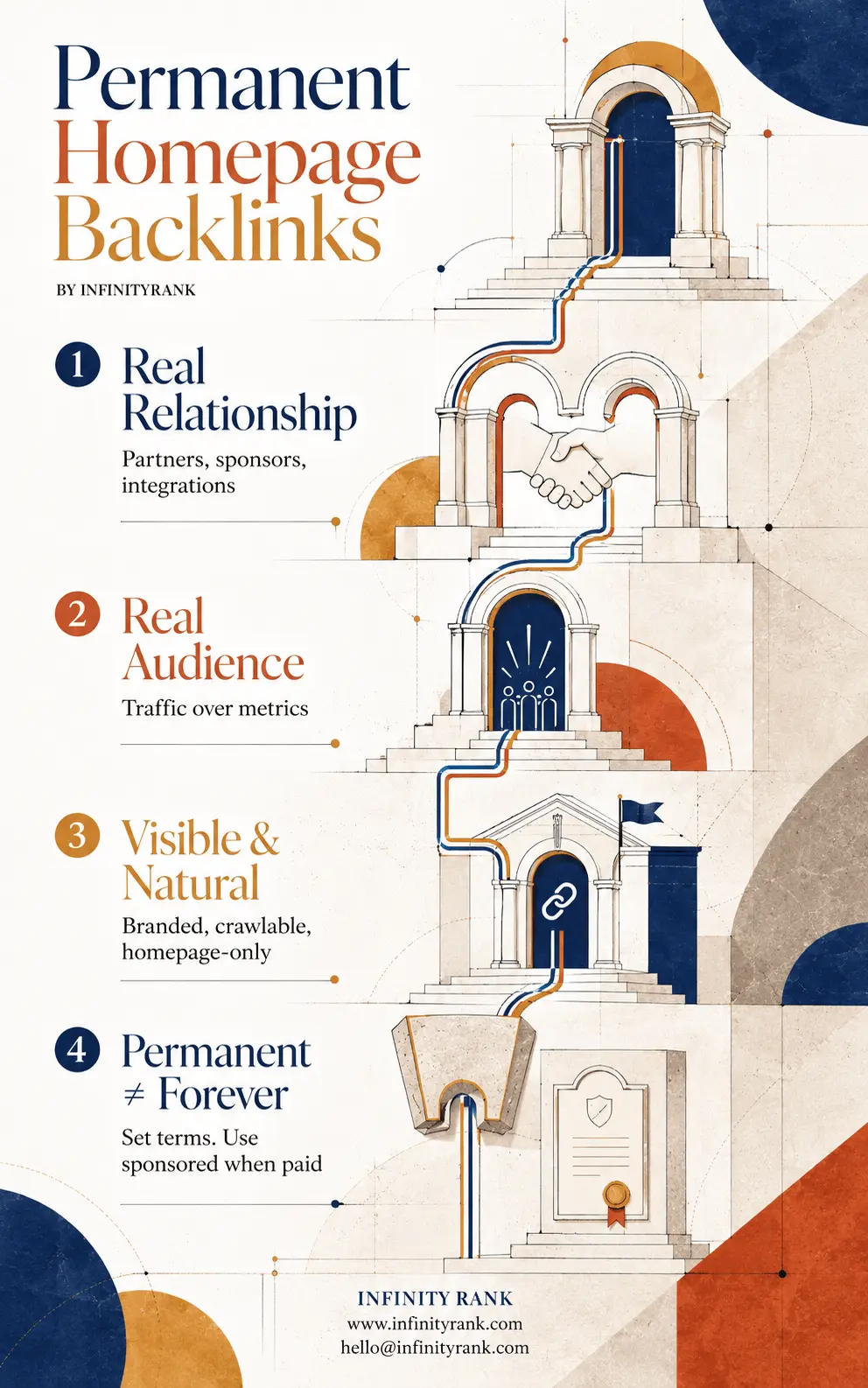
Securing strong homepage links works best when you focus on real human relationships instead of just chasing big numbers. By keeping your links visible, natural, and honest, you protect your website from sudden algorithm drops. Use these core pillars as your quick checklist to build authentic search power that lasts.
Can Homepage Backlinks Help SEO?
A homepage backlink can help when it comes from a relevant, credible and genuinely useful source.
Google uses links to discover pages and as one of the signals for understanding page relevance. However, Google does not state that a homepage backlink automatically receives preferential treatment simply because it appears on a homepage.
Potential benefits include:
Greater Brand Visibility
Homepages often receive more direct visits than individual internal pages. A prominent logo, partner mention or recommendation may therefore expose your brand to a wider audience.
That benefit depends on the website having real visitors. A homepage with high third-party authority metrics but no meaningful audience offers little referral value.
Referral Traffic
Visitors may click through when the link is relevant to what they are trying to do.
For example, a project management platform linking to an official integration partner gives users a practical reason to visit the partner’s website. A random footer link on an unrelated blog does not.
Page-Level Authority
A website’s homepage may attract more backlinks than its internal pages. That can make it a strong page, but it should be checked rather than assumed.
Review the specific page’s backlinks, organic visibility, traffic and outbound links. Do not make a decision using domain-level metrics alone.
Long-Term Exposure
A link that remains live for several years can continue sending visitors and supporting brand recognition.
That does not mean its SEO value automatically “compounds.” The linking page can lose visibility, change its link attributes, become irrelevant or disappear.
Are Homepage Backlinks Better Than Contextual Backlinks?
Not necessarily.
A relevant contextual backlink inside a detailed article can be more useful than a generic homepage logo. It may give search engines and readers clearer information about why the link exists and what the destination page covers.
| Factor | Homepage Backlink | Contextual Backlink |
| Typical placement | Partner section, logo grid, testimonial or homepage content | Article, guide, case study or resource page |
| Topical context | Can be limited | Usually stronger |
| Brand visibility | Potentially high | Depends on page traffic |
| Referral intent | Strong when the partnership is relevant | Strong when the link supports the surrounding content |
| Longevity | Can change during redesigns | Can remain stable but may also be updated |
| Main risk | Paid logos, irrelevant partners and footer placements | Paid insertions, low-quality guest posts and unnatural anchors |
| Best use | Partnerships, integrations, clients and brand relationships | Supporting claims, recommendations and useful resources |
The strongest option is the link that makes the most sense to a real visitor.
A link from the homepage of a respected industry body may be valuable. A contextual link from a highly relevant internal guide may also be valuable. The URL depth alone does not decide the outcome.
What Makes a Homepage Backlink Valuable?
Evaluate the following factors before pursuing a placement.
1. Topical Relevance
The relationship between the two websites should be clear.
Good examples include:
- A CRM linking to an integrated email platform
- A marketing agency linking to a verified technology partner
- A professional association linking to a member business
- An event organiser linking to an official sponsor
- A supplier linking to an authorised distributor
A homepage backlink from an unrelated website may provide little value and can look manufactured when the connection cannot be explained.
2. A Legitimate Reason for the Link
Ask why the publisher is linking.
Valid reasons may include:
- A genuine integration
- A customer relationship
- A strategic partnership
- Membership in an organisation
- Sponsorship
- A joint research project
- A featured testimonial
- A product or service recommendation
“Because we paid for ranking value” is not an editorial reason.
3. Real Traffic and Audience
Check whether the website attracts real users from relevant markets.
Third-party metrics such as Domain Rating or Domain Authority can help with initial filtering, but they are not Google metrics and should not be used as proof of quality.
Review:
- Organic traffic trends
- Ranking keywords
- Brand searches
- Geographic audience
- Content quality
- Social or community activity
- Whether the business itself appears genuine
Our guide to link-building metrics explains how to assess backlinks without relying on a single authority score.
4. Placement and Visibility
A clearly labelled partner mention within the main homepage content is different from a tiny link hidden at the bottom of the footer.
Check whether the link is:
- Visible without deceptive styling
- Surrounded by relevant context
- Likely to be noticed by visitors
- Included for a genuine navigational or commercial purpose
- Limited to the homepage rather than distributed across every page
Hidden links and links designed primarily to manipulate search systems violate Google’s spam policies.
5. Natural Anchor Text
Homepage backlinks usually work best with branded anchor text.
Examples:
- InfinityRank
- Infinity Rank
- infinityrank.com
- Visit InfinityRank
- Official integration partner
Avoid forcing exact-match commercial phrases such as:
- best link-building agency
- buy permanent backlinks
- cheap SEO backlinks
- top SEO company
Google recommends concise, descriptive anchor text that helps users and search engines understand the destination.
Logo links also need descriptive image alt text because Google can use an image’s alt attribute as anchor text.
6. Indexability and Crawlability
The link should use a standard HTML anchor element with a working href attribute.
Also check that:
- The homepage is indexed
- The link appears in the rendered HTML
- The destination returns a valid response
- The link is not blocked by broken scripts
- The website has not added a sitewide
nofollowdirective - The linking domain is not deindexed or under an obvious manual action
Google generally discovers crawlable links through standard <a href=""> elements.
7. Outbound-Link Quality
Review the other websites linked from the homepage.
Warning signs include:
- Dozens of unrelated commercial partners
- Casino, payday loan, adult or questionable pharmaceutical links
- Exact-match anchors across unrelated industries
- A constantly changing collection of paying advertisers
- Links to low-quality or compromised websites
- No clear explanation of the relationships
A homepage that sells links to anyone is not a credible endorsement.
What Does “Permanent” Actually Mean?
A permanent backlink normally means the publisher intends to retain the placement indefinitely or for a defined minimum period.
It does not mean the link is guaranteed forever.
A homepage backlink may disappear because:
- The website is redesigned
- The partnership ends
- The company is acquired
- The domain changes ownership
- A sponsor agreement expires
- The homepage layout has limited space
- The publisher changes the destination URL
- The page becomes noindexed
- The link is changed to
nofolloworsponsored - The website closes
Before agreeing to a placement, define the terms.
For a commercial arrangement, ask:
- How long is the placement expected to remain live?
- Is the link homepage-only or sitewide?
- Where will it appear?
- What anchor text or logo will be used?
- Will the link carry a rel attribute?
- What happens if the homepage is redesigned?
- Is a replacement offered if the link is removed early?
- Can the publisher change the destination URL later?
A written retention period is more meaningful than the vague word “permanent.”
Are Paid Homepage Backlinks Safe?
Buying a followed homepage link specifically to manipulate rankings is risky.
Google’s spam policies identify buying or selling links for ranking purposes as link spam. This can include exchanging money, goods, services or free products for links that pass ranking credit. Google also identifies excessive link exchanges and widely distributed footer or template links as potential spam practices.
That does not mean businesses cannot advertise, sponsor organisations or form paid partnerships.
It means the link should be qualified correctly.
Google recommends:
<a href="https://example.com" rel="sponsored">Brand Name</a>
rel="nofollow" remains acceptable, although Google prefers rel="sponsored" for advertisements and paid placements.
A qualified sponsored links placement can still provide:
- Referral traffic
- Brand exposure
- Credibility with the publisher’s audience
- Leads and sales
- Awareness among potential partners
What it should not be sold as is a guaranteed method of passing ranking authority.
Legitimate Ways to Earn Homepage Backlinks
Build Real Product Integrations
Integration partnerships create a clear reason for both companies to link.
The best opportunities arise when the integration is genuinely useful and actively promoted through:
- An integration directory
- Launch content
- Partner pages
- Co-marketing
- Product documentation
- Homepage partner sections
Do not request a homepage link before the integration provides value.
Develop Strategic Partnerships
Suppliers, distributors, agencies, technology providers and complementary businesses may link to one another when the relationship is useful to customers.
The link should communicate that relationship clearly rather than appearing as an unexplained SEO placement.
Secure Customer or Partner Features
A company may feature your business through:
- A testimonial
- A customer success story
- A featured implementation
- A partner spotlight
- A homepage case-study carousel
Provide a specific quote, measurable result and permission to use your logo. That makes the feature easier to publish.
Support Relevant Organisations
Sponsoring an industry event, nonprofit, local initiative or professional organisation can generate legitimate visibility.
Choose organisations whose audience overlaps with yours. Do not sponsor random websites purely because they promise a followed homepage backlink.
Where compensation or sponsorship is involved, the link should normally be qualified with rel="sponsored".
Create a Co-Marketing Asset
Two companies may collaborate on:
- Original research
- A benchmark report
- A webinar
- A free tool
- An industry event
- A joint campaign
- A product bundle
A homepage feature can be justified during the active campaign. The long-term link should remain only when it continues helping visitors.
Earn a Place in a Genuine Resource Section
Some businesses feature essential tools, professional partners or recommended services on their homepages.
Pitch only when your product belongs there. Explain:
- What problem it solves
- How the publisher’s audience benefits
- Why it complements the existing resources
- What evidence supports the recommendation
Generic outreach asking for “a permanent dofollow homepage link” will be ignored by credible publishers.
Use Manual, Relevance-First Outreach
Manual link building lets you investigate each website, relationship and placement before making contact.
It should not mean sending the same email to thousands of prospects. Proper manual link building relies on research, genuine relevance and a defensible reason for the link.
Homepage Backlink Red Flags
Reject or investigate a placement when the provider:
- Guarantees a ranking increase
- Refuses to reveal the domain before payment
- Sells links by DA or DR alone
- Offers the same homepage package across unrelated industries
- Requires exact-match commercial anchor text
- Claims paid links do not need rel=”sponsored”
- Places links in hidden or low-visibility areas
- Confuses homepage links with sitewide footer links
- Operates a network of nearly identical websites
- Cannot explain why the website would naturally mention your brand
- Guarantees lifetime placement without defining what happens after a redesign or sale
- Has no replacement or retention policy
- Publishes casino, finance, health, crypto and general consumer links on the same homepage
A real homepage mention should survive a basic question:
Would this link still make sense if search engines did not exist?
If the answer is no, the placement is probably being manufactured for rankings.
How to Measure the Value of a Homepage Backlink
Do not judge the result using rankings alone.
Record the following before the link goes live:
- Target-page rankings
- Organic clicks and impressions
- Referral traffic
- Assisted conversions
- Direct and branded search traffic
- Leads or sales from the referring domain
- The linking page’s traffic and visibility
- The link’s placement, anchor and attributes
After publication, monitor:
Referral Sessions
Use GA4 to identify visits from the linking domain. Review engagement, enquiries, purchases and other relevant conversions.
Search Console Performance
Track impressions, clicks and average position for the linked page and closely related queries.
Do not attribute every movement to the backlink. Rankings can change because of content updates, technical work, competitor activity, seasonality and search-system updates.
Brand Demand
Look for changes in:
- Branded searches
- Direct visits
- Mentions
- Demo requests
- Partner enquiries
- Assisted conversions
A highly visible homepage feature may be more valuable as a branding asset than as a direct ranking tactic.
Link Retention
Check periodically that:
- The link is still live
- The destination is correct
- The placement has not changed
- The anchor remains appropriate
- The rel attributes match the agreement
- The homepage remains indexed
Homepage Backlink Evaluation Checklist
Before approving a homepage backlink, confirm:
- The website is topically or commercially relevant.
- The business and audience are genuine.
- The homepage receives real traffic.
- The reason for the link is clear.
- The link helps visitors.
- The placement is visible.
- The anchor is branded or natural.
- The link is not hidden in a template.
- Paid placements use
rel="sponsored"or an appropriate alternative. - The homepage is indexed.
- The surrounding outbound links are credible.
- The placement period is defined.
- Early-removal terms are documented.
- The link is not being sold with ranking guarantees.
Failing several of these checks is enough reason to reject the opportunity.
Frequently Asked Questions
Are homepage backlinks always better than blog backlinks?
No. A contextual link from a relevant, authoritative article may provide stronger topical context and more qualified referral traffic. Evaluate the individual backlink profile and placement rather than assuming the homepage is superior.
Can a homepage backlink really be permanent?
Not literally. “Permanent” normally describes the publisher’s intention or an agreed retention period. A website owner can later redesign the site, remove the link, sell the domain or close the business.
Is buying a homepage backlink against Google’s guidelines?
Paying for a link that passes ranking credit can violate Google’s spam policies. Paid advertisements and sponsorship links should normally use rel="sponsored"; nofollow is also acceptable.
Do sponsored homepage backlinks have any value?
Yes. They can generate referral traffic, brand exposure, leads, credibility and commercial relationships. They should not be purchased on the assumption that they will pass ranking authority.
What is the difference between a homepage backlink and a sitewide backlink?
A homepage backlink appears on the main page only. A sitewide backlink repeats across many pages through a global template such as the footer, sidebar or header.
What anchor text should a homepage backlink use?
Branded anchors, company names, product names and descriptive neutral phrases are generally the most defensible. Avoid forcing keyword-heavy commercial anchors.
How many homepage backlinks do I need?
There is no reliable number. Results depend on your current authority, competition, target pages, content, technical condition and the quality of each referring source. Anyone promising rankings from a fixed number of links is guessing.
Should a homepage backlink point to my homepage?
Not automatically. Link to the page that best matches the context. An integration mention may point to an integration page, while a company logo may reasonably point to the homepage.
Final Thoughts
Permanent homepage backlinks are not automatic SEO shortcuts.
A legitimate homepage mention can increase visibility, send referral traffic and support your wider authority-building strategy. But its value comes from relevance, audience, context and the reason the link exists—not simply from its position on the root URL.
Treat “permanent” as a placement term, not a guarantee. Investigate the website, confirm the relationship, use natural anchor text and qualify paid links correctly.
Most importantly, do not build your strategy around buying followed homepage links from websites that sell space to anyone.
A relevant editorial link, digital PR mention, industry partnership or useful resource can outperform a homepage placement that exists only to manipulate rankings.