A press release can support SEO, but it is not a shortcut to easy rankings.
That distinction matters. Too many brands treat press releases like backlink machines. They stuff keywords into headlines, force exact-match anchor text into the body, distribute the same announcement across dozens of sites, and expect Google to reward them.
That is outdated SEO.
Modern press release SEO is about making your announcement easier to find, understand, index, cite, and share. The real value comes from visibility, referral traffic, branded search demand, journalist pickup, and natural editorial coverage. Not from trying to manipulate rankings with syndicated links.
Google’s spam policies warn against tactics designed to manipulate search rankings, and Google also provides specific guidance on qualifying paid or sponsored links with attributes such as rel="sponsored" or rel="nofollow".
Here is how to optimize a press release properly.
What Is Press Release SEO?
Press release SEO is the process of optimizing a company announcement so search engines, journalists, customers, and industry sites can easily understand it.
That includes:
- Writing a clear, searchable headline
- Using relevant keywords naturally
- Structuring the release for fast scanning
- Adding useful links without over-optimization
- Including optimized images and media assets
- Publishing the release on your own site
- Distributing it through relevant channels
- Tracking performance after publication
The goal is not to “build backlinks” through press release syndication. The goal is to increase discoverability and make the announcement useful enough that real people may cover it, reference it, or visit your site.
When Is a Press Release Worth Publishing?
Not every update deserves a press release.
A press release is worth publishing when the announcement has a real news angle. Examples include:
- A product launch
- A major company milestone
- A funding announcement
- A merger or acquisition
- A new executive hire
- A research report or industry study
- An event announcement
- A major partnership
- A new market expansion
- A public response to an important industry issue
Weak announcements do not become stronger because you add keywords. If there is no real story, SEO cannot fix it.
Before writing, ask one question:
Would a journalist, customer, investor, or industry reader care about this without being paid to care?
If the answer is no, publish a blog update instead.
The Blueprint for Search-Driven Press Releases
The old way of blasting out press releases just to “trick” the algorithm is officially dead. In today’s world, a release has to work twice as hard: it needs to grab the attention of a busy journalist while ticking all the right boxes for modern search engines.
If you focus only on keywords and forget the story, you’ll end up with a page that no one reads and Google eventually ignores. This framework is designed to help you bridge that gap, ensuring your news has the structure, authority, and “real-world” value required to rank high and stay there.
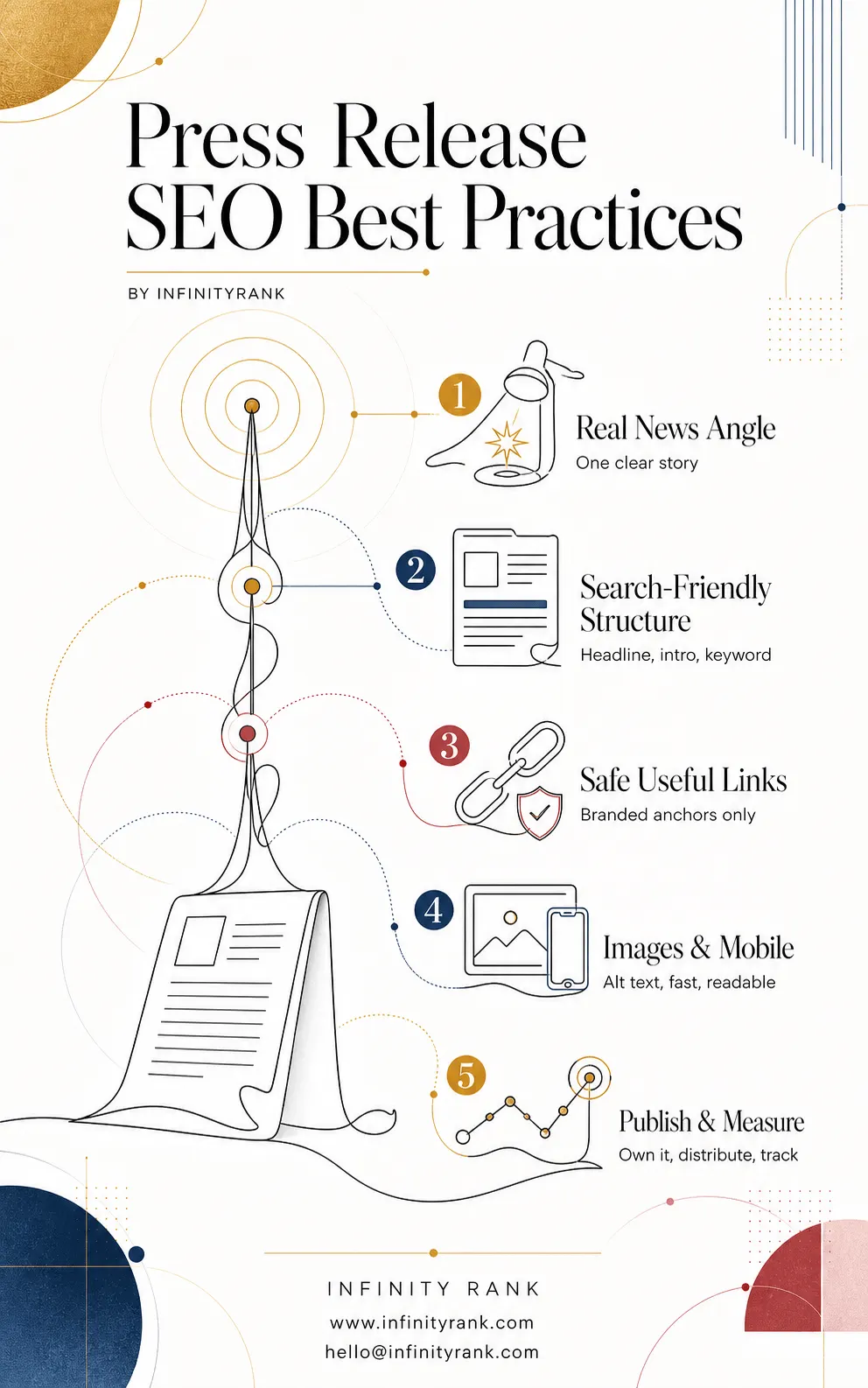
At the end of the day, a press release is a tool for visibility, not a shortcut for SEO. When you focus on providing actual value and follow these five core principles, you build a digital footprint that search engines trust. By keeping your links safe and your story clear, you ensure your news doesn’t just go out—it actually gets found. Now, let’s dive into the specific best practices that will help your next release reach the right audience.
1. Start With a Clear News Angle
Your press release needs one primary angle.
Do not try to announce five things at once. Search engines and readers both need clarity.
Weak angle:
“Company announces continued commitment to innovation and digital transformation.”
Better angle:
“Infinity Rank Launches Press Release Distribution Service for SEO-Focused Brands.”
The second example is specific. It tells readers who did what and why it matters.
A strong press release angle should answer:
- What happened?
- Who is involved?
- Why does it matter now?
- Who is affected?
- What should the reader do next?
Put the answer in the opening paragraph. Do not bury the actual news under corporate filler.
2. Write a Search-Friendly Headline
Your headline should be clear before it is clever.
A press release headline has two jobs:
- Tell readers what happened.
- help search engines understand the topic.
Do not keyword-stuff it.
Bad headline:
Best Press Release SEO Best Practices Company Launches Best SEO Press Release Distribution Service
Good headline:
Infinity Rank Launches SEO-Focused Press Release Distribution Service
The better version uses natural language. It includes the company name, the action, and the core topic without sounding spammy.
For SEO, keep the headline:
- Specific
- Under 70 characters when possible
- Focused on the announcement
- Free of hype words like “revolutionary,” “game-changing,” and “world-class” unless they are genuinely defensible
If the press release is hosted on your website, use a slightly optimized title tag. The title tag can include the brand, announcement, and keyword variation.
Example:
Infinity Rank Launches SEO Press Release Distribution Service
3. Use the Main Keyword Naturally
The primary keyword should appear in important places, but it should not dominate the page.
For this topic, the primary keyword is:
press release SEO best practices
Use it in:
- The title tag
- The H1
- The introduction
- One H2 if natural
- Body copy where relevant
- Meta description if it fits
Do not repeat it every paragraph.
Use related terms instead:
- SEO press release
- press release optimization
- press release distribution
- media coverage
- PR SEO
- journalist outreach
- branded search
- editorial links
- media pickup
This gives the page topical depth without keyword stuffing. Google defines keyword stuffing as filling a page with keywords or numbers in an unnatural way to manipulate rankings.
4. Put the Important Information in the First Paragraph
The first paragraph should summarize the entire announcement.
Use the classic news format:
- Who
- What
- When
- Where
- Why
- How
Example:
Infinity Rank, an SEO agency focused on search visibility and digital PR, has launched a press release distribution service designed to help businesses publish clearer announcements, earn media visibility, and track referral traffic from PR campaigns.
That is stronger than opening with vague context like:
In today’s competitive digital landscape, businesses need innovative strategies to stand out online.
That sentence says nothing. Cut it.
5. Use Links Carefully
This is the section most SEO press release articles get wrong.
A press release should include links, but those links must be useful and safe.
Good links include:
- A link to the announcement page
- A link to a relevant product or service page
- A link to a supporting report, study, or resource
- A branded homepage link
- A media kit or downloadable asset link
Bad links include:
- Exact-match commercial anchors
- Multiple links to the same sales page
- Keyword-stuffed anchors
- Repeated links in boilerplate text
- Links inserted only for PageRank
Bad example:
Learn more from the best SEO agency for press release SEO services and affordable press release distribution SEO packages.
Better example:
Learn more about Infinity Rank’s press release distribution service.
Use branded or natural anchor text. Avoid exact-match money anchors.
If the release is distributed through a paid PR platform or syndicated across third-party sites, links should usually be qualified with rel="sponsored" or rel="nofollow". Google says rel="sponsored" should be used for advertisements or paid placements, while rel="nofollow" is acceptable when you do not want Google to associate your site with the linked page.
The safest approach:
- Use one or two links in the body
- Use branded anchor text
- Use naked URLs where appropriate
- Avoid keyword-rich anchor text
- Do not rely on syndicated links as an SEO ranking tactic
A press release can lead to SEO value when real publishers, bloggers, journalists, or industry sites cover the story and link naturally. That is different from mass syndicated links.
6. Write a Strong Quote
Most press release quotes are useless.
Bad quote:
“We are thrilled to announce this exciting new solution and remain committed to delivering excellence to our valued customers.”
That says nothing.
A good quote should add context, opinion, or strategic meaning.
Better quote:
“Most brands still treat press releases like backlink tools, which creates risk and weak content,” said [Name], [Title] at Infinity Rank. “Our approach focuses on clear announcements, safe linking, media visibility, and measurable referral traffic.”
Use one or two quotes. Do not turn the release into a quote dump.
7. Add Media Assets With Descriptive Alt Text
Images can improve a press release, especially when the announcement involves a product, event, executive hire, report, or visual data.
Use:
- Product screenshots
- Founder or executive headshots
- Event photos
- Charts from original research
- Company logos
- Infographics
- Short videos where relevant
Optimize every image.
Use descriptive filenames:
Bad:
IMG_4729.jpg
Better:
infinity-rank-press-release-distribution-dashboard.jpg
Use useful alt text:
Bad:
press release SEO best practices press release SEO distribution SEO press release
Better:
Infinity Rank dashboard showing press release campaign tracking
Google recommends descriptive filenames, titles, and alt text, and warns against stuffing alt attributes with keywords because it creates a poor user experience and may be treated as spam.
8. Make the Press Release Mobile-Friendly
Your press release must be easy to read on mobile.
That means:
- Short paragraphs
- Clear headings
- Fast-loading images
- No oversized tables
- No intrusive popups
- Clickable phone numbers and email addresses
- A visible call to action
This matters because mobile accounts for more than half of worldwide desktop-vs-mobile web traffic. StatCounter reported mobile at 53.78% worldwide in April 2026.
Do not publish a press release that only looks good on desktop.
9. Publish the Release on Your Own Website First
Before distributing a press release, publish a clean version on your own site.
This gives you:
- A canonical page to link to
- A controlled version of the announcement
- Better tracking
- A page you can update later
- A destination for journalists and customers
The page should include:
- Clear title tag
- Meta description
- H1
- Date published
- Author or company attribution
- Body copy
- Media contact
- Company boilerplate
- Relevant internal links
- Optimized images
- Article or NewsArticle structured data where appropriate
Google says Article structured data can help Google understand article pages and show better title text, images, and date information in Search.
Do not rely only on third-party PR platforms. Own the primary version.
10. Write a Meta Description That Sells the Click
The meta description does not guarantee rankings. It can still influence clicks when Google uses it.
Google says snippets are primarily created from page content, but Google may use the meta description when it describes the page better than other parts of the content.
Bad meta description:
Press release SEO best practices, SEO press release, press release optimization, press release backlinks, press release distribution.
Good meta description:
Learn how to optimize a press release for search, media pickup, safe links, keywords, images, distribution, and measurable PR performance.
Keep it specific. Do not stuff keywords.
11. Choose Distribution Channels Carefully
Press release distribution is not automatically SEO.
Some platforms syndicate your release across many low-value pages. That may create visibility, but it does not mean you earned high-quality editorial links.
Before choosing a distribution service, check:
- Does it reach relevant journalists?
- Does it support industry targeting?
- Does it allow proper link attributes?
- Does it provide reporting?
- Does it show pickup locations?
- Does it let you include images or media assets?
- Does it have transparent pricing?
- Does it avoid spammy placement claims?
A good distribution strategy should combine:
- Publishing on your site
- Sending to relevant journalists
- Pitching niche publications
- Sharing with partners
- Using targeted PR distribution
- Promoting through owned channels
- Repurposing the announcement into blog, social, and email content
Do not just blast the release everywhere.
12. Track the Right SEO and PR Metrics
Do not measure press release SEO by “number of syndicated backlinks.”
That is a shallow metric.
Track:
- Referral traffic from distribution sites
- UTM campaign traffic
- Branded search impressions
- Search Console impressions and clicks
- Media pickups
- Journalist responses
- Direct traffic lift
- Assisted conversions
- Demo requests or form submissions
- Mentions without links
- Natural editorial links earned after outreach
Use UTM parameters on campaign links where possible.
Example:
?utm_source=press_release&utm_medium=pr&utm_campaign=product_launch
This separates PR traffic from normal organic, direct, and referral traffic.
Press Release SEO Checklist
Before publishing, check the following:
- The announcement is genuinely newsworthy.
- The headline clearly explains what happened.
- The primary keyword appears naturally.
- The first paragraph answers who, what, when, where, why, and how.
- The release includes one useful quote.
- Links are branded, relevant, and not over-optimized.
- Paid or syndicated links are qualified with
nofolloworsponsored. - Images have descriptive filenames and alt text.
- The page is mobile-friendly.
- The release is published on your own site.
- The meta description is unique and click-focused.
- The release includes media contact information.
- The company boilerplate is short and factual.
- Tracking links or UTM parameters are added.
- Performance is reviewed after publication.
Common Press Release SEO Mistakes
Treating Press Releases as Link Building
This is the biggest mistake.
A press release can support link earning, but it is not the same as link building. If your strategy depends on syndicated links with commercial anchor text, it is weak and risky.
Stuffing Keywords Into the Headline
Search engines do not need five versions of the same phrase. Readers hate it too.
Use the keyword once if it fits. Then move on.
Publishing Without a Clear CTA
Every press release needs a next step.
Examples:
- Visit the product page
- Download the report
- Register for the event
- Contact the media team
- Request a demo
- View the full announcement
Do not make readers guess.
Using Generic Quotes
A quote should add something the rest of the release does not say. If it sounds like it came from a corporate template, rewrite it.
Forgetting Measurement
If you do not track the release, you cannot prove whether it worked.
At minimum, track referral traffic, branded search, media pickups, and conversions.
FAQ: Press Release SEO Best Practices
Can a press release improve SEO?
Yes, but usually indirectly. A press release can support SEO through branded search, referral traffic, media coverage, and natural editorial links. Syndicated press release links should not be treated as guaranteed ranking signals.
Are press release backlinks good for SEO?
Not by default. Links from paid or syndicated press release distribution should usually be qualified with rel="sponsored" or rel="nofollow". The stronger SEO value comes when independent sites cover the announcement and link naturally.
How many links should a press release include?
Usually one to three links are enough. Link to the most relevant page, use branded or natural anchor text, and avoid exact-match commercial anchors.
Should I publish the press release on my website?
Yes. Publish the official version on your own site first. Then use distribution, outreach, social, and email to send people back to the canonical announcement.
How long should a press release be?
Most press releases should be around 400 to 800 words. Complex announcements, research reports, and major company news may need more detail, but clarity matters more than length.
Should I use keywords in a press release?
Yes, but naturally. Use the main keyword in the title, intro, and body where it fits. Add related terms and entities, but do not repeat the same phrase unnaturally.
How do I measure press release SEO performance?
Track referral traffic, branded search impressions, Search Console clicks, UTM campaign data, media pickups, natural links, and conversions. Do not rely only on syndicated pickup counts.
Final Thoughts
Press release SEO works when the release is actually useful.
Start with real news. Write a clear headline. Use keywords naturally. Add safe, relevant links. Publish the announcement on your own website. Optimize images. Choose distribution carefully. Track the results.
Do not chase spammy backlinks.
The best press release SEO strategy is simple: make the announcement clear enough for search engines, credible enough for journalists, and useful enough for your audience.