
Competitor backlink analysis shows you which websites link to competing pages, why those links exist, and whether similar placements are realistic for your business.
The objective is not to copy every backlink a competitor has. Many competitor links will be irrelevant, outdated, paid, sitewide, inaccessible, or tied to relationships you cannot reproduce.
A useful analysis separates those links from genuine opportunities. The final result should be a qualified list of websites that:
- Link to one or more relevant competitors
- Do not currently link to your website
- Publish content related to your market
- Have clear editorial standards
- Could reasonably link to an asset, expert, product, or resource you can provide
This guide explains how to choose the right competitors, run a backlink-gap analysis, assess link quality, classify opportunities, build an outreach list, and track the results.
What Are Competitor Backlinks?
Competitor backlinks are links from external websites to pages owned by businesses or websites competing with you in search results.
For example, suppose three industry blogs link to a competitor’s research report. Those links reveal several useful facts:
- The topic attracts editorial interest.
- The linking publications cover your market.
- Research-based content may work as a linkable format.
- The writers or editors have linked to similar businesses before.
This does not mean those websites will automatically link to you. It means they are more relevant prospects than a random list of domains taken from a generic outreach database.
A competitor backlink analysis examines these patterns across individual pages, referring domains, anchor text, placement types, and content formats.
A backlink is an individual external link. A referring domain is the website supplying one or more links. Our guide to referring domains versus backlinks explains why those figures should not be treated as interchangeable.
Competitor Backlink Strategy for Higher Search Rankings
Analyzing your top search competitors is one of the fastest ways to uncover proven link-building opportunities. Instead of targeting random websites, you need to identify sites competing directly for your main keywords and extract their strongest backlink sources. Filtering this list ensures you prioritize high-authority, topically relevant, and real sites while discarding low-quality spam. This simple guide breaks down five essential steps to analyze competitor links and earn high-value placements for your business.
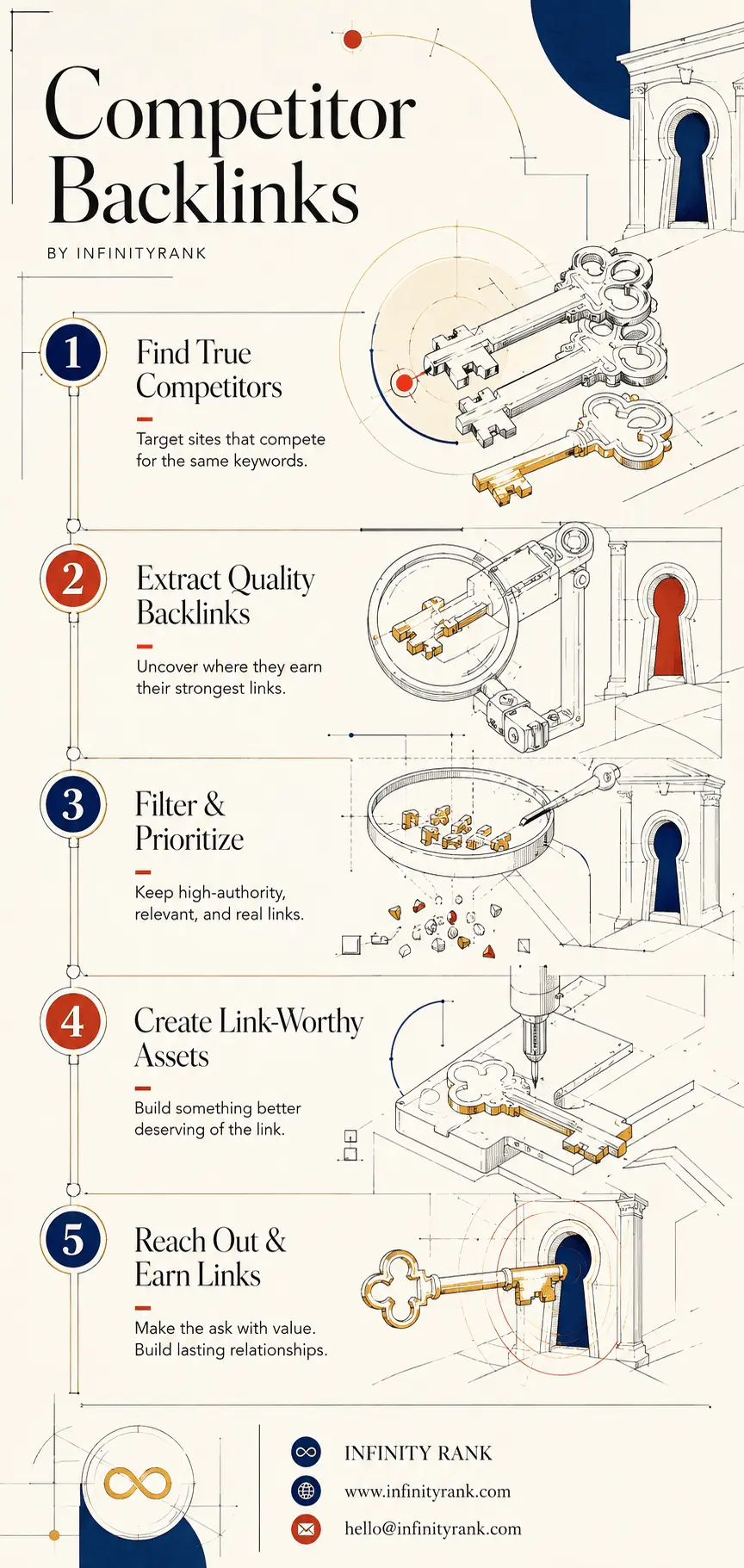
Once you have identified your prime target links, the next phase is building link-worthy assets that offer far more value than what currently exists. Approaching webmasters with a compelling pitch and genuine value allows you to secure editorial placements while building lasting industry relationships. Use these five core pillars as your strategic blueprint to replicate competitor success, close your backlink gap, and climb search engine rankings.
Why Competitor Backlink Analysis Matters
Google states that it uses links to understand how pages relate to one another and that PageRank continues to form part of its core ranking systems. Links are not the only factor involved in search visibility, but they remain one category of signal used to understand pages and discover content.
Competitor backlink data can help you:
- Find publications already covering your topic
- Identify content formats that attract citations
- Discover resource pages, directories, associations, podcasts, and industry lists
- Spot unlinked brand mentions and broken-link opportunities
- Understand which competitor pages attract the most referring domains
- Find websites that link to several competitors but not to you
- Avoid spending time on irrelevant prospects
- Compare your link acquisition against the actual search market
The analysis is most useful when you look for repeatable patterns.
One competitor link may be accidental. A domain linking to three or four competing businesses is more likely to be a publication, directory, reviewer, partner, or resource page worth investigating.
What Competitor Backlink Data Cannot Tell You
Backlink tools provide useful evidence, but they do not tell you everything.
A report cannot confirm:
- Why an editor originally added the link
- Whether money or another commercial arrangement was involved
- How much referral traffic the link generated
- Whether the link caused a ranking change
- Whether the publication will consider another company
- Whether the competitor has a personal or business relationship with the website
- Whether the link will remain live
- Whether the backlink database has found every link
Different tools maintain different indexes and crawl the web at different times. Their backlink totals will rarely match exactly.
Metrics such as Domain Rating and Domain Authority are also third-party estimates. They are not Google scores. They can help screen large lists, but they cannot replace a manual review. See our comparison of Domain Rating and Domain Authority for the limitations of each metric.
The Competitor Backlink Analysis Process
A complete workflow has eight stages:
- Choose the correct competitors.
- Run a backlink-gap analysis.
- Export and organize the data.
- Remove irrelevant or risky prospects.
- Classify the remaining opportunities.
- Score and prioritize each prospect.
- Create the asset or outreach angle.
- Track outreach and acquired links.
Skipping the filtering and classification stages usually produces a large spreadsheet with no clear next action.
1. Choose the Right Competitors
Do not assume that every company competing with you commercially is also competing with you in organic search.
Use several competitor types.
Business competitors
These companies sell a similar product or service to a similar audience.
A local accounting firm, for example, may consider other accounting firms in its city to be business competitors.
Search competitors
These are the websites that rank for the keywords you want to target.
They may include:
- Direct competitors
- Large publishers
- Marketplaces
- Review websites
- Directories
- Software comparison platforms
- Government or association websites
- Educational resources
A publisher may not sell the same service as you, but it can still compete for the same search result.
Page-level competitors
Page-level competitors rank with a specific article, landing page, tool, report, or resource.
Suppose you want to rank a guide for “SaaS onboarding metrics.” The relevant backlink comparison is not necessarily between your entire domain and another software company’s entire domain. It may be between your guide and the individual reports or articles currently ranking for that topic.
Link competitors
A link competitor is a website that repeatedly earns links from the publications you want to reach.
It may not rank for your main commercial keywords. Its value comes from having a link-acquisition model you can study.
Build the initial competitor list
Start with five to ten relevant competitors. Record:
| Field | What to enter |
| Competitor | Company or website name |
| Competitor type | Business, search, page-level, or link competitor |
| Target keyword | The query where you compete |
| Ranking URL | The exact competitor page |
| Comparison scope | Exact URL, subfolder, subdomain, or domain |
| Reason for inclusion | Why this competitor is relevant |
Do not compare your small local business with a global publisher at the domain level unless there is a clear reason. The publisher may have millions of links that have nothing to do with your market.
Use exact-URL comparisons when your objective is to understand why a particular page ranks or attracts links.
2. Run a Backlink-Gap Analysis
A backlink-gap analysis finds websites that link to competitors but do not link to you.
This is usually more useful than exporting every backlink from one competitor because it highlights domains that have already referenced several businesses or resources in your market.
Using Ahrefs Link Intersect
Ahrefs places Link Intersect under Competitive Analysis. Its current workflow allows you to compare a target domain or URL against as many as ten competitors.
The basic process is:
- Open Competitive Analysis.
- Select Link Intersect.
- Enter your website, subfolder, or exact target URL.
- Add the competitor domains or URLs.
- Choose Referring domains or Referring pages.
- Select the correct scope for each entry.
- Click Show link opportunities.
- Apply relevance and quality filters.
- Export the results.
Use referring domains for initial prospect discovery. Use referring pages when you need to inspect the exact article, resource page, directory, or list containing the link.
Do not limit the analysis to domain-level comparisons. If you are building links to one guide or landing page, compare it with equivalent competitor URLs.
Using Bing Webmaster Tools
Bing Webmaster Tools offers a free Backlinks report that can compare your verified website with up to two other sites.
It is useful for an initial competitor check, particularly when a paid backlink tool is not available.
The free report will not provide the same depth, historical data, or filtering as a full commercial platform, but it can still reveal:
- Referring domains
- Referring pages
- Domains linking to competitors but not to you
- Repeated sources worth reviewing manually
Other backlink platforms
Semrush, Moz, Majestic, and other SEO platforms provide similar comparison and export functions.
Choose a platform based on:
- Database coverage
- Page-level filtering
- Historical data
- Link-status monitoring
- Export limits
- API or reporting requirements
- Existing team workflow
- Budget
No platform has a complete record of every link on the web. When a prospect matters, verify the linking page manually.
3. Export and Organize the Backlink Data
A raw backlink export usually contains more information than you need and less context than you need.
Build a working sheet with the following columns:
| Column | Purpose |
| Competitor | The competitor receiving the link |
| Competitor target URL | The page being linked to |
| Referring domain | The external website |
| Referring page | The exact linking page |
| Link target | Destination on the competitor’s site |
| Anchor text | Clickable text used in the link |
| Link attribute | Follow, nofollow, sponsored, or UGC |
| First seen | When the tool first detected the link |
| Last seen | Most recent detection date |
| Estimated page traffic | Third-party organic traffic estimate |
| Domain metric | DR, DA, Authority Score, or equivalent |
| Topical relevance | Low, medium, or high |
| Placement type | Editorial, resource page, directory, footer, profile, or other |
| Opportunity type | Broken link, list inclusion, data pitch, mention, partnership, or other |
| Contact | Writer, editor, owner, or relevant department |
| Priority score | Your qualification score |
| Outreach status | Not contacted, sent, replied, accepted, rejected, or follow-up |
| Live result | Final acquired-link URL |
| Notes | Context and next action |
One domain may link to several competitors from the same page. Do not create five separate outreach prospects unless each link presents a different opportunity.
Group duplicate referring domains before reviewing them.
4. Filter for Relevance, Quality, and Risk
Do not sort the export by DR and contact the highest-scoring domains first.
A useful competitor backlink must make sense at three levels:
- The website
- The linking page
- The proposed placement
Check topical and audience relevance
Ask:
- Does the website cover your industry or a related subject?
- Does the specific page overlap with your target topic?
- Would the website’s audience understand why your resource is included?
- Would the link still be useful if search engines provided no ranking benefit?
A niche website is not automatically good. It may still publish thin content, sell links, or accept unrelated submissions.
Our guide to niche-relevant backlinks explains how to distinguish genuine topical relevance from superficial keyword overlap.
Review the exact linking page
Open the page and check:
- Is it accessible?
- Is it indexed?
- Has it been updated recently?
- Is the main content useful?
- Is the competitor link still present?
- Is the link inside the main article or buried in a template?
- Does the page link to many unrelated commercial websites?
- Does the link support a factual statement or recommendation?
- Does the website identify an author or editorial team?
- Would your proposed replacement improve the page?
A strong domain can contain weak pages. A smaller publication can contain an excellent, highly relevant page.
Examine the placement
Common placement types include:
- Editorial citation
- Resource list
- Product comparison
- “Best tools” article
- Partner page
- Association directory
- Podcast show notes
- Author biography
- News coverage
- Sponsored content
- Footer or sidebar
- Forum or user-generated content
- Syndicated copy
An editorial citation inside relevant content is normally more useful than a repeated footer link. That does not mean every contextual link is valuable or every directory link is useless. The page, audience, editorial process, and purpose still matter.
Check link attributes
Common attributes include:
rel="nofollow"rel="sponsored"rel="ugc"
Google recommends using sponsored for paid placements and ugc for links in user-generated content. A nofollow link can still provide visibility, referral traffic, and brand exposure, but you should record the attribute accurately.
Do not reject every nofollow link automatically. A citation from a major publication may still be commercially useful even when the link is qualified.
Use traffic estimates carefully
SEO tools estimate organic traffic. They do not show verified referral traffic from the linking page to the competitor.
Treat estimated traffic as one screening signal. A page with little search traffic may still have:
- Newsletter traffic
- Direct visitors
- A specialist audience
- Internal traffic from a larger website
- Strong industry credibility
Treat domain metrics as filters, not decisions
DR, DA, and similar metrics estimate aspects of a domain’s link profile.
They do not confirm:
- Editorial quality
- Relevance
- Real readership
- Independence
- Referral traffic
- Search-engine trust
- Whether a link was paid
- Whether a placement is safe
A relevant trade publication with a modest metric can be more useful than an unrelated high-metric website that publishes paid guest posts across dozens of industries.
Remove clear risk signals
Exclude or investigate websites showing patterns such as:
- Large numbers of unrelated sponsored articles
- “Dofollow guest post” or link-sale pages
- Casino, loan, adult, and unrelated commercial links mixed into ordinary articles
- Scraped or automatically rewritten content
- No visible editorial ownership
- Hundreds of thin category pages
- Repeated exact-match commercial anchors
- Sitewide template links
- Deindexed or inaccessible pages
- Private blog network footprints
- Artificial traffic or ranking patterns
- Irrelevant country or language targeting
- Lists created only to sell placement
Google’s spam policies identify paid links that pass ranking credit, excessive link exchanges, automated link creation, low-quality directories, optimized footer links, and other manipulative practices as forms of link spam.
Finding a questionable link in a competitor’s profile is not a reason to reproduce it.
5. Classify Each Link Opportunity
The type of competitor link determines what you need to offer.
Resource-page inclusion
The competitor is listed on a curated page of tools, guides, suppliers, associations, or recommended resources.
Your opportunity depends on whether your page adds something missing from the list.
A generic request to “add our website” is weak. A better pitch explains:
- Which section your resource fits
- What it covers that the current list does not
- Why it helps the page’s readers
- Where the editor can review it
List or comparison inclusion
The competitor appears in a “best tools,” “top companies,” product comparison, or alternative list.
Before contacting the writer, check:
- Whether the article accepts new entries
- Whether your product meets the stated criteria
- Whether the article is editorial or affiliate-driven
- Whether the competitor is included because of a paid relationship
- Whether you can provide useful evidence, screenshots, pricing, or product access
Do not ask for inclusion if the product is not a genuine fit.
Broken-link replacement
The referring page links to a competitor resource that now returns an error, redirects incorrectly, or no longer covers the original subject.
A replacement must match the dead page’s purpose. An unrelated commercial page is not a valid substitute.
Check an archived version of the dead page where possible. Then offer an existing resource or create a replacement that covers the same need more accurately.
Original data or research
The competitor earned links through statistics, survey results, benchmarks, or proprietary analysis.
Do not copy its figures or repackage its study. Develop a distinct dataset, updated sample, narrower market, or different method.
Useful formats include:
- Industry benchmarks
- Market surveys
- Anonymized customer data
- Pricing studies
- Geographic comparisons
- Trend reports
- Public-dataset analysis
- Technical experiments
State the methodology, sample size, collection period, and limitations.
Unlinked brand mention
A page mentions your company, product, study, employee, or campaign without linking to the relevant page.
The request is simple: thank the author, identify the mention, and provide the most useful destination URL.
Do not demand a link or imply that the writer made an error.
Expert contribution
The competitor was cited as a source, quoted in an article, interviewed on a podcast, or included in a roundup.
The opportunity is not the link itself. It is access to the writer, publisher, podcast, or editorial format.
Offer a specific expert angle supported by experience, data, or a clear opinion. Generic commentary is rarely useful.
Partnership or association link
The competitor appears on:
- Integration pages
- Supplier directories
- Trade associations
- Certification websites
- Event sponsor pages
- Vendor case studies
- Local business networks
- Client or partner pages
These links usually require a real relationship. Cold outreach cannot reproduce a partnership that does not exist.
Instead, ask whether your business already has legitimate suppliers, clients, platforms, associations, or certifications that should reference it.
Digital PR opportunity
The competitor earned links through a newsworthy report, campaign, announcement, or expert reaction.
Study the editorial angle rather than the final backlink.
Ask:
- What made the story timely?
- What evidence supported it?
- Which publications covered it?
- Did the coverage come from one original story that others repeated?
- Could your business produce a distinct story with credible data?
6. Score and Prioritize the Opportunities
Use a scoring system to keep qualification consistent.
The following is an example, not an industry standard.
| Factor | Score |
| Topical relevance | 0–3 |
| Relevance of the exact page and placement | 0–2 |
| Editorial quality | 0–2 |
| Organic visibility or real audience evidence | 0–1 |
| Realistic acquisition path | 0–1 |
| Contactability or existing relationship | 0–1 |
| Paid-link, spam, or reputation risk | 0 to −5 |
Example
Suppose a project-management publication links to two competing software tools in a current guide to sprint planning.
- Topical relevance: 3
- Page and placement relevance: 2
- Editorial quality: 2
- Audience evidence: 1
- Realistic acquisition path: 1
- Contactability: 1
- Risk: 0
- Total: 10
Now compare it with a high-DR general blog that publishes unrelated paid articles every day.
- Topical relevance: 1
- Page and placement relevance: 1
- Editorial quality: 0
- Audience evidence: 0
- Realistic acquisition path: 1
- Contactability: 1
- Risk: −4
- Total: 0
The second website may have the higher domain metric. It is still the worse opportunity.
Only pursue the number of prospects your team can research and contact properly. A list of 20 qualified prospects is more useful than an export containing 2,000 unreviewed domains.
7. Match the Opportunity With the Right Asset
Outreach cannot compensate for a weak destination page.
Match the competitor link to something that gives the publisher a reason to update or expand its content.
| Competitor link type | What you may need |
| Statistics citation | Current, transparent data |
| Broken resource | A close and stronger replacement |
| Tool comparison | Clear product evidence and screenshots |
| Resource page | A useful evergreen guide or tool |
| Expert quote | Specific professional insight |
| News coverage | A credible and timely story |
| Partner listing | A real commercial relationship |
| Association directory | Valid membership or certification |
| Template link | A usable template with clear instructions |
| Calculator link | A functional, accurate tool |
| Case-study citation | Documented results and methodology |
Do not clone the competitor’s article, design, dataset, or downloadable asset.
The objective is to understand why a publisher linked, then provide a distinct resource that serves the same audience better or fills a different gap.
Strong linkable assets often include:
- Original research
- Benchmarks
- Calculators
- Templates
- Technical reference pages
- Checklists
- Maps
- Industry databases
- Case studies with evidence
- Visual explainers
- Free tools
- Current statistics pages
8. Conduct Focused Outreach
Research the person responsible for the page before writing.
Depending on the website, that may be:
- The article author
- A section editor
- A content manager
- A partnerships manager
- The company owner
- A resource-page administrator
- A podcast producer
- A communications team
Your message should explain:
- Why you selected the page
- What you noticed
- What you are offering
- Why it helps the reader
- Where the person can review it
Do not begin with empty praise. Refer to something specific.
Resource-page outreach template
Subject: Resource suggestion for “[Page title]”
Hi [Name],
I was reviewing your [page title] resource and saw the section covering [specific topic].
We have published a [guide/tool/template] that explains [specific benefit or missing subject]. It may fit the section because [one clear reason]:
[URL]
The resource includes [specific evidence, feature, dataset, or practical element].
Thanks for considering it.
[Name] [Role, Company]
Broken-link outreach template
Subject: Broken reference on “[Page title]”
Hi [Name],
Your article on [topic] links to [original resource or page description], but that page currently [returns a 404/redirects to an unrelated page/is no longer available].
We have a current resource covering the same subject:
[URL]
It includes [brief description of relevant coverage]. It may be a suitable replacement if you update the article.
[Name] [Role, Company]
Unlinked-mention template
Subject: Link for the [Company/resource] mention
Hi [Name],
Thank you for mentioning [company, person, report, or product] in your article on [topic].
For readers who want the original source, this is the most relevant page:
[URL]
Thanks again for including us.
[Name] [Role, Company]
Expert-contribution template
Subject: Source available for [specific topic]
Hi [Name],
I saw your recent coverage of [specific subject]. I work on [relevant area] at [company] and can provide evidence-based commentary on:
- [Specific point]
- [Specific point]
- [Specific point]
We also have [relevant internal data, case evidence, or professional experience] covering [subject].
I can send a concise response with supporting context if you are working on a related update.
[Name] [Role, Company]
Follow-up cadence
One or two polite follow-ups are usually enough.
A practical starting point is:
- Initial message
- First follow-up after four to six business days
- Final follow-up approximately one week later
Adjust the schedule to the publication and urgency of the topic.
Stop contacting anyone who declines, asks to be removed, or makes it clear that the page is not open to updates.
How to Track the Campaign
Do not measure the campaign only by the number of emails sent.
Track:
- Qualified prospects
- Contacts found
- Messages delivered
- Replies
- Positive replies
- Links acquired
- Rejected or unsuitable prospects
- Live referring pages
- Target URLs
- Link attributes
- Anchor text
- First-live date
- Lost links
- Referral sessions
- Assisted conversions
- Target-page impressions and clicks
- Ranking and visibility changes
Our guide to link-building metrics explains which campaign KPIs are useful and which figures are easily inflated.
Ranking changes should not automatically be attributed to one link. Search visibility can also change because of:
- Content updates
- Internal linking
- Competitor changes
- Technical fixes
- Search-system updates
- Search-intent changes
- New pages entering the result
- Seasonality
For commercial reporting, evaluate link acquisition alongside qualified referral traffic, leads, assisted revenue, and the wider return on link-building investment.
Common Competitor Backlink Analysis Mistakes
Copying every competitor link
Competitors can have bad links. Some may be paid, automated, outdated, or irrelevant.
Treat each backlink as evidence to investigate, not an instruction to follow.
Choosing competitors by brand reputation
A well-known company is not automatically the correct backlink competitor.
Compare the pages and websites competing for your actual search topics.
Using DR or DA as the main quality test
High metrics do not guarantee a useful or safe placement.
Review the page, website, audience, link context, and acquisition model.
Contacting domains without opening the linking page
The URL may be broken, syndicated, outdated, or unrelated to the competitor’s current business.
Manual review is mandatory.
Pitching the homepage for every opportunity
Most editorial links point to pages that support a specific statement, solve a problem, provide evidence, or offer a useful tool.
Use the destination page that best matches the publisher’s content.
Ignoring the competitor’s reason for earning the link
A competitor may have received a link because it supplied data, sponsored an event, joined an association, built an integration, or employed the quoted expert.
The reason matters more than the fact that the backlink exists.
Reproducing manipulative links
Google identifies practices such as paid ranking links, excessive exchanges, automated links, low-quality directory links, and optimized sitewide placements as link spam.
Private blog networks, link farms, and bulk guest-post schemes sit firmly in this category. Do not assume a tactic is safe because another website is using it.
Failing to monitor acquired links
Links can be removed, changed, redirected, or qualified with different attributes.
Check important acquired links periodically and maintain the page they reference.
Competitor Backlink Analysis Checklist
Before starting outreach:
- Select relevant business, search, page-level, and link competitors.
- Record the exact competitor URLs you need to compare.
- Run a backlink-gap or Link Intersect report.
- Group duplicate referring domains.
- Open every important referring page.
- Remove irrelevant, paid, spammed, or unrealistic prospects.
- Classify each opportunity by link type.
- Identify why the competitor received the link.
- Match the opportunity with a suitable asset or relationship.
- Score relevance, quality, feasibility, and risk.
- Find the correct contact.
- Write a page-specific outreach message.
- Track every response and acquired placement.
- Review link quality after acquisition.
- Measure business outcomes rather than raw backlink totals.
Final Thoughts
Competitor backlink analysis works best as a research and qualification method.
It shows you where relevant websites already cite businesses, experts, tools, and resources in your market. It does not remove the need for strong content, editorial judgment, legitimate relationships, or careful outreach.
Start with three to five relevant search competitors. Find websites linking to several of them but not to you. Remove the domains that are irrelevant or risky. Then classify the remaining opportunities by what would genuinely justify a link.
That produces a smaller list, but it is a list your team can act on.
Frequently Asked Questions
What is a competitor backlink?
A competitor backlink is an external link pointing to a competing website or page. Analyzing these links can reveal publications, resource pages, partnerships, content formats, and outreach opportunities relevant to your market.
What is a backlink gap?
A backlink gap is the difference between the websites linking to your competitors and those linking to you. Backlink-gap tools identify domains or pages that reference competitors but do not currently reference your website.
Is analyzing competitor backlinks a black-hat tactic?
No. Reviewing publicly available backlink data is not a spam tactic.
The risk depends on how you acquire the resulting links. Paid links that pass ranking credit, excessive link exchanges, automated placement, private blog networks, and other manipulative tactics can violate search-engine spam policies.
Should I copy every backlink my competitors have?
No. Competitor profiles often contain low-quality, irrelevant, paid, repeated, or inaccessible links.
Investigate why each link exists and whether the same type of placement is relevant and legitimate for your business.
How can I check competitor backlinks for free?
Bing Webmaster Tools provides a Backlinks report that can compare your verified website with up to two other sites. You can also manually review competitor mentions, resource pages, association listings, partner pages, podcasts, and industry roundups.
Free methods are useful for an initial review but normally provide less coverage and filtering than paid platforms.
Why do backlink tools show different numbers?
Each platform operates its own web crawler and backlink database. The tools crawl different pages, revisit them at different times, and use different rules for canonical URLs, redirects, duplicates, and lost links.
Use the data comparatively rather than expecting exact agreement.
Which competitors should I analyze?
Analyze competitors that rank for the same important queries, target the same audience, or consistently earn links from websites relevant to your market.
Include exact competing URLs when you are analyzing one topic or target page.
How many competitors should I compare?
Five to ten relevant competitors are normally enough for an initial analysis. The correct number depends on the market and the tool being used.
A smaller, carefully selected group is better than a large list of unrelated domains.
Which competitor backlink tool is best?
There is no universal best tool.
Ahrefs is useful for page-level backlink research, Link Intersect analysis, filtering, and exports. Semrush, Moz, Majestic, and other platforms offer different databases and workflows. Bing Webmaster Tools provides a useful free comparison for verified website owners.
Choose based on database coverage, required reports, export limits, monitoring, and budget.
How often should I review competitor backlinks?
Review them when planning a new content or outreach campaign and monitor important competitors periodically.
The appropriate frequency depends on how quickly your market publishes content and acquires links. A fast-moving software or media market may justify monthly monitoring. A stable local market may require less frequent reviews.
Do I need more backlinks than a competitor to outrank it?
No fixed backlink number guarantees a higher ranking.
Search visibility depends on the query, content relevance, page quality, internal linking, technical accessibility, search intent, competition, and other signals. Raw backlink totals do not account for the relevance or quality of individual links.