Search is no longer just about matching keywords to pages. Google also tries to understand entities: businesses, people, products, places, organizations, books, events, and the relationships between them.
That is where Knowledge Graph optimization comes in.
The goal is not to “hack” Google’s Knowledge Graph with a Machine ID. That is the wrong way to think about it. A Machine ID, or MID, is an identifier used inside a knowledge graph. It can help systems distinguish one entity from another, but it is not a ranking shortcut, a trust badge, or a guaranteed path to a Knowledge Panel.
A better goal is simple: make your entity easier for search engines to understand, verify, and connect across the web.
That means your website, structured data, Google Business Profile, social profiles, business listings, press mentions, authoritative backlinks, and third-party references should all describe the same entity in a consistent way.
Done properly, entity SEO can help Google understand who you are, what you do, where you operate, and why your brand is relevant.
What Is a Machine ID?
A Machine ID (MID) is a globally unique identifier generated and used by a knowledge graph. Google’s Enterprise Knowledge Graph documentation describes MIDs as identifiers used to represent entity clusters after reconciliation and merging. In plain English, a MID helps a knowledge graph know that different references point to the same entity.
For example, a person, company, product, or place may be mentioned across different sources. A knowledge graph needs a way to connect those mentions without confusing similar names.
That is what entity identifiers help with.
Google’s newer Cloud Knowledge Graph MID format includes examples such as:
| MID Type | Example Format | Meaning |
| Cloud Knowledge Graph MID | c-024dcv3mk | Cloud Knowledge Graph entity ID |
| Candidate MID | r-02b72jsgrbws18 | Candidate ID generated during reconciliation |
| Reconciled MID | e-02b72jsgrbws18 | Reconciled master entity MID in a private graph |
| Google Knowledge Graph MID | /m/045c7b | Older Google Knowledge Graph-style MID |
The important point: you do not manually assign yourself a Google MID to improve rankings.
A MID is an identifier used by knowledge graph systems. Your SEO job is to make your entity clear, consistent, and well-supported enough for Google to understand it.
Does a MID Help Your Site Rank?
Not directly.
A MID does not work like a backlink, title tag, content update, or technical SEO fix. Having an entity identifier does not automatically improve rankings, create a Knowledge Panel, or make Google trust your site more.
Google’s structured data guidance is clear: structured data can make a page eligible for enhanced search features, but Google does not guarantee that correctly marked-up content will appear as a rich result. Structured data issues can affect rich-result eligibility, but they do not directly affect normal web search rankings.
So the safer way to frame this is:
A MID may reflect that an entity exists inside a knowledge graph, but Knowledge Graph optimization is about improving entity clarity, consistency, and authority — not chasing the MID itself.
The Knowledge Graph Success Roadmap
Understanding Machine IDs and the Knowledge Graph can be complex, but it essentially boils down to how Google identifies your brand. To help you visualize the journey from a basic search result to a verified entity, I’ve mapped out the five key stages of the process below.
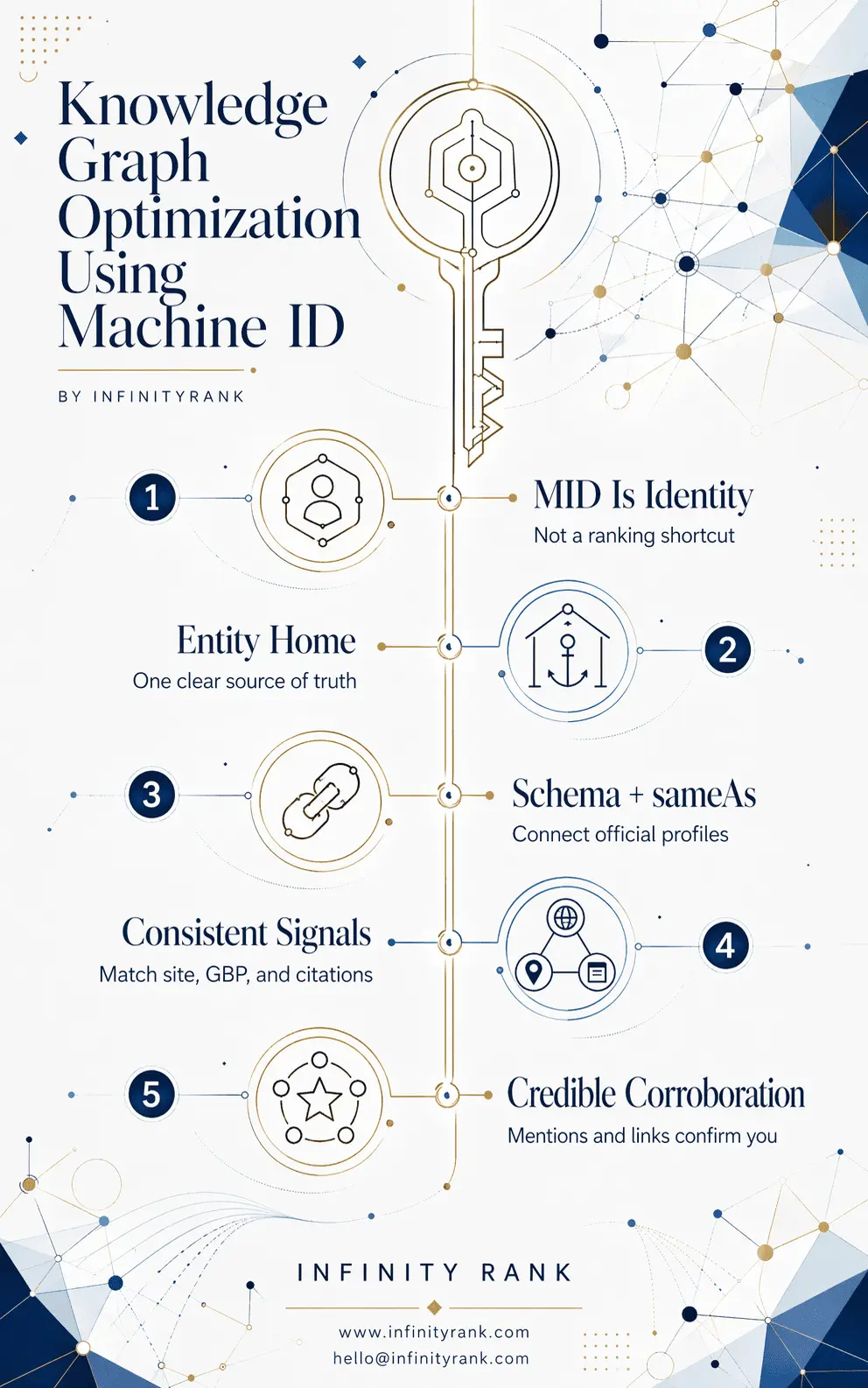
As the roadmap shows, it’s not about finding a “shortcut” but about building a credible, consistent digital identity. From setting up your Entity Home to gathering credible mentions, each step strengthens Google’s trust in who you are.
Now that you have the full picture, let’s dive into how you can start implementing these steps for your own brand.
What Knowledge Graph Optimization Actually Means
Knowledge Graph optimization is the process of helping Google and other search systems understand your entity with confidence.
For a business, that means Google should be able to answer questions like:
- What is the official brand name?
- What does the company do?
- What website represents the entity?
- Where is the business located?
- Who founded it or operates it?
- Which social profiles belong to it?
- Which third-party sources confirm the same facts?
- Which topics, services, and industries is the entity known for?
The stronger and more consistent those signals are, the easier it becomes for search engines to connect your brand to the right entity.
Step 1: Build a Clear Entity Home on Your Website
Your website should be the primary source of truth about your business.
Start with your homepage, About page, Contact page, service pages, author pages, and legal/business information. These pages should use the same facts consistently.
At minimum, your site should clearly show:
- Legal or public-facing business name
- Brand name
- Website URL
- Logo
- Business category
- Address, if relevant
- Phone number, if relevant
- Founder or leadership details, if relevant
- Social profile links
- Service areas
- Core services
- Short brand description
Do not make Google piece together your identity from vague copy.
Bad:
We are a leading digital company helping brands grow online.
Better:
Infinity Rank is a link building and SEO agency based in Albuquerque, New Mexico, helping SaaS, ecommerce, and B2B companies earn authoritative backlinks and improve organic visibility.
The second version gives Google clearer entity information.
Step 2: Add Organization Schema Markup
Structured data gives Google explicit clues about a page and the entities mentioned on it. Google says structured data is a standardized format for providing information about a page and classifying its content.
For most businesses, start with Organization or LocalBusiness schema.
Here is a basic example:
<script type="application/ld+json">
{
  "@context": "https://schema.org",
  "@type": "ProfessionalService",
  "@id": "https://infinityrank.com/#organization",
  "name": "Infinity Rank",
  "alternateName": "InfinityRank",
  "url": "https://infinityrank.com/",
  "logo": {
    "@type": "ImageObject",
    "url": "https://infinityrank.com/wp-content/uploads/2024/11/Infinity-rank-logo-v2-03-2048x553-1-e1731668310896.png"
  },
  "image": "https://infinityrank.com/wp-content/uploads/2024/11/Infinity-rank-logo-v2-03-2048x553-1-e1731668310896.png",
  "description": "Infinity Rank is an SEO and link building agency helping brands improve organic visibility through content, digital PR, authority building, and tailored SEO strategies.",
  "slogan": "Hands-free, tailored SEO that ranks and scales without headaches, hidden costs, or guesswork.",
  "foundingDate": "2020",
  "email": "hello@infinityrank.com",
  "telephone": "+1-505-575-5826",
  "priceRange": "$$",
  "address": {
    "@type": "PostalAddress",
    "streetAddress": "1209 Mt. Road",
    "addressLocality": "Albuquerque",
    "addressRegion": "NM",
    "postalCode": "87110",
    "addressCountry": "US"
  },
  "areaServed": {
    "@type": "Country",
    "name": "United States"
  },
  "contactPoint": {
    "@type": "ContactPoint",
    "telephone": "+1-505-575-5826",
    "email": "hello@infinityrank.com",
    "contactType": "customer service",
    "availableLanguage": "English",
    "url": "https://infinityrank.com/contact/"
  },
  "sameAs": [
    "https://www.linkedin.com/company/infinityrank",
    "https://www.facebook.com/infinityrankseo/",
    "https://www.instagram.com/infinityrankseo/",
    "https://x.com/infinityrankseo",
    "https://bsky.app/profile/infinityrank.com"
  ],
  "knowsAbout": [
    "SEO",
    "Link Building",
    "Backlinks",
    "Guest Posting",
    "Digital PR",
    "Press Release Distribution",
    "Content Marketing",
    "Technical SEO",
    "Search Engine Optimization"
  ],
  "hasOfferCatalog": {
    "@type": "OfferCatalog",
    "name": "Infinity Rank SEO Services",
    "itemListElement": [
      {
        "@type": "Offer",
        "itemOffered": {
          "@type": "Service",
          "name": "Link Building",
          "url": "https://infinityrank.com/guest-post-link-building/"
        }
      },
      {
        "@type": "Offer",
        "itemOffered": {
          "@type": "Service",
          "name": "Content Marketing",
          "url": "https://infinityrank.com/content-strategy-services/"
        }
      },
      {
        "@type": "Offer",
        "itemOffered": {
          "@type": "Service",
          "name": "Press Release Backlinks",
          "url": "https://infinityrank.com/press-release-backlinks/"
        }
      },
      {
        "@type": "Offer",
        "itemOffered": {
          "@type": "Service",
          "name": "SaaS Link Building"
        }
      },
      {
        "@type": "Offer",
        "itemOffered": {
          "@type": "Service",
          "name": "Digital PR"
        }
      },
      {
        "@type": "Offer",
        "itemOffered": {
          "@type": "Service",
          "name": "White Label Link Building"
        }
      },
      {
        "@type": "Offer",
        "itemOffered": {
          "@type": "Service",
          "name": "HARO Link Building"
        }
      },
      {
        "@type": "Offer",
        "itemOffered": {
          "@type": "Service",
          "name": "Technical SEO Audit"
        }
      }
    ]
  }
}
</script>
Do not add fake details. Do not mark up information that is not visible or supported on the page. Google’s structured data guidelines warn against misleading markup and require the structured data to represent the main visible content.
Step 3: Use sameAs Carefully
The sameAs property helps connect your website entity to official external profiles.
Good sameAs candidates include:
- LinkedIn company page
- X/Twitter profile
- Facebook page
- Instagram profile
- YouTube channel
- Crunchbase profile
- Wikidata page, if one exists and is accurate
- Wikipedia page, if one exists and is accurate
- Industry directory profiles
- Review profiles
- Founder profiles, where relevant
Do not stuff sameAs with every random mention. Use profiles that clearly represent the same organization.
Weak sameAs usage creates noise. Strong sameAs usage reinforces entity confidence.
Step 4: Optimize Your Google Business Profile
For local or service-area businesses, your Google Business Profile matters. Google describes Business Profile as a free way for businesses to appear on Google Search and Maps, with information such as photos, hours, phone number, and website.
Use the current name: Google Business Profile, not Google My Business.
Your profile should match your website exactly where possible:
- Business name
- Address
- Phone number
- Website URL
- Business category
- Opening hours
- Service areas
- Logo
- Photos
- Business description
For entity SEO, consistency is the point. If your website says one thing, your Business Profile says another, and directories say a third thing, you are creating ambiguity.
Step 5: Create Consistent Entity Signals Across the Web
Google does not rely only on your own website. It compares signals across the open web.
Audit your brand presence across:
- Business directories
- Review platforms
- Social profiles
- Local citations
- Press mentions
- Podcast appearances
- Guest posts
- Partner pages
- Industry lists
- Author bios
- Conference profiles
- Data providers
Look for inconsistencies in:
- Brand spelling
- Address
- Phone number
- Website URL
- Founding year
- Founder names
- Service descriptions
- Logo usage
- Social profile links
Small differences are not always fatal, but repeated inconsistencies make the entity harder to reconcile.
Step 6: Build Authority With Relevant Mentions and Links
Knowledge Graph optimization is not only a technical task. Authority still matters.
If no reputable sites mention your brand, Google has less external evidence to work with. Strong entity signals usually come from a mix of:
- Authoritative backlinks
- Digital PR
- Industry coverage
- Expert quotes
- Brand mentions
- Case studies
- Reviews
- Podcast interviews
- Partner pages
- Data-driven content
The goal is not just “more links.” The goal is credible corroboration.
A backlink from a relevant industry publication can support both ranking and entity understanding. A brand mention in a trusted source can help confirm that your company exists in a specific market or category.
For example, if your business wants to be recognized as a SaaS link building agency, the surrounding mentions should consistently connect the brand to SaaS, SEO, link building, digital PR, and content marketing.
Step 7: Use the Knowledge Graph Search API for Checking, Not Manipulation
Google’s Knowledge Graph Search API lets users find entities in Google’s Knowledge Graph. Google describes it as using schema.org types and JSON-LD, and its typical uses include finding notable matching entities, predictive completion, and organizing content using Knowledge Graph entities. It is also read-only.
That matters.
You can use the API to check how an entity appears, but you cannot use it to force your business into the Knowledge Graph.
Use it to answer questions like:
- Does Google return an entity for this brand name?
- Is the result the correct entity?
- What description appears?
- What URL is associated with the entity?
- Are there confusingly similar entities?
- Does the entity have a recognizable MID?
- Are the returned entity types accurate?
If the API returns the wrong entity or no entity, that is a signal to improve entity clarity. It is not a button you press to “submit” your business.
Step 8: Understand Entity Reconciliation Properly
Entity reconciliation is useful, but the original article overstated its SEO role.
Google’s Enterprise Knowledge Graph documentation explains that the Entity Reconciliation API reads source BigQuery tables, maps entities to a schema, clusters matching entities, and outputs linking results with a new MID column. This is mainly an enterprise data workflow, not a standard small-business SEO tactic.
Use entity reconciliation if you are dealing with large datasets, messy records, product catalogs, locations, or internal knowledge graph projects.
For ordinary SEO, focus on:
- Clear brand information
- Structured data
- Consistent citations
- Strong backlinks
- Authoritative mentions
- Accurate social and business profiles
- Helpful content around your entity and expertise
Practical Entity SEO Checklist
| Task | Why It Matters |
| Use one official brand name everywhere | Reduces entity ambiguity |
| Add Organization or LocalBusiness schema | Gives search engines explicit entity details |
Use a stable @id in schema | Helps connect site-wide entity references |
Link official profiles with sameAs | Connects your web presence |
| Keep Google Business Profile accurate | Supports local entity recognition |
| Audit business listings | Removes contradictory NAP data |
| Earn relevant backlinks and mentions | Builds external validation |
| Publish clear About and Contact pages | Establishes the website as the entity home |
| Use consistent author and founder bios | Supports person/entity relationships |
| Check Knowledge Graph API results | Helps identify entity confusion |
Common Mistakes to Avoid
Treating MID as an SEO ranking factor
A MID is an identifier, not a ranking lever. Do not sell it as a shortcut.
Adding fake schema details
Only mark up information that is accurate, visible, and relevant.
Using outdated terminology
Use Google Business Profile, not Google My Business.
Linking weak or irrelevant profiles in sameAs
Only include profiles that clearly represent the same entity.
Ignoring brand ambiguity
If your company name is similar to another business, you need stronger disambiguation signals: location, founder, logo, industry, service niche, and official profiles.
Expecting structured data to guarantee rich results
Structured data can help Google understand your content and may enable search features, but Google does not guarantee display.
Final Thoughts
Machine IDs matter in knowledge graph systems, but they are not the main job of entity SEO.
Your real task is to make your brand easy to understand and hard to confuse.
That means your website should clearly define your entity. Your schema should reinforce the same facts. Your Google Business Profile and social profiles should match. Your backlinks, press mentions, citations, and third-party references should confirm who you are and what you are known for.
That is how Knowledge Graph optimization works in practice.
Not by chasing a MID.
Not by stuffing schema.
Not by making ranking promises Google does not support.
Entity SEO works when your brand information is accurate, consistent, crawlable, and backed by credible sources.
Frequently Asked Questions
What is a Machine ID in Google’s Knowledge Graph?
A Machine ID, or MID, is a unique identifier used by a knowledge graph to distinguish entities. It helps systems connect references to the same entity across different data sources.
Can I create my own Google Knowledge Graph MID?
No. You cannot manually create a Google Knowledge Graph MID for SEO purposes. MIDs are generated and used inside knowledge graph systems.
Does having a MID improve Google rankings?
Not directly. A MID is not a ranking factor. It may indicate that an entity exists in a knowledge graph, but it does not guarantee better rankings, rich results, or a Knowledge Panel.
How do I optimize for the Knowledge Graph?
Start with clear entity information on your website, add accurate Organization or LocalBusiness schema, use official sameAs links, keep your Google Business Profile updated, build authoritative mentions, and maintain consistent business information across the web.
Is structured data enough to get into the Knowledge Graph?
No. Structured data helps Google understand your content, but it does not guarantee Knowledge Graph inclusion, rich results, or rankings.
What is the Knowledge Graph Search API used for?
The Knowledge Graph Search API can be used to search for entities in Google’s Knowledge Graph and inspect returned entity data. It is useful for checking entity visibility, but it does not let you force an entity into the Knowledge Graph.
Should local businesses use Google Business Profile for entity SEO?
Yes. Local and service-area businesses should keep their Google Business Profile accurate and consistent with their website, citations, and social profiles.