Outsourcing link building can save months of prospecting, outreach, follow-ups, content production, and publisher negotiation.
It can also waste your budget.
Weak providers often sell recycled publisher lists, irrelevant guest posts, inflated authority metrics, poorly written content, or links placed on websites built mainly to sell links. The report may show ten new backlinks, but that does not mean the campaign improved rankings, brought referral traffic, or supported a valuable page.
The answer is not to avoid outsourcing. It is to retain control of the strategy while outsourcing the repetitive work to a provider whose process you can inspect.
This guide explains:
- What outsourced link building includes
- When outsourcing makes sense
- Which tasks should remain in-house
- How much different campaign models may cost
- How to assess providers and proposed websites
- Which contract terms protect you
- How to measure whether the campaign is working
What Does It Mean to Outsource Link Building?
Outsourced link building means hiring a freelancer, specialist agency, digital PR team, marketplace, or white-label provider to handle some or all of your backlink acquisition.
The work may include:
- Backlink and competitor research
- Link-gap analysis
- Prospecting
- Website quality checks
- Outreach and follow-ups
- Content creation
- Publisher communication
- Placement negotiation
- Anchor-text planning
- Live-link verification
- Link monitoring
- Campaign reporting
Google uses links to discover pages and as one of the signals it considers when assessing page relevance. That does not mean every backlink is an endorsement, or that adding more links automatically produces higher rankings. The source, context, anchor text, target page, and reason for the link all matter. Google’s link guidance specifically emphasizes crawlable links, descriptive anchor text, and relevance.
A provider should therefore sell more than a backlink count. It should provide research, editorial judgment, quality control, and reporting.
Outsourcing Link Building Framework for Safe SEO Growth
Delegating your off-page campaigns to external vendors can rapidly scale your search rankings, but only if executed with a clear roadmap. Before handing off outreach, you must prepare first by defining specific business goals, evaluating your linkable assets, and setting an accurate budget. Choosing expertise over the cheapest provider protects your site from black-hat networks and low-tier link vendors. This simple guide breaks down five essential steps to delegate your link acquisition safely and build lasting authority.
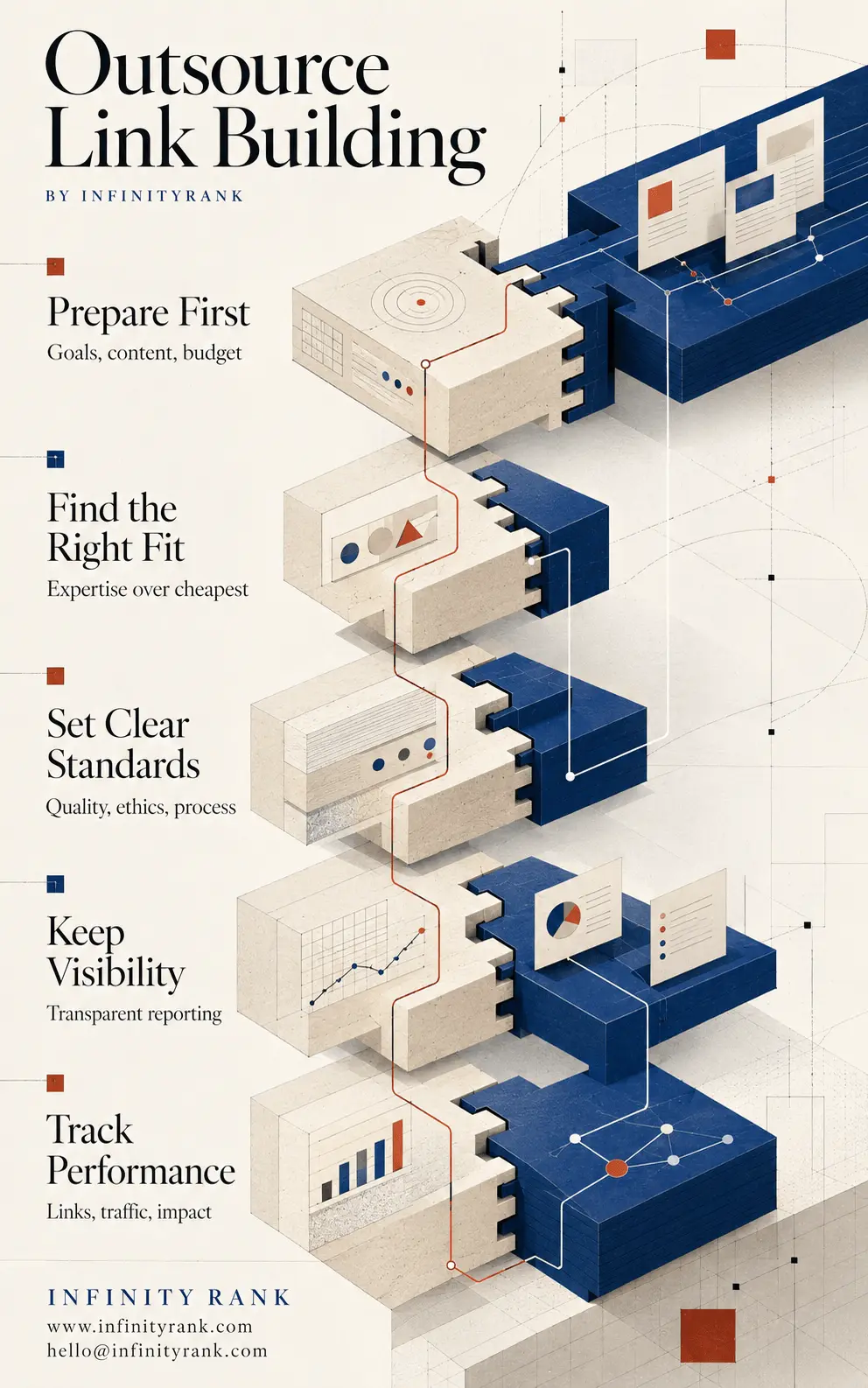
Maintaining high campaign standards requires establishing strict quality controls, ethical guidelines, and proven outreach workflows. Demanding full visibility through transparent reporting ensures you can continuously verify every placement while tracking real performance metrics like keyword rankings, referral traffic, and conversion impact. Use these five core pillars as your operational checklist to choose the right partner and scale your backlink profile without risk.
When Should You Outsource Link Building?
Outsourcing makes sense when your team has a clear SEO strategy but lacks the time, systems, contacts, or specialist staff needed to execute it.
You may be ready to outsource when:
- You know which pages need links and why
- Your priority pages are useful, indexable, and conversion-ready
- You have already completed basic keyword and competitor research
- You can define acceptable and unacceptable websites
- You have analytics and Search Console configured
- Your internal team cannot maintain regular prospecting and outreach
- You need to increase output without hiring a full outreach team
- You need fulfillment support for several SEO clients
- Your industry requires specialist prospecting or digital PR
For agencies, outsourcing can also provide fulfillment capacity behind the scenes. Our guide to white-label SEO link building explains how that model works when the agency retains the client relationship and the provider handles production.
When Should You Not Outsource It?
Do not hire a link-building provider simply because your rankings are weak.
Backlinks will not repair a website with the wrong search intent, weak content, broken indexation, poor internal linking, or no clear commercial strategy.
Delay the campaign when:
- You cannot identify the pages that should receive links
- Your target pages are thin, outdated, or nearly identical to competing pages
- Important pages are blocked, canonicalized incorrectly, or not indexed
- Your website has no clear conversion path
- You expect links to compensate for poor products or weak offers
- You cannot review proposed placements
- You are only interested in increasing DA or DR
- You expect guaranteed rankings
- Your available budget only supports bulk, low-cost links
- Nobody on your team will review reports or hold the provider accountable
Fixing these problems first gives each acquired link a better chance of supporting a useful page.
Four Link-Building Outsourcing Models
There is no single correct provider type. The right choice depends on your budget, internal SEO knowledge, approval requirements, and campaign size.
| Outsourcing Model | Best For | Main Advantage | Main Risk |
| Freelancer | Small campaigns with close internal supervision | Lower overhead and direct communication | Limited capacity, tools, and quality assurance |
| Specialist link-building agency | Businesses that need strategy and execution | Dedicated systems, research, outreach, content, and reporting | Higher cost and possible loss of control if the process is vague |
| Link marketplace | Experienced teams that can inspect every website themselves | Fast access to a large selection of placements | Recycled inventory, paid-placement risk, and inconsistent quality |
| White-label provider | SEO agencies serving multiple clients | Scalable fulfillment under the agency’s brand | The agency remains responsible for every bad placement |
| Digital PR agency | Brands seeking editorial coverage and high-authority mentions | Can earn links, coverage, referral traffic, and brand visibility | Higher cost, less predictable output, and no legitimate link guarantee |
A marketplace may suit a senior SEO team that only needs access to publishers. A managed agency is usually safer when you need research, strategy, content, outreach, and quality control handled together.
What Should You Outsource?
Outsource work that requires time, systems, and execution capacity:
- Prospect database development
- Competitor backlink collection
- Website qualification
- Contact research
- Outreach personalization
- Follow-up sequences
- Content coordination
- Publisher communication
- Placement verification
- Link monitoring
- Routine reporting
These activities are labor-intensive and easier to scale through a team with established processes.
What Should Stay In-House?
Do not hand complete control of your off-page SEO to an outside provider.
Your company or lead SEO should retain control over:
Commercial priorities
The provider should not decide which products, services, or markets matter most to your business.
Target-page selection
You should approve which pages receive links. Sending every backlink to the homepage is usually lazy. Sending links to weak pages is equally wasteful.
Content and keyword strategy
Link building should support an existing search strategy. It should not determine that strategy.
Anchor-text rules
Providers should work within approved anchor categories rather than forcing exact-match commercial anchors into every placement.
Brand and factual claims
Your team must approve statements about your company, products, results, clients, and regulated subjects.
Final quality approval
Someone inside your business should have the power to reject a proposed domain or live placement.
Performance evaluation
The provider may prepare reports, but it should not be the only party deciding whether its own campaign succeeded.
Step 1: Prepare Your Website and Target Pages
Before prospecting begins, confirm that the pages receiving links deserve them.
Check indexation
Verify that the target page is indexable, included in the correct sitemap, internally linked, and not blocked by robots directives or an incorrect canonical tag.
Match search intent
A link cannot rescue a page that answers the wrong question. Compare the target page with the pages already ranking for its main search terms.
Improve the content
The page should provide a clear reason for another website to reference it. That reason may be:
- Original research
- A useful guide
- A detailed comparison
- A free tool
- Expert commentary
- A case study
- A template
- Statistics
- A visual asset
- A distinctive product or service
Review the conversion path
Commercial pages should contain a clear next step. Informational pages should direct qualified visitors toward a related service, product, consultation, or deeper resource.
Fix major technical problems
A backlink does not become worthless because a page loads slowly, and Google does not apply a simple automatic “slow-page penalty.” However, poor loading performance, responsiveness, and visual stability can damage user experience. Google recommends good Core Web Vitals as part of broader page experience.
Technical SEO and link building should support each other rather than compete for attention.
Step 2: Write a Clear Campaign Brief
Do not ask a provider to “build high-quality links.” That instruction is too vague to enforce.
Your campaign brief should define the following.
Business objective
Examples include:
- Increase non-branded organic traffic to a service category
- Improve visibility for a group of commercial keywords
- Support a new product launch
- Strengthen local relevance in selected cities
- Earn qualified referral traffic
- Increase editorial brand mentions
- Reduce a clear referring-domain gap against named competitors
Target pages
List the exact URLs that may receive links and explain why each page matters.
Target markets
Define the required countries, languages, industries, and audiences.
A US campaign should not quietly become a collection of cheap placements on unrelated international websites.
Approved link methods
State whether the provider may use:
- Editorial outreach
- Guest contributions
- Digital PR
- Expert commentary
- Resource-page outreach
- Broken-link outreach
- Unlinked mention reclamation
- Niche edits
- Local citations
- Relevant directories
- Sponsored placements
Prohibited methods
Your exclusions may include:
- Private blog networks
- Hacked links
- Automated links
- Comment spam
- Forum profile spam
- Mass directory submissions
- Expired-domain networks
- Irrelevant guest-post websites
- Hidden links
- Sitewide footer links
- Exact-match anchor campaigns
- Undisclosed subcontractors
Reporting requirements
Define exactly what the provider must report for every placement.
Step 3: Define What a Good Backlink Looks Like
Do not approve a website based only on Domain Rating or Domain Authority.
DR and DA are third-party estimates created by SEO software companies. They can help filter a large list, but they are not Google metrics and do not prove that a placement is relevant, safe, or useful.
Assess each opportunity using several signals.
| Quality Factor | What to Check | Warning Signs |
| Topical relevance | The website and linking page cover subjects connected to your page | The site publishes every imaginable commercial topic |
| Editorial purpose | The link helps the reader understand or complete something | The sentence exists only to hold a keyword-rich link |
| Organic visibility | The website ranks for credible, relevant searches | Traffic appears inflated, irrelevant, or dependent on a few suspicious pages |
| Page quality | The article is useful, original, readable, and internally linked | Thin content, factual errors, copied sections, or obvious automated production |
| Outbound links | Commercial links appear selective and contextually justified | Every article links to unrelated paying clients |
| Indexation | The domain and placement page are indexable | Large sections of the website are removed from Google |
| Ownership and accountability | Real business, editorial team, author, or contact details are visible | Anonymous website with no clear purpose |
| Anchor text | The anchor reads naturally and accurately describes the destination | Repetitive exact-match commercial anchors |
| Link attribute | The attribute matches the nature of the placement | Paid placement presented as independent editorial endorsement |
| Stability | The publisher has a reasonable content history | Constant redesigns, disappearing posts, domain changes, or widespread link deletion |
A backlink can have modest third-party authority metrics and still be useful when it is highly relevant, editorially justified, and capable of sending the right audience.
A high-DR website can still be a poor choice if it publishes unrelated paid posts and has no real readership.
For a deeper review of these signals, see our guide to link-building metrics.
Step 4: Set a Budget Based on the Work Required
Link-building prices vary because providers are not selling identical work.
One quote may include strategy, manual prospecting, original content, outreach, negotiations, quality checks, monitoring, and replacements. Another may only provide access to a list of websites already selling posts.
The following figures are broad market examples, not fixed rates or a quotation:
| Service Type | Broad Cost Range | Typical Use |
| Foundational links | $50-$250 per link | Citations, trusted directories, profiles, and basic brand coverage |
| Guest-post outreach | $150-$750 per link | Regular niche-relevant content placements |
| Niche edits | $100-$600 per link | Contextual additions to existing relevant pages |
| Editorial outreach | $300-$1,000+ per link | Selective placements requiring stronger research and outreach |
| Digital PR | $750-$1,500+ per unique linking domain | Research, stories, expert commentary, and media outreach |
| Managed campaigns | $2,500-$10,000+ per month | Ongoing strategy, content, outreach, reporting, and quality control |
Actual costs depend on the niche, country, language, competition, content requirements, publisher standards, outreach difficulty, approval process, and reporting depth.
See our full link-building pricing guide for a more detailed breakdown.
Do not assume that cheap means dangerous or expensive means good.
A basic directory citation may be inexpensive because it requires little work. It should not be sold as a powerful editorial backlink.
A $1,500 placement can still be poor if the website is irrelevant, has manipulated traffic, and accepts almost any paid article.
The price must be judged against the process and the final placement.
A Necessary Warning About Paid Links
Paying for advertising or sponsorship is a normal part of online publishing. Paying for links intended to pass ranking credit is a different matter.
Google’s spam policies classify buying or selling links for ranking purposes as link spam. This includes exchanging money, goods, or services for links that are intended to manipulate search rankings. Google allows advertising and sponsored links when they are properly qualified with rel="sponsored" or rel="nofollow".
This creates an obvious question for any outsourced campaign:
Is the provider earning an editorial link, arranging a disclosed sponsored placement, or buying an unqualified link intended to influence rankings?
Make the provider answer that question in writing.
Guest posting is not automatically safe merely because someone calls it “white hat.” Scaled paid guest posts, optimized anchors, weak publisher websites, and articles created mainly to carry links can still create risk.
Step 5: Ask Providers These Questions
A serious provider should be able to answer these before receiving payment.
How do you find prospects?
Ask whether the list is built for your campaign or pulled from existing paid inventory.
Can we review sample placements?
Samples reveal more than sales claims.
Can we approve or reject domains before publication?
Approval rights reduce surprises.
How do you define relevance?
“Same niche” is not enough. Ask about domain-level, section-level, and page-level relevance.
How do you verify organic traffic?
Ask which tools are used and whether traffic geography and ranking topics are reviewed.
How do you detect link farms and private networks?
The answer should cover ownership patterns, outbound links, content history, traffic, and backlink profiles.
Do publishers receive payment?
The provider should disclose compensation and how paid links are qualified.
Who writes the content?
Ask about writers, editing, fact-checking, plagiarism checks, and your approval rights.
How are anchor texts selected?
Avoid providers that promise repeated exact-match anchors.
Do you guarantee dofollow links?
Treat the claim cautiously. A provider should not control an independent publisher’s editorial decisions.
What is your replacement policy?
Ask what happens if a page is deleted, deindexed, redirected, or changed.
Do you use subcontractors?
You need to know who handles your brand, data, content, and outreach.
What appears in the report?
Reports should include the live URL, target URL, anchor, link attribute, publication date, placement type, and quality notes.
Can you guarantee rankings?
The correct answer is no. Providers can guarantee contracted work, not a specific Google position.
How do you measure performance?
Link count and average DR are not enough.
Step 6: Start With a Pilot Campaign
Do not begin with a long contract and a large link quota when you have never worked with the provider.
A practical pilot may cover:
- One target topic or service group
- A small batch of five to ten placements
- One 60- to 90-day outreach cycle
- Defined approval rules
- A fixed reporting format
- A clear replacement policy
- A review meeting after delivery
The purpose is not to prove that rankings will increase within a few weeks. The purpose is to test the provider’s judgment and execution.
Review:
- Prospect relevance
- Communication
- Content quality
- Accuracy
- Anchor selection
- Delivery speed
- Publisher transparency
- Placement quality
- Reporting
- Response to rejected opportunities
- Link retention
A provider that becomes defensive when you reject weak websites is not a partner you should scale.
Step 7: Review Every Placement
Inspect both the website and the exact page.
Before publication, check:
- Website topic and audience
- Organic traffic subjects and geography
- Recent content
- Outbound commercial links
- Publisher identity
- Indexation
- Existing backlink profile
- Signs of ownership by a wider network
After publication, confirm:
- Correct target URL
- Correct anchor text
- Correct brand and factual claims
- Correct link attribute
- Natural placement
- Indexable page
- No accidental
noindex - No redirect through an unknown tracking domain
- No unrelated commercial links added around yours
- Content quality
- Mobile usability
Do not approve a placement merely because the provider delivered the promised DR.
Step 8: Measure More Than Link Count
Link building should be measured at three levels.
Delivery metrics
These tell you whether the provider completed the contracted work:
- New live links
- New referring domains
- Target pages supported
- Link attributes
- Placement types
- Publication dates
- Approved versus rejected prospects
- Link retention
- Replacement rate
Search-performance metrics
These indicate whether the supported pages are gaining visibility:
- Organic impressions
- Organic clicks
- Average position for defined query groups
- Number of ranking keywords
- Visibility of target pages
- Non-branded organic traffic
- Search demand for the brand
Use Google Search Console to track impressions, clicks, queries, and target-page performance. Its Links report can also show linking sites, linked pages, and anchor text, but Google describes the report as a sample of known links rather than a complete backlink index.
Use a dedicated rank tracker when you need stable monitoring for a selected keyword set.
Business metrics
These determine whether the campaign contributes to revenue:
- Referral sessions
- Organic leads
- Qualified inquiries
- Assisted conversions
- Sales from supported landing pages
- Pipeline value
- Customer acquisition cost
- Incremental contribution profit
- Campaign ROI
Google Analytics can help assess traffic sources, sessions, landing-page behavior, and conversions. It is not a backlink database or a complete ranking tracker.
Our guide to link-building ROI explains how to evaluate contribution without attributing every organic improvement to backlinks alone.
How Long Does Outsourced Link Building Take to Work?
There is no universal three-month or six-month deadline.
The timeline depends on:
- How quickly publishers respond
- Whether content must be created
- How quickly the linking page is crawled and indexed
- The strength and relevance of the placement
- The quality of the target page
- Competition
- Your existing backlink profile
- Other technical and content changes
- Seasonality
- Changes made by competitors
- Google’s own systems
A provider may be able to estimate delivery. It cannot responsibly guarantee when Google will change a ranking.
Early signs may include:
- New referring domains
- More impressions for the target page
- New long-tail rankings
- Referral visits
- Improved crawling or discovery
Commercial results often take longer and should be assessed over a consistent reporting period.
Link-Building Red Flags
Avoid or investigate providers that claim:
- “Guaranteed first-page rankings”
- “100 high-authority links in seven days”
- “DA 90 links for $50”
- “All links are permanent”
- “Every link is dofollow”
- “We accept every niche”
- “No content required”
- “No need to approve websites”
- “Our private network cannot be detected”
- “We cannot disclose where links come from”
- “Exact-match anchors are best”
- “DR is the only metric that matters”
- “Traffic does not matter”
- “We do not provide live URLs”
- “You do not need reporting”
Also be cautious when:
- Most websites share similar designs or authors
- Domains gained authority suddenly
- Organic traffic has collapsed
- Content shifts between unrelated niches
- Publisher pages contain excessive casino, loan, essay, CBD, or adult links
- Articles are obviously written only to host backlinks
- The provider refuses to explain publisher compensation
- Links disappear soon after reporting
- Your content is published without approval
See our breakdown of common link-building mistakes for additional warning signs.
Contract Terms to Set Before Starting
A clear agreement should cover:
Deliverables
Define whether you are buying outreach activity, content, placements, campaign hours, or a minimum number of live links.
Quality standards
Attach the approved criteria to the contract. Do not rely on the phrase “high-quality websites.”
Approval rights
State whether you can reject domains, content, anchors, or target pages before publication.
Publisher compensation
Require disclosure of paid and sponsored arrangements.
Link attributes
State how sponsored, nofollow, and user-generated link attributes will be handled.
Replacement terms
Define the replacement period and the events that qualify:
- Link deletion
- Page deletion
- Domain expiration
- Deindexation
- Incorrect redirect
- Link changed to a different destination
- Material change in link attribute
Do not expect a provider to replace a link indefinitely. Do expect the policy to be clear before payment.
Content ownership
Specify who owns drafts, research, creative assets, and unpublished content.
Reporting
State the required fields, delivery schedule, and reporting platform.
Confidentiality
Protect campaign information, customer data, access credentials, and unreleased business information.
Termination
Avoid an agreement that traps you after the provider has repeatedly failed its own quality standards.
Is Outsourcing Better Than Building an In-House Team?
It depends on campaign size and control requirements.
An in-house team may be better when:
- Link building is a core long-term growth channel
- You need deep product or industry expertise
- Brand controls are strict
- You operate in a regulated field
- You have enough work to support dedicated staff
- You want direct ownership of publisher relationships
Outsourcing may be better when:
- Campaign volume changes frequently
- Hiring and training would take too long
- You need immediate specialist support
- Your internal team already manages strategy
- You need access to writers, outreach staff, and quality reviewers
- You run campaigns across several industries or countries
A hybrid model often works best: keep strategy, target selection, quality standards, and final approval in-house while outsourcing research, outreach, content coordination, and monitoring.
Frequently Asked Questions
What is the best way to outsource link building?
Start with a clear campaign brief, documented quality standards, sample-placement review, and a limited pilot. Retain control of target pages, anchor rules, brand claims, and final approvals. Do not hire based only on price, DA, DR, or a promised link count.
How much does outsourced link building cost?
Costs vary by method and workload. Basic foundational links may cost far less than editorial outreach or digital PR. Managed campaigns commonly cost several thousand dollars per month because they include research, prospecting, outreach, content, negotiation, quality control, monitoring, and reporting.
Should I hire a freelancer or an agency?
Hire a freelancer when the campaign is small and you can closely manage quality. Hire an agency when you need greater capacity, several specialists, content support, quality assurance, and consistent reporting. Inspect actual work in either case.
Can I outsource link building without an SEO strategy?
You can, but you should not. Without clear target pages, search goals, content priorities, and measurement, the provider will be forced to make decisions that should belong to your business or lead SEO.
Are paid backlinks against Google’s rules?
Payment for advertising or sponsorship is allowed when the link is appropriately qualified, normally with rel="sponsored" or rel="nofollow". Buying unqualified links for the purpose of manipulating rankings can violate Google’s spam policies.
Are guest-post links safe?
Not automatically. A useful editorial contribution on a relevant website may be legitimate. Scaled paid guest posts, irrelevant publisher sites, keyword-heavy anchors, and articles created mainly to carry ranking links can create risk.
How can I tell whether a link-building service is legitimate?
Ask for samples, quality criteria, publisher-compensation disclosure, approval rights, reporting fields, anchor rules, and replacement terms. Then inspect the exact websites rather than trusting screenshots of DR or traffic.
How many backlinks do I need?
There is no universal number. The answer depends on the target page, competition, current referring-domain coverage, content quality, market, and the types of links competitors have earned. Build a page-level and topic-level comparison before setting a quota.
How long should I run a link-building campaign?
Run the campaign while it supports defined commercial and search objectives at an acceptable cost and risk level. Review delivery monthly and broader performance over a longer, consistent period. Do not continue merely because the agreement renews automatically.
Outsource Link Building Without Losing Control
Infinity Rank provides managed and white-label link-building support for businesses and SEO agencies.
We can help with:
- Competitor and backlink research
- Campaign planning
- Manual prospecting
- Publisher qualification
- Outreach
- Content production
- Guest-post placements
- Niche-relevant backlinks
- Digital PR
- White-label fulfillment
- Link monitoring and reporting
Before recommending a campaign, we review your website, target pages, competitors, existing backlink profile, market, and budget.
You receive a defined process and clear reporting, not a mystery package built around inflated metrics.
Book a link-building consultation
Email: hello@infinityrank.com Phone: +1 (505) 575-5826