Link building pricing varies widely because not all backlinks are built the same way. A link from a relevant, editorially reviewed website with real organic traffic costs more than a link from a weak directory, link farm, or generic guest post site. That difference matters.
In 2026, quality link building usually costs anywhere from $150 to $1,500+ per link, depending on the method, niche, website quality, content requirements, and risk level. Managed link building retainers often start around $2,500 to $5,000 per month, while digital PR campaigns can cost significantly more because they require ideation, data, outreach, and media pitching.
The mistake is judging link building only by price. Cheap links can be useless. Expensive links can still be bad. The real question is not “How much does a backlink cost?” It is:
What are you actually paying for, and will the link help your search visibility without creating unnecessary risk?
This guide breaks down link building pricing, cost factors, package models, red flags, and how to budget properly.
Quick Answer: Link Building Pricing in 2026
| Link Building Type | Typical Cost Range | Risk Level | Best For |
| Foundational links | $50–$250 per link | Low to medium | New sites, basic brand footprint |
| Guest post outreach | $150–$750 per link | Medium | Niche relevance and steady link growth |
| Niche edits / link insertions | $100–$600 per link | Medium to high | Existing relevant content placements |
| Editorial outreach | $300–$1,000+ per link | Low to medium | Safer authority building |
| Digital PR links | $750–$1,500+ per unique link | Low, if earned editorially | High-authority media coverage |
| Agency retainers | $2,500–$10,000+ per month | Depends on process | Ongoing SEO campaigns |
| Enterprise digital PR | $10,000–$30,000+ per campaign | Low, if earned editorially | Competitive niches and national brands |
These are market ranges, not guarantees. BuzzStream’s updated link building pricing analysis puts digital PR link building at around $1,250–$1,500 per unique link, and notes that digital PR campaigns often cost $5,000–$10,000 while earning several unique linking domains.
Why Link Building Pricing Varies So Much
Backlink pricing is inconsistent because providers sell different things under the same label.
One agency may charge $300 for a weak guest post on a low-traffic site. Another may charge $1,500 for a relevant editorial placement earned through research, outreach, and media relationships. Both may call the result “one backlink,” but the SEO value is not equal.
Good link building requires several layers of work:
- competitor backlink analysis
- prospect research
- website quality checks
- outreach strategy
- email personalization
- content production
- editorial negotiation
- placement review
- anchor text control
- link monitoring
- reporting
If a provider is charging very little, one of those steps is usually missing.
Link Building Pricing: Evaluating Value Over Cost
Understanding how to budget for off-page SEO can be incredibly frustrating due to the massive variation in costs across the industry. When evaluating different packages, you must prioritize value over price by judging links based on their actual organic impact rather than just the sticker price. A high-quality placement requires a thorough process spanning deep research, manual outreach, professional content creation, and a strict editorial review. This simple guide breaks down the core factors you need to analyze to ensure your budget goes toward safe, high-performing assets.
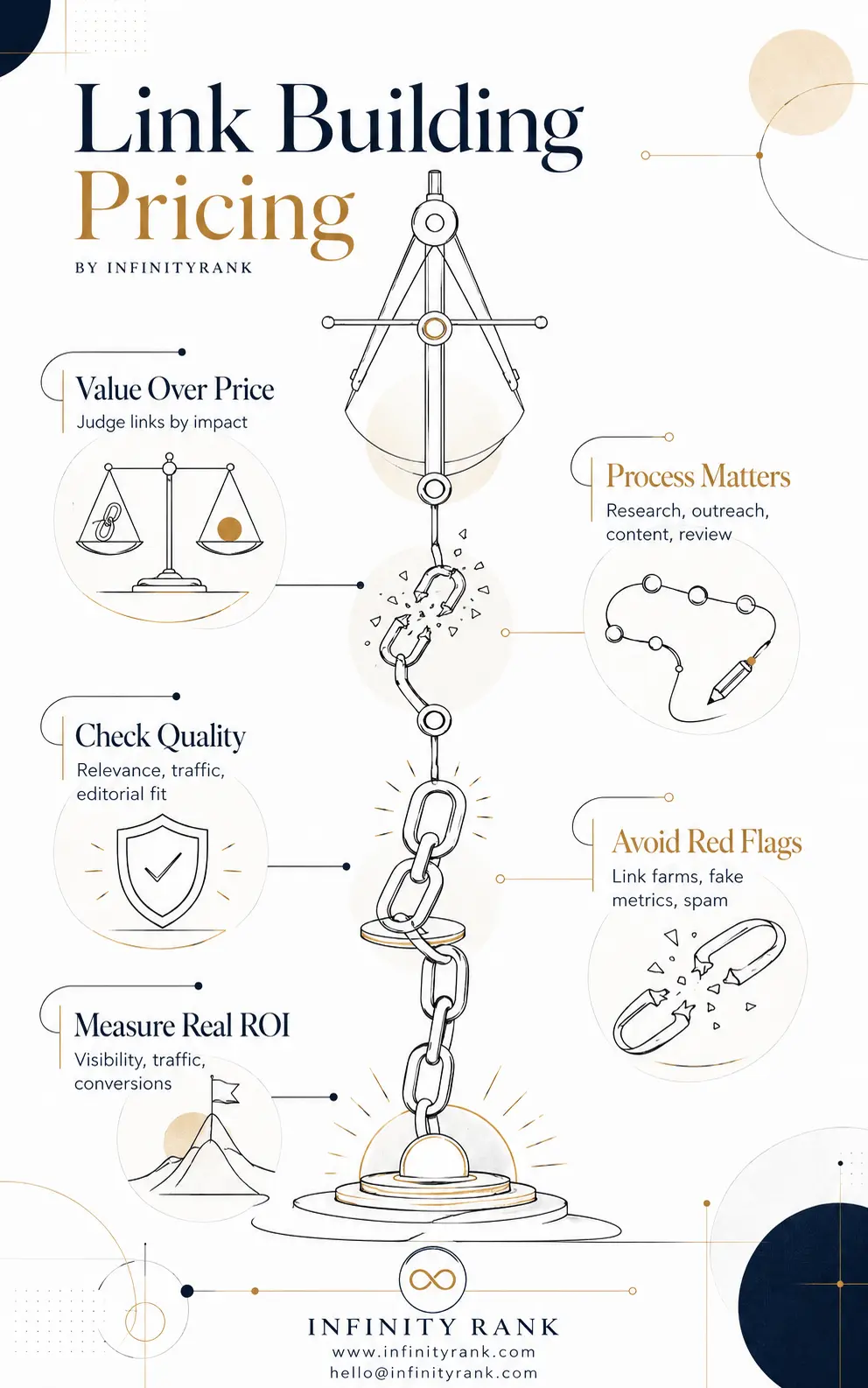
Investing in search authority works best when you carefully check quality signs like topical relevance, real organic traffic, and proper editorial fit while steering completely clear of major red flags like link farms, fake metrics, and automated spam.
Ultimately, the true success of your campaign comes down to tracking tangible returns like search visibility, growing traffic, and actual business conversions. Use these five core pillars as your strategic checklist to spend your marketing budget wisely and build sustainable ranking power.
Cost by Link Building Method
1. Foundational Links
Typical cost: $50–$250 per link
Foundational links include business directories, social profiles, local citations, niche directories, review platforms, and basic brand listings.
These links are useful for brand legitimacy, local SEO, and creating a natural starting point for a new website. They are not usually powerful enough to move competitive rankings on their own.
Use foundational links when:
- your site is new
- your brand has almost no online footprint
- you need local citations
- competitors are listed in the same trusted directories
Avoid paying premium prices for basic listings. If a link can be added by anyone in five minutes, it should not be priced like an editorial backlink.
2. Guest Post Outreach
Typical cost: $150–$750 per link
Guest post link building means publishing an article on another website and including a link back to your site. It can work when the site is relevant, real, and editorially controlled.
It becomes risky when it turns into scaled paid posting across thin websites created mainly to sell links.
A good guest post placement should have:
- topical relevance
- real organic traffic
- visible editorial standards
- indexed pages
- natural outbound links
- a clean backlink profile
- useful content written for readers, not just for the link
Do not judge guest post pricing only by Domain Rating or Domain Authority. DR and DA are third-party metrics. They are useful filters, not proof of quality.
3. Niche Edits / Link Insertions
Typical cost: $100–$600 per link
A niche edit is a link added to an existing page rather than a new guest post. This can be valuable if the page is already indexed, relevant, and receiving traffic.
It is also one of the easiest areas to abuse.
A good niche edit should be placed inside relevant content where the link genuinely helps the reader. A bad niche edit is a random keyword-stuffed link inserted into an old article with no editorial reason.
Before paying for niche edits, check:
- whether the page gets organic traffic
- whether the content is relevant to your page
- how many outbound links are already on the page
- whether the page has been used for obvious link selling
- whether the anchor text looks natural
- whether the site accepts irrelevant links across many industries
If the placement looks forced, skip it.
4. Editorial Outreach Links
Typical cost: $300–$1,000+ per link
Editorial outreach focuses on earning links from relevant websites by pitching useful content, expert input, statistics, original assets, or helpful resources.
This is usually safer than buying a placement outright because the link has an editorial reason to exist.
Examples include:
- resource page outreach
- expert commentary
- broken link building
- unlinked brand mention outreach
- journalist outreach
- original data promotion
- content asset promotion
Ahrefs groups link building into adding links, asking for links, buying links, and earning links. It also notes that links from relevant pages on authoritative websites tend to have the strongest influence.
That is the standard you should use when evaluating cost. A relevant earned link is usually worth more than a cheap link from a random site with inflated metrics.
5. Digital PR Links
Typical cost: $750–$1,500+ per unique link
A digital PR campaign is one of the most expensive forms of link building because you are paying for campaign strategy, data, content, media pitching, and journalist outreach.
A digital PR campaign may involve:
- original research
- surveys
- data analysis
- interactive assets
- expert commentary
- press releases
- journalist pitching
- follow-up outreach
- brand mention tracking
BuzzStream reports that many agencies price digital PR campaigns around $5,000–$10,000, often aiming for several unique linking domains rather than selling links one by one.
Digital PR is best for brands that need authority, trust, and high-quality coverage. It is not the cheapest option, and results are not guaranteed, but the upside is stronger than low-grade link buying.
Monthly Link Building Packages
Many businesses prefer monthly packages because link building is not a one-time task. A retainer gives the agency enough time to research competitors, build prospect lists, pitch sites, create content, and report results.
| Package Type | Typical Monthly Cost | Expected Output | Best For |
| Starter | $1,500–$3,000/month | Foundational links, light outreach, small link targets | Local businesses, new sites |
| Growth | $3,000–$7,500/month | Regular outreach, content placements, link monitoring | SMEs, SaaS, ecommerce |
| Authority | $7,500–$15,000/month | Editorial outreach, digital PR, stronger placements | Competitive niches |
| Enterprise | $15,000+/month | Multi-market campaigns, PR, content assets, reporting | National or high-value brands |
Do not buy a package only because it promises a fixed number of links. A package offering “30 high-quality backlinks for $500” is not a bargain. It is a warning sign.
What Affects Link Building Cost?
Website Quality
The better the linking website, the more the placement usually costs or the harder it is to earn. Strong websites have real audiences, strict editorial standards, and fewer reasons to link to weak content.
Check:
- organic traffic
- topical relevance
- indexation
- backlink profile
- outbound link patterns
- content quality
- author credibility
- spam signals
Niche Competition
Some industries are more expensive because they are harder to pitch and more competitive.
Expensive niches often include:
- finance
- legal
- gambling
- crypto
- health
- insurance
- SaaS
- real estate
- cybersecurity
In these niches, publishers are stricter, competitors spend more, and low-quality links are easier to detect.
Content Requirements
Sometimes the link itself is not the expensive part. The content is.
A strong campaign may require linkable assets such as:
- expert-written articles
- original statistics
- graphics
- surveys
- landing pages
- reports
- tools
- calculators
- case studies
If the content is weak, outreach becomes harder and link quality drops.
Outreach Difficulty
Manual outreach takes time. Good link builders do not blast the same email to thousands of websites. They qualify prospects, personalize pitches, follow up, and negotiate placements.
Higher-quality outreach costs more because it uses human judgment.
Anchor Text Control
Exact-match anchor text is risky when overused. Natural link building uses a mix of branded, partial-match, URL, topical, and generic anchors.
A provider promising aggressive exact-match anchors at scale is not helping you. They are increasing your footprint.
Reporting and Quality Assurance
A proper link building campaign should include reporting.
At minimum, you should receive:
- live URL
- target URL
- anchor text
- link attribute
- placement date
- linking domain
- estimated traffic
- relevance notes
- content title
- link status
- replacement policy
If the report only shows DR and URL, it is too thin.
Cheap vs Expensive Link Building
Cheap link building is not always dangerous. Some low-cost links are simply basic or low-impact. Examples include directory listings, profile links, or citations.
The problem starts when cheap links are sold as powerful ranking assets.
Cheap link building is usually bad when it involves:
- link farms
- private blog networks
- spun content
- irrelevant guest posts
- hacked links
- automated links
- mass directory submissions
- comment spam
- low-quality press release syndication
- sites that exist mainly to sell backlinks
Expensive link building is also not automatically good. A $1,500 link from an irrelevant site with fake traffic is still a bad link.
Price is only useful when combined with quality checks.
Is Paying for Links Against Google’s Guidelines?
This is where many pricing guides are too vague.
Google allows buying and selling links for advertising or sponsorship purposes, but paid or sponsored links should be qualified with rel="nofollow" or rel="sponsored". Google’s spam policies say buying or selling links for ranking purposes can violate its rules when links are not properly qualified.
That means you need to separate three things:
1. Paid advertising links
These should use rel="sponsored" or rel="nofollow".
2. Editorially earned links
These are links given because your content, data, product, or expertise is useful.
These are the risky links. They are bought to manipulate rankings and are not properly disclosed or qualified.
The safest long-term strategy is to invest in content, outreach, digital PR, and editorial link earning rather than relying on paid link schemes.
What Should Be Included in Link Building Pricing?
A serious link building provider should not only sell “links.” They should sell a process.
A proper link building campaign should include:
Strategy
The agency should understand your niche, competitors, target pages, commercial goals, and current backlink profile before building links.
Prospect Research
They should build a list of relevant websites instead of pulling random domains from a vendor database.
Quality Checks
Every prospect should be reviewed for relevance, traffic, spam patterns, outbound links, and content standards.
Outreach
Manual outreach should be personalized enough to earn responses from real editors, site owners, or journalists.
Content
If content is included, it should be original, useful, and written to match the publisher’s audience.
Placement Review
You should be able to review placements or at least receive clear quality criteria before links go live.
Reporting
Reports should include more than DR. They should show link URL, anchor, target page, link attribute, traffic estimate, and notes.
Monitoring
Links can disappear. A good provider should monitor placements and explain its replacement policy.
Red Flags When Buying Link Building Services
Avoid providers that make promises like:
- “Guaranteed rankings”
- “DA 90 links for $50”
- “100 backlinks in 7 days”
- “Permanent homepage links“
- “No need for content”
- “Any niche accepted”
- “Exact-match anchors guaranteed”
- “Private network, impossible to detect”
- “We only sell dofollow links”
- “No reporting, but trust us”
Also be careful with providers that price links only by DR or DA. Third-party authority metrics can be manipulated. A site with high DR but no organic traffic, no real audience, and irrelevant outbound links is not a strong placement.
How Much Should You Budget?
Your budget should depend on your site stage, competition, and revenue potential.
Local Business
A local business may start with $1,000–$3,000 per month for citations, local links, supplier links, niche directories, and light outreach.
Best focus:
- local citations
- chamber of commerce links
- local sponsorships
- supplier/vendor links
- local PR
- review platforms
Ecommerce Site
An ecommerce brand may need $3,000–$10,000 per month, especially if targeting competitive product categories.
Best focus:
- product-led PR
- gift guides
- niche blogs
- review content
- resource pages
- comparison assets
- digital PR campaigns
SaaS Company
A SaaS company may need $5,000–$15,000+ per month, depending on keyword difficulty and market competition.
Best focus:
- data studies
- software comparison pages
- integration pages
- partner links
- expert commentary
- digital PR
- statistics pages
Legal, Finance, Health, or Insurance Site
These niches usually need higher budgets because trust standards and competition are higher.
Best focus:
- expert-led content
- digital PR
- editorial outreach
- original research
- high-authority niche publications
- compliance-safe campaigns
Trying to compete in these markets with cheap backlinks is usually a waste of money.
Per-Link Pricing vs Monthly Retainers
Both pricing models can work, but they serve different needs.
Per-Link Pricing
Per-link pricing is simple. You pay for each live placement.
Pros:
- clear cost per result
- easy to compare vendors
- useful for small campaigns
- predictable output
Cons:
- can encourage quantity over quality
- may ignore strategy
- may push vendors toward easier placements
- often undercounts content and outreach work
Monthly Retainers
A retainer gives the agency room to build a proper campaign.
Pros:
- better strategy
- stronger outreach
- more flexibility
- easier to align with SEO goals
- supports digital PR and content assets
Cons:
- harder to judge by link count alone
- requires trust and reporting
- may take longer to show results
If your only goal is to buy a set number of links, per-link pricing is easier. If your goal is sustainable organic growth, a retainer is usually better.
How Many Links Do You Need Per Month?
There is no universal number.
A small local business may only need a few relevant links per month. A SaaS company targeting competitive keywords may need dozens of strong referring domains over time. A national ecommerce site may need ongoing link acquisition across category pages, content assets, and brand campaigns.
The better question is:
How many quality referring domains do your competitors have, and how fast are they earning new ones?
To answer that, review:
- top-ranking pages
- referring domain count
- link quality
- link velocity
- content depth
- brand authority
- internal linking
- topical relevance
Do not copy competitors blindly. Use their backlink profiles to understand the level of investment required.
How to Evaluate Link Quality Before Paying
Use this checklist before approving a placement.
| Quality Check | Good Sign | Bad Sign |
| Relevance | Site covers your niche or adjacent topic | Site posts about every industry |
| Traffic | Has organic traffic from real keywords | No traffic or sudden fake spikes |
| Content | Useful, edited, written for readers | Thin, AI-spun, generic posts |
| Outbound links | Links are natural and limited | Every article links to commercial sites |
| Indexation | Pages are indexed in Google | Many pages not indexed |
| Link profile | Earns links from real sites | Mostly spam or PBN links |
| Anchor text | Natural and varied | Exact-match anchors everywhere |
| Editorial standards | Clear authors, categories, guidelines | No real editorial control |
If a provider refuses to show sample placements, walk away.
Link Building ROI: How to Think About Value
A backlink is not valuable because it exists. It is valuable if it helps improve organic visibility, authority, referral traffic, rankings, or conversions.
Track link building ROI through:
- ranking improvements
- organic traffic growth
- assisted conversions
- lead quality
- revenue from organic search
- improved indexation
- stronger topical authority
- lower dependency on paid ads
BuzzStream’s 2026 statistics report says many organizations invest in link building to improve organic traffic and rankings, while fewer directly measure sales or leads. That is a problem. Link building should eventually connect to business outcomes, not just link counts.
What Is a Fair Price for a Backlink?
A fair price depends on what is included.
A $200 link may be fair if it is a simple but relevant guest post on a modest niche site.
A $1,500 link may be fair if it comes from a strong editorial campaign, a real publication, and a page that can actually influence visibility.
A $50 link from a spammed-out site is overpriced because it adds no real value and may create risk.
Use this rule:
If the price is low because the process is efficient, fine. If the price is low because quality control is missing, avoid it.
Final Recommendation
Do not buy the cheapest link building package you can find. Buy the best process you can afford.
For most businesses, a sensible starting budget is:
- $1,500–$3,000/month for local or early-stage campaigns
- $3,000–$7,500/month for steady growth campaigns
- $7,500–$15,000+/month for competitive SEO campaigns
- $10,000+ per campaign for serious digital PR
Before hiring any provider, ask what you are paying for: strategy, outreach, content, placement quality, reporting, and risk management.
The right links can strengthen your rankings, brand authority, and organic traffic. The wrong links can waste your budget or create cleanup work later.
If you want link building that supports long-term SEO growth, focus on relevance, editorial quality, and transparency — not just link count.
FAQs About Link Building Pricing
How much does link building cost?
Quality link building usually costs between $150 and $1,500+ per link. Monthly retainers often start around $2,500 to $5,000 and can exceed $10,000 for competitive niches or digital PR campaigns.
Why are high-quality backlinks expensive?
High-quality backlinks are expensive because they require research, outreach, content, editorial approval, and quality control. You are not just paying for a URL. You are paying for the work required to earn or secure a relevant placement.
Are cheap backlinks worth it?
Usually not. Cheap backlinks can be useful for basic citations or foundational listings, but they rarely move competitive rankings. If cheap links come from link farms, spam sites, or irrelevant guest post networks, avoid them.
Is buying backlinks safe?
Buying links for advertising or sponsorship can be acceptable when the links are properly qualified with rel="nofollow" or rel="sponsored". Buying links specifically to pass ranking signals is risky and can violate Google’s spam policies.
Are link building packages worth it?
They can be worth it if the package includes strategy, relevant placements, content quality, transparent reporting, and link monitoring. They are not worth it if they only promise a fixed number of links without quality standards.
How many backlinks do I need per month?
It depends on your competition, current authority, target keywords, and content quality. Instead of chasing a fixed number, compare your backlink profile with the top-ranking pages in your niche.
What should I ask before hiring a link building agency?
Ask for sample placements, quality criteria, reporting format, anchor text policy, replacement policy, content process, compliance approach, and whether links are earned editorially or paid placements.
What is better: guest posting or digital PR?
Guest posting can work for steady niche-relevant links. Digital PR is better for earning stronger editorial coverage, brand mentions, and high-authority links. Digital PR usually costs more but can produce better long-term authority.
Should I pay per link or choose a monthly retainer?
Per-link pricing works for small, controlled campaigns. Monthly retainers are better for long-term growth because they allow for strategy, content planning, outreach, and ongoing optimization.