Link building still matters in 2026, but the standard for a useful backlink is much higher than it used to be.
Google uses links as one signal for understanding pages and discovering content. But building more links for the sake of increasing a backlink count is not a strategy. Relevance, editorial quality, placement, intent, and the page receiving the link all matter.
A successful campaign needs a repeatable process.
This link building checklist covers seven steps: auditing your existing backlinks, setting campaign goals, qualifying prospects, creating linkable assets, running outreach, choosing compliant acquisition tactics, and measuring results.
Link Building Visual Checklist
Executing a successful off-page campaign requires a structured approach starting with a comprehensive audit first to review current links, referring domains, and backlink patterns. Once you understand your existing profile, you can set clear goals designed to strengthen priority pages across your site architecture. To maximize campaign efficiency, always qualify prospects by prioritizing topical relevance before domain authority metrics. This simple guide breaks down five essential steps to organize and scale your outreach efforts effectively.
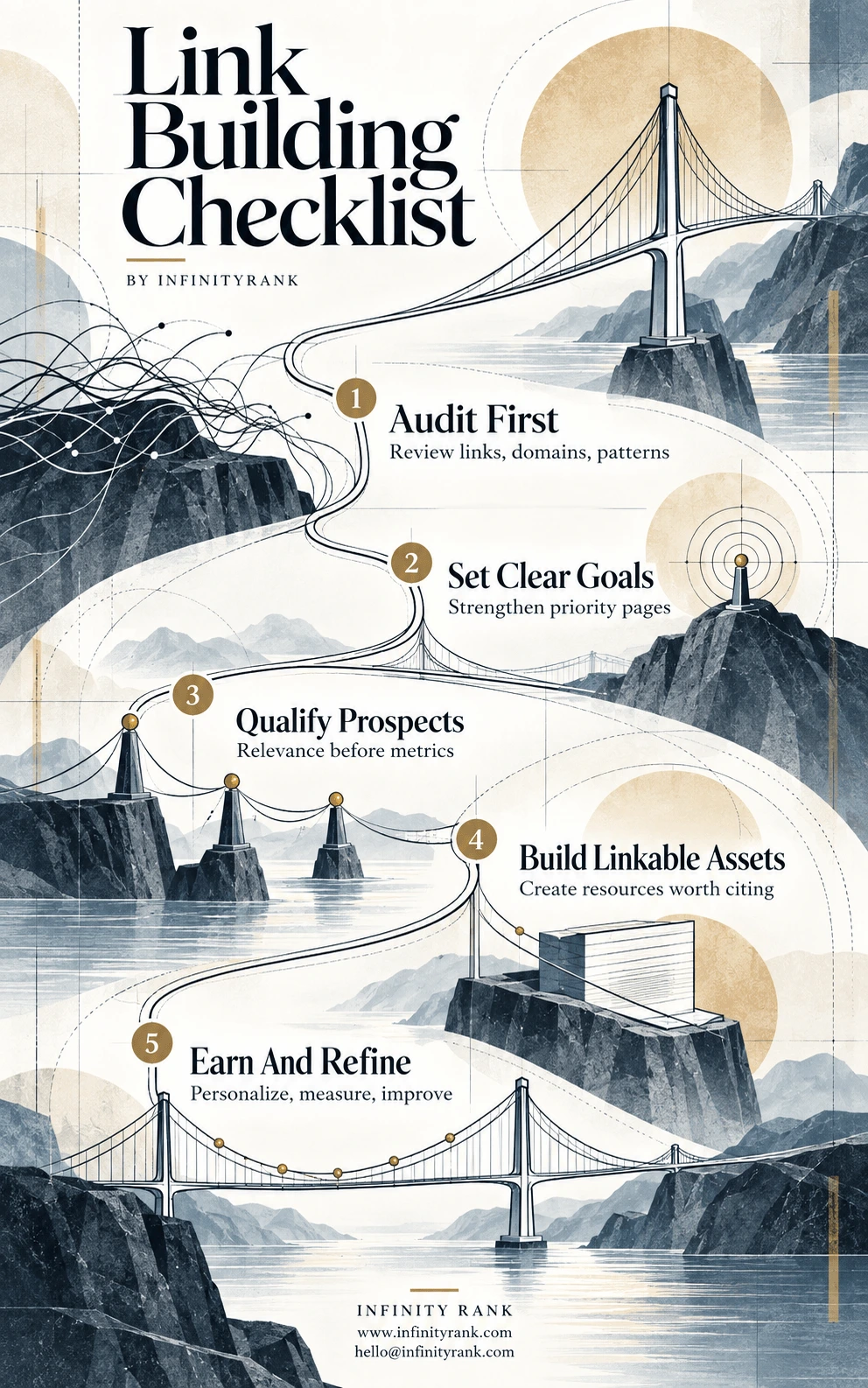
Securing sustainable authority depends on your ability to build linkable assets, creating valuable industry resources that third-party sites naturally want to cite. As you roll out outreach, focus on personalized messaging to earn placements and continuously refine your workflow based on performance data. Use these five core pillars as your strategic framework to execute an error-free link acquisition process that drives long-term search value.
Link Building Checklist: Quick Overview
Before launching a campaign, make sure you can check these boxes:
- Audit your current backlinks and referring domains
- Review suspicious links without automatically disavowing them
- Compare your link profile with relevant search competitors
- Choose the pages you want to strengthen
- Set measurable campaign goals
- Build a qualified prospect list
- Evaluate relevance and editorial quality before third-party metrics
- Create assets worth citing
- Personalize outreach around a specific reason to link
- Use multiple legitimate link acquisition methods
- Avoid paid or manipulative links that pass ranking credit
- Keep anchor text natural and descriptive
- Track new and lost referring domains
- Measure rankings, referral traffic, leads, and conversions
- Review results and refine your campaign
Here is how to work through each step.
Step 1: Audit Your Backlink Profile
Do not start by building more links.
Start by understanding what you already have.
Use Google Search Console together with backlink tools such as Ahrefs, Semrush, Moz, or Majestic to review your existing link profile. Different tools maintain different indexes, so their backlink counts will not always match.
Focus on patterns rather than one headline metric.
Review:
- Total referring domains
- New and lost backlinks
- Pages receiving the most links
- Anchor text
- Topically relevant referring sites
- Repeated sitewide links
- Links from irrelevant or low-quality pages
- Unusual spikes in link acquisition
- Links pointing to deleted or redirected pages
- Competitors attracting links you do not have
Do Not Automatically Disavow “Toxic” Links
A backlink tool may label a domain as toxic, suspicious, or high risk. That does not mean you should immediately add it to a disavow file.
Google says most websites do not need to use its Disavow Links tool.
Disavow should be treated as an advanced measure for situations involving a considerable volume of artificial, spammy, or low-quality links that have caused, or are likely to cause, a manual action.
Random scraper links, strange domains, or links you did not build are not automatically a reason to disavow an entire domain.
Review intent and history first.
If you have previously purchased manipulative links, participated in link schemes, inherited questionable SEO work, or received a manual action, investigate those links carefully. Where possible, attempt removal before considering a disavow file.
For a deeper process, see our guide to disavowing toxic backlinks without hurting SEO.
Compare Referring Domains, Not Just Backlink Totals
One website can link to you hundreds of times through a footer or template.
That does not equal hundreds of independent editorial endorsements.
Track both backlinks and referring domains. Then look at where those links appear and why they exist.
Our guide to referring domains vs. backlinks explains the distinction in more detail.
Step 2: Define Clear Link Building Goals
“Get more backlinks” is not a useful campaign goal.
Decide what the links are supposed to accomplish.
A link building campaign might support:
- Rankings for specific commercial pages
- Visibility for an important topic cluster
- Referral traffic
- Brand discovery
- Digital PR coverage
- New referring domains
- Authority around a specific product or service category
- Links to pages that competitors currently outperform
Start with the page, not the metric.
For example, if an important service page ranks on page two for a valuable query, your goal might be to strengthen that page and its supporting content with relevant editorial links.
Then choose measurable KPIs.
Useful metrics include:
- Relevant referring domains acquired
- Links to priority pages
- Target-page rankings
- Search impressions and clicks
- Referral sessions
- Qualified leads
- Assisted conversions
- Outreach response rate
- Placement rate
- Cost per acquired link or placement
Metrics such as Domain Authority and Domain Rating can help with comparison and prospect screening, but they are third-party metrics. Google does not use Moz DA or Ahrefs DR as ranking factors.
Do not make increasing a third-party score the primary objective of your campaign.
Step 3: Identify High-Value Link Opportunities
Not every website that can link to you is worth pursuing.
A good prospect should make sense for your business, your audience, and the page you want to promote.
Evaluate Topical Relevance First
Ask:
- Does the site regularly publish about your industry?
- Would its readers reasonably care about your resource?
- Does the linking page have a genuine editorial reason to mention you?
- Would the link still make sense if search engines did not exist?
A relevant industry publication with a smaller audience can be more useful than a large unrelated website.
Review Editorial Quality
Open the site and inspect it manually.
Look for:
- Original articles
- Named authors or clear editorial ownership
- Useful content written for humans
- Logical site structure
- Recent activity
- Relevant outbound references
- Real business or publication information
- Pages indexed and accessible in search
Be cautious when a site publishes unrelated topics purely to sell placements.
A website covering accounting software, casinos, home improvement, cryptocurrency, CBD, and pet food with no clear editorial focus is not automatically valuable because an SEO tool gives it a high score.
Check Its Outbound Link Patterns
Review several recent articles.
Warning signs include:
- Repeated exact-match commercial anchors
- Multiple unrelated paid-looking links per article
- Thin guest posts
- Obvious link insertions
- Links to questionable industries
- Large numbers of sponsored posts without proper qualification
- Sitewide keyword-rich footer links
- Pages created mainly to host outbound links
Third-party metrics can support your judgment, but they should not replace it.
Run a Competitor Link Gap Analysis
Review pages currently ranking for the searches you care about.
Look for websites that link to several competitors but not to you.
These may include:
- Industry publications
- Resource pages
- Associations
- Local organizations
- Suppliers
- News websites
- Blogs
- Comparison articles
- Statistics pages
- Partner websites
A competitor link is not automatically one you should copy. Use it as a lead, then qualify the site independently.
Step 4: Create Content Worth Linking To
Outreach becomes much easier when you have something useful to promote.
The strongest linkable assets usually give publishers a reason to cite, reference, demonstrate, or recommend something.
Original Research and First-Party Data
If your business has useful proprietary data, turn it into a clear resource.
Examples include:
- Industry benchmarks
- Survey results
- Customer trend reports
- Market data
- Pricing studies
- Usage statistics
- Year-over-year comparisons
Original data gives journalists, bloggers, and researchers something they cannot cite from hundreds of competing sites.
Definitive Reference Resources
Create the page someone would naturally want to use when explaining a topic.
That might be:
- A detailed guide
- Glossary
- Statistics collection
- Comparison
- Checklist
- Industry database
- Research summary
- Frequently updated reference page
Depth alone is not enough. The resource needs to be accurate, easy to navigate, and genuinely useful.
Free Tools and Templates
Interactive or practical assets can attract links because they solve a problem.
Examples:
- Calculators
- Checklists
- Templates
- Generators
- Worksheets
- Interactive maps
- Data explorers
A useful tool can continue earning links long after the initial outreach campaign ends.
Visual Assets
Charts, diagrams, original illustrations, and infographics can make complicated information easier to cite.
Do not create an infographic merely because “infographics earn links.”
It still needs useful information.
Make the asset easy to understand, provide context around it, and give publishers a clear source to reference.
Update Existing Assets
You may already have pages with backlink potential.
Look for older content that:
- Already earns some links
- Ranks for relevant queries
- Contains outdated statistics
- Has lost traffic
- Covers an evergreen topic
- Can be expanded with original information
Updating an established resource can be more efficient than starting from zero.
Step 5: Run Personalized Outreach
Generic outreach gets ignored.
Personalization does not mean inserting a first name into a template. It means having a credible reason to contact that specific person.
A practical outreach workflow looks like this:
- Find a relevant website or page.
- Identify the right editor, writer, or site owner.
- Read the page you are referencing.
- Identify a specific reason your resource is useful.
- Explain that value in a short email.
- Make one clear request.
- Follow up if appropriate.
- Stop after reasonable follow-ups if there is no response.
Keep the Email Focused
The recipient should quickly understand:
- Who you are
- Why you contacted them
- Which page you are referring to
- What you are offering
- Why it helps their readers
- What you want them to do
Avoid long introductions about your company.
Lead with relevance.
Give Them a Real Reason to Link
Weak pitch:
“Your article is great. We recently published a guide. Can you add our link?”
Better reason:
- Their resource contains an outdated statistic you have replaced with newer data
- Your tool helps readers complete a task discussed in their article
- You found a broken reference and have a suitable replacement
- Your original research adds evidence to a point they already make
- Your expert commentary helps with a story they are researching
Link building works better when the placement improves the publisher’s content.
Step 6: Use Multiple Legitimate Link Building Strategies
There is no requirement to manufacture a perfectly “diverse” backlink profile.
Use different tactics because different opportunities exist, not because you are trying to create an artificial-looking distribution.
Useful approaches include:
Digital PR
Create newsworthy research, data, expert commentary, or stories and pitch them to relevant journalists and publications.
Digital PR can generate both linked and unlinked brand coverage.
Journalist and Expert Requests
Respond to relevant journalist requests and expert-source opportunities where you have genuine expertise.
Do not submit generic AI-generated commentary to every available request. Relevance and credibility matter.
Guest Contributions
Contributing useful content to reputable industry publications can build exposure and relationships.
The problem begins when guest posting becomes a scaled system for placing keyword-rich links purely to manipulate rankings.
Focus on editorial value.
Resource Page Link Building
Find curated pages that already recommend useful resources in your field.
If your page genuinely belongs there, contact the publisher with a specific reason to include it.
Broken Link Building
Find relevant outbound links that no longer work.
If you have a strong replacement resource, alert the publisher and suggest it.
The replacement needs to match the original context. A broken link does not give you a reason to pitch an unrelated commercial page.
Unlinked Brand Mentions
Search for websites that mention your company, product, research, or team without linking to the source.
When a link would genuinely help readers identify the referenced business or resource, ask the publisher to add one.
Listicle Link Building
Find “best tools,” “best companies,” comparison, or recommended-resource articles where your business genuinely qualifies.
Do not treat every listicle as a paid-placement opportunity.
Evaluate editorial quality first.
Local Citations
For local businesses, legitimate directories, chambers of commerce, associations, and location-specific resources can help establish accurate business information and generate relevant referral visibility.
Do not submit your business to hundreds of low-quality directories simply to increase link counts.
Partnerships and Industry Relationships
Suppliers, associations, software partners, events, charities, universities, and professional organizations can create legitimate linking opportunities when there is a real relationship.
The link should document that relationship, not exist solely for SEO.
Keep Link Building Within Google’s Spam Policies
Google defines link spam as links created primarily to manipulate search rankings.
Examples include:
- Buying or selling links for ranking purposes
- Excessive link exchanges
- Automated link creation
- Low-quality directory links
- Keyword-rich links placed through distributed widgets
- Widely distributed footer or template links
- Optimized links in low-quality guest posts
- Forum comments created for keyword-rich backlinks
Paid sponsorships and advertising links can exist legitimately. When appropriate, they should be qualified with rel="sponsored" or rel="nofollow" rather than being sold as ranking-credit links.
The question to ask is simple:
Would this link still have a legitimate reason to exist if Google did not count links as a search signal?
If the answer is no, review the tactic carefully.
Use Natural Anchor Text
Anchor text is the clickable text of a link.
Google recommends anchor text that is descriptive, reasonably concise, and relevant to both the page containing the link and the destination.
Good anchor text helps users understand what they will find after clicking.
Do not try to force the same exact-match keyword into every backlink.
A natural profile may include:
- Brand names
- Page titles
- URLs
- Product names
- Descriptive phrases
- Partial-match phrases
- Contextual anchors
Anchor text should fit naturally into the sentence.
The goal is clarity, not keyword manipulation.
Step 7: Track, Measure, and Refine
Link building is not complete when a backlink goes live.
Measure what happens afterward.
Track Link Acquisition
Monitor:
- New backlinks
- New referring domains
- Lost links
- Target URLs receiving links
- Anchor text
- Link placement
- Follow, nofollow, and sponsored attributes
- Relevant referral traffic
Do not panic if different backlink tools report different totals. Each tool crawls the web differently.
Look at trends and individual placements.
Measure Search Performance
Track priority pages in Google Search Console and your SEO platform.
Watch:
- Impressions
- Clicks
- Average position
- Target keyword visibility
- Organic landing-page traffic
- Conversions
A new backlink does not guarantee an immediate ranking increase.
Search performance depends on many factors, including content quality, relevance, competition, technical accessibility, internal linking, query intent, and other ranking signals.
There is no universal “wait 60 days and rankings will increase” rule.
Measure Business Value
A link can be useful even when it does not produce an obvious ranking jump.
It may generate:
- Referral traffic
- Leads
- Sales
- Newsletter signups
- Brand searches
- Journalist relationships
- Future partnership opportunities
Measure the outcome that matches the original campaign goal.
Review Tactics Regularly
Every month or campaign cycle, ask:
- Which tactics generated qualified opportunities?
- Which publishers drove referral traffic?
- Which assets attracted links most easily?
- Which outreach angles earned replies?
- Which target pages improved?
- Which tactics consumed time without producing value?
- Which acquired links were actually relevant?
Then allocate more effort to what works.
Final Link Building Checklist
Before considering a campaign complete, confirm:
Backlink Audit
- Existing backlinks reviewed
- Referring domains reviewed
- Suspicious links investigated
- Disavow used only when genuinely necessary
- Competitor link gaps analyzed
Strategy
- Priority pages selected
- Search intent reviewed
- Campaign goals defined
- KPIs selected
Prospecting
- Topical relevance checked
- Editorial quality reviewed
- Site activity reviewed
- Outbound-link patterns checked
- Third-party metrics used only as supporting data
Content
- Linkable asset provides unique value
- Facts and data are current
- Original sources are cited
- Page is easy to navigate
- Visual assets include descriptive alt text
Outreach
- Correct contact identified
- Email references something specific
- Value proposition is clear
- Request is relevant
- Follow-up process is defined
Compliance
- Links are not purchased for ranking manipulation
- Commercial links are properly qualified where necessary
- Anchor text is natural
- No scaled exact-match guest-post links
- No automated or bulk spam tactics
Measurement
- New and lost links tracked
- Referring domains tracked
- Priority-page performance tracked
- Referral traffic reviewed
- Leads and conversions measured where possible
- Campaign reviewed and refined
Final Thoughts
Good link building in 2026 is not about hitting an arbitrary backlink target.
It is about earning relevant references from websites that have a legitimate reason to mention your business, content, research, or expertise.
Start with a clear goal. Build something worth citing. Choose prospects carefully. Conduct useful outreach. Stay within Google’s spam policies. Then measure whether the campaign contributes to search visibility, referral traffic, brand exposure, or business results.
That process is slower than buying hundreds of links from a package.
It is also far more defensible.
FAQs
How Many Backlinks Do I Need to Rank?
There is no universal backlink target.
Review the pages currently ranking for the queries you want to compete for, but do not judge competition by backlink count alone. Content quality, search intent, topical relevance, internal linking, site authority, technical SEO, and other signals also affect rankings.
A smaller number of relevant editorial links can be more useful than a large volume of weak links.
Are All Backlinks Good for SEO?
No.
Links created primarily to manipulate search rankings can violate Google’s spam policies. That includes certain paid links, automated links, excessive exchanges, keyword-rich guest-post links, low-quality directory placements, and other manipulative tactics.
At the same time, an unattractive or unknown backlink does not automatically mean your site is at risk.
Review the context before taking action.
Should I Disavow Spammy Backlinks?
Usually not as routine maintenance.
Google says most websites do not need the Disavow Links tool. It should generally be considered when a site has a considerable number of artificial or low-quality links that have caused, or are likely to cause, a manual action.
Do not disavow domains solely because an SEO tool assigns them a high toxicity score.
How Long Does Link Building Take to Work?
There is no fixed timeline.
A new link needs to be discovered and processed, and any SEO impact exists alongside many other ranking signals.
Results vary based on competition, the quality and relevance of the links, the strength of the target page, your existing site authority, technical SEO, content, and search intent.
Evaluate link building over meaningful campaign periods rather than expecting a guaranteed ranking increase within a specific number of weeks.
What Makes a High-Quality Backlink?
A strong backlink usually has a legitimate editorial reason to exist.
Look for:
- Topical relevance
- Useful surrounding content
- A trustworthy publishing site
- Natural anchor text
- Appropriate placement
- A page accessible to search engines
- Genuine reader value
DA, DR, traffic estimates, and similar third-party metrics can help with screening, but no single metric proves that a backlink is high quality.
Can I Build Links Without Creating Content?
Yes.
Local citations, partnerships, business associations, unlinked brand mentions, expert commentary, product listings, and other legitimate activities can generate links without publishing a new article first.
However, strong linkable assets give you more reasons to contact publishers and can make larger campaigns easier to scale.
Is Buying Backlinks Against Google’s Guidelines?
Buying a link is not inherently forbidden when the link exists for advertising or sponsorship and is properly qualified.
The problem is buying links that pass ranking credit primarily to manipulate search results.
Google recommends qualifying paid links with attributes such as rel="sponsored" or rel="nofollow" where appropriate.