Link building is difficult because you cannot control the final decision. You can create a strong asset, find a relevant website, and write a good pitch, but the publisher still decides whether to link to you.
That uncertainty creates several recurring problems:
- Finding websites worth contacting
- Getting replies without sending spam
- Producing content people have a reason to reference
- Controlling campaign costs
- Staying within Google’s policies
- Scaling without lowering standards
- Measuring whether the work produces business value
These challenges do not disappear when you use better tools or send more emails. They require a structured process.
Google still uses link-analysis systems, including PageRank, to understand how pages relate to one another and which pages may be useful for a query. However, links are only part of a much larger ranking system. A higher backlink count does not automatically produce better rankings.
This guide explains the seven biggest link building challenges, why they occur, and how to solve them without relying on shortcuts.
Off-Page SEO: Dead End Ahead?
Most backlink campaigns fail not from a lack of effort, but because teams burn through their budgets repeating outdated outreach tactics that modern webmasters instantly ignore. Between aggressive spam filters, inflated metric networks, and the high cost of content creation, scaling your digital authority feels like an uphill battle. To break out of this cycle, you must treat off-page optimization as an exact, data-driven supply chain rather than a numbers game.
This campaign survival checklist addresses five operational bottlenecks you must solve to protect your budgets and secure high-performance placements.
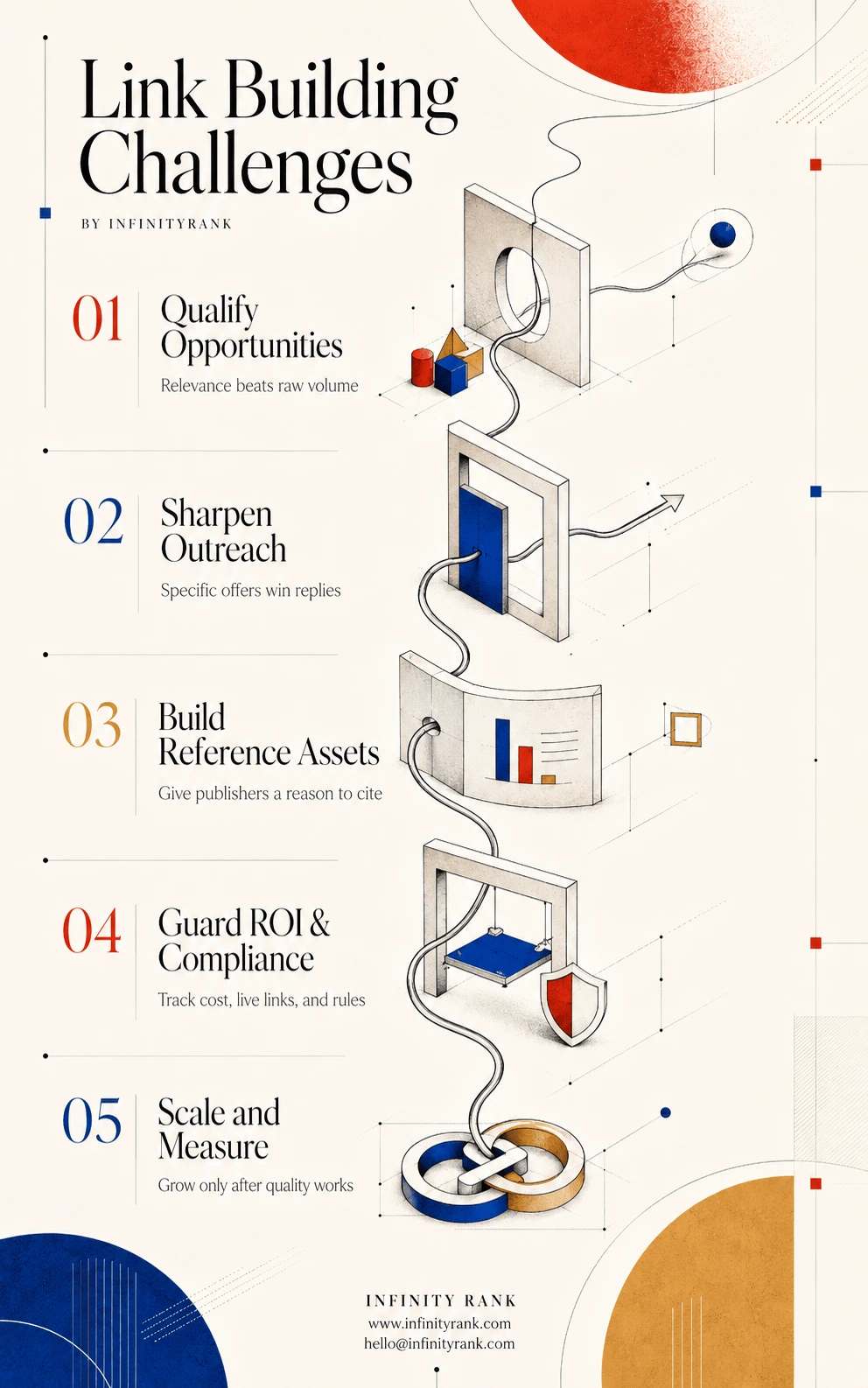
Overcoming modern outreach roadblocks requires a strict shift from mass volume to iron-clad quality filters. By tightening your prospecting criteria, polishing your pitch angles, and verifying long-term compliance, you keep your backlink profile resilient against algorithm updates. Use the link-building-challenges-infographic as your strategic map to identify and fix leaks in your current campaign pipeline.
Link Building Challenges at a Glance
| Challenge | Common Warning Sign | Practical Solution | Primary Metric |
| Finding quality opportunities | Large prospect list with little relevance | Use strict page- and site-level qualification | Qualified prospect rate |
| Getting outreach replies | High email volume with few positive responses | Segment prospects and make the pitch specific | Positive reply rate |
| Creating link-worthy content | Useful article receives no citations | Build assets around reference value | Referring domains earned |
| Controlling cost and ROI | Spending rises without measurable outcomes | Track the full campaign cost and resulting value | Cost per qualified link |
| Following Google’s rules | Paid or optimized links pass ranking credit | Avoid manipulative placements and qualify paid links | Compliance rate |
| Scaling the campaign | Link volume rises while quality falls | Standardize research, review, and quality control | Approval and rejection rates |
| Measuring success | Reporting focuses only on link counts or DR | Combine link, traffic, conversion, and visibility data | Business impact |
1. Finding High-Quality Link Opportunities
Finding websites is easy. Finding websites that are relevant, credible, editorially sound, and likely to link is much harder.
A prospect should not qualify simply because it has a high Domain Rating, Domain Authority, or estimated traffic figure. Third-party metrics can help you sort a large list, but they do not determine whether a specific link belongs on a specific page.
Why prospecting goes wrong
Most weak prospect lists suffer from one or more problems:
- The website covers an unrelated subject.
- The domain looks authoritative, but the proposed page has no connection to the target content.
- The website publishes low-quality contributed articles across unrelated industries.
- Existing outbound links appear unnatural or commercially inserted.
- The site has no meaningful editorial standards.
- The proposed link would add nothing for the reader.
- Multiple prospects belong to the same publisher or website network.
Google’s spam policies specifically identify practices such as low-quality directory links, automated link creation, optimized links in paid guest posts, and widely distributed footer links as forms of link spam.
How to qualify a prospect
Review both the domain and the exact page where the link could appear.
Use the following criteria:
| Criterion | What to Check |
| Topical relevance | Does the website regularly cover your industry or a closely related subject? |
| Page-level relevance | Would your page genuinely support the article being pitched? |
| Editorial quality | Are articles accurate, useful, well-written, and properly reviewed? |
| Real audience | Does the website appear to serve readers rather than exist mainly to publish links? |
| Outbound-link pattern | Are links placed naturally, or are articles filled with commercial anchors? |
| Placement quality | Would the link appear inside useful editorial content rather than a footer, author box, or unrelated paragraph? |
| Business relevance | Could the publication send qualified visitors, influence buyers, or improve brand visibility? |
Create a simple score from zero to two for each criterion:
- 0: Poor or absent
- 1: Acceptable but not strong
- 2: Strong
Do not contact every website that passes a minimum authority metric. Prioritize prospects with the strongest combination of topical relevance, editorial quality, and page-level fit.
Where to find better prospects
Useful prospect sources include:
- Websites linking to competing resources
- Unlinked mentions of your brand or products
- Resource pages in your industry
- Broken pages that previously earned relevant links
- Trade publications and professional associations
- Suppliers, partners, and customers with legitimate reasons to mention you
- Journalists and writers covering your subject
- Existing articles that lack a useful source, example, tool, or explanation
Competitor backlinks can reveal patterns, but copying a competitor’s profile is not a strategy. Some of their links may be outdated, irrelevant, paid, or impossible to reproduce.
The goal is not to collect every available prospect. It is to identify websites where your contribution would make editorial sense.
2. Getting Responses to Outreach Emails
Low response rates are usually blamed on subject lines. The larger problem is often the offer.
Publishers ignore emails that:
- Could have been sent to any website
- Ask for a link without providing a reason
- Praise the recipient without mentioning anything specific
- Hide the request behind several paragraphs of filler
- Promote content that is no better than what the publisher already has
- Demand a particular anchor or placement
- Arrive after several irrelevant pitches from the same sender
Sending more weak emails does not fix weak outreach. It increases the amount of spam associated with your brand.
Segment prospects before writing
Group prospects according to why they might care about your content.
For example:
- Writers who referenced an outdated statistic
- Pages linking to a broken resource
- Journalists covering a recent industry development
- Resource pages missing a relevant tool
- Existing brand mentions without a link
- Articles that would benefit from an expert quote or visual
Each segment needs a different pitch. A broken-link email should not use the same template as a digital PR pitch.
Write around the publisher’s benefit
A useful outreach email answers four questions quickly:
- Why are you contacting this person?
- What specific page or section are you referring to?
- What are you offering?
- Why would it improve the content for their readers?
A basic outreach email could look like this:
Subject: Source for your guide to [topic]
Hi [Name],
I was reading your article on [specific subject], particularly the section about [specific point].
We recently published [brief description of the asset], which includes [unique data, tool, example, or explanation]. It may be useful for readers who want to [specific benefit].
Here it is: [URL]
No problem if it is not a fit.
Thanks,
[Name]
The email is short, but brevity alone is not enough. The page, offer, and recipient must still match.
Improve outreach systematically
Track outreach as a funnel:
- Emails delivered
- Replies received
- Positive replies
- Content requests
- Links secured
- Links still live after publication
If emails are delivered but ignored, review the pitch and offer. If people reply positively but links rarely go live, review your follow-up process, content quality, and the amount of work required from the publisher.
Use templates to maintain structure, not to remove judgment. Personalization should explain why the pitch belongs on that specific page. Mentioning the recipient’s first name is not meaningful personalization.
3. Producing Content That Deserves Links
A page can be well-written and still give publishers no reason to cite it.
Most standard blog posts are designed to rank, educate, or convert. A linkable asset has an additional purpose: it gives another writer something useful to reference.
Why ordinary articles fail to attract links
Common problems include:
- The page repeats information already available elsewhere.
- The content makes claims without original evidence.
- The topic has little citation demand.
- The article is broad but not definitive.
- The useful information is buried under unnecessary text.
- The visual assets are difficult to reuse or understand.
- The article was created before anyone checked whether publishers would care.
Length is not the deciding factor. A short calculator, dataset, template, map, or chart can earn more references than a long article that adds nothing new.
Formats that can attract links
Strong linkable assets often include:
- Original surveys or proprietary data
- Industry benchmarks
- Free calculators or interactive tools
- Templates and downloadable resources
- Definitive guides to complicated subjects
- Maps, charts, and visual explainers
- Expert roundups with genuine analysis
- Regularly updated statistics pages
- Public databases or directories
- Case studies with transparent methods and results
The format should follow the information. Do not create an infographic because infographics are supposed to attract links. Create one when a visual format makes the subject easier to understand or reference.
Validate the idea before production
Before investing in a major asset:
- Search for existing resources on the subject.
- Review which competing pages have already earned links.
- Identify what those pages lack.
- List the publications and writers that could realistically reference the asset.
- Confirm that the subject appears in articles, reports, or recurring industry discussions.
- Decide how the asset will remain accurate after publication.
A linkable asset without a realistic outreach audience is simply expensive content.
Refresh and reclaim existing assets
You may not need to start from zero.
Audit existing pages for:
- Outdated figures
- Broken external references
- Missing examples
- Weak visual presentation
- Lost backlinks
- Unlinked brand mentions
- Pages that already attract links but have not been updated
Improving a proven asset is often more efficient than publishing another generic guide. A content refresh can also give you a legitimate reason to contact people who previously mentioned or linked to the resource.
4. Balancing Cost and ROI
Link building is not free, even when no money changes hands for the link itself.
A campaign can require:
- Strategist and researcher time
- Prospecting and outreach tools
- Content writers and editors
- Designers or developers
- Original research
- Email infrastructure
- Quality assurance
- Reporting and monitoring
- Legitimate advertising or sponsorship costs
Ignoring internal labour makes the campaign appear cheaper than it is.
Calculate the real campaign cost
Start with:
Total campaign cost = labour + tools + content production + design or development + outreach infrastructure + approved sponsorship costs
Then calculate:
Cost per qualified referring domain = total campaign cost ÷ new qualified referring domains acquired
Do not count every new link equally. Exclude or flag links that are:
- Irrelevant
- Duplicated across the same publisher network
- Removed shortly after publication
- Placed on low-quality pages
- Qualified as sponsored when the campaign goal was editorial coverage
- Pointing to the wrong URL
- Using inappropriate anchor text
Measure more than rankings
Rankings can change for many reasons. A campaign should also be evaluated through:
- Referral sessions
- Referral leads or sales
- Assisted conversions
- Organic clicks and impressions to target pages
- New ranking keywords
- Brand mentions
- Coverage in relevant publications
- Links earned by the asset after direct outreach ends
- Sales conversations influenced by published coverage
A relevant industry link that generates qualified enquiries may be more valuable than a higher-metric link that sends no readers and has no connection to the business.
Control costs before scaling
Set clear approval rules before outreach begins.
For example:
- Which industries are relevant?
- Which countries or audiences matter?
- Which page types are acceptable?
- Which placement types are prohibited?
- Are sponsored placements allowed?
- What is the maximum production cost for a contributed article?
- Which target pages support business goals?
- Who approves exceptions?
Without these rules, teams waste time negotiating opportunities that should have been rejected during prospecting.
5. Navigating Google’s Link Spam Policies
The safest link building strategy is not one that attempts to look natural. It is one based on legitimate editorial value rather than ranking manipulation.
Google defines link spam as creating links to or from a site primarily to manipulate search rankings. Its examples include buying followed links, excessive link exchanges, automated link creation, low-quality directory links, and advertorial or guest-post links that pass ranking credit through optimized anchor text.
Paid placements require proper qualification
Advertising and sponsorships are normal online business activities. The problem begins when payment is exchanged for a link intended to influence rankings.
Google recommends marking advertisements and paid placements with rel="sponsored". The nofollow attribute remains acceptable, although Google states that sponsored is preferred for paid links.
Do not pay for an editorial placement on the condition that it includes a followed link.
Guest contributions are not automatically safe
A guest article can be legitimate when it:
- Serves the publication’s existing audience
- Meets the publisher’s editorial standards
- Is written for communication or expertise rather than anchor placement
- Avoids forced keyword-rich links
- Discloses commercial relationships where necessary
- Is not duplicated across numerous websites
The label “guest post” does not determine whether a placement is acceptable. The purpose, quality, editorial independence, link treatment, and scale matter.
Avoid manipulated anchor text
Do not require publishers to use an exact-match commercial keyword.
A natural link may use:
- Your brand name
- The article title
- A product or tool name
- A descriptive phrase
- A plain URL
- Wording chosen by the publisher
The anchor should fit the sentence and help the reader understand the destination. Trying to engineer a predetermined anchor distribution creates unnecessary risk and often makes the content worse.
Use a compliance checklist
Before approving a tactic, ask:
- Is the link being created mainly to manipulate rankings?
- Has money, a product, or another benefit been exchanged?
- If so, will the link use the correct rel attribute?
- Does the article have value without the backlink?
- Is the website relevant to the subject?
- Would the placement still make sense if search engines ignored the link?
- Is the anchor written for readers rather than a target keyword?
- Is the same tactic being repeated at an unnatural scale?
If the opportunity only works when the commercial relationship is hidden, reject it.
6. Scaling Without Losing Quality
Scaling link building means increasing the number of qualified opportunities your team can process. It does not mean sending the same pitch to a larger list.
Quality usually falls when teams increase outreach before documenting how prospects, content, and placements should be reviewed.
Build the process before increasing volume
A scalable campaign needs defined stages:
- Strategy: Select target pages, audiences, and asset types.
- Research: Find relevant publications and pages.
- Qualification: Review editorial quality and placement fit.
- Outreach: Contact the appropriate person with a specific offer.
- Content: Produce any required contribution or supporting asset.
- Approval: Review the page, anchor, destination, and disclosures.
- Verification: Confirm that the placement is live and correct.
- Monitoring: Check whether the link remains live and useful.
- Reporting: Connect campaign activity to traffic, visibility, and business outcomes.
Each stage needs an owner and a definition of completion.
Automate administration, not judgment
Automation can help with:
- Removing duplicate domains
- Finding contact details
- Checking whether an email was delivered
- Scheduling follow-ups
- Recording campaign status
- Detecting removed links
- Producing recurring reports
Human review is still needed for:
- Relevance
- Editorial quality
- Pitch angle
- Reputation risk
- Anchor context
- Content approval
- Policy compliance
A tool can tell you that a domain has traffic. It cannot decide whether the proposed link makes sense for the article’s readers.
Maintain a central campaign record
For each prospect, record:
- Domain and exact page
- Publisher or network ownership
- Contact details
- Reason for outreach
- Target asset
- Target URL
- Outreach status
- Response status
- Content requirements
- Expected placement type
- Anchor text
relattribute- Publication date
- Last verification date
- Rejection reason
Rejection data matters. If the team repeatedly rejects prospects for the same reason, improve the research criteria rather than continuing to clean weak lists later.
Scale only after quality is stable
Before increasing outreach volume, confirm that:
- Most prospects meet the qualification standard.
- Emails are reaching the intended recipients.
- Positive replies come from suitable publications.
- Produced content passes editorial review.
- Live placements match the approved terms.
- Compliance checks are documented.
- Reporting distinguishes strong links from weak ones.
More activity is not progress when the rejection rate rises with it.
7. Measuring Link Building Success Correctly
A campaign report should not begin and end with the number of links acquired.
Link counts, Domain Rating, and Domain Authority can help describe activity, but they do not prove that the campaign improved visibility, traffic, leads, or revenue.
Track leading indicators
Leading indicators show whether the process is functioning:
- Qualified prospects added
- Percentage of researched sites approved
- Emails delivered
- Reply rate
- Positive reply rate
- Pitch-to-publication rate
- Average time from first contact to publication
- Content acceptance rate
- Cost per qualified referring domain
These metrics help identify operational problems before waiting for changes in organic performance.
Review the quality of each placement
Record:
- Topical relevance
- Page-level relevance
- Editorial context
- Link destination
- Anchor text
- Placement position
relattribute- Publication status
- Whether the page remains accessible and indexable
- Whether the link sends relevant referral traffic
Avoid reducing quality to one third-party score.
Track business and search outcomes
Outcome metrics can include:
- Referral traffic
- Referral conversions
- Assisted conversions
- Organic clicks and impressions
- Visibility of target pages
- New keyword coverage
- Qualified leads
- Revenue influenced by referral or organic visits
- Branded searches and mentions
- Additional links earned without direct outreach
Do not claim that one link caused a ranking increase unless you have evidence that separates it from content changes, technical work, algorithm updates, competitor activity, and other factors.
Google uses multiple ranking systems. Link analysis remains part of those systems, but it does not operate in isolation.
A 30-Day Plan for Fixing a Weak Link Building Campaign
Week 1: Audit the current campaign
- Review existing backlinks and active prospects.
- Remove irrelevant, duplicated, or low-quality opportunities.
- Check paid placements for appropriate link qualification.
- Identify target pages tied to clear business goals.
- Document current costs and results.
Week 2: Improve the offer
- Select or create one asset with genuine reference value.
- Refresh outdated pages that already attract links.
- Define the audience and publications likely to care.
- Prepare different outreach angles for each prospect segment.
- Create qualification and compliance checklists.
Week 3: Run a controlled outreach campaign
- Start with the strongest prospects.
- Send specific, benefit-led emails.
- Record replies and objections.
- Avoid increasing volume until the message and offer show promise.
- Review every content or placement request before agreeing.
Week 4: Measure and refine
- Compare approved prospects, replies, positive replies, and live links.
- Review which segments produced the strongest opportunities.
- Calculate the campaign cost to date.
- Check live placements for context, anchor text, destination, and
relattributes. - Update the process before beginning the next campaign.
The purpose of the first month is not to generate the largest possible number of links. It is to create a repeatable process that can grow without sacrificing relevance or compliance.
Final Thoughts
The biggest link building problems are rarely caused by a lack of tools. They come from weak targeting, generic outreach, undifferentiated content, poor cost control, risky tactics, premature scaling, and shallow reporting.
A better campaign follows a clear sequence:
- Choose a target page with a legitimate business purpose.
- Create something another publisher has a reason to reference.
- Find websites and pages where that reference would help readers.
- Contact the right person with a specific offer.
- Review every opportunity for relevance, quality, and compliance.
- Track the complete cost and outcome of the work.
- Scale only after the process produces consistently acceptable placements.
Link building cannot guarantee rankings. Done properly, however, it can support discovery, referral traffic, editorial visibility, brand authority, and broader organic growth.
Frequently Asked Questions
Is link building still important for SEO in 2026?
Links remain part of Google’s core ranking systems. Google states that its systems use links to understand what pages are about and which pages may be helpful for a query. However, links are only one part of the ranking process, and acquiring more links does not compensate for weak content, poor relevance, or technical problems.
How many backlinks do I need to rank?
There is no universal number.
The requirement depends on the query, competing pages, search intent, content quality, website strength, internal linking, and the relevance and context of existing backlinks. Review competing pages for context, but do not treat their backlink count as a quota.
Are guest posts still useful for link building?
They can be useful when the contribution serves the host publication’s audience and follows its editorial standards.
Guest posting becomes risky when articles are created mainly to insert keyword-rich links, when placements are bought without proper qualification, or when low-value content is distributed across many unrelated websites.
Should I buy backlinks?
Do not buy followed links for ranking purposes.
Google lists buying or selling links that pass ranking credit as link spam. Legitimate advertising and sponsorship links should be qualified, preferably with rel="sponsored".
How long does link building take to produce results?
There is no fixed timeline.
Research, outreach, editorial review, content production, and publication can all take time. Search performance may also change gradually and can be affected by many factors beyond backlinks. Measure campaign progress through both process metrics and longer-term business outcomes.
Should I hire a link building agency?
An agency may help when you lack the internal staff, systems, publisher relationships, or production capacity to run the campaign properly.
Before hiring one, ask:
- How are prospects found and reviewed?
- Are websites manually checked?
- Are placements paid, earned, or sponsored?
- How are paid links qualified?
- Who writes and reviews contributed content?
- Can you reject a prospect before publication?
- How are anchors and target URLs selected?
- How are removed links handled?
- Which metrics appear in reports?
- Does the agency guarantee rankings or a fixed number of “authority” links?
Reject providers that cannot explain where links come from, rely on undisclosed website networks, guarantee rankings, or sell followed links primarily for ranking manipulation.