A topical map for SEO is not just a brainstorm of blog ideas. It is a structured plan that connects your main topic, supporting subtopics, keyword clusters, search intent, and internal links.
Done properly, it helps you answer three important questions:
- What content should we create?
- What existing content should we improve?
- How should these pages connect to build stronger topical coverage?
Search engines do not need you to use the phrase “topical map.” But they do need to crawl, understand, and evaluate your content clearly. Google’s own SEO guidance focuses on making content easier to crawl, index, and understand, while also creating helpful, reliable, people-first content. A topical map helps with that when it is built around real user needs instead of random keyword stuffing.
Below are five tools that can help you build a practical topical map for SEO. Some are built specifically for SEO. Others are better for visual planning or team collaboration. The right choice depends on whether you need keyword data, SERP clustering, competitor research, content briefs, or a simple visual structure.
What Is a Topical Map in SEO?
A topical map is a content planning framework that organizes a website around a main subject and its related subtopics.
For example, if your main topic is dental SEO, your topical map may include:
- Dental SEO cost
- Local SEO for dentists
- Google Business Profile optimization for dental clinics
- Dental backlinks
- Dental SEO audits
- SEO for orthodontists
- Dental content marketing
- Dental website optimization
Each subtopic can become a dedicated page or article. The goal is not to publish dozens of disconnected posts. The goal is to build a logical content structure where each page supports the wider topic.
A strong topical map usually includes:
- A main pillar topic
- Supporting topic clusters
- Keyword groups
- Search intent labels
- Existing page URLs
- New content opportunities
- Internal linking notes
- Priority scores based on business value and SEO difficulty
That last part matters. A topical map is not useful if it only looks nice. It needs to tell your team what to publish, what to update, and what to link together.
Topical Map vs. Topic Cluster vs. Keyword Map
These terms often get mixed together. They are related, but not identical.
| Term | What It Means | Best Use |
| Topical map | A full strategic layout of a topic, subtopics, pages, keyword groups, and internal links | Planning SEO content at site or category level |
| Topic cluster | A group of related pages connected to a main pillar page | Building authority around one specific subject |
| Keyword map | A document that assigns target keywords to specific URLs | Preventing keyword overlap and cannibalization |
| Content map | A broader content plan that may include SEO, funnel stage, audience, and format | Planning content across marketing channels |
A topical map is the bigger strategy. Topic clusters and keyword maps are parts of that strategy.
What to Look for in a Topical Map Tool
Not every tool on this list does the same job. Before choosing one, decide what problem you are trying to solve.
A good topical mapping workflow should help you:
- Find related topics and subtopics
- Group keywords by search intent
- Spot content gaps
- Compare competitor coverage
- Avoid keyword cannibalization
- Plan pillar pages and supporting pages
- Build internal links between related pages
- Prioritize pages based on SEO value and business relevance
Here is the blunt version: if a tool only gives you a pretty diagram, it is not enough for SEO. Visual mapping is useful, but you still need search data, SERP analysis, or competitor insight somewhere in the process.
Quick Comparison: Best Topical Map Tools for SEO
| Tool | Best For | SEO-Specific? | Main Strength | Main Weakness |
| Thruuu | SERP-based keyword clustering and briefs | Yes | Groups keywords based on Google SERP similarity | Less useful if you only need visual planning |
| MindMeister | Visual mapping and team planning | No | Clean mind maps and collaboration | No native SEO data |
| Ahrefs | Competitor research and content gaps | Yes | Strong keyword and competitor data | Not a dedicated visual topical map builder |
| Semrush | Keyword strategy and topic planning | Yes | Structured keyword plans, topic ideas, and clustering | Can feel bloated if you only need mapping |
| Surfer SEO | Content optimization and topical coverage | Yes | Topical Map, Content Editor, and Content Audit workflow | Best value when you also need content optimization |
The Step-by-Step Topical Mapping Process
If you want to rank today, you can’t just target random keywords. You need to show Google you’re an expert on the whole topic. This might sound complicated, but it’s actually pretty simple when you have a plan. We’ve broken the process down into five easy steps to help you organize your content and build real authority in your niche.
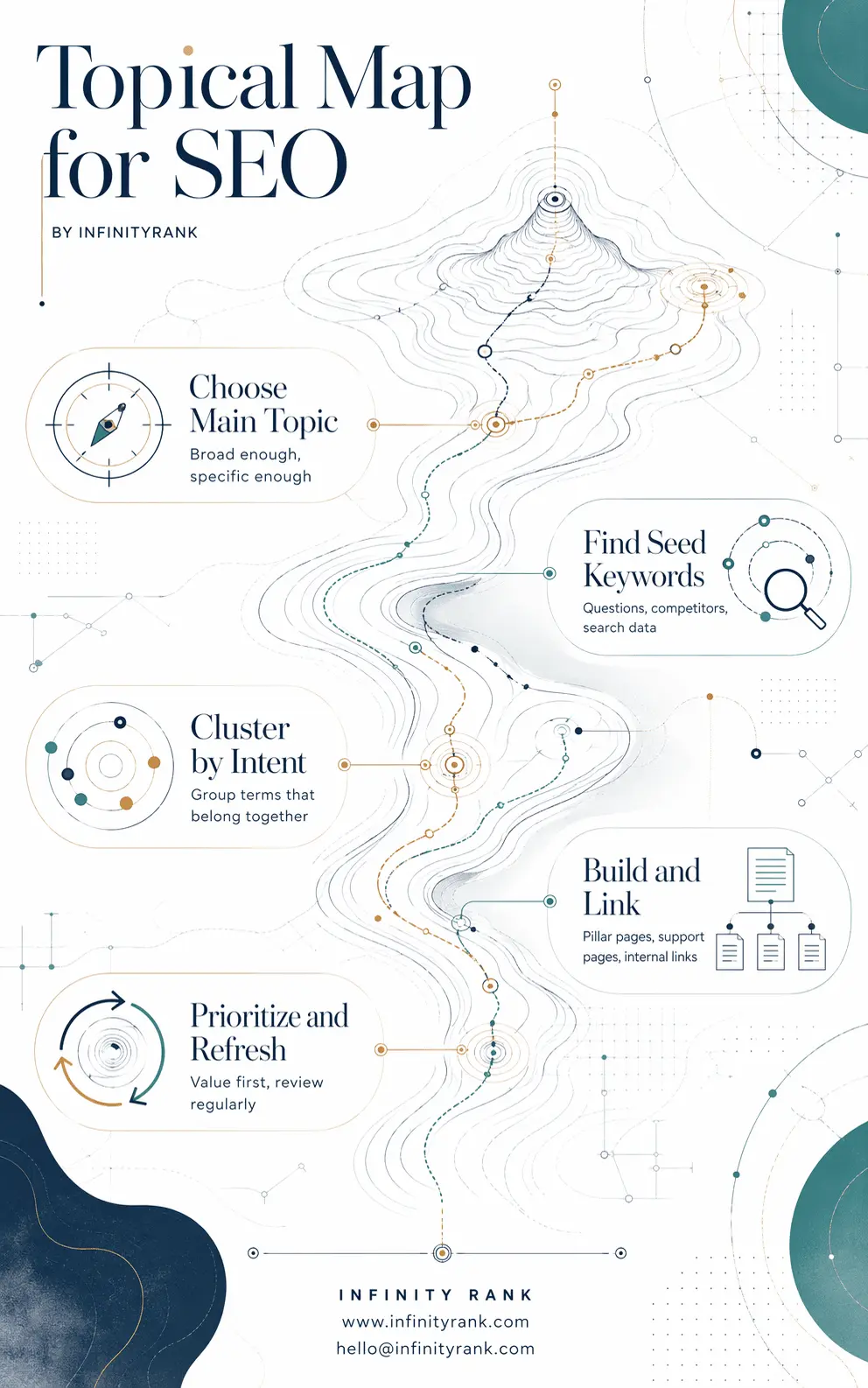
Tools can help you find the data, but a solid map is what actually guides your growth. Following this workflow ensures you aren’t just publishing random posts, but building a library of content that works together. Ready to dive into the details of step one? Let’s get started.
1. Thruuu: SERP-Based Keyword Clustering
Thruuu is one of the better options if you want your topical map to be based on actual search results, not just keyword similarity.
Its keyword clustering tool groups keywords based on SERP similarity. In plain English, that means it looks at whether Google ranks similar URLs for different keywords. If the same URLs rank for two keywords, those keywords may belong in the same cluster. This helps reduce keyword cannibalization and makes the map more aligned with real search intent.

Why Thruuu Works Well for Topical Mapping
Thruuu is useful because topical maps often fail when keywords are grouped only by wording. Two keywords can look similar but have different intent. Two other keywords can look different but belong on the same page because Google treats them similarly.
Thruuu helps with:
- SERP-based keyword clustering
- Topic cluster planning
- Content brief creation
- Competitor SERP analysis
- Search intent grouping
- Content gap discovery
Thruuu’s topical map workflow can also move from topic discovery into content briefs, including SERP insights, competitor analysis, and outline suggestions.
Best Use Case
Use Thruuu when you already have a list of keywords and need to turn them into clean topic clusters.
For example, if you upload keywords around “dental SEO,” Thruuu can help you identify which terms should be grouped into one page and which deserve separate pages.
Weakness
Thruuu is not the best tool for visual brainstorming. It is stronger for SEO clustering and SERP-based planning. If your team needs a visual board, pair it with MindMeister, FigJam, Miro, or a spreadsheet.
2. MindMeister: Visual Content Mapping
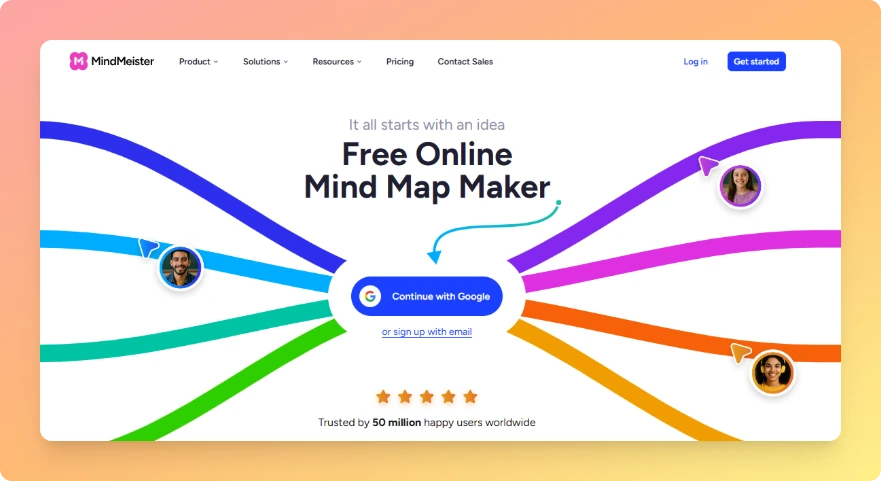
MindMeister is not an SEO tool. That is not a flaw. It is a mind-mapping tool, and it works well when you need to visualize a topical structure before assigning keywords, URLs, and internal links.
MindMeister lets users create visual maps, organize topics with drag-and-drop, add links and notes, and collaborate with team members. Its collaboration features also support real-time sharing and discussion.
Why MindMeister Works Well for Topical Mapping
SEO teams often jump straight into keyword spreadsheets. That can work, but it gets messy fast.
MindMeister is useful when you want to see the full content architecture at a glance.
You can map:
- Main pillar topics
- Supporting subtopics
- Blog categories
- Commercial pages
- Informational pages
- Internal linking paths
- Content ownership by team member
Best Use Case
Use MindMeister when your topical map needs to be reviewed by writers, editors, founders, clients, or non-SEO stakeholders.
It is especially useful during early planning because visual maps make gaps obvious. If one cluster has 20 ideas and another has only two, you can spot the imbalance quickly.
Weakness
MindMeister does not give you keyword volume, ranking difficulty, SERP overlap, competitor gaps, or content optimization data. Do not use it as your only SEO research tool.
The best workflow is simple:
- Research and cluster keywords in Thruuu, Ahrefs, Semrush, or Surfer.
- Move the final structure into MindMeister for visual planning.
- Add URLs, ownership, priority, and internal linking notes.
3. Ahrefs: Competitor and Content Gap Research
Ahrefs is not a traditional topical map tool, but it is one of the strongest tools for building the research behind a topical map.
Its Content Explorer helps users explore top-performing pages, spot content gaps, and plan content using performance data. Its Content Gap tool helps identify keywords competitors rank for that your site does not.

Why Ahrefs Works Well for Topical Mapping
A topical map should not be built from guesses. Ahrefs helps you understand what already works in your niche.
You can use Ahrefs to:
- Analyze competitor pages
- Find ranking keywords
- Discover content gaps
- Identify parent topics
- Review backlink potential
- Find proven content formats
- Check whether a subtopic deserves its own page
Ahrefs is especially useful when you are mapping a competitive niche and need to know what top-ranking sites already cover.
Best Use Case
Use Ahrefs when you want to reverse-engineer competitor topical coverage.
For example, if you are building a topical map for “SaaS link building,” you can plug competitor domains into Ahrefs and identify which related keywords and pages they rank for. Then you can decide what to create, what to ignore, and what needs a stronger angle.
Weakness
Ahrefs gives you excellent data, but it does not automatically turn that data into a clean visual topical map. You will still need to organize findings in a spreadsheet, mind map, or project management tool.
4. Semrush: Structured Keyword Strategy
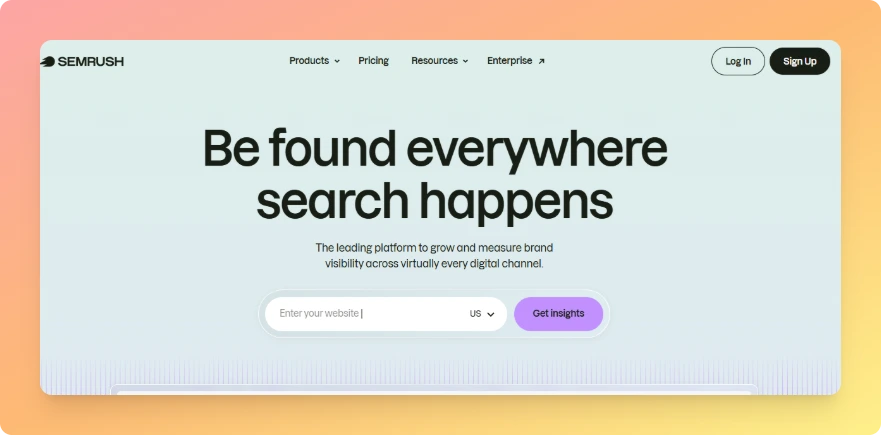
Semrush is useful for topical mapping because it combines topic research, keyword discovery, competitive analysis, and keyword strategy planning.
Its Keyword Strategy Builder is built to organize keyword research into structured content plans. Semrush says the tool can analyze keyword lists and group them into topics, pillar pages, and subpages.
Semrush also has Topic Research, which generates content ideas around a topic and helps users explore related angles.
Why Semrush Works Well for Topical Mapping
Semrush is strong when you want one platform for several parts of the topical mapping process.
You can use it to:
- Generate topic ideas
- Build keyword clusters
- Plan pillar and subpage structures
- Analyze competitors
- Review keyword difficulty
- Find content gaps
- Prioritize topics by search potential
Best Use Case
Use Semrush if you want a structured SEO workflow and already rely on Semrush for keyword research, competitor tracking, or content planning.
It works well for agencies because it can support multiple clients, multiple projects, and repeatable keyword mapping processes.
Weakness
Semrush can be overkill if you only need a simple topical map for one website. It has a lot of features, and that can slow down users who only need topic clustering and a clean content plan.
5. Surfer SEO: Topical Maps & Content Optimization
Surfer SEO is useful because it connects topical planning with content optimization.
Surfer’s Topical Map feature identifies new content opportunities by analyzing topical coverage and finding nearby topic clusters based on semantic similarity. It is designed to show current topical coverage and reveal content gaps.
Surfer also connects this planning process with tools like Content Editor and Content Audit. Its Content Audit identifies pages that may need re-optimization based on performance and Content Score.
Why Surfer SEO Works Well for Topical Mapping
Surfer is useful when you do not just want to plan content. You also want to optimize the pages you already have.
You can use Surfer to:
- Identify missing topic clusters
- Review topical coverage
- Plan new content
- Optimize existing articles
- Refresh pages with declining performance
- Improve semantic keyword coverage
- Audit content that may need updates
Best Use Case
Use Surfer when your website already has content and you need to decide what to update, what to consolidate, and what to create next.
For example, if your site has 40 SEO articles but no clear topical structure, Surfer can help identify gaps and point you toward related clusters.
Weakness
Surfer is strongest when content optimization is part of the workflow. If you only need raw keyword research or competitor gap data, Ahrefs or Semrush may be better starting points.
Sample Topical Map for SEO
Here is a simplified topical map example for a website targeting dental SEO.
Pillar Page
Dental SEO: Complete Guide for Dental Practices
Cluster 1: Local Dental SEO
- Local SEO for dentists
- Google Business Profile for dentists
- Dental clinic local citations
- How dentists can rank in Google Maps
- Local SEO mistakes dental practices make
Cluster 2: Dental SEO Costs
- How much does dental SEO cost?
- Dental SEO pricing models
- Is dental SEO worth it for small practices?
- Dental SEO vs paid ads
- Monthly SEO budget for dentists
Cluster 3: Dental Website Optimization
- Dental website SEO checklist
- Best dental website structure for SEO
- Dental service page optimization
- Dental website speed and technical SEO
- Dental schema markup
Cluster 4: Dental Content Marketing
- Blog ideas for dental clinics
- Dental content marketing strategy
- How to write dental service pages
- Patient education content for dentists
- Dental FAQ pages for SEO
Cluster 5: Dental Link Building
- Dental backlinks
- Local dental link building
- Dental directory links
- Digital PR for dental practices
- Guest posting for dental websites
Internal Linking Notes
The pillar page should link to each cluster page. Each cluster page should link back to the pillar page. Related subtopic pages should also link to each other where relevant.
For example:
- “Dental SEO cost” should link to “Dental SEO vs paid ads.”
- “Google Business Profile for dentists” should link to “How dentists can rank in Google Maps.”
- “Dental backlinks” should link to “Local dental link building.”
That is how a topical map becomes more than a content list. It becomes a connected SEO structure.
How to Create a Topical Map for SEO
You do not need to overcomplicate this. Use this workflow.
1. Choose the Main Topic
Start with a topic broad enough to support multiple pages but specific enough to match your business.
Bad example:
Marketing
Too broad.
Better example:
SEO for SaaS companies
Specific enough to map.
2. Find Seed Keywords
Use Ahrefs, Semrush, Google Search Console, Google autocomplete, competitor pages, and customer questions.
Look for:
- Commercial keywords
- Informational keywords
- Comparison keywords
- Problem-based searches
- Local or industry-specific variations
3. Cluster Keywords by Intent
Do not create one page per keyword. That creates thin content and keyword cannibalization.
Group keywords that share the same search intent. SERP-based clustering tools like Thruuu are useful here because they look at what Google is actually ranking, not just whether keywords contain similar words.
4. Choose Pillar Pages and Supporting Pages
Your pillar page should cover the broad topic. Supporting pages should go deeper into specific subtopics.
Example:
- Pillar: SaaS SEO
- Supporting page: SaaS technical SEO
- Supporting page: SaaS link building
- Supporting page: SaaS content strategy
- Supporting page: SaaS SEO metrics
5. Map Existing URLs
Before creating new content, check what you already have.
Mark each topic as:
- Existing page
- Needs update
- Needs consolidation
- New page needed
- Not worth targeting
This step prevents duplicate content and wasted writing.
6. Add Internal Links
Every topical map should include internal linking instructions.
At minimum, decide:
- Which pages link to the pillar page
- Which cluster pages link to each other
- Which commercial pages need supporting informational links
- Which older posts need new links added
Internal links help users move through related content and help search engines understand page relationships.
7. Prioritize the Map
Not every topic deserves immediate attention.
Prioritize based on:
- Business value
- Search demand
- Ranking difficulty
- Existing authority
- Content gaps
- Conversion potential
A low-volume keyword with high buyer intent may be more valuable than a high-volume informational keyword that never converts.
8. Review and Update the Map Regularly
A topical map is not a one-time document. Search behavior changes. Competitors publish new content. Your own pages rise, drop, or become outdated.
Review your map every quarter or after major ranking changes.
Look for:
- Declining pages
- Missing subtopics
- New competitor content
- Cannibalized keywords
- Pages that should be merged
- Pages that need stronger internal links
Which Topical Map Tool Should You Choose?
Use this simple breakdown.
Choose Thruuu if you want SERP-based keyword clustering and content briefs.
Choose MindMeister if you need a clean visual map for planning and collaboration.
Choose Ahrefs if competitor research and content gaps are your main priority.
Choose Semrush if you want a broader keyword strategy workflow with topic planning.
Choose Surfer SEO if you want topical mapping connected to content optimization and audits.
For most SEO teams, the best setup is not one tool. It is a workflow:
- Use Ahrefs or Semrush for keyword and competitor research.
- Use Thruuu for SERP-based clustering.
- Use MindMeister or a spreadsheet to visualize the map.
- Use Surfer SEO to optimize and refresh content.
That gives you data, structure, and execution.
Common Topical Mapping Mistakes
Mistake 1: Building Around Keywords Instead of Topics
A topical map should not be a dump of keywords. Keywords are inputs. Topics are the structure.
Mistake 2: Creating Too Many Thin Pages
If five keywords share the same search intent, they probably belong on one strong page, not five weak ones.
Mistake 3: Ignoring Internal Links
A topical map without internal linking notes is incomplete. The connection between pages is part of the strategy.
Mistake 4: Copying Competitors Blindly
Competitor research is useful, but your map should reflect your own business goals. Do not create pages just because a competitor has them.
Mistake 5: Never Updating the Map
A topical map gets stale. Review it regularly and adjust based on rankings, conversions, and new search behavior.
Final Thoughts
A topical map for SEO helps you build content with structure instead of guessing what to publish next.
The best tools depend on your workflow. Thruuu is strong for SERP-based clustering. MindMeister is useful for visual planning. Ahrefs is excellent for competitor and content gap research. Semrush works well for keyword strategy and topic planning. Surfer SEO connects topical coverage with content optimization.
The tool matters, but the process matters more.
Start with a clear main topic. Group keywords by intent. Build pillar and supporting pages. Add internal links. Prioritize based on business value. Then keep the map updated as your rankings and market change.
That is how a topical map becomes an actual SEO asset instead of another forgotten spreadsheet.
Frequently Asked Questions
What is a topical map in SEO?
A topical map is a structured plan that organizes your website content around a main topic and its related subtopics. It helps you plan pillar pages, supporting articles, keyword clusters, and internal links.
Are topical maps a Google ranking factor?
No. Google does not list “topical maps” as a direct ranking factor. But topical maps can help you create clearer, more complete, and better-organized content, which supports crawlability, relevance, and user usefulness.
What is the best tool for creating a topical map?
Thruuu is strong for SERP-based keyword clustering. Ahrefs and Semrush are better for keyword and competitor research. Surfer SEO is useful for topical coverage and content optimization. MindMeister is best for visual planning.
Can I create a topical map without paid SEO tools?
Yes. You can start with Google Search Console, Google autocomplete, competitor pages, and a spreadsheet. Paid tools make the process faster and more data-driven, but they are not required for a basic map.
How often should I update my topical map?
Review your topical map every quarter or whenever you see major ranking changes, new competitors, or shifts in search demand. Update pages, merge overlapping content, and add internal links as needed.