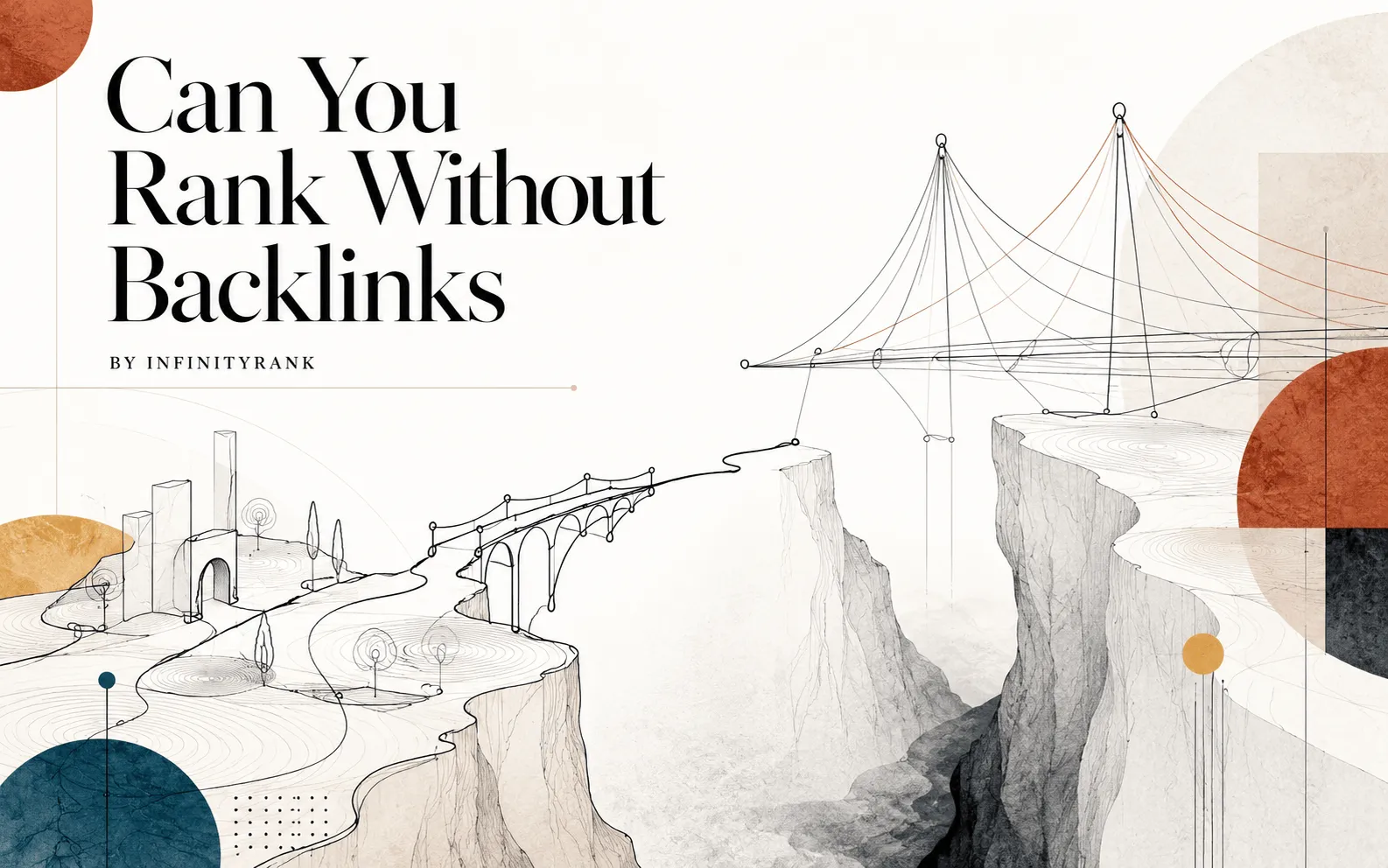
Yes, you can rank without backlinks—but the answer depends on what “without backlinks” means.
A page with no external links pointing directly to it can rank, especially when the keyword is specific, competition is weak, and the website already has some authority. A completely new website with no backlinks anywhere faces a much harder task.
Backlinks are not the only factor Google considers. Relevance, search intent, content quality, internal links, technical accessibility, page experience, location, and other signals can all affect visibility. However, Google still uses link analysis systems, including PageRank, as part of its core ranking systems.
The realistic answer is therefore:
You can rank without direct backlinks for some searches. Ranking a backlink-free domain for competitive commercial keywords is far less likely.
Rank Without Links: Pure Myth?
Believing you can easily conquer search engines without a single backlink is a dangerous trap that leaves high-quality pages buried on page ten. While capturing low-competition, long-tail keywords using pure content optimization is entirely possible, entering difficult or trust-sensitive niches without external authority signals is a losing battle.
Understanding exactly when content alone is enough and when you must build structural trust saves months of wasted optimization effort. This SERP analysis framework breaks down five critical filters to evaluate your realistic ranking potential before targeting a new keyword.

Striking the perfect balance between organic content optimization and active link building keeps your SEO strategy highly efficient. By carefully auditing keyword intent, evaluating domain signals, and identifying competitive gaps, you know exactly when a piece of content can win on its own merits. Use the visual roadmap above as your tactical operational filter to determine if a page is ready to compete or needs structural backing.
What Does “Without Backlinks” Actually Mean?
SEO discussions often use “zero backlinks” without defining it. That creates misleading comparisons.
There are four different situations to consider.
No Backlinks to the Ranking Page
The specific page has no known external backlinks, but other pages on the website do.
This is the most common form of a “backlink-free” ranking. The page may still benefit from:
- Links pointing to the homepage or other pages
- Strong internal links
- Existing brand recognition
- Site-wide quality and trust signals
- An established crawling and indexing history
A page with no direct backlinks is not necessarily operating without link-supported authority.
No Backlinks to the Entire Domain
No external websites link to any page on the domain.
This is a much stricter test. A new domain must rely almost entirely on relevance, content, internal structure, technical accessibility, and weak competition.
Such a site may rank for highly specific or poorly served queries, but its ability to compete for valuable keywords will usually be limited.
No Active Link Building
The website owner is not deliberately acquiring links, but the domain may already have backlinks earned through publicity, partnerships, citations, previous content, or natural mentions.
This is not the same as having zero backlinks.
No Backlinks Detected by an SEO Tool
Ahrefs, Semrush, Moz, and similar platforms do not have access to Google’s complete link index. A tool showing zero backlinks does not prove that Google has found none.
Always describe these cases as having no backlinks detected by the selected tool, rather than claiming conclusively that no links exist.
Do You Need Backlinks to Rank?
Not for every keyword.
Google says its ranking systems primarily evaluate pages while also using site-wide signals and classifiers. It also confirms that systems analysing how pages link to each other remain part of its core ranking infrastructure.
That means links matter, but their importance varies by query.
For a narrow informational search with weak results, a highly relevant page may rank without direct backlinks. For a competitive query such as “best credit cards,” “enterprise SEO services,” or “buy running shoes,” content relevance alone is unlikely to overcome established brands with stronger authority, recognition, and link profiles.
Backlinks are therefore not an on-or-off requirement. They become more important as competition, commercial value, and the strength of the existing results increase.
When Can You Rank Without Backlinks?
Backlink-free rankings are most realistic in the following situations.
1. The Keyword Is Specific and Weakly Contested
Long-tail keywords often have clearer intent and fewer pages targeting them precisely.
Examples include:
- How to stop a garden hose connector from leaking
- Best pizza oven for a narrow apartment balcony
- How to calibrate a CNC lathe for titanium
- Why a particular software error appears after an update
A lower search volume does not automatically make a keyword easy. However, specific queries often present more opportunities because fewer competitors have created a genuinely useful page for that exact problem.
The deciding factor is the current search results—not an arbitrary search-volume range or difficulty score.
2. The Page Is Published on an Established Website
A new page can rank without direct backlinks when it sits on a domain that already has:
- Relevant backlinks to other pages
- Strong internal linking
- Closely related supporting content
- Consistent organic visibility
- An established crawling and indexing history
In this situation, the page is not truly disconnected from link authority. Internal links can help search engines discover it, understand its context, and distribute importance from other parts of the site.
3. Existing Results Poorly Match Search Intent
A backlink-free page can outperform stronger domains when the current results do not properly answer the query.
Common weaknesses include:
- Product pages ranking for an informational search
- Broad articles ranking for a specific problem
- Outdated instructions
- Thin pages with no examples
- Pages targeting a slightly different audience
- Forum discussions with incomplete answers
- Content written for another country, platform, or product version
Do not try to make your article longer merely because competing articles are long. Create a page that matches the intent more precisely and solves the problem with less friction.
4. The Topic Is New or Underserved
New products, regulations, technologies, software errors, and industry changes may initially have limited competition.
A relevant page published quickly can rank before competitors build stronger resources. Those rankings may become harder to retain as established websites enter the search results, so early visibility should not be mistaken for permanent authority.
5. The Search Depends Heavily on First-Hand Information
Original information can compensate for limited page-level authority when it provides something competitors do not have.
Examples include:
- Original research
- Proprietary data
- First-hand testing
- Detailed product comparisons
- Real screenshots
- Local observations
- Templates or calculators
- Expert commentary
- Documented processes
Repeating information already available on ten established websites gives Google little reason to rank a weaker page above them.
6. The Query Is Local
Local businesses can appear in Google’s map results without building a large traditional backlink profile. However, it is wrong to say links do not matter in local SEO.
Google says local results are mainly based on relevance, distance, and prominence. Its explanation of prominence specifically mentions both website links and reviews.
A business should therefore focus on:
- A complete and accurate Google Business Profile
- The correct primary and secondary categories
- Accurate opening hours and contact information
- Genuine customer reviews
- Useful photos and business details
- Relevant local landing pages
- Consistent business information
- Local mentions and links where appropriate
Proximity cannot be optimised away. A strong profile may still rank differently for two searchers in different locations.
When Is Ranking Without Backlinks Unlikely?
Some searches are poor candidates for a no-link strategy.
Competitive Commercial Keywords
Keywords connected directly to valuable products, services, leads, loans, insurance, software, legal services, or high-ticket purchases usually attract serious SEO investment.
The ranking pages may have strong content, recognised brands, established domains, and substantial backlink profiles. Matching their word count or title format will not remove that authority gap.
Broad National or International Keywords
Broad queries usually have more possible interpretations and more competitors.
A specialist article may rank for “how to repair a cracked ceramic pizza stone,” while “best pizza ovens” is likely to require far more authority, testing, brand credibility, and promotion.
A New Domain in a Competitive Market
A brand-new site has no established history, limited internal authority, and few external signals.
It may gain impressions for narrow searches, but expecting rapid rankings for competitive terms without promotion or links is unrealistic.
Trust-Sensitive Subjects
Medical, financial, legal, safety, and other high-consequence subjects demand particularly reliable information.
A technically optimised article from an unknown source should not be expected to outrank established institutions simply because it targets a less competitive phrase.
Search Results Dominated by Major Brands
When nearly every result comes from a well-known company, government body, university, major publisher, or dominant marketplace, the barrier is not just the number of backlinks.
You may also be competing against:
- Brand recognition
- First-party data
- Extensive supporting content
- Experienced editorial teams
- Strong user demand
- Long-established websites
A narrow angle may be more realistic than attacking the broad keyword directly.
How to Tell Whether a Keyword Can Rank Without Backlinks
Do not make the decision from a keyword-difficulty score alone. Review the actual search results.
1. Confirm the Search Intent
Search the keyword and identify what Google currently displays:
- Guides
- Product pages
- Category pages
- Videos
- Forums
- Local results
- Tools
- Comparison articles
- News stories
A blog post is unlikely to rank if the search results clearly favour product categories or local businesses.
2. Analyse the Ranking Pages, Not Just Their Domains
Check whether the individual ranking URLs have external backlinks.
A page with zero direct backlinks may look like an easy competitor, but it could belong to a highly authoritative domain and receive strong internal links.
Review both:
- Page-level backlink strength
- Domain-wide backlink strength
Do not treat them as interchangeable.
3. Review Internal Support
Look at how the competing page is connected to the rest of its website.
Ask:
- Is it linked from the main navigation?
- Is it part of a relevant content hub?
- Do other high-performing pages link to it?
- Is the site strongly associated with the topic?
- Does the page sit several clicks away from the homepage?
A well-supported page may rank with few direct backlinks because the site’s internal structure is doing much of the work.
4. Identify Weaknesses You Can Actually Fix
Useful opportunities include:
- Missing steps
- Unanswered subquestions
- Outdated screenshots
- Poor readability
- Weak examples
- No original evidence
- Incorrect regional information
- A mismatch between the title and the content
- Excessive filler before the answer
Do not assume you can win merely by publishing more words.
5. Compare Business Value and Competition
A keyword with only 50 searches per month can still be highly competitive when each visitor is commercially valuable.
Likewise, a higher-volume informational query may be easier when few businesses have a reason to target it.
Search volume is not a reliable substitute for SERP analysis.
6. Check More Than One Backlink Index
SEO tools discover different links at different times. Use their numbers as comparative estimates, not absolute truth.
Record:
- The tool used
- The date checked
- Page-level referring domains
- Domain-level referring domains
- Whether the links appear relevant and crawlable
This makes any “zero-backlink” claim more credible.
7. Test and Measure
Publish the page, connect it through relevant internal links, and monitor it in Google Search Console.
Track:
- Indexing status
- Impressions
- Average position
- Queries triggering the page
- Click-through rate
- Changes after content revisions
If the page gains impressions but stalls below the leading results, the problem may be authority, content quality, intent alignment, or a combination of them.
How to Improve Your Chances Without Direct Backlinks
You cannot manufacture authority through on-page optimisation alone, but you can remove weaknesses that prevent a page from competing.
Match the Search Intent Precisely
Answer the main question early.
Then provide the level of detail the query requires. A simple definition may need a concise answer, while a technical troubleshooting query may require ordered steps, screenshots, warnings, and alternative fixes.
Avoid forcing unrelated sections into the page solely to make it look comprehensive.
Add Information Competitors Do Not Have
Useful differentiation may include:
- Original examples
- First-hand experience
- Screenshots
- Data
- Expert input
- Clear comparison criteria
- Downloadable resources
- A decision framework
- Common failure points
- Limitations and exceptions
A rewrite of existing search results is not a competitive advantage.
Strengthen On-Page SEO
Use the primary topic naturally in:
- The title tag
- H1
- Opening section
- Relevant subheadings
- URL
- Image context
- Meta description
Also make sure the page has:
- One clear H1
- Descriptive headings
- A logical content order
- Useful image alt text
- A relevant title and description
- A clean canonical URL
- No indexing restrictions
- No broken page elements
Exact-match repetition is not a substitute for clarity.
Use Internal Links Strategically
Link to the page from relevant articles and important hub pages.
Internal links should:
- Use descriptive anchor text
- Come from contextually related pages
- Help users continue their research
- Avoid repetitive, forced anchors
- Point toward genuinely important content
Google’s SEO Starter Guide recommends creating a logical site structure and linking to important pages from other relevant pages. It also notes that crawlers discover much of the web automatically through links.
Build a Supporting Topic Structure
A single isolated article may not answer every related need.
Create supporting pages when they serve a clear purpose, then connect them logically. For example, a central link-building guide could connect to focused pages about:
Do not create dozens of near-duplicate articles merely to appear authoritative. Each page should answer a distinct search need.
Improve Technical Accessibility
A strong article cannot rank if search engines cannot reliably access or index it.
Check:
- Robots directives
- Canonical tags
- HTTP status codes
- XML sitemap inclusion
- Mobile rendering
- JavaScript dependencies
- Duplicate versions
- Orphaned pages
- Redirect chains
- Server reliability
Submitting a sitemap or requesting indexing can help Google find a page, but neither guarantees indexing or rankings.
Improve Page Experience
Make the page easy to use on mobile and desktop.
Current Core Web Vitals assess loading performance, responsiveness, and visual stability. Google defines good thresholds as:
- LCP within 2.5 seconds
- INP below 200 milliseconds
- CLS below 0.1
Google also makes clear that good Core Web Vitals do not guarantee top rankings. Relevance and overall usefulness remain necessary.
Promote the Content
Ranking without deliberate link building does not mean publishing and doing nothing.
You can still promote a page through:
- Email newsletters
- Social channels
- Relevant communities
- Existing customers
- Professional networks
- Partnerships
- Digital PR
- Paid distribution
- Industry discussions
Promotion can generate users, feedback, mentions, and naturally earned links. Google’s SEO guidance explicitly recommends promoting new content so interested audiences and search engines can discover it more quickly.
When Should You Start Building Backlinks?
Consider link building when:
- The page is indexed but has stopped progressing
- Competing pages provide comparable content but have stronger links
- The keyword has significant commercial value
- The SERP is dominated by established domains
- Your site lacks authority in the subject
- You are targeting national or international visibility
- Competitors continue earning relevant mentions
- Better content and internal links have not closed the gap
Do not build links to compensate for a weak page. Fix search intent, content, technical problems, and internal linking first.
Then pursue relevant links that make sense for the page and its audience. A small number of credible links can be more useful than a large volume of unrelated placements.
When Backlinks Matter Most
| Scenario | Can It Rank Without Direct Backlinks? | Main Considerations |
| Specific, low-competition informational query | Often possible | Intent match, usefulness, internal links |
| New page on an established domain | Possible | Existing domain links and internal support |
| New domain targeting a narrow query | Possible but uncertain | Discovery, weak competition, technical quality |
| Local map results | Sometimes | Relevance, distance, prominence, reviews and profile quality |
| Competitive commercial keyword | Unlikely | Page authority, domain strength, brand and links |
| Broad national or international keyword | Very unlikely | Strong competitors, promotion, authority and sustained investment |
FAQs
Can You Rank Number One on Google Without Backlinks?
Yes, a page can rank first without any detected direct backlinks. This is most realistic for narrow, underserved, highly relevant, or location-dependent searches.
The result may still benefit from backlinks pointing elsewhere on the same domain.
Can a New Website Rank Without Backlinks?
A new website can rank for very specific searches with limited competition. It will usually struggle to achieve consistent visibility for competitive or commercially valuable keywords until it develops stronger content, recognition, promotion, and external authority.
Do Internal Links Count as Backlinks?
No. Backlinks are links from external websites.
Internal links connect pages within the same website. They still matter because they help users and crawlers find content, clarify relationships between pages, and distribute importance through the site.
Do Local Businesses Need Backlinks?
Not every local business needs a large backlink profile to appear in map results. However, links can contribute to local prominence, alongside reviews and other information about how well known the business is. Relevance and the searcher’s distance also affect local rankings.
What Is a Zero-Backlink SEO Experiment?
It is a test of whether a page can rank without external backlinks pointing directly to it.
A credible experiment must disclose:
- Whether the domain already had backlinks
- Which link index was checked
- When the link count was checked
- How the page was internally linked
- The target location and device
- The keyword and ranking timeline
Without those details, “zero backlinks” is often a misleading claim.
How Do I Know Whether a Keyword Requires Backlinks?
Review the current ranking pages.
Compare their intent, quality, page-level links, domain-level strength, internal support, brand recognition, and relevance. When every strong result also has meaningful authority, expecting to compete without links is usually unrealistic.
Should You Skip Link Building Entirely?
No.
A no-link strategy may produce early rankings for narrow opportunities, but it limits the number and competitiveness of keywords you can realistically pursue. Link building should support strong content—not replace it.
Final Thoughts
You can rank without backlinks, but only under the right conditions.
A specific page may rank without direct external links when it answers a weakly contested query, matches the search intent precisely, receives strong internal support, or sits on an established domain. A completely backlink-free website targeting competitive commercial keywords faces a far greater challenge.
The correct strategy is not to choose between content and backlinks.
Start by creating the best page for the query, fixing technical problems, and building a logical internal structure. Analyse the actual search results rather than relying on a single difficulty score. When authority remains the clear gap, add focused, relevant link building to the strategy.