White label SEO link building lets agencies outsource backlink acquisition while selling the service under their own brand. The agency manages the client relationship, strategy, reporting, and pricing. The white label provider handles the manual work: prospecting, outreach, content coordination, placement, and link reporting.
For agencies, this solves a real capacity problem. Link building is slow, repetitive, and difficult to scale without trained outreach staff, content support, quality control, and publisher relationships. A good white label partner gives you fulfillment capacity without forcing you to hire an in-house link building team.
But link building is also risky when it is handled badly. Low-quality guest posts, irrelevant placements, private blog networks, spammy anchors, and paid links without proper controls can damage client trust and create search risk. Google’s spam policies warn that manipulative tactics can cause pages or entire sites to rank lower or be omitted from search results.
This guide explains how white label SEO link building works, what agencies should expect, how to vet providers, what pricing usually looks like, and how to avoid bad placements.
What Is White Label SEO Link Building?
White label SEO link building is an outsourced service where a third-party provider builds backlinks for your clients while your agency presents the work as its own.
The provider usually stays invisible to the client. Your agency remains the main point of contact. Reports, deliverables, and campaign updates can be branded with your agency name.
A white label link building provider may handle:
- Prospect research
- Publisher outreach
- Guest post coordination
- Niche edit opportunities
- Digital PR outreach
- Resource page link building
- Content writing
- Anchor text planning
- Link placement tracking
- White label reporting
The goal is simple: help your agency deliver backlinks without building the entire fulfillment system internally.
White-Label Link Building: Scaling Your Agency Safely
Scaling an agency requires a difficult choice: stretch your internal team to the breaking point or outsource execution to someone you trust with your client relationships. White-label link building offers a bridge between the two, providing the infrastructure to deliver premium backlinks under your own brand name.
To protect your reputation and keep client retention high, you need a partnership built on transparency, quality control, and strict safety guidelines. This roadmap for white-label SEO growth details the core criteria to evaluate when trusting an external team with your backlink fulfillment.
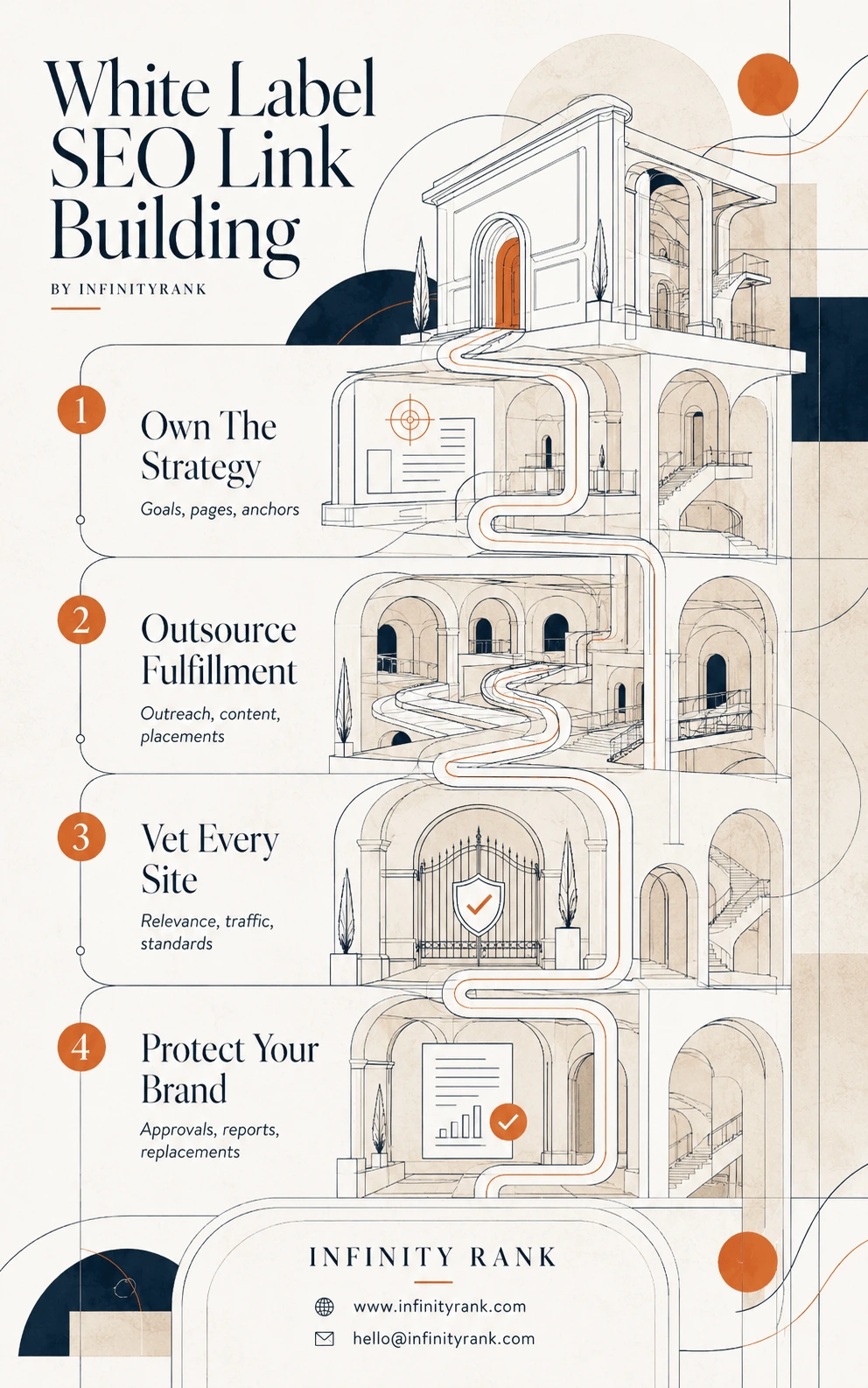
Scaling your agency shouldn’t mean sacrificing the quality of your deliverables. By vetting fulfillment partners against these rigorous standards, you turn link building into a reliable, hands-off revenue driver that keeps clients coming back. Use the white-label-seo-link-building-infographic as your checklist when choosing or auditing an optimization partner.
Why Agencies Use White Label Link Building
Agencies usually outsource link building for one of four reasons: capacity, expertise, speed, or margin.
1. It Saves Time
Manual outreach takes hours. Your team has to find relevant sites, qualify them, contact editors, negotiate placements, write or approve content, track responses, follow up, and verify live links.
That workload is hard to justify if your agency already handles technical SEO, content, reporting, account management, and sales.
A white label partner removes the operational burden.
2. It Helps Agencies Scale
Hiring a full link building team is expensive. You need outreach specialists, content writers, editors, link quality reviewers, and campaign managers.
White label fulfillment lets you sell link building to more clients without expanding payroll every time demand increases.
3. It Gives Access to Existing Publisher Relationships
Good providers already have outreach systems and publisher relationships. That can shorten delivery time and improve placement consistency.
This does not mean every provider is good. Some rely on recycled site lists, low-quality guest post farms, or irrelevant placement networks. That is why vetting matters.
4. It Protects Your Brand When Reporting Is Done Properly
A professional white label provider should give you clean, client-ready reports. These reports should include live URLs, anchor text, target pages, placement dates, link type, site metrics, and notes.
Your client should not see messy spreadsheets, unknown vendor branding, or unexplained backlinks.
How White Label SEO Link Building Works
Most campaigns follow a simple workflow.
Step 1: Campaign Goals and Target Pages
Your agency decides what the campaign needs to support. That may include:
- Ranking commercial pages
- Supporting blog content
- Building topical authority
- Improving authority for a new domain
- Strengthening local SEO pages
- Supporting a product, service, or category page
Do not let the provider choose target URLs blindly. Your agency should own the strategy.
Step 2: Anchor Text Planning
Anchor text must look natural. A healthy campaign usually includes a mix of:
- Branded anchors
- URL anchors
- Partial-match anchors
- Topical anchors
- Generic anchors
- Limited exact-match anchors
Overusing exact-match anchors is one of the easiest ways to make a backlink profile look manipulated.
Step 3: Prospecting and Site Qualification
The provider finds websites that may accept content or link placements. Each site should be reviewed for quality before approval.
At minimum, review:
- Topical relevance
- Real organic traffic
- Indexation
- Content quality
- Outbound link patterns
- Spam indicators
- Site design and editorial standards
- Existing rankings
- Whether the site links to suspicious niches
Do not buy links based only on DA, DR, or traffic estimates. Those metrics can be useful, but they are not quality guarantees.
Step 4: Content Creation or Placement
Depending on the link type, the provider may write a guest post, pitch an editor, update an existing article, or secure a resource-page mention.
The content should be useful enough to belong on the publishing site. Weak filler content built only around a backlink is a quality problem.
Step 5: Link Approval and Publication
For higher-control campaigns, the agency should approve the publishing site before content is created or before the link goes live.
This prevents bad placements from reaching the client report.
Step 6: Reporting
Once the link is live, the provider should send a white label report with all relevant placement details.
A proper report should include:
- Live URL
- Target URL
- Anchor text
- Link type
- Placement date
- Publishing site
- Niche or category
- Organic traffic estimate
- Authority metric
- Link attribute
- Indexation status
- Notes or replacement policy
Types of White Label Link Building Services
Not every link building method has the same value or risk. Agencies should know what they are buying.
Guest Post Link Building
Guest posting involves publishing a new article on a third-party website with a backlink to the client’s site.
This can work when the site is relevant, the content is useful, and the placement is editorially reasonable. It becomes risky when the post is thin, irrelevant, or clearly part of a paid guest post network.
Niche Edits
A niche edit places a link into an existing article.
The advantage is that the page may already be indexed and have history. The risk is that many niche edits are inserted into weak or unrelated pages. Agencies should review the exact page before approval.
Resource Page Link Building
Resource page link building targets pages that list useful tools, guides, companies, or references.
This works best when the client has something genuinely worth citing, such as a guide, calculator, template, study, or useful service page.
Digital PR Links
Digital PR earns links through stories, data campaigns, expert commentary, news hooks, or original research.
These links are harder to guarantee but often provide stronger authority and brand value. Digital PR is usually more expensive and less predictable than standard guest post fulfillment.
HARO / Journalist Outreach
Journalist outreach involves responding to reporter requests or pitching expert quotes.
This can produce strong links, but it requires speed, credible subject-matter expertise, and strong responses. It is not a guaranteed link source.
Local Citation and Directory Links
For local SEO clients, citations and business directories can support NAP consistency and local visibility.
These are not the same as editorial backlinks. They serve a different purpose and should not be sold as high-authority editorial link building.
How Much Does White Label Link Building Cost?
White label link building pricing varies widely. Public pricing examples range from low-cost placements around $45 to agency-grade placements commonly priced around $200–$300+ per link, depending on site quality, niche difficulty, approval requirements, and service model.
Some providers sell individual links. Others sell monthly packages. Higher-end services may price campaigns based on strategy, content, outreach complexity, and publication quality.
Cost usually depends on:
- Niche difficulty
- Site quality
- Organic traffic
- Editorial standards
- Content requirements
- Link type
- Turnaround time
- Approval workflow
- Replacement policy
- Reporting depth
Do not choose the cheapest provider automatically. Cheap link building often means recycled sites, irrelevant placements, weak content, and higher risk.
A better question is: Can this provider deliver links your agency would be comfortable showing to a serious client?
How to Vet a White Label Link Building Provider
A bad provider can create client churn, ranking risk, and reputation damage. Vet aggressively before reselling their service.
Ask These Questions Before Hiring
- Can we approve sites before placement?
- Do you use manual outreach or an existing publisher database?
- Do you use PBNs, link farms, or expired domains?
- What traffic and quality standards do you require?
- Can we review sample placements?
- Who writes the content?
- Can we control anchor text?
- Do you work in restricted or sensitive niches?
- What happens if a link is removed?
- Do you provide white label reports?
- Are links marked as sponsored or nofollow when required?
- What is your average turnaround time?
- Do you guarantee indexation?
- How do you define a “quality” site?
If a provider cannot answer these clearly, do not use them.
Red Flags to Avoid
Avoid providers that offer:
- Guaranteed rankings
- Hundreds of links for a very low price
- No site approval
- No sample placements
- No traffic standards
- No niche relevance checks
- Exact-match anchor stuffing
- Links from unrelated blogs
- Sites with obvious paid-post footprints
- Links from pages with dozens of outbound links
- No replacement policy
- No transparency about methods
“High DA” alone is not enough. A high-metric site can still be irrelevant, spammy, or part of a link-selling network.
Link Quality Checklist for Agencies
Use this checklist before approving any placement.
Site-Level Checks
- The site has real organic traffic.
- The site ranks for relevant keywords.
- The site publishes useful content.
- The site is topically relevant to the client.
- The site does not publish obvious spam.
- The site does not link heavily to gambling, adult, casino, crypto spam, or unrelated niches.
- The site has an actual audience or editorial purpose.
Page-Level Checks
- The page topic matches the client’s niche.
- The backlink fits naturally in context.
- The anchor text is not forced.
- The page is indexable.
- The article is not thin or AI-spammy.
- The page does not contain excessive outbound links.
- The content is useful without the backlink.
Campaign-Level Checks
- Anchor text is diversified.
- Link velocity looks reasonable.
- Target URLs are chosen strategically.
- Placements support business goals.
- Reports are clean and client-ready.
- Risk level matches the client’s tolerance.
Risks of White Label Link Building
White label link building is not automatically safe. It depends on the provider, method, quality control, and disclosure practices.
Google recommends qualifying certain outbound links with attributes such as rel="nofollow" or rel="sponsored" where appropriate, especially when links involve sponsorship, payment, or other compensation.
Common risks include:
- Paid links passed as editorial links
- Irrelevant placements
- Over-optimized anchor text
- Low-quality guest post sites
- PBN links
- Link farms
- AI-generated filler content
- Links placed on pages with no traffic
- Unclear reporting
- No replacement policy
- Client expectations based on guaranteed rankings
The agency is still responsible for what it sells. Outsourcing the work does not outsource accountability.
How Agencies Should Position White Label Link Building to Clients
Do not sell link building as a magic ranking button. That is lazy and risky.
Position it as part of a broader SEO strategy that also includes:
- Technical SEO
- Content strategy
- On-page optimization
- Internal linking
- Conversion-focused landing pages
- Local SEO, where relevant
- Authority building
- Ongoing performance tracking
A better client explanation:
“Backlinks help build authority, but they work best when paired with strong content, technical SEO, and a clean site structure. Our link building process focuses on relevant placements, natural anchor text, and transparent reporting.”
That is more credible than promising rankings.
What a White Label Link Building Report Should Include
A client-ready report should be simple, branded, and transparent.
Include:
- Campaign name
- Reporting period
- Client domain
- Target URL
- Anchor text
- Live placement URL
- Publishing domain
- Link type
- Follow/nofollow/sponsored attribute
- Placement date
- Domain metric
- Organic traffic estimate
- Niche/category
- Content title
- Status
- Notes
- Replacement eligibility
Do not send clients raw vendor exports unless they are clean, branded, and understandable.
When White Label Link Building Makes Sense
White label SEO link building is a good fit when:
- Your agency has SEO clients but lacks outreach capacity.
- You want to add link building without hiring a team.
- Your clients need authority building.
- You can manage strategy internally.
- You have clear quality standards.
- You want predictable fulfillment.
- You can review placements before delivery.
It is not a good fit when:
- You expect guaranteed rankings.
- You want the cheapest links possible.
- You do not understand link quality.
- You cannot review placements.
- Your provider refuses transparency.
- Your clients are in high-risk niches and need strict compliance.
How to Resell White Label Link Building Profitably
To protect margin, agencies should not resell links as isolated commodities.
Instead, package link building inside broader SEO retainers.
For example:
Basic Authority Package
- 2–3 quality links per month
- Anchor text planning
- Monthly report
- Basic placement review
Growth SEO Package
- 4–6 quality links per month
- Content support
- Competitor backlink gap review
- Landing page recommendations
- Monthly strategy call
Competitive SEO Package
- 8+ links per month
- Digital PR or premium outreach
- Full placement approval
- Advanced reporting
- Quarterly authority review
This makes the service more strategic and less transactional.
Common Mistakes Agencies Make
Mistake 1: Buying Links Based Only on DA or DR
Authority metrics are third-party estimates. They can be manipulated. Always check relevance, traffic, content quality, and outbound link patterns.
Mistake 2: Ignoring Anchor Text Risk
Exact-match anchors can help in small amounts, but overuse looks unnatural. Use branded and partial-match anchors more often.
Mistake 3: Skipping Site Approval
If you do not review placements before they go live, you may end up reporting links you would never have approved.
Mistake 4: Selling Guaranteed Rankings
No provider can honestly guarantee rankings from link building. Rankings depend on competition, content, technical SEO, intent match, algorithm changes, and many other factors.
Mistake 5: Not Explaining Risk to Clients
Clients do not need a lecture on search patents. They do need a clear explanation that link building quality matters and that spammy shortcuts can backfire.
White Label SEO Link Building FAQs
Is white label SEO link building safe?
It can be lower-risk when the provider uses relevant sites, manual quality checks, natural anchor text, useful content, and transparent reporting. It becomes risky when providers use spammy sites, irrelevant placements, paid-link networks, or manipulative anchor text.
How long does white label link building take?
Most campaigns take a few weeks from order to live placement, depending on the provider, niche, content requirements, and approval process. Digital PR and journalist outreach can take longer because placements are less predictable.
Should agencies approve every link before it goes live?
Yes, especially for new providers or sensitive clients. Pre-approval protects your brand and prevents low-quality placements from reaching the client report.
Are guest post links still useful?
Guest post links can be useful when the publishing site is relevant, real, and editorially credible. Low-quality guest post farms are not useful and can create risk.
What is the difference between white label link building and regular link building?
Regular link building is delivered directly by the provider to the end client. White label link building is delivered by the provider to your agency, then resold under your brand.
Can white label link building improve rankings?
It can support rankings when combined with strong content, technical SEO, internal linking, and search-intent alignment. Links alone cannot fix weak pages, poor site structure, or bad content.
What should agencies avoid?
Avoid providers that promise guaranteed rankings, sell very cheap bulk links, hide placement sources, refuse samples, use irrelevant sites, or rely only on DA/DR metrics.
Final Thoughts
White label SEO link building can help agencies scale faster, improve client retention, and add a valuable service without building an outreach department from scratch.
But the provider matters. Cheap, vague, or low-quality link building can damage rankings, waste client budget, and hurt your agency’s reputation.
The right partner should give you relevant placements, transparent methods, approval options, clean reporting, and clear quality standards. Treat white label link building as a fulfillment partnership, not a shortcut.