A broken link building campaign starts with a page that’s already broken and ends, ideally, with a relevant page linking to you instead.
Finding the dead link isn’t the difficult part anymore. Ahrefs, Semrush, Screaming Frog, browser extensions, and other tools can surface 404s quickly.
The difficult part is finding broken links worth pursuing, creating a replacement that genuinely fits, and giving a busy site owner enough reason to make the edit.
That’s where most campaigns win or lose.
This broken link building guide focuses on those decisions: how to find opportunities, how to vet them without relying on arbitrary DR cutoffs, what a replacement page needs to accomplish, how to write outreach that doesn’t look automated, and when guest posting is the better use of your time.
One warning before you start: discovery scales much more easily than conversion.
What Is Broken Link Building?
Broken link building means finding a dead external link on someone else’s website and suggesting relevant live content as a replacement.
The dead URL often returns a 404, although other permanently unavailable pages can create the same opportunity.
The basic process looks like this:
- Find a page containing a dead outbound link.
- Check what the dead resource originally covered.
- Confirm that the linking page is worth pursuing.
- Create or identify a strong replacement resource.
- Contact the site owner or editor.
- Show them the broken link and suggest your page as an alternative.
The difference between broken link building and a standard cold link request is the reason for the outreach.
A normal link pitch asks someone to add something that isn’t currently missing.
A broken link pitch points out something that already needs fixing.
You’re still asking for consideration. But you’re giving the publisher a practical reason to review the request.
Broken Link Reclamation Visual Strategy
Finding dead resource links across the web is simple, but identifying high-value replacement prospects requires a systematic approach to spot good breaks. Successful campaigns depend on your ability to vet the page carefully, evaluating topical relevance, domain quality, publication recency, and overall audience fit. To maximize conversion rates, you must match the resource precisely, replacing dead guides with guides and broken tools with tools. This simple guide breaks down four core steps to transform broken links into high-authority backlinks.
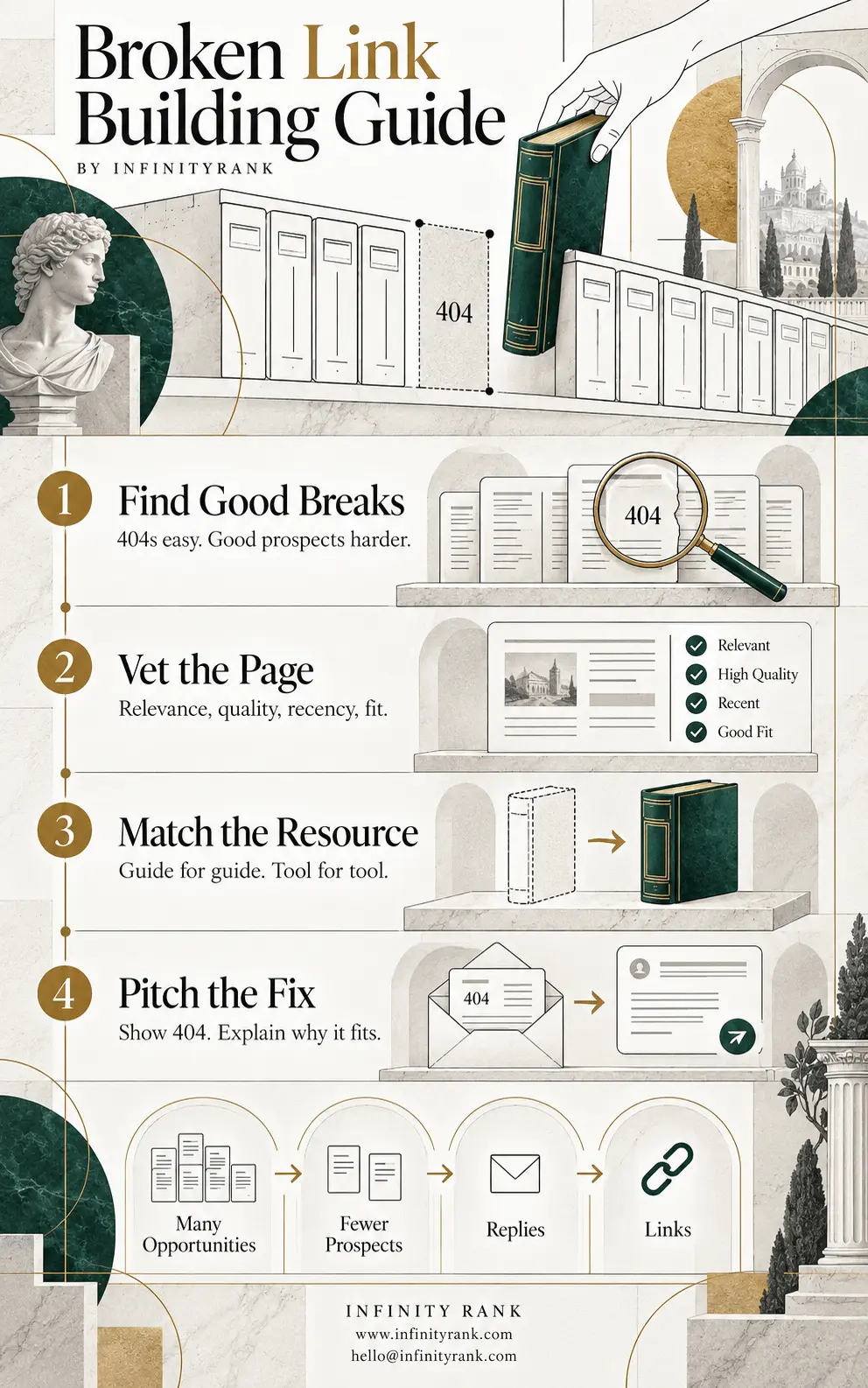
Securing new link placements comes down to how effectively you pitch the fix, clearly highlighting the broken 404 error while demonstrating why your content is a seamless replacement. Scaling this strategy relies on refining a high-volume funnel, filtering many opportunities down to targeted prospects to generate positive replies and earned links. Use these core pillars as your strategic framework to turn dead web pages into valuable backlink assets for your domain.
Why Broken Link Building Still Works in 2026
Broken link building still works because links still break.
Companies close. Domains expire. Websites move to new content management systems. URLs change during redesigns. Articles get deleted. Resources disappear without redirects.
That creates a constant supply of dead references across the web.
Google also continues to use links as part of its systems for understanding pages and their relationships. That does not mean every backlink improves rankings or that link quantity should be chased blindly. Relevance, editorial context, site quality, and the broader SEO picture all matter.
What has changed is competition.
Years ago, finding a strong broken page was a meaningful advantage by itself. Today, most professional link builders have access to similar backlink databases and crawling tools.
A dead resource with links from prominent websites can therefore attract multiple competing replacement pitches.
That changes the strategy.
Instead of asking:
How many broken links can we find?
Ask:
How many broken links can we find where our replacement is genuinely useful and the publisher still has a reason to update the page?
Prioritize opportunities where:
- The host page is active and maintained.
- The dead resource matters to the surrounding content.
- Your page closely matches the original purpose of the link.
- You can offer something equal to or better than what disappeared.
- The prospect has not obviously turned into a link-selling operation.
- The edit would improve the page for readers.
Broken link building is not an easy-backlink shortcut.
It is targeted editorial outreach with a better opening reason than most cold pitches.
How to Find Broken Links for Link Building
There are three practical ways to start, from manual prospecting to higher-volume crawling.
1. Check Relevant Resource Pages
Search for pages in your niche using phrases such as:
[topic] resources[topic] useful links[topic] recommended reading[topic] helpful resources[topic] tools
Open promising pages and check their outbound links with a browser extension or crawler.
This method is slow, but the manual review can uncover useful pages that don’t appear in obvious competitor backlink exports.
It also overlaps naturally with resource page link building. Running both tactics together makes more sense than treating them as completely separate campaigns.
2. Find Competitor Pages That Lost Their Destination
Run competitor domains through Ahrefs or Semrush and look for broken pages that still have referring domains pointing to them.
This is often more efficient because you are starting with a dead resource that already proved capable of earning links.
Before creating a replacement, inspect:
- Which pages link to the dead URL.
- Why they linked to it.
- The anchor text used.
- Whether those linking pages are still live.
- Whether the links appear editorially placed.
- What the dead resource originally contained.
A broken URL with hundreds of backlinks is not automatically better than one with 15.
Ten relevant editorial prospects can be more useful than hundreds of links from weak directories, scraped pages, sitewide templates, or irrelevant domains.
3. Crawl a Prospect List With Screaming Frog
For larger campaigns, build a seed list of relevant websites and crawl them with Screaming Frog SEO Spider.
You can use list mode to work through selected URLs and identify broken outbound links.
This works well when prospecting:
- Industry associations.
- University resource pages.
- Trade organizations.
- Government or nonprofit resources.
- Curated tool lists.
- Publisher resource hubs.
- B2B directories with editorial oversight.
Volume goes up quickly.
So does noise.
The crawl finds technical opportunities. It does not tell you which ones deserve outreach. Manual qualification still matters.
Broken Link Building Tools and Current Pricing
Pricing below was checked in September 2026. Vendors change plans and limits regularly, so confirm current pricing before buying specifically for a campaign.
| Tool | Best For | Free or Entry Access | Current Starting Point |
| Ahrefs | Competitor backlinks and broken-page research | Free tools for verified sites; Starter can inspect competitor data with limits | Starter: $29/month; Standard: $249/month |
| Semrush | Competitor backlink analysis and filtering | Limited free access and trial options | Pro: $139.95/month |
| Screaming Frog SEO Spider | Crawling prospect URLs and finding broken links | Free version crawls up to 500 URLs | £199/year per licence |
| Check My Links | Checking individual pages quickly | Free | Free |
| Wayback Machine | Recovering old versions of dead pages | Free | Free |
A few details matter.
Ahrefs’ free verified-project access is useful for your own websites, but competitor prospecting requires paid access. Its $29 Starter plan provides limited access to Site Explorer for unverified websites.
However, some of the more useful scaled workflows sit higher. Ahrefs currently lists Content Explorer and Batch Analysis under Standard, which starts at $249 per month.
Screaming Frog’s free edition is capped at 500 URLs per crawl, but it can export crawl data, including broken-link information. The paid licence removes the 500-URL crawl limit and unlocks additional configuration, saving, integrations, and advanced features.
Can You Do Broken Link Building for Free?
Yes.
A basic free workflow looks like this:
- Search manually for relevant resource pages.
- Open each page.
- Check outbound links using Check My Links or another free checker.
- Open dead URLs in the Wayback Machine.
- Review what the original content provided.
- Check whether the host page is legitimate and actively maintained.
- Create or select a suitable replacement.
- Find the correct contact and pitch manually.
You lose speed and backlink-database depth.
You gain tighter manual control.
For a small campaign, that trade-off can be completely reasonable.
How to Vet a Broken Link Before You Pitch It
Most wasted outreach starts with bad qualification.
Do not reduce prospecting to one metric.
Domain Rating, Domain Authority, estimated traffic, backlink count, and referring domains can all help, but none should decide the campaign alone.
Use a combined review.
| Factor | What to Check | Warning Signs |
| Topical relevance | Does the host page and surrounding paragraph match your replacement? | Link would feel forced or unrelated |
| Real visibility | Does the domain or page appear to receive legitimate organic visibility? | No meaningful content or obvious search manipulation |
| Editorial quality | Is the page written and maintained for real readers? | Thin pages, spun content, automated directories |
| Link context | Why did the author cite the original resource? | Footer, comments, widgets, sponsored blocks |
| Referring domains | Are worthwhile sites still linking to the dead resource? | Mostly spam, networks, irrelevant domains |
| Recency | Does the host page still appear maintained? | Years of neglect and multiple unfixed errors |
| Replacement fit | Can your content perform the same job as the dead page? | Your page covers a different intent |
| Outbound-link profile | Does the site link naturally to relevant sources? | Large numbers of unrelated commercial links |
Traffic
Organic traffic can be useful as a quality signal, but do not use an arbitrary rule such as:
Under 500 visits = reject.
A specialized B2B publication with modest search traffic may be far more valuable than a general site with thousands of irrelevant visits.
Look at traffic alongside audience relevance and editorial quality.
Authority Metrics
DR and DA are third-party metrics, not Google metrics.
Use them for comparison and prioritization, not as hard definitions of link quality.
A relevant DR 25 industry association may be worth pursuing.
A DR 75 website built around selling unrelated links may not be.
Our link building metrics guide covers the metrics worth checking without treating any one number as truth.
Referring Domains
A dead resource with multiple legitimate referring domains gives you multiple potential prospects.
But raw count can be misleading.
Look at who is linking, where the link appears, and why it exists.
The goal is not to find the dead URL with the biggest backlink number.
The goal is to find replacement opportunities you can realistically win.
Recency
Recently broken links can be attractive because the host page may still be actively maintained.
But there is no universal 30-, 60-, or 90-day cutoff.
A resource page last updated six months ago may still have an active editor. A page updated yesterday may be autogenerated and useless.
Use recency as evidence, not a rule.
Spam and Link-Selling Footprints
Skip websites that appear to exist primarily to sell links.
Watch for:
- Hundreds of unrelated commercial outbound links.
- Sudden topic changes across articles.
- Obvious sponsored posts without disclosure.
- Casino, crypto, CBD, finance, SaaS, and home-improvement articles mixed randomly.
- Exact-match anchors everywhere.
- Thin pages created around guest-post placements.
These are the profiles you do not want to spend time acquiring and later worrying about in a toxic backlink review.
For a broader qualification workflow, use our link building checklist.
Creating the Replacement Page
Finding the dead URL comes first.
Understanding why people linked to it comes next.
Open the old URL in the Wayback Machine and inspect the original page.
Ask:
- What search intent did it satisfy?
- What information did it provide?
- Was it a guide, dataset, tool, template, study, calculator, directory, or list?
- Which section attracted links?
- What anchor text did linking sites use?
- Has the topic changed since it was published?
Then build or choose a replacement that does the same job better.
If the dead page was a detailed 3,000-word industry study, a generic 600-word blog post is not a credible replacement.
If it was a calculator, replacing it with an article explaining calculators misses the point.
If it was a curated statistics page, your replacement should provide usable statistics.
Match the function, not only the keyword.
Do Not Pitch Service Pages as Resource Replacements
A page linking to an educational guide usually does not want to replace it with an agency sales page.
The replacement should improve the host page for readers.
That usually means promoting:
- Original research.
- Complete guides.
- Data pages.
- Tools.
- Templates.
- Calculators.
- Checklists.
- Reference material.
- Useful comparison resources.
Creating a thin page solely to catch one broken backlink is one of the link building mistakes that turns a sensible tactic into a low-quality one.
Broken Link Building Outreach That Gets Replies
Your email has two jobs:
- Make the problem easy to verify.
- Make the replacement easy to evaluate.
Do not bury the broken link under an introduction about your company.
Subject Lines Worth Testing
- Broken link on [page title]
- Quick fix for your [topic] resources page
- Dead resource on [page title]
- [Domain] is linking to a 404
Do not assume one formula universally “works.”
Test subject lines against your own list and track response rates.
Outreach Template
Hi [Name],
I was reading your [page title] page and noticed the link to [dead resource] is returning a 404.
I put together a resource covering the same topic: [your URL]. It includes [specific relevant feature or section], so it may work as a replacement if you think it fits.
Either way, thought you’d want to know the original link is dead.
[Your name]
Why this works structurally:
- The issue appears immediately.
- The dead resource is specific.
- The replacement explains why it fits.
- The site owner is not pressured.
- There is no fake compliment.
- There is no three-paragraph agency introduction.
Short Version
Hi [Name],
Quick heads-up: the link to [dead resource] on [page title] is returning a 404.
If you need a replacement, [your URL] covers the same topic and includes [specific detail].
Thought it was worth flagging either way.
[Your name]
How Many Follow-Ups Should You Send?
There is no universal number.
A reasonable starting sequence is:
- Initial email.
- Follow-up after roughly one week.
- Final follow-up about one week later.
For especially valuable, carefully researched prospects, a third follow-up may be worth testing.
Do not keep sending “just bumping this” emails indefinitely.
LaGrowthMachine’s 2026 broken link building guide recommends up to two follow-ups for medium-value prospects and up to three for its highest-value tier.
Your own campaign data should eventually replace somebody else’s recommendation.
What Is a Realistic Broken Link Building Conversion Rate?
Published benchmarks are useful, but they should not be treated as guarantees.
LaGrowthMachine reports aggregated 2025-2026 agency campaign data from more than 50 campaigns showing approximately:
- 15-25% response rates
- 5-8% link conversion from total emails sent
- 3-5 hours of work per acquired link
It also reports materially different conversion rates depending on targeting and personalization.
That matters.
A 5-8% benchmark does not mean sending 20 emails guarantees a link.
A campaign can perform much better or much worse depending on:
- Niche.
- Content quality.
- Prospect quality.
- Site authority.
- Personalization.
- Email deliverability.
- Competition.
- How recently the resource broke.
- Whether the webmaster still maintains the page.
Treat external benchmarks as a planning range.
Track your own numbers as soon as you have enough volume.
Broken Link Building vs. Guest Posting
Neither tactic wins in every situation.
They solve different problems.
| Factor | Broken Link Building | Guest Posting |
| Opportunity trigger | Existing dead link | Publisher accepts new content |
| Control over surrounding copy | Low | Higher |
| Control over target page | Limited by replacement relevance | Usually higher |
| Content requirement | Existing or new replacement resource | New article for publisher |
| Prospect supply | Limited by relevant broken links | Limited by publisher inventory |
| Predictability | Variable | Usually easier to plan |
| Outreach angle | Fix an existing problem | Pitch new editorial content |
| Best use | Strong linkable assets | Planned link acquisition and thought leadership |
Run Guest Posting First When:
- You need predictable monthly outreach volume.
- You need more control over which pages receive links.
- You have writing capacity.
- Relevant publishers accept contributed content.
- You are building authority around specific commercial or informational topics.
Our guest post link building service covers how that process works.
Run Broken Link Building First When:
- You already have strong resource content.
- Paid placement budgets are limited.
- Your niche contains many curated resource pages.
- Guest-post inventory is weak.
- You have tools, studies, templates, guides, or data that can replace outdated resources naturally.
Most serious campaigns should not depend on one tactic.
Guest posting can provide predictable prospecting.
Broken link building can uncover editorial placements that would be difficult to create from scratch.
For broader cost comparisons, see our link building pricing guide.
Broken Link Building vs. Niche Edits
Both tactics place links into existing content.
The difference is the reason for the edit.
A niche edit asks the publisher to add your link to content that already works without it.
Broken link building identifies a reference that no longer works and proposes a replacement.
That gives broken link outreach a stronger natural reason.
But it also limits inventory.
There are far more live pages that could theoretically accept a relevant contextual link than pages containing a dead resource your content can replace.
That makes niche edits potentially easier to scale, although quality varies dramatically depending on how placements are sourced.
See our full comparison of guest posting vs. niche edits before choosing between those approaches.
Is Broken Link Building Scalable?
Prospecting is scalable.
Placements are less predictable.
You can crawl hundreds or thousands of URLs and generate a large list of broken links.
But most of that list will disappear during qualification.
Some links will be:
- Irrelevant.
- In abandoned content.
- From low-quality sites.
- In sections editors never update.
- Pointing to resources you cannot realistically replace.
- Surrounded by commercial link-selling activity.
- Already restored or redirected by the time you contact the site.
That is why the wrong metric is:
Broken URLs found.
Track the funnel instead.
What to Track in a Broken Link Campaign
| Metric | What It Tells You |
| Broken URLs found | Raw prospecting volume |
| Qualified prospects | How much of the raw list is usable |
| Contacts found | Whether prospects are realistically reachable |
| Emails delivered | Deliverability health |
| Replies | Outreach relevance and targeting |
| Positive replies | Offer quality |
| Links placed | Actual campaign output |
| Conversion rate | Placements divided by delivered outreach |
| Average time to placement | Operational speed |
| Lost links after placement | Durability |
| Target page | Which assets attract links |
| Anchor type | How publishers naturally reference the asset |
Do not publish a case study table unless you have actual campaign data behind it.
If you have not tracked broken link building separately before, run a controlled test first and document the funnel.
Expired domains can also surface useful opportunities because websites disappearing from the web can leave inbound links pointing at dead pages. Our expired domains link building guide covers how to investigate them without assuming every expired domain is valuable.
Monitor Links After They Go Live
Winning the placement is not the end.
Links disappear.
Publishers redesign websites, update articles, change CMS platforms, merge pages, remove sections, and occasionally delete entire sites.
A backlink placed in March may no longer exist by August.
Track:
- Whether the linking page remains live.
- Whether your URL is still present.
- Whether the link attribute changes.
- Whether the target URL redirects.
- Whether the anchor text changes.
- Whether the linking page becomes deindexed.
Our guide to backlink monitoring tools covers practical options.
Who Broken Link Building Works Best For
SaaS Companies
Strong fit when the company already publishes:
- Documentation.
- Templates.
- Benchmarks.
- Original research.
- Comparison resources.
- Free tools.
- Integration guides.
Software markets change quickly. Companies shut down, tools rebrand, features disappear, and integrations get deprecated.
That creates natural replacement opportunities.
Agencies
Useful as one part of a wider link acquisition program.
The limitation is forecasting.
Broken-link inventory varies, which makes it harder to promise the same number of placements every month than with more controlled prospecting methods.
Use it alongside guest posting, digital PR, resource-page outreach, and other tactics.
Ecommerce Brands
Usually a weaker fit if the website consists mainly of category and product pages.
A product page rarely replaces an editorial resource naturally.
Broken link building becomes more viable when the ecommerce site has genuinely useful supporting content such as:
- Buying guides.
- Calculators.
- Research.
- Tutorials.
- Data.
- Comparison tools.
- Reference content.
B2B Service Companies
Often a good fit.
Industry associations, trade publications, vendor lists, professional bodies, and old whitepapers can create relevant broken-link opportunities.
The replacement content still needs to be educational rather than a disguised service pitch.
Startups
Useful when cash is tighter than time.
The free workflow makes it possible to test broken link building without paying for a large outreach stack.
But results can be uneven, so do not build the entire acquisition plan around it.
Combine it with digital PR and journalist outreach tactics such as the options in our HARO alternatives guide.
Enterprise SEO Teams
The prospecting side scales well for teams with crawling, backlink, and outreach infrastructure.
The bottleneck often moves internally:
- Content approval.
- Brand review.
- Legal review.
- Subject-matter expert access.
- Production time for replacement assets.
Finding the broken link can take seconds.
Creating the resource capable of replacing it may take weeks.
Common Broken Link Building Mistakes
Pitching Every 404 You Find
A dead URL is not automatically an opportunity.
Qualify the linking page, context, audience, and replacement fit first.
Replacing a Strong Resource With Thin Content
If the dead page was useful enough to earn links, your replacement needs to justify the same citation.
Match or improve its usefulness.
Relying Only on DR
DR is useful for prioritization.
It is not a quality guarantee.
Check relevance, traffic, editorial standards, link context, and site history.
Sending Generic Outreach at Scale
Finding the same dead link as everyone else gives you no advantage.
Your advantage comes from a better replacement and better targeting.
Creating Content Only for the Backlink
If the page would have no reason to exist without the outreach campaign, reconsider it.
Good replacement assets should be valuable to your own audience too.
Ignoring Deliverability
A perfect email cannot convert if it lands in spam.
Monitor:
- Bounce rate.
- Sending-domain reputation.
- Mailbox health.
- Authentication.
- List quality.
- Sending volume.
Treating Benchmarks as Guarantees
Someone else’s 8% conversion rate is not your 8% conversion rate.
Use external numbers for planning.
Use your own campaign data for decisions.
FAQ
What Is Broken Link Building?
Broken link building is the process of finding dead links on other websites and suggesting relevant live content as a replacement.
The tactic works best when your replacement genuinely performs the same job as the missing resource.
Is Broken Link Building Still Effective in 2026?
Yes, but results depend heavily on prospect quality, competition, content quality, and outreach.
Modern tools make finding broken links easy. Qualification and replacement quality are the harder parts.
How Do You Find Broken Links for Link Building?
Common methods include:
- Checking resource pages manually.
- Finding competitor pages that return 404s but still have backlinks.
- Crawling relevant websites with Screaming Frog.
- Monitoring expired or disappearing resources.
- Reviewing outdated industry directories and reference pages.
What Tools Are Used for Broken Link Building?
Common options include:
- Ahrefs.
- Semrush.
- Screaming Frog SEO Spider.
- Check My Links.
- Wayback Machine.
You do not need all of them.
A free campaign can be run with manual search, a browser link checker, Wayback Machine, and careful prospect review.
Is Broken Link Building Safe for SEO?
Broken link building can be a legitimate editorial link acquisition tactic when the replacement is relevant and useful.
The tactic itself does not make every resulting link safe.
Google’s spam policies still apply. Manipulative placements, paid links intended to pass ranking signals, irrelevant links, automated schemes, and low-value content created mainly to manipulate rankings can create risk.
Focus on links that make sense for users even if SEO value is ignored.
How Is Broken Link Building Different From Guest Posting?
Guest posting involves publishing new content on another website.
Broken link building works with an existing page and proposes replacing a dead external reference with a live resource.
Guest posting usually gives you more control.
Broken link building gives you a stronger reason for asking an existing page to be edited.
How Is Broken Link Building Different From Niche Edits?
A niche edit adds a link to existing content.
Broken link building is a specific type of existing-page outreach where a dead link creates the reason for the proposed change.
How Much Does Broken Link Building Cost?
It depends on the workflow.
A manual campaign can be run with free tools, making time the main cost.
Paid software increases prospecting speed. Third-party 2025-2026 campaign data published by LaGrowthMachine estimates roughly 3-5 hours of work per acquired link for well-executed campaigns, but that is a benchmark, not a guarantee.
Agency and outsourced campaign pricing varies widely based on prospect quality, content production, outreach, niche difficulty, and placement standards.
What Is a Realistic Response Rate?
LaGrowthMachine reports approximately 15-25% response rates and 5-8% link conversion across aggregated 2025-2026 agency campaign data covering more than 50 campaigns.
Treat those figures as external benchmarks.
Your actual performance may be substantially higher or lower.
Why Do Links Break?
Common causes include:
- Pages being deleted.
- URLs changing without redirects.
- Domains expiring.
- Companies closing.
- Website migrations.
- CMS changes.
- Site restructures.
- Content being consolidated.
- Resources being removed or replaced.
These changes create new broken-link opportunities continuously.
Should You Use Broken Link Building?
Use broken link building when you have content worth linking to and a realistic pool of relevant dead resources.
Do not use it because somebody told you it is an easy way to earn backlinks.
It is not.
The tactic works when three things line up:
- The publisher has a real problem.
- Your content genuinely solves it.
- Your outreach makes the fix easy to evaluate.
If one of those is missing, finding more 404s will not save the campaign.