Automotive SEO is competitive because most searches have clear buying intent. Someone looking for a “used Toyota dealer near me,” “brake repair in Dallas,” or “BMW parts online” is not browsing casually. They are close to calling, booking, visiting, or buying.
That is why link building matters.
But automotive link building is not about collecting random backlinks from any site that will publish your URL. That approach creates weak signals, attracts low-quality traffic, and can put your site at risk if links are bought, manipulated, or placed on irrelevant websites.
Good automotive link building does three things:
- It strengthens your website’s authority around vehicles, parts, repairs, servicing, financing, or local automotive topics.
- It improves your local relevance by connecting your business with real local organizations, suppliers, partners, and publications.
- It earns referral traffic from places where potential customers already pay attention.
Google says local results are mainly influenced by relevance, distance, and prominence. Links are not the only factor, but strong local and industry mentions can support prominence when they come from credible sources.
This guide explains how to build automotive backlinks safely and strategically for dealerships, repair shops, body shops, parts stores, towing companies, detailing businesses, and automotive ecommerce brands.
What Is Link Building for Automotive Websites?
Link building for automotive websites is the process of earning links from relevant third-party websites to your automotive business website.
These links may come from:
- Local business organizations
- Automotive directories
- Vehicle marketplaces
- Manufacturer or supplier pages
- Industry blogs and publications
- Local news sites
- Event sponsorship pages
- Partner businesses
- Resource pages
- Customer case studies
- Data reports or buying guides
A backlink works like a pathway from another website to yours. Google also uses links to discover pages across the web, which is why links remain part of how websites get found and understood.
The key word is relevant.
A repair shop in Phoenix does not need 200 generic blog links from unrelated websites. It needs links and mentions from local organizations, automotive partners, suppliers, certification bodies, fleet clients, local publications, and useful content assets that make sense for the business.
Automotive Link Building Steps for Trust and Rankings
Growing an automotive business online requires more than just standard local ads. To drive a steady stream of customer leads, your website needs high-quality backlinks that prove your local authority and industry expertise to search engines. Getting featured on trusted car publications, local directories, and community event pages is the best way to build a powerful online presence. This simple guide outlines five practical steps to earn relevant automotive links that safely increase your search visibility.
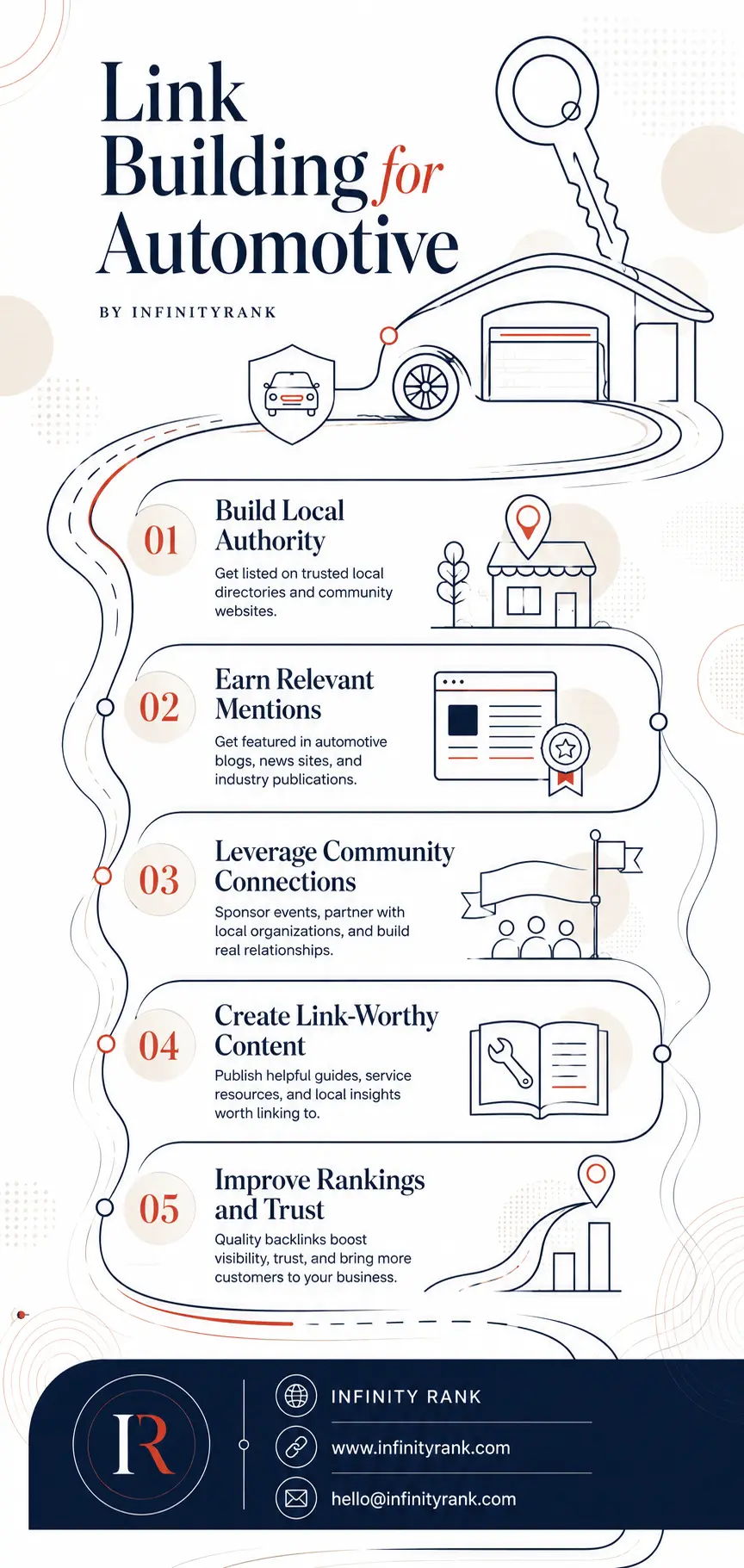
Building strong search authority in the automotive space takes regular effort, but the payoff is a continuous influx of local customers. Combining helpful service guides with genuine community partnerships ensures your business stays ahead of local competitors. Use these five core pillars as your strategic roadmap to outrank the competition and build long-term trust with ready buyers.
Why Automotive Businesses Need Backlinks
Backlinks are not a shortcut. They are a credibility layer.
If your website has thin service pages, poor technical SEO, duplicate location pages, weak Google Business Profile optimization, or no reviews, links will not fix the whole problem. But once the foundation is in place, quality backlinks can help you compete for harder local and organic searches.
1. Backlinks Support Local SEO
Automotive businesses are often local-first businesses. Dealers, repair shops, tire shops, collision centers, and detailing companies need visibility in city-level and “near me” searches.
Useful local backlinks can come from:
- Chamber of commerce pages
- Local sponsorship pages
- Community event websites
- Local newspapers
- Business associations
- Schools, charities, and nonprofits
- Nearby partner businesses
- Local fleet or commercial clients
These links help connect your business to a specific city, region, or service area. That matters because automotive customers usually want a provider nearby.
2. Backlinks Help Build Trust
A link from a real automotive publication, supplier, dealership partner, local newspaper, or trade association carries more trust than a link from a generic guest post farm.
For automotive businesses, trust is not optional. Customers are making expensive decisions. They want to know whether your dealership is legitimate, your repair shop is reliable, your parts are compatible, or your service team knows what it is doing.
Relevant backlinks help reinforce that credibility.
3. Backlinks Can Drive Referral Traffic
The best links are not just SEO signals. They can send real visitors.
Examples:
- A tire shop listed on a local winter driving safety guide
- A dealership featured in a local EV buying article
- A repair shop mentioned on a fleet maintenance partner page
- An auto parts ecommerce site cited in an installation tutorial
- A body shop listed by an insurance or collision repair partner
If nobody would ever click the link, question whether the link is worth building.
4. Backlinks Help Content Compete
Automotive websites often publish content around buying guides, maintenance tips, model comparisons, financing, repair symptoms, parts compatibility, and ownership costs.
Those topics can be competitive. A strong content page usually needs more than decent writing. It needs authority, internal links, and external references from relevant sites.
Match the Link Strategy to the Automotive Business Type
Not every automotive business needs the same backlink strategy. A used car dealer, auto repair shop, and parts ecommerce brand have different search intent, customers, and link opportunities.
| Business Type | Best Link Targets | Content Assets That Attract Links |
| Car dealerships | Manufacturer pages, local news, event sponsorships, auto marketplaces, finance partners | Model comparisons, local car-buying guides, trade-in guides, EV buying guides |
| Auto repair shops | Supplier pages, certification pages, local partners, fleet clients, community sites | Maintenance checklists, repair cost guides, seasonal driving guides |
| Body shops | Insurance partners, collision networks, paint suppliers, safety organizations | Accident repair guides, insurance claim guides, repair process explainers |
| Auto parts stores | Installation blogs, enthusiast forums, product review sites, supplier pages | Compatibility guides, installation tutorials, comparison charts |
| Towing companies | Local directories, police/community resources, roadside safety pages, repair shop partners | Roadside emergency guides, towing cost guides, accident checklists |
| Detailing businesses | Local lifestyle sites, car clubs, luxury vehicle communities, event pages | Detailing care guides, ceramic coating explainers, before/after case studies |
| Automotive SaaS or B2B brands | Industry publications, podcasts, partner pages, software directories | Data reports, benchmark studies, workflow guides, case studies |
This is where most generic automotive SEO articles fail. They tell every business to “get backlinks,” but they do not explain which links are worth pursuing.
Best Automotive Backlink Sources
1. Google Business Profile and Core Local Citations
Start with the basics. This is not glamorous, but it is necessary.
Claim and optimize your Google Business Profile. Use accurate business information, service categories, hours, photos, products, services, and appointment links where relevant. Google’s own local ranking guidance says complete and accurate business information helps relevance.
Then build or clean up your local citations.
Important citation sources may include:
- Bing Places
- Apple Maps
- Yelp
- Better Business Bureau
- Chamber of Commerce
- Local business directories
- Industry-specific directories
- DealerRater
- Cars.com
- Autotrader
- RepairPal, where relevant
- Carfax service/shop listings, where relevant
Do not submit your business to hundreds of junk directories. That is outdated SEO. Focus on trusted platforms that real customers or search engines may use.
2. Manufacturer, Supplier, and Certification Links
These are some of the most overlooked automotive backlinks.
If your business has official relationships, certifications, or supplier partnerships, check whether those organizations maintain partner directories or certified provider pages.
Examples:
- A tire shop listed by tire brands it carries
- A repair shop listed by equipment or diagnostic tool partners
- A body shop listed by paint suppliers
- A dealership listed by the manufacturer
- An EV installer listed by charger manufacturers
- A performance shop listed by parts manufacturers
- A detailer listed by ceramic coating brands
These links are highly relevant because they connect your business to the products, services, and brands you actually work with.
Action step: make a spreadsheet of every manufacturer, supplier, vendor, certification body, warranty provider, and software platform connected to your business. Check each website for “find a dealer,” “certified installer,” “authorized partner,” “where to buy,” or “service locator” pages.
3. Local Partnerships
Automotive businesses naturally work with other local businesses. Turn those real-world relationships into online mentions where appropriate.
Potential partners include:
- Towing companies
- Car washes
- Detailers
- Tire shops
- Insurance brokers
- Finance companies
- Driving schools
- Fleet operators
- Rental companies
- Body shops
- Local dealerships
- Auto glass companies
- Vehicle wrap shops
- Commercial contractors with fleets
Do not do mass reciprocal link exchanges. That looks forced and weak.
Instead, create useful partner pages or resource pages that make sense for customers. For example, an auto repair shop could publish a “Trusted Local Automotive Resources” page that includes a towing partner, tire partner, collision partner, and inspection partner. If those partners also mention your business naturally, that is a legitimate local relationship.
4. Local News and Digital PR
Local PR works well for automotive businesses because cars, transport, safety, jobs, and local commerce are newsworthy when framed correctly.
Weak pitch: “Please write about our dealership.”
Better pitch: “We analyzed 500 used car listings in Austin and found which models held value best in 2026.”
Useful automotive PR angles include:
- Local used car price trends
- Most in-demand vehicle models in your city
- EV adoption trends in your area
- Winter driving safety tips
- Summer road trip inspection checklist
- Teen driver safety campaign
- Free vehicle inspection event
- Charity repair program
- Local fleet maintenance data
- Classic car event sponsorship
- Road safety campaign with schools or nonprofits
Journalists do not owe you coverage. Give them something useful, local, and specific.
5. Sponsorships and Community Links
Sponsorships can generate strong local links when they are genuine.
Examples:
- Youth sports teams
- Local car shows
- Charity drives
- School safety events
- Community festivals
- Trade school programs
- Driving safety workshops
- Local nonprofit fundraisers
The mistake is sponsoring anything just to get a backlink. Relevance still matters.
A car dealership sponsoring a local auto show makes sense. A repair shop supporting a trade school automotive program makes sense. A towing company sponsoring a road safety campaign makes sense.
The link should be a byproduct of a real relationship, not the only reason the sponsorship exists.
6. Automotive Directories and Marketplaces
Some automotive directories are useful. Many are not.
Good directory links usually have at least one of these qualities:
- Real users visit the platform
- The directory ranks for relevant automotive searches
- Listings are moderated
- The platform is niche-relevant
- The page includes accurate business details
- The listing can send referral traffic
- The site is not overloaded with spam listings
Useful examples may include dealer marketplaces, review platforms, repair shop directories, local business directories, and trade association listings.
Avoid directories that accept every submission instantly, publish thin pages, use spun descriptions, or exist only to sell links.
7. Guest Contributions and Expert Commentary
Guest posting is not automatically bad. Low-quality guest posting is.
A good guest contribution should be written for a real publication with a real audience. It should offer useful expertise, not just exist to insert a link.
Good automotive guest topics include:
- “How to inspect a used car before buying”
- “What drivers should know before financing a vehicle”
- “Common brake problems drivers ignore”
- “How EV maintenance differs from gas vehicle maintenance”
- “What fleet managers should track in preventive maintenance”
- “How to choose the right tires for local weather conditions”
Bad guest topics are generic, overused, and written only for anchor text.
Avoid any publisher that promises guaranteed dofollow links, has no editorial standards, publishes every niche under the sun, or sells obvious link packages.
8. Linkable Automotive Content
If your website only has service pages and sales pages, you are making link building harder.
People rarely link to a page that says “we sell cars” or “we repair brakes.” They link to useful resources.
Create linkable assets worth referencing.
Examples:
- Used car buying checklist
- Vehicle maintenance calendar
- Brake repair cost guide
- Tire replacement guide by mileage and climate
- EV charging guide for your city
- Local road trip safety checklist
- Car ownership cost calculator
- Seasonal inspection checklist
- Model comparison pages
- Parts compatibility guide
- “What this dashboard warning light means” guide
- Accident checklist PDF
- Fleet maintenance checklist
- Local vehicle registration or inspection guide
These assets give journalists, bloggers, local organizations, and partners a reason to link to your site.
9. Customer and Partner Case Studies
Case studies can earn links when they involve another business, fleet, organization, or community project.
Examples:
- How your repair shop reduced downtime for a local delivery fleet
- How your dealership helped a local nonprofit replace vehicles
- How your body shop repaired hail damage after a regional storm
- How your detailing company prepared vehicles for a local auto show
- How your parts company supported a restoration project
If the partner is proud of the outcome, they may link to the case study from their own website or share it through their channels.
Get permission before naming customers or publishing details.
10. Influencer, YouTube, and Review Links
Automotive influencers can help, but this area needs care.
If you pay an influencer, sponsor a video, provide a free product, or compensate someone for coverage, any link should be qualified properly. Google recommends using rel="sponsored" for paid placements, while nofollow is still acceptable for flagging those links.
That does not mean influencer campaigns are useless. It means you should not treat paid influencer links as clean editorial backlinks.
Use influencer campaigns for:
- Brand exposure
- Product demonstrations
- Referral traffic
- Video visibility
- Social proof
- Customer education
Do not use them as a disguised paid link scheme.
Automotive Links to Avoid
Bad links can waste budget, create risk, and make the site harder to trust.
Avoid:
- Private blog networks
- Mass directory submissions
- Irrelevant guest posts
- Exact-match anchor text spam
- Footer or sidebar sitewide links
- Paid dofollow links without disclosure
- Link farms
- Forum profile spam
- Comment spam
- AI-generated guest post networks
- Foreign-language links unrelated to your market
- Sites with obvious casino, adult, crypto, or hacked content footprints
- Any vendor promising a fixed number of “high DA backlinks” without showing relevance
Google’s spam policies warn that link spam can cause pages or sites to rank lower or be omitted from search results.
The rule is simple: if the link would look embarrassing in a manual review, do not build it.
How to Evaluate an Automotive Backlink
Before pursuing a link, ask these questions.
Is the Site Relevant?
A link from a local auto parts supplier, city newspaper, repair association, dealership partner, or automotive publication is relevant.
A link from a generic lifestyle blog with articles about casinos, pet food, crypto, and car insurance is not.
Is the Link Local, Industry-Specific, or Both?
The best links usually have one or both of these qualities:
- Local relevance: city, county, state, region
- Industry relevance: automotive, transport, repair, parts, vehicles, insurance, fleet, road safety
A local link from a chamber of commerce may be useful. An industry link from an automotive publication may be useful. A local automotive link is even better.
Would a Real Customer Click It?
This is the fastest quality test.
If a real customer, journalist, partner, supplier, or enthusiast could reasonably click the link, it has potential value.
If the link is buried on a spam page no human would read, skip it.
Is the Placement Editorial?
An editorial link inside useful content is usually stronger than a random directory footer, sidebar, profile page, or author bio link.
Context matters.
Is the Anchor Text Natural?
Do not force exact-match anchor text like “best used car dealer Dallas” into every backlink.
Use a natural mix:
- Brand name
- URL
- Business name
- Service name
- Partial-match anchors
- Descriptive anchors
- Citation-style anchors
Examples:
- Infinity Auto Group
- Visit the dealership website
- certified Toyota repair shop
- used car buying guide
- brake repair cost guide
- local EV maintenance checklist
Aggressive anchor text is one of the easiest ways to make a link profile look manipulated.
A Practical Automotive Link Building Process
Step 1: Audit Your Current Backlinks
Use tools like Ahrefs, Semrush, Moz, Majestic, or Google Search Console to review your current backlink profile.
Look for:
- Referring domains
- Lost links
- Toxic-looking links
- Overused anchor text
- Links to old or redirected pages
- Strong pages that need more internal links
- Competitor domains linking to similar businesses
Do not panic over every low-quality link. Most sites have some junk links. Focus on patterns, not isolated noise.
Step 2: Analyze Competitor Links
Search for your top competitors in your city or niche.
Check where they are getting links from. Study competitor backlinks across:
- Local newspapers
- Directories
- Sponsorships
- Associations
- Supplier pages
- Guest posts
- Podcasts
- Resource pages
- Review sites
- Marketplace listings
Then separate the links into three groups:
- Links you can realistically replicate
- Links you can improve on with better content or outreach
- Links that are low quality and should be ignored
Do not copy competitors blindly. Some of their links may be junk.
Step 3: Fix Citation and Profile Gaps
Before advanced outreach, clean up the basics.
Check that your business name, address, phone number, website, hours, and categories are consistent across major platforms.
For dealerships and repair shops with multiple locations, each location should have accurate local citations and a strong location page on your website.
Step 4: Build Linkable Assets
Create at least one asset that deserves outreach.
Good options:
- Local car buying guide
- Seasonal maintenance checklist
- Repair cost guide
- Used vehicle inspection checklist
- Road safety resource
- EV ownership guide
- Fleet maintenance calculator
- Parts compatibility guide
- Accident checklist
Do not pitch weak blog posts. Pitch useful resources.
Step 5: Do Targeted Outreach
Targeted outreach should be specific. Mass email blasts are lazy and usually fail.
Build small lists of:
- Local journalists
- Automotive bloggers
- Local organizations
- Suppliers
- Partners
- Trade schools
- Community groups
- Event organizers
- Industry associations
Send a short pitch explaining why the resource is useful to their audience.
Step 6: Track Links and Business Impact
Do not measure link building only by domain authority or domain rating. Those are third-party metrics, not business outcomes.
Track link building metrics that connect to real performance:
- New referring domains
- Link relevance
- Organic traffic growth
- Local rankings
- Map Pack visibility
- Leads from organic search
- Calls and form submissions
- Referral traffic
- Rankings for service + city keywords
- Rankings for buying-intent content
- Assisted conversions
A link that sends qualified customers is more valuable than a high-metric link nobody sees.
Example Automotive Link Building Campaigns
Campaign 1: Used Car Dealer
Asset: “Used Car Buying Guide for [City] Drivers”
Targets: Local news, finance blogs, driving schools, colleges, community websites
Angle: Help first-time buyers avoid overpaying and spot red flags
Potential Links: Local media mention, driving school resource page, college student resource page, finance partner link
Campaign 2: Auto Repair Shop
Asset: “Seasonal Vehicle Maintenance Checklist for [City]”
Targets: Local news, neighborhood associations, insurance brokers, fleet operators
Angle: Prevent breakdowns before extreme weather seasons
Potential Links: Local safety article, partner resource page, newsletter mention
Campaign 3: Body Shop
Asset: “What to Do After a Car Accident in [State]”
Targets: Insurance brokers, legal blogs, safety organizations, local publications
Angle: Practical accident checklist for drivers
Potential Links: Insurance resource page, local safety article, partner blog mention
Campaign 4: Auto Parts Ecommerce Store
Asset: “Parts Compatibility Guide for [Vehicle Model]”
Targets: Enthusiast blogs, forums, YouTube creators, installation tutorial websites
Angle: Help buyers avoid ordering the wrong part
Potential Links: Forum citations, installation guide links, product review mentions
Campaign 5: Detailing Business
Asset: “Ceramic Coating Maintenance Guide”
Targets: Local luxury car clubs, auto show websites, car care blogs
Angle: Help owners protect high-value vehicles
Potential Links: Club resource page, event sponsor page, niche blog mention
Frequently Asked Questions
What is link building for automotive websites?
Link building for automotive websites means earning backlinks from relevant local, automotive, supplier, partner, media, and industry websites. These links help improve search visibility, build credibility, and send qualified referral traffic to dealerships, repair shops, parts stores, and other automotive businesses.
Are backlinks important for car dealerships?
Yes, but only when they are relevant and trustworthy. Car dealerships can benefit from links from manufacturer pages, local news, vehicle marketplaces, finance partners, sponsorships, local organizations, and useful buying guides. Random backlinks from unrelated websites are not a serious strategy.
What are the best backlinks for auto repair shops?
The best backlinks for auto repair shops usually come from local organizations, supplier pages, certification bodies, fleet clients, towing partners, parts brands, local news, and maintenance resources. The strongest links are both locally relevant and automotive-specific.
How many backlinks should an automotive website build per month?
There is no universal number. A small repair shop in a low-competition city may only need a few strong local links per month. A dealership group, national parts store, or competitive ecommerce brand may need a larger ongoing campaign. Quality, relevance, and consistency matter more than a fixed number.
Are directory links good for automotive SEO?
Some directory links are useful. Major local directories, automotive marketplaces, review platforms, and industry-specific listings can support visibility and citation consistency. Low-quality directories that exist only to sell links should be avoided.
Can sponsorships help automotive link building?
Yes, if the sponsorship is real and relevant. Local events, trade schools, charities, car shows, road safety campaigns, and youth sports sponsorships can earn useful local mentions and backlinks. Sponsorships should not be used as disguised paid link schemes.
Are paid backlinks safe for automotive SEO?
Paid links that pass ranking credit are risky. Google recommends marking paid placements with rel="sponsored", and nofollow is still an acceptable way to qualify those links. Paid links should be used for exposure and referral traffic, not to manipulate rankings.
How long does automotive link building take to work?
Most businesses should expect link building to support growth over months, not days. Results depend on competition, site quality, content strength, technical SEO, local SEO, and the quality of links earned. For competitive automotive searches, link building should be treated as an ongoing process.
What tools can track automotive backlinks?
Common backlink tools include Ahrefs, Semrush, Moz, Majestic, and Google Search Console. Use them to monitor referring domains, lost links, anchor text, competitor links, and link quality. Do not rely on one metric alone.
Final Thoughts
Automotive link building works when it reflects real authority.
A dealership should earn links from local media, manufacturers, marketplaces, finance partners, and car-buying resources. A repair shop should earn links from suppliers, certifications, fleet clients, local organizations, and maintenance content. A parts brand should earn links from guides, tutorials, reviews, and enthusiast communities.
The wrong approach is simple: buy random links, publish generic guest posts, submit to hundreds of directories, and hope rankings improve.
The right approach is harder but safer: build useful assets, strengthen real relationships, earn local and industry mentions, and measure whether those links help search visibility, referral traffic, and leads.
That is how link building for automotive SEO should work.