SEO becomes harder when a home service company expands from one location to ten, fifty, or several hundred.
The problem is not simply producing more pages or creating more Google Business Profiles. A franchise network must maintain consistent branding and technical standards while giving every legitimate location enough local relevance to compete in its own market.
Without clear control, common problems appear quickly:
- Franchisees create or claim profiles under personal accounts.
- Multiple branches target the same service area.
- Location pages repeat the same content with a different city name.
- Phone numbers and opening hours conflict across websites and directories.
- Reviews go to the wrong branch.
- Corporate cannot tell which locations generate qualified leads.
- Closed or transferred locations remain visible online.
- Franchisees hire separate agencies that work against each other.
Effective SEO for home service franchises requires a shared system. The franchisor controls the infrastructure, rules, data, and reporting. Franchisees provide accurate local information, customer proof, market knowledge, and approved local activity.
This guide explains how to build that system.
SEO Strategy for Home Service Franchises
Scaling organic search traffic across multiple franchise locations requires balancing corporate domain authority with hyper-local visibility. Winning local markets starts by optimizing each location with a unique Google Business Profile, dedicated location pages, and custom local schema markup for every branch. To earn client confidence and satisfy local search algorithms, franchises must consistently build local trust by collecting genuine customer reviews, showcasing completed jobs, and managing accurate local citations. This simple guide breaks down five essential steps to establish dominant local search rankings for multi-unit home service brands.
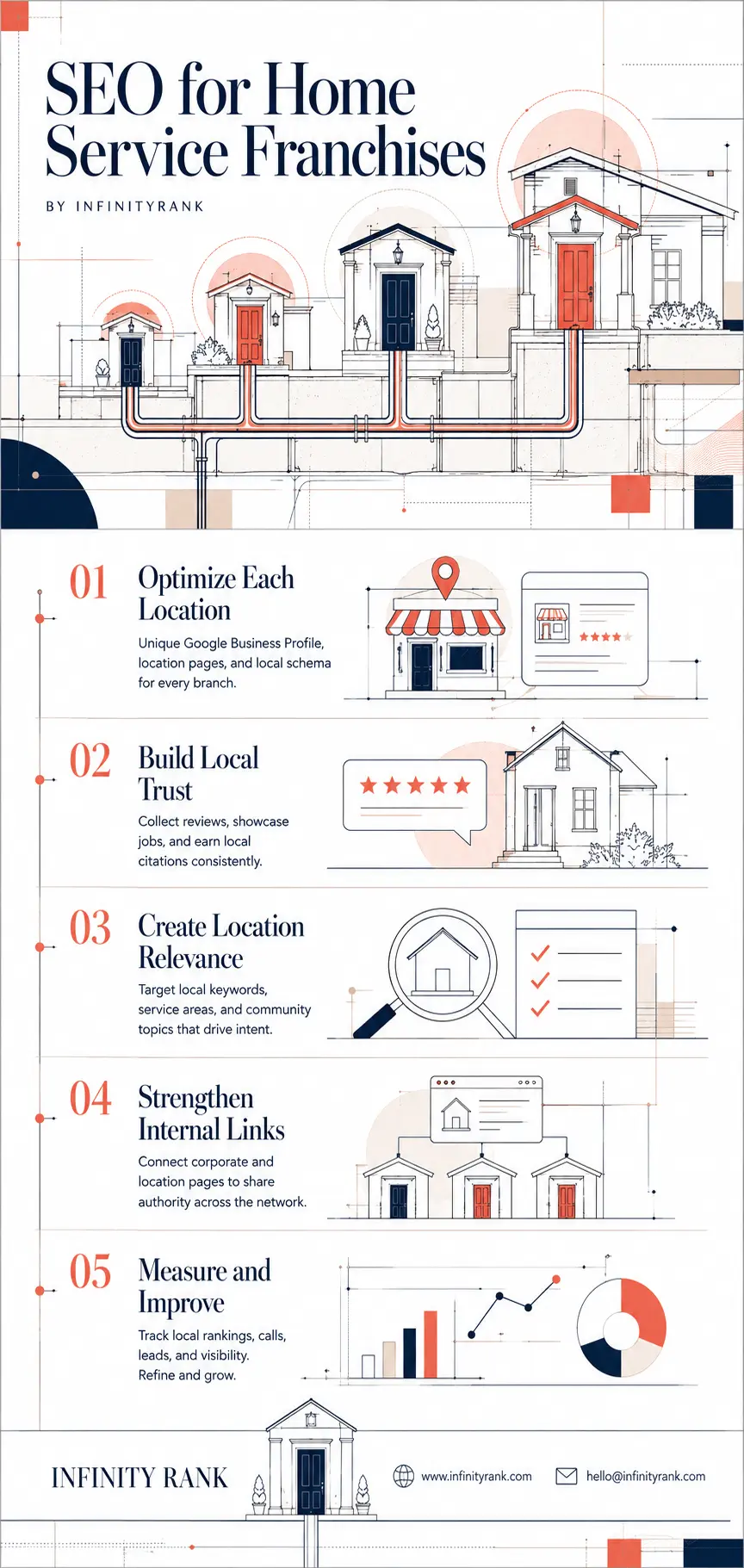
Establishing strong regional relevance relies on targeting high-intent local keywords, defined service areas, and community-focused topics. Connecting corporate parent pages with individual location landing pages through strategic internal linking ensures search authority flows seamlessly across your entire franchise network. By continuously measuring local rankings, phone calls, inbound leads, and overall map visibility, you can systematically refine your strategy to maximize return on investment. Use these five core pillars as your strategic roadmap to outrank local competitors and scale revenue across every branch.
Why Franchise SEO Is Different From Single-Location SEO
A single-location plumber, cleaning company, HVAC contractor, landscaper, roofer, or restoration business has one website, one main service area, and usually one Google Business Profile.
A franchise has several connected but distinct entities:
- The national or regional brand
- The corporate website
- Individual franchise locations
- Franchise owners and local teams
- Separate service territories
- Multiple phone numbers and booking routes
- Local profiles, citations, reviews, and partnerships
- Central and local marketing campaigns
Each location needs to be discoverable in its own market, but every location cannot make independent SEO decisions without limits.
Too much central control produces generic pages with no local proof. Too little control produces duplicate content, inconsistent branding, weak data, and account ownership disputes.
The right model is central governance with local execution.
Decide What Corporate Controls and What Franchisees Control
Before changing titles, building links, or publishing local content, assign responsibility for every part of the SEO program.
A practical ownership model looks like this:
| SEO Responsibility | Franchisor or Corporate Team | Franchisee or Local Team |
| Main website and hosting | Owns and maintains | No direct control |
| Technical SEO standards | Defines and enforces | Reports local problems |
| Location-page template | Creates and controls | Supplies accurate local material |
| Google Business Profile policy | Defines ownership and access | Maintains approved local details |
| Business name and branding | Defines | Uses approved version |
| Services and service areas | Sets rules | Confirms local availability |
| Local photos and staff details | Sets quality standards | Supplies original assets |
| Review-request process | Provides system and policy | Sends requests after real jobs |
| Review responses | Provides guidance | Responds or approves responses |
| Citation management | Coordinates centrally | Confirms business information |
| National content | Researches and publishes | Provides subject expertise |
| Local content | Approves format and standards | Supplies local facts and examples |
| Local partnerships | Defines compliance rules | Builds genuine relationships |
| Analytics and reporting | Consolidates network data | Reviews and acts on local results |
Document these responsibilities instead of relying on informal agreements.
The policy should also explain what happens when:
- A franchise is sold
- A location closes
- A franchisee changes address
- A manager leaves
- A location changes its phone number
- Two franchisees dispute a service territory
- A location receives a Google suspension
- A franchisee wants to hire a separate marketing provider
These events are predictable. The process should exist before they happen.
Establish Google Business Profile Governance
Google Business Profiles are among the most valuable—and most frequently mishandled—assets in franchise SEO.
Keep Primary Ownership Under Organisational Control
Do not allow a franchise location’s only profile owner to be an employee, former agency, temporary manager, or franchisee’s personal email account.
The franchisor or an approved organisational account should retain appropriate ownership access. Franchisees and local managers can receive the level of access needed to update information, add photos, publish posts, or respond to reviews.
Google provides separate owner and manager roles, and primary ownership can be transferred when required. Build an access register showing:
- Location
- Profile URL
- Primary owner
- Other owners
- Managers
- Recovery email
- Verification status
- Date last audited
Review the register at least quarterly and immediately after staff, agency, or ownership changes.
Create Profiles Only for Eligible Locations
A franchise does not qualify for a separate profile in every city it wants to target.
Google allows separate profiles for genuine service-business locations when those locations have separate staff and service areas. A business that operates from one base cannot create additional profiles simply to rank in nearby cities.
For each proposed profile, confirm:
- The location represents a real operating base.
- Staff work from that location.
- The location serves customers during its stated hours.
- The address complies with Google’s rules.
- The business can complete verification.
- The profile represents the actual business rather than a lead-generation page.
Do not use virtual offices, shared addresses without real operations, rented mailboxes, or employee homes solely to manufacture additional map visibility.
Use the Real Business Name
The profile name should match the name used in the real world.
Do not add cities, service keywords, promotional language, telephone numbers, or opening hours unless they are genuinely part of the business name.
For example, do not change:
ClearFlow Plumbing
to:
ClearFlow Plumbing — Best 24/7 Emergency Plumber in Dallas
The second version may look more relevant, but it misrepresents the business and creates policy risk.
Google’s guidelines require businesses to represent themselves accurately and state that unnecessary information should not be added to the business name.
Standardise Categories Without Misrepresenting Locations
Comparable franchise locations should use a consistent primary category that represents the brand’s main service.
Secondary categories may differ when a branch genuinely offers additional services, but they should not be added simply to target more keywords.
Maintain an approved category list containing:
- Primary category
- Permitted secondary categories
- Services required for each category
- Categories that must not be used
- Approval process for exceptions
This prevents one location from being configured as a plumber, another as a general contractor, and another as a water damage restoration service when all three perform the same core work.
Set Addresses and Service Areas Correctly
A storefront or hybrid business may display its address when customers can visit during the stated hours.
A service-area business that does not serve customers at its address should hide the address and define the areas it actually serves. Google currently allows up to 20 service areas and advises businesses to keep the overall area reasonably connected to their operating base.
Service areas should reflect operational reality. Adding more cities does not guarantee visibility in those cities.
For franchises, service-area settings must also match contractual territories. Do not let neighbouring branches claim the same broad list of cities without a lead-routing and page-targeting plan.
Give Each Location a Direct Customer Route
Whenever practical, use a location-specific phone number and a website URL that represents the individual branch.
Google recommends using a local number rather than a central helpline where possible and requires the phone number to remain under the business’s direct control.
A central call centre can still handle enquiries, but tracking and routing must identify the correct location. Customers should not click a local profile, reach a national operator, repeat their details, and then discover that the selected branch does not serve them.
Maintain Complete, Accurate Profiles
Each location should have:
- Correct business name
- Correct primary and secondary categories
- Location-specific phone number
- Correct location-page URL
- Accurate regular and special hours
- Real service areas
- Services available at that branch
- Booking or appointment link where relevant
- Original exterior, interior, vehicle, equipment, staff, and project photos
- A clear business description
- Relevant attributes
- A documented review-response process
Local results are primarily influenced by relevance, distance, and prominence. Google also states that links, reviews, and positive ratings can contribute to prominence. No optimisation can override the searcher’s location or guarantee a particular position.
Use One Strong Website Unless There Is a Clear Reason Not To
For most home service franchises, one central domain with dedicated location sections is easier to govern than a separate website for every franchisee.
A central architecture can:
- Consolidate brand authority
- Apply technical fixes across the network
- Keep designs and conversion paths consistent
- Simplify analytics and call tracking
- Prevent franchisees from publishing conflicting information
- Create clear relationships between services and locations
- Preserve equity when a franchise changes ownership
- Reduce maintenance and security risk
A typical structure might be:
/services/
/services/plumbing/
/services/drain-cleaning/
/locations/
/locations/texas/
/locations/texas/dallas/
/locations/texas/austin/
The exact folders matter less than consistency, crawlability, and a clear relationship between the brand, services, states, regions, and branches.
Separate websites may still make sense when the network includes acquired brands, legally distinct regional companies, different countries, separate languages, or contractual limitations. That decision should follow a full migration and governance review—not personal preference from individual franchisees.
Build Location Pages That Deserve to Rank
A location page should help someone decide whether that branch is the right provider.
It should not exist merely because a keyword tool showed search volume for “service + city.”
What a Strong Franchise Location Page Includes
Each indexable page should contain enough unique information to justify its existence:
- Location or territory name
- Accurate address or service-area explanation
- Location-specific phone number
- Opening and emergency hours
- Services genuinely available from that branch
- Areas and neighbourhoods served
- Franchise owner, manager, or local team information
- Local licences, certifications, memberships, or insurance details
- Original team, vehicle, office, equipment, and project photos
- Locally relevant testimonials
- Real project or customer examples
- Local guarantees or service conditions
- Directions, parking details, or coverage information where relevant
- Local FAQs
- Clear call, booking, or quote CTA
- Links to relevant service pages
- Links to nearby locations when useful
A map embed alone does not make a page local.
Changing the city name in a national template does not make a page unique.
Do Not Publish Thin City Pages at Scale
A franchise may serve many cities from one operating location. That does not mean it needs hundreds of near-identical pages.
Pages that repeat the same content while swapping city names, ZIP codes, or map embeds offer little value. At scale, they can resemble doorway pages created to rank for similar geographic searches.
Google defines doorway abuse as creating pages or sites to rank for specific, similar queries while directing users toward the same destination.
Before indexing a city or area page, ask:
- Does this page serve a distinct audience?
- Does it contain substantial local information?
- Does the location genuinely serve this area?
- Is the content materially different from nearby pages?
- Can a visitor make a better decision after reading it?
- Is there local proof, expertise, or operational information to include?
If the answer is no, keep the area within the main location page rather than creating a weak standalone URL.
Use a Location-Page Quality Gate
Create a publication checklist with mandatory fields.
For example, do not publish or index a new location page until it contains:
- Verified contact information
- Approved service territory
- Unique introduction
- Unique service information
- At least one original local image
- Local team or ownership details
- Local proof or project information
- Unique FAQs
- Working conversion tracking
- Correct internal links
- Valid structured data
- Corporate editorial approval
This creates a repeatable standard instead of debating page quality branch by branch.
Manage Territory Overlap Before It Creates Cannibalisation
Home service franchises frequently have neighbouring territories. Two branches may both want to target the same city, suburb, or ZIP code.
Without rules, they may create competing pages, duplicate content, contradictory service claims, and confusing booking paths.
Build a central territory map showing:
- Franchise location
- Primary service area
- Secondary service area
- Overlap zones
- Services offered
- Lead-routing rules
- Assigned organic landing page
- Assigned Google Business Profile
- Exceptions and temporary coverage arrangements
For each geographic market, choose which page should be the primary organic destination.
Do not allow two locations to publish equivalent pages for:
Emergency Plumber in Springfield
Decide which branch owns the query based on actual territory, distance, staffing, availability, and contractual rules.
When two branches legitimately serve the same market, the website can explain the shared coverage and route the visitor based on ZIP code, service type, or availability. It should not pretend that both branches have an exclusive local presence.
Create a Content System for Corporate and Local Teams
“Publish more blogs” is not a franchise content strategy.
The network needs different content types for different jobs.
Corporate Content
The central team should usually control:
- National service guides
- Core service pages
- Maintenance and diagnostic resources
- Financing information
- Warranty explanations
- Brand standards
- Safety and compliance content
- Research and original data
- National partnerships
- Franchise-wide case studies
Corporate content creates consistency and prevents every franchisee from producing a weaker version of the same article.
Local Content
Local teams can contribute:
- Regional regulations
- Weather-related service issues
- Seasonal maintenance advice
- Local project examples
- Area-specific service questions
- Community partnerships
- Local team profiles
- Before-and-after projects
- Local property or infrastructure considerations
Local content still needs editorial control. Franchisees should submit facts, images, and examples through a standard form. The content team can then verify, edit, optimise, and publish the material.
Service Content
Every core service needs a clear commercial page.
For example, a plumbing franchise may need separate pages for:
- Emergency plumbing
- Drain cleaning
- Sewer repair
- Water heater installation
- Leak detection
- Pipe repair
- Commercial plumbing
Location pages should link to the services available locally. Service pages should help users find the closest appropriate branch.
Proof Content
Homeowners want evidence that the company can perform the work safely and reliably.
Useful proof includes:
- Named case studies where permission exists
- Documented before-and-after projects
- Certifications
- Licences
- Insurance information
- Technician qualifications
- Warranty terms
- Service-process explanations
- Original photos
- Verifiable reviews
Do not invent customer stories or publish anonymous percentage improvements without evidence.
Build a Location-Level Review System
Reviews affect both customer decisions and local prominence, but a franchise needs more than a generic “ask for reviews” policy. Google confirms that review quantity and positive ratings can contribute to local ranking.
Route Every Request to the Correct Location
Connect the review request to the branch that completed the job.
Your CRM or field-service software should identify:
- Location
- Technician
- Service
- Completion date
- Customer status
- Review-request status
- Review destination
Do not send every customer to the national brand profile or head-office listing.
Ask After a Real Service Outcome
Good request points include:
- Job completion
- Successful inspection
- Confirmed repair
- Positive follow-up
- Resolved support issue
Keep the request simple. Do not pressure customers to use specific keywords or provide a five-star rating.
Do Not Gate or Incentivise Reviews
Do not ask satisfied customers to post publicly while directing unhappy customers to a private form.
Do not offer discounts, gifts, entries, or payments in exchange for positive reviews.
The process should invite genuine feedback from eligible customers regardless of the expected rating.
Respond Locally but Use Clear Standards
Review responses should sound human, not copied from a corporate template.
Provide local teams with rules covering:
- Response time
- Privacy
- Tone
- Escalation
- Refund or legal disputes
- Abusive reviews
- Fake-review reporting
- When corporate approval is required
A useful response can confirm the service performed and show that the branch takes the customer’s experience seriously. It should not expose private job details or argue publicly.
Clean Up Citations and Business Information
A citation is a mention of a location’s business details on a directory, platform, association, or local website. Some citations include a backlink; others do not.
The goal is not to submit every location to hundreds of low-quality directories.
The goal is to make the business easy to verify.
Create a Master Location Database
Maintain one approved source of truth containing:
- Business name
- Alternate approved name
- Address
- Suite or unit
- Phone number
- Website URL
- Location-page URL
- Booking URL
- Opening hours
- Special hours
- Primary category
- Secondary categories
- Services
- Service areas
- Latitude and longitude
- Opening date
- Closure status
- Google Business Profile URL
- Major directory URLs
Do not manage this data through disconnected email threads and old spreadsheets.
Prioritise Relevant Listings
Focus on:
- Major search and map platforms
- Trusted business directories
- Industry associations
- Licensing bodies
- Local chambers
- Trade organisations
- Relevant home service platforms
- Local business organisations
- High-quality regional directories
Correct conflicting names, addresses, phone numbers, URLs, and duplicate records before chasing more volume.
For larger networks, central listing-management tools may help distribute and monitor location data. Infinity Rank’s guide to local link-building tools compares options for citation management, audits, map tracking, outreach, and multi-location reporting.
Earn Local Links Through Real Relationships
A franchise location does not need random backlinks from unrelated blogs.
It needs references that make sense for the business, market, and audience.
Potential local sources include:
- Chambers of commerce
- Trade associations
- Property-management partners
- Real estate agencies
- Suppliers
- Training organisations
- Certification bodies
- Local charities
- Schools
- Community events
- Local newspapers
- Neighbourhood publications
- Municipal resource pages
- Business-improvement districts
A sponsorship can be worthwhile when the business genuinely supports the organisation and receives legitimate visibility. Do not sponsor irrelevant websites solely to buy ranking value.
National teams can also support the network with:
- Original industry research
- Expert commentary
- Seasonal data
- Maintenance reports
- Safety resources
- Digital PR
- Linkable tools
- Visual resources
- National partnerships
Local links work best when they reflect real activity. Infinity Rank’s manual link-building guide explains how prospect qualification, relevant outreach, useful content, and transparent tracking differ from mass email and low-quality link schemes.
Fix Technical SEO Across the Entire Network
Technical problems multiply across franchise websites because templates affect hundreds of pages at once.
A single broken component can damage every location page.
Audit the network for:
- Pages blocked from crawling
- Accidental
noindextags - Incorrect canonical tags
- Duplicate titles and headings
- Broken location links
- Orphaned branches
- Redirect chains
- Slow templates
- Uncompressed images
- Poor mobile layouts
- JavaScript-rendered content that search engines cannot reliably access
- Duplicate city pages
- Incorrect structured data
- Invalid sitemap URLs
- Closed locations returning soft 404s
- Internal search pages being indexed
- Parameter and filter duplication
Create Rules for Location Changes
When a branch moves:
- Update the location page.
- Update the Google Business Profile.
- Update the master location database.
- Update priority citations.
- Verify phone and booking routes.
- Preserve the URL where practical.
- Add redirects if the URL must change.
- Test structured data.
- annotate the change in reporting.
When a branch closes:
- Decide whether another branch assumes the territory.
- Update the Google Business Profile correctly.
- Remove booking options.
- Explain the closure to users.
- Redirect the page only when a genuinely relevant replacement exists.
- Remove or update internal links.
- update directories and citations.
- Preserve historical data in analytics.
Do not redirect every closed location to the homepage. That often creates a poor user experience and hides the context of the closure.
Use Structured Data Accurately
Location pages can use the most specific suitable LocalBusiness subtype where the visible page supports it.
Relevant properties may include:
- Name
- Address
- Phone number
- URL
- Opening hours
- Geographic coordinates
- Image
- Area served
- Parent organisation
- Price range where appropriate
Google states that LocalBusiness structured data can help it understand details such as business hours and departments. Markup must match the visible page and does not guarantee a rich result.
The corporate homepage can also use Organisation structured data for the overall brand.
Do not add fake reviews, false locations, hidden business details, or irrelevant properties merely because a schema plugin permits them.
Improve On-Page SEO and Conversion Together
Ranking a location page is useless when the visitor cannot confirm coverage or contact the right branch.
Every important page should answer four questions quickly:
- What service is available?
- Where is it available?
- Why should the visitor trust this company?
- What should the visitor do next?
Titles and Headings
Write page titles and H1s that describe the real page.
Examples:
Dallas Plumbing Services | Brand Name
Drain Cleaning in Dallas, TX | Brand Name
Brand Name Dallas | Local Plumbing Team
Do not force every keyword variation into the title.
Use one clear H1 and descriptive H2s for services, service areas, local proof, FAQs, and contact information.
Calls and Forms
Make the primary action obvious on mobile and desktop.
Depending on the service, this may be:
- Call now
- Request service
- Book an inspection
- Get a quote
- Schedule an appointment
Forms should ask only for information needed to route and qualify the enquiry.
For urgent services, do not hide the telephone number beneath several promotional sections.
Mobile Performance
Many home service enquiries happen while the customer is dealing with an immediate problem.
Test:
- Tap-to-call buttons
- Sticky mobile CTAs
- Booking tools
- Address or ZIP-code routing
- Forms
- Menus
- Page speed
- Image loading
- Consent banners
- Live chat
- Error messages
A technically “responsive” page can still be difficult to use.
Prepare the Franchise for AI-Assisted Search
There is no separate shortcut that replaces standard SEO for AI Overviews or AI Mode.
Google’s current guidance says the same foundations remain relevant: crawlable pages, useful content, internal links, accurate structured data, good page experience, quality images, and maintained Business Profile information. There is no special AI schema or additional technical requirement for inclusion.
For a home service franchise, that means:
- Keep location information current.
- Publish clear service explanations.
- Show real expertise and proof.
- Answer specific customer questions.
- Maintain accurate profiles and citations.
- Make important information available in text.
- Use structured data that matches the page.
- Build credible brand and local references.
- Avoid mass-produced city pages with no original value.
Strong local SEO supports both conventional search and AI-assisted discovery. Do not create hundreds of shallow “AI-optimised” pages.
Measure Leads, Bookings, and Revenue by Location
Franchise SEO cannot be managed with one national traffic chart.
Each location needs its own performance view.
Track Search Visibility
Monitor:
- Non-branded clicks
- Branded clicks
- Search impressions
- Local organic rankings
- Map visibility by neighbourhood
- Indexed location and service pages
- Search queries by page
- Competitor visibility
- Technical errors
Track Business Outcomes
Monitor:
- Calls
- Qualified calls
- Missed calls
- Form submissions
- Booked appointments
- Quote requests
- Completed jobs
- Lead-to-booking rate
- Booking-to-job rate
- Revenue from organic leads
- Average job value
- Customer acquisition cost where available
Track Google Business Profile Performance
Google allows businesses managing multiple profiles to download performance data for several locations at once and compare them in a spreadsheet.
Include:
- Calls
- Website clicks
- Direction requests
- Bookings
- Search views
- Map views
- Review count
- Average rating
- Review-response time
Do not treat every profile action as a qualified lead.
Use Clean Attribution
Use:
- Location-specific tracking numbers
- Dynamic number insertion on the website
- UTMs on profile links
- Separate booking links
- CRM source fields
- Location and territory fields
- Call recordings where lawful
- Spam and wrong-number filtering
Separate leads from:
- Organic search
- Google Business Profile
- Paid search
- Local Services Ads
- Referral traffic
- Direct traffic
- Other campaigns
The purpose is not to produce a larger dashboard. It is to identify which locations need more visibility, better conversion, stronger follow-up, or operational support.
A 90-Day SEO Rollout for Home Service Franchises
A large network should not attempt to fix everything at once.
Start with the risks that affect ownership, eligibility, indexation, and lead tracking.
Days 1–30: Control and Audit
- Inventory every location.
- Audit Google Business Profile ownership.
- Remove obsolete users.
- Document primary owners and managers.
- Confirm each profile’s eligibility.
- Audit names, addresses, numbers, categories, hours, and URLs.
- Crawl the website.
- identify indexation and duplication problems.
- Map every location page to a real branch.
- Review territory overlap.
- Verify analytics, call tracking, and form tracking.
- Create the master location database.
- Choose a pilot group of locations.
Days 31–60: Repair the Foundation
- Correct profile data.
- Resolve duplicate profiles.
- Fix broken location pages.
- Correct canonical and indexation errors.
- Update the location-page template.
- Improve mobile conversion paths.
- Add approved structured data.
- Build the review-request workflow.
- Add UTMs and location-level tracking.
- Establish franchisee submission forms for photos and local information.
- Update priority citations.
- Train the pilot franchisees.
Days 61–90: Publish and Expand
- Rewrite weak pilot location pages.
- Publish local proof and project material.
- Strengthen service-to-location internal links.
- Launch review requests.
- Begin local partnership outreach.
- Create location-level reports.
- Compare pilot performance with baseline data.
- Document failures and exceptions.
- Refine the process.
- Roll the improved system out to the next location group.
A pilot exposes problems before they affect the entire network.
Common Franchise SEO Mistakes
Letting Every Franchisee Control Its Own Website
This creates inconsistent branding, weak security, conflicting data, and fragmented authority.
Letting an Agency Own Critical Accounts
Agencies can manage accounts. They should not become the only owners of profiles, analytics, tag managers, domains, or call-tracking systems.
Publishing One City Page for Every Keyword
A page needs a real purpose and local value. Replacing a place name in a template is not localisation.
Sending All Reviews to One Profile
The branch that completed the work should usually receive the review.
Reporting Traffic Without Lead Quality
More sessions do not matter when the calls are outside the service area, for unavailable services, or never answered.
Hiding Poor Franchisee Follow-Up
SEO may generate the lead correctly while the branch misses the call or responds two days later. Reporting must separate marketing failure from operational failure.
Treating Citations and Backlinks as the Same Thing
Citations validate business information. Backlinks are clickable references. Some listings provide both, but they solve different problems.
Expecting Service Areas to Create Rankings
Adding a city to a Google Business Profile does not establish a physical presence or guarantee visibility there.
Using Different Agencies Without Shared Rules
Separate providers may create duplicate pages, conflicting tracking, risky links, or inconsistent profile edits. Every provider must work inside the same governance system.
How Long Does Franchise SEO Take?
There is no universal three-month, six-month, or twelve-month guarantee.
Some fixes can produce value quickly:
- Correcting a broken telephone number
- Restoring an indexed location page
- Repairing a booking form
- Resolving account access
- Updating incorrect opening hours
- Fixing lead routing
Competitive visibility usually takes longer.
The timeline depends on:
- Number of locations
- Existing authority
- Website condition
- Local competition
- Profile history
- Content quality
- Technical debt
- Review strength
- Link profile
- Franchisee participation
- Speed of implementation
Judge the program by completed fixes, lead quality, booked work, and location-level improvement—not by an arbitrary promise.
Final Thoughts
SEO for home service franchises is an operational system, not a collection of local keyword tricks.
The franchisor needs to control the website, standards, profile ownership, data, tracking, and reporting. Franchisees need a clear process for providing accurate local information, earning reviews, supplying real proof, and building legitimate community relationships.
Start with three actions:
- Audit ownership and accuracy across every Google Business Profile.
- Evaluate whether each indexed location page provides genuine local value.
- Build reporting that connects search visibility to qualified leads, bookings, and revenue by location.
Once those foundations are controlled, content, reviews, citations, technical improvements, and link building become easier to scale.
Frequently Asked Questions
Who should own each franchise location’s Google Business Profile?
The franchisor or an approved organisational account should retain appropriate ownership access. Franchisees and local managers can receive owner or manager access based on their responsibilities. No profile should depend entirely on one employee, franchisee, or agency account.
Does every franchise location qualify for a Google Business Profile?
No. Each profile must represent an eligible real-world business location. Service businesses with different operating locations, separate staff, and separate service areas may qualify for individual profiles. Creating profiles merely to target additional cities violates the purpose of the platform.
Should every franchise location have its own website?
Usually not. One central domain with dedicated location sections is easier to govern, maintain, measure, and strengthen. Separate sites may be justified for acquired brands, different countries, distinct legal entities, or contractual reasons.
How do franchises avoid duplicate location pages?
Use a controlled template but require substantial local information before publication. Every page should contain verified branch details, original local proof, relevant services, local FAQs, useful service-area information, and a clear customer route. Do not publish pages that only swap the city name.
Can two franchise locations target the same city?
They can both serve the area when operationally legitimate, but the website needs a clear territory and lead-routing plan. Avoid publishing competing pages with the same purpose. Assign a primary destination or use a location finder to route customers based on ZIP code, availability, or service type.
What happens to SEO when a franchise location closes?
Update the Google Business Profile, booking routes, location database, citations, internal links, and website content. Redirect the page only when a genuinely relevant replacement exists. Do not silently send every closed-location URL to the homepage.
How should reviews be managed across a franchise network?
Send customers to the profile for the location that completed the job. Use a compliant request process, avoid incentives and review gating, define response standards, and track review volume and response time by branch.
Which SEO metrics should franchises compare across locations?
Compare non-branded visibility, local rankings, profile actions, qualified calls, forms, booked appointments, conversion rates, completed jobs, revenue, review performance, and lead follow-up. Traffic alone is not enough.
Can paid advertising replace SEO for a home service franchise?
No. Paid search, Local Services Ads, and SEO serve different purposes. Advertising can generate demand while campaigns are active. SEO builds organic visibility, location assets, useful content, and long-term discoverability. Many franchises use both, but they should track each channel separately.
Does SEO also help a franchise appear in AI search?
The same core work supports eligibility for AI-assisted Google Search features: crawlable pages, useful content, strong internal linking, accurate structured data, maintained Business Profiles, and credible business information. Google does not require separate AI schema or a special file.