Hiring an SEO company can give your business specialist expertise, additional implementation capacity, better data, and a more structured approach to organic growth.
But an agency is not automatically the right choice for every business.
Some companies need technical support, content production, digital PR, and ongoing reporting. Others can handle basic SEO internally or get the help they need from a freelancer.
The real question is not simply, “Do I need an SEO company?”
It is:
Does hiring an SEO company give us capabilities, time, or expertise that we cannot obtain more efficiently elsewhere?
This guide explains the main benefits of hiring an SEO company, what a competent agency should actually deliver, how much SEO services may cost, and when an agency is—or is not—the right investment.
What Does an SEO Company Do?
An SEO company helps improve how a website is discovered, understood, and presented in organic search results.
Depending on the business and contract, its work may include:
- Technical SEO audits
- Keyword and audience research
- Competitor analysis
- Content planning and optimisation
- Internal linking
- Website migration support
- Local SEO
- Link building and digital PR
- Google Search Console analysis
- Conversion tracking
- Performance reporting
- Coordination with developers, writers, and internal marketing teams
A good agency should not apply the same checklist to every client. It should first understand the business model, customers, competitors, website, commercial priorities, and implementation constraints.
Google recommends checking whether a prospective SEO provider is genuinely interested in the business, can explain its methods, provides realistic estimates, and follows Google Search Essentials.
Hiring an SEO Agency: Worth the Investment?
Trying to handle your own website optimization can quickly become overwhelming. Between fixing technical code bugs, writing fresh content, and trying to build links, there are simply too many moving pieces for a busy business to manage alone. Hiring a professional SEO company solves this problem by bringing in a full team that connects your search strategy directly to sales and revenue. This simple breakdown shows five clear ways an agency turns complex data into steady, everyday business growth.
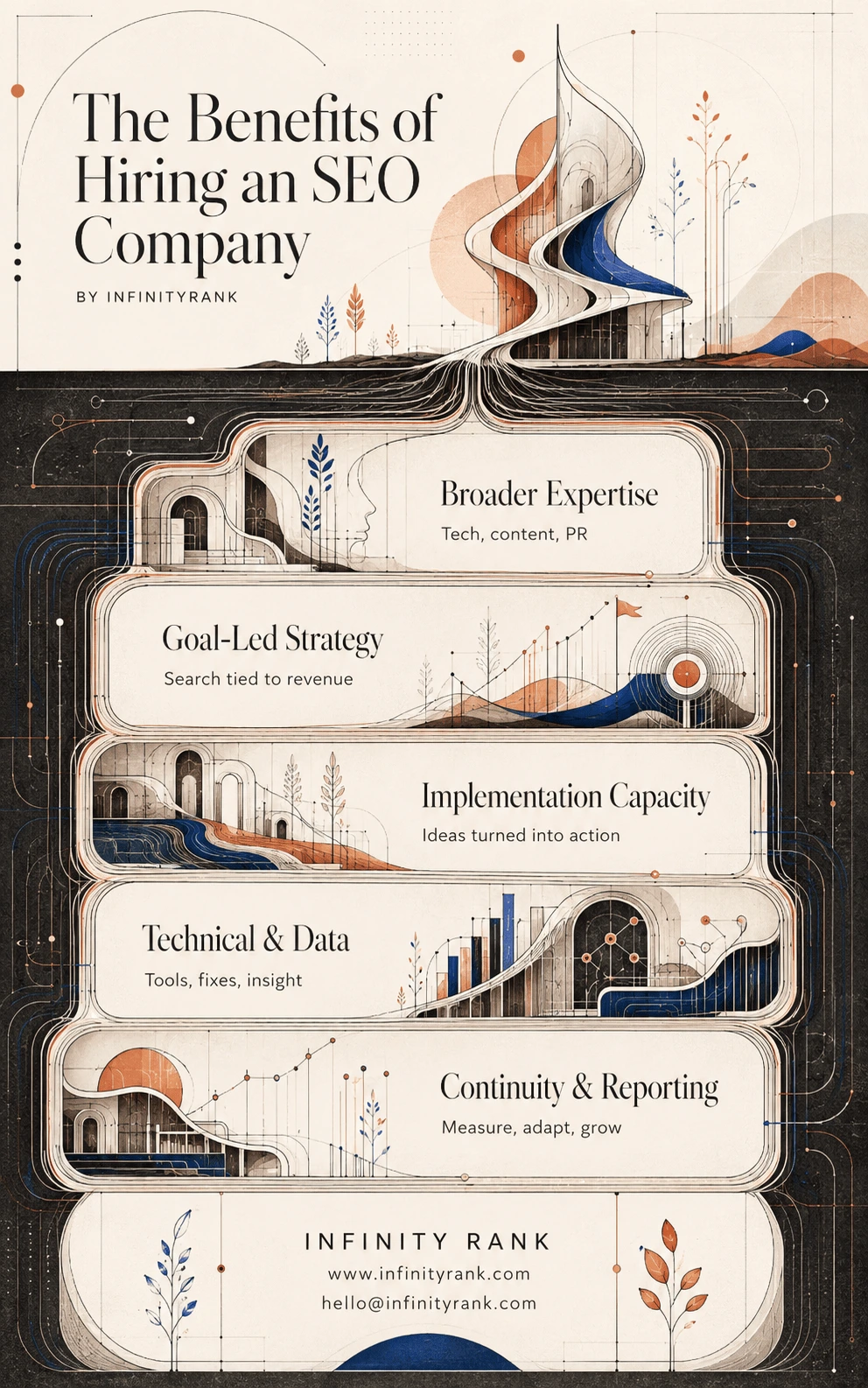
You do not have to struggle with search algorithms and ranking drops on your own. Partnering with professionals helps you skip the stressful guesswork, repair hidden site errors, and get clear progress reports that actually matter to your bottom line
The Main Benefits of Hiring an SEO Company
1. Access to Broader SEO Expertise
SEO is not one isolated task.
A campaign may require technical auditing, analytics, copywriting, content strategy, digital PR, link acquisition, local optimisation, and developer support. Few business owners—or individual marketing employees—are specialists in all of those areas.
An established SEO company can provide access to several disciplines through one working relationship.
This is particularly valuable when your website has:
- Crawling or indexing problems
- A large number of pages
- Multiple locations
- International versions
- Complex templates
- Declining organic traffic
- A history of poor-quality SEO work
- An upcoming redesign or migration
Google specifically identifies a new website or redesign as a useful time to involve an SEO professional because search requirements can then be considered before development decisions are finalised.
The benefit is not that an agency possesses secret ranking knowledge. It is that experienced specialists should recognise problems faster, prioritise them properly, and avoid repeating common mistakes.
2. A Strategy Built Around Business Goals
Traffic alone is not a useful business objective.
A website can attract thousands of visitors and still generate few qualified enquiries or sales. A competent SEO company should therefore connect search activity to outcomes such as:
- Qualified leads
- Online sales
- Appointment bookings
- Store visits
- Demo requests
- Subscription growth
- Pipeline value
- Customer acquisition cost
The strategy should also reflect how the business operates.
A local service company may need location pages, Google Business Profile optimisation, review acquisition, and call tracking. An ecommerce business may need category-page improvements, product schema, faceted-navigation controls, and commercial content. A SaaS company may need comparison pages, use-case content, integration pages, and non-brand demand generation.
A tailored strategy should define:
- Who the business needs to reach
- What those people search for
- Which pages should meet that demand
- What prevents those pages from performing
- Which actions are most likely to produce commercial value
- How success will be measured
Without that connection, SEO becomes a list of disconnected tasks rather than a growth programme.
3. More Implementation Capacity
Many SEO campaigns fail because recommendations are produced but never implemented.
An audit may identify hundreds of issues, but the document itself creates no value. Someone still has to update templates, improve content, redirect URLs, revise internal links, brief developers, create assets, and check that the changes work.
An agency can provide additional capacity through:
- SEO strategists
- Content writers and editors
- Outreach specialists
- Digital PR teams
- Technical consultants
- Designers
- Developers or developer liaison
- Data and reporting specialists
This can be more practical than asking one internal marketer to manage strategy, production, technical work, reporting, and stakeholder approval alone.
Before signing a contract, confirm exactly what the agency will implement. Some providers only make recommendations. Others complete content, outreach, and selected website changes themselves.
That distinction has a direct effect on cost, speed, and accountability.
4. Better Technical SEO and Website Performance
Technical SEO helps search engines crawl, render, index, and understand a website.
Common technical work includes:
- Resolving indexing problems
- Improving site architecture
- Fixing broken internal links
- Consolidating duplicate pages
- Managing redirects
- Reviewing canonical tags
- Improving XML sitemaps
- Checking robots directives
- Auditing JavaScript rendering
- Protecting traffic during migrations
- Maintaining mobile and desktop content parity
- Implementing valid structured data
Technical improvements can also help users by making pages faster, easier to navigate, and less prone to errors.
Google uses the mobile version of a website’s content for indexing and ranking, so important content, internal links, metadata, and structured data must remain available on mobile pages.
Structured data can make eligible pages available for supported rich-result formats, but it is not a guaranteed ranking boost or a shortcut into AI-generated search features. Google states that established SEO practices remain relevant to its generative search experiences.
A capable agency should explain which technical problems matter, which do not, and what business impact is expected from fixing them. If your website is large or complex, working with an advanced technical SEO consultant may be worth considering alongside a broader agency engagement.
5. Access to SEO Tools and Better Data
Professional SEO work often uses several tools for different purposes.
These may include:
- Google Search Console
- Google Analytics
- Keyword databases
- Crawlers
- Rank trackers
- Backlink analysis platforms
- Log-file analysers
- Page-speed testing tools
- Reporting dashboards
An agency normally includes access to its own tool stack within its fees. That does not make the tools free,the cost is built into the service but it may be more practical than buying and learning several subscriptions internally.
Tools, however, are not a substitute for judgement.
Third-party platforms use their own databases and proprietary metrics. Their traffic estimates, authority scores, keyword volumes, and difficulty scores can be useful for comparison, but they are not direct Google measurements.
Google advises businesses to assess third-party SEO tools and recommendations critically and verify advice against official search documentation.
A good agency should therefore combine tool data with:
- Search Console performance
- Analytics and conversion data
- CRM or sales information
- Website crawling
- Manual search-result analysis
- Customer and commercial insight
6. Consistent Content Planning and Production
Publishing isolated blog posts without a clear strategy rarely produces reliable results.
An SEO company can help create a structured content programme based on:
- Search demand
- Customer questions
- Commercial priorities
- Existing content gaps
- Competitor coverage
- Sales objections
- Product or service expertise
- Internal linking opportunities
This may include:
- Service pages
- Product or category content
- Buying guides
- Comparison pages
- Case studies
- Original research
- Industry resources
- Glossary content
- Supporting articles
The goal should not be to publish the highest possible number of pages. It should be to create useful pages for identifiable audiences and purposes.
Google’s guidance states that SEO is helpful when applied to people-first content rather than content created mainly to manipulate rankings.
A reliable agency should be able to explain:
- Why each page is needed
- Which audience it serves
- What makes it more useful than existing results
- Who will review its factual accuracy
- How it supports the wider website
- How performance will be measured
Content should not be approved merely because it contains target keywords.
7. Stronger Link Acquisition and Digital Authority
Links can help search engines discover pages and understand relationships between websites.
They can also produce referral traffic, brand exposure, partnerships, and media coverage. The importance of backlinks lies not in quantity alone,the quality and relevance of links matter far more than the raw total.
A competent SEO company may support link acquisition through:
- Digital PR campaigns
- Original research
- Expert commentary
- Newsworthy data
- Resource development
- Relationship-based outreach
- Unlinked brand mention reclamation
- Broken-link opportunities
- Relevant editorial contributions
The agency should be able to explain why a particular website or publication is relevant. It should not rely on bulk packages, private networks, automated outreach, or paid placements disguised as independent editorial recommendations.
Ask how prospective agencies assess:
- Relevance
- Editorial standards
- Organic visibility
- Website quality
- Audience fit
- Placement context
- Link attributes
- Spam risk
Avoid any provider whose main offer is a guaranteed number of links from sites above a third-party authority score. Those scores can support analysis, but they do not prove editorial quality, relevance, traffic, or business value. Common link building mistakes often stem from choosing providers on volume and price alone.
8. Clearer Measurement and Accountability
SEO reporting should show more than ranking movements.
A useful report should explain:
- What work was completed
- What changed on the website
- What happened to organic visibility
- Which landing pages gained or lost traffic
- Whether qualified conversions increased
- What problems remain
- What will be done next
- Which results can reasonably be connected to the campaign
Suitable KPIs may include:
- Organic leads or sales
- Conversion rate
- Revenue or pipeline from organic search
- Non-brand clicks and impressions
- Local calls, directions, or bookings
- Performance of priority landing pages
- Growth in relevant referring domains
- Indexed-page health
- Technical issue resolution
- Assisted conversions
Keyword rankings can provide diagnostic information, but they should not be treated as the final business outcome. A clearer way to frame agency performance is through link building ROI and measurable SEO metrics tied to commercial goals.
Before hiring an agency, ask to see an anonymised example report. Check whether it provides analysis and decisions or merely exports charts from third-party tools.
9. Time Savings and Strategic Continuity
SEO requires repeated work.
Websites change. Competitors publish new pages. Products are added. Links break. Search demand shifts. Developers release updates. Content becomes outdated.
An agency can provide continuity by maintaining a backlog, monitoring important changes, and coordinating work across different specialists.
That can free internal teams to focus on areas where their knowledge is more valuable, such as:
- Product development
- Customer service
- Sales
- Operations
- Subject-matter review
- Brand direction
The benefit is not that the business can completely ignore SEO. The strongest agency relationships still require internal input, access, approval, expertise, and implementation support.
An agency should reduce the burden,not remove the business from the process. This also applies to recurring activities like link reclamation, which require consistent monitoring that is difficult to sustain without dedicated resources.
When Hiring an SEO Company Makes Sense
An SEO company is usually worth considering when one or more of the following applies:
Your Website Has Serious Technical Problems
A large, complex, or poorly maintained website may require expertise that is not available internally.
You Are Planning a Redesign or Migration
SEO involvement before development can prevent avoidable losses caused by deleted pages, changed URLs, missing content, weak redirects, or altered internal linking. The risks of getting this wrong are significant—see what is involved in redesigning a website without losing SEO.
Organic Growth Has Stalled
An external team can identify whether the problem is technical, strategic, competitive, content-related, or caused by weak implementation. Reviewing common SEO mistakes is a useful starting point before engaging an agency.
Your Internal Team Lacks Capacity
You may understand what needs to be done but lack the people required to execute it consistently.
You Operate in a Competitive Market
Competitive search results may require better content, stronger authority, deeper technical work, and more sustained investment. Understanding which industries need SEO the most can help you benchmark how much effort your market typically demands.
Organic Search Has Clear Commercial Potential
SEO is easier to justify when customers actively search for your services or products and the potential return is large enough to support professional investment.
You Need Several SEO Skills
An agency can be more practical when the project requires technical, editorial, analytical, and promotional expertise at the same time.
When You May Not Need an SEO Company
Hiring an agency is not always necessary.
Google notes that small local businesses can often complete much of the basic work themselves, particularly when they are willing to learn fundamental SEO practices.
An agency may not be the right choice when:
- Your website is small and technically simple
- Search demand for your offer is extremely limited
- You have not yet validated the product or business model
- Your budget cannot support meaningful implementation
- You already have an experienced internal SEO team
- You need help with only one defined task
- Internal approvals prevent recommended changes from being made
- You expect guaranteed rankings or immediate returns
A freelancer or consultant may be more suitable for a focused audit, strategy review, migration, or training project. There are also dedicated SEO companies for small businesses that operate at lower price points if internal delivery is not viable.
SEO Agency vs Freelancer vs In-House vs DIY
| Option | Best suited to | Main advantage | Main limitation |
| SEO agency | Businesses needing several skills and ongoing delivery | Wider team and greater capacity | Higher cost and less direct control |
| Freelancer or consultant | Defined projects or specialist support | Flexible and often less expensive | Capacity depends on one person |
| In-house SEO | Businesses with continuous, substantial SEO needs | Deep company knowledge and direct access | Recruitment cost and narrower skill coverage |
| DIY SEO | Small, simple websites with limited budgets | Low direct cost and full control | Requires time, learning, and consistent execution |
The correct model depends on the amount of work, available budget, internal capability, and level of specialist knowledge required.
Some businesses use a hybrid model—for example, an internal marketing manager supported by an agency for technical SEO, content production, or link acquisition.
What Should an SEO Retainer Include?
Do not accept a proposal that promises only “ongoing optimisation.”
The contract should define what the agency is responsible for.
Depending on the campaign, a retainer may include:
- Initial discovery and benchmarking
- Technical auditing
- Keyword and market research
- Strategy development
- Content briefs
- Content creation or editing
- On-page optimisation
- Internal-link improvements
- Digital PR or link acquisition
- Local SEO work
- Developer recommendations
- Implementation support
- Analytics and conversion tracking
- Monthly reporting
- Strategy calls
- Quarterly reviews
Clarify:
- How many hours or deliverables are included
- Whether content writing is included
- Whether development is included
- Who owns all accounts and assets
- Who approves website changes
- How links are acquired
- How work is documented
- What happens when priorities change
- What the cancellation terms are
The business should retain ownership of its website, analytics, Search Console, content, and other core accounts.
How Much Does It Cost to Hire an SEO Company?
SEO pricing varies significantly.
The cost depends on:
- Website size
- Market competition
- Geographic reach
- Technical complexity
- Content requirements
- Link acquisition
- Number of products or locations
- Reporting requirements
- Whether implementation is included
- The agency’s experience and location
SEO services may be sold through:
- Monthly retainers
- Fixed-price projects
- Hourly consulting
- Audits
- Content or link-building packages
- Hybrid agreements
In a survey of 439 SEO service providers, Ahrefs found that $501–$1,000 was the most common monthly retainer band, while 42.8% of respondents charged between $501 and $2,000 per month. Those figures combine different provider types and regions, so they should be treated as market context—not as a reliable quote for a specific campaign.
A lower price is not automatically better value.
A cheap package that produces generic content, automated reports, and irrelevant links may create little value or cause additional cleanup work. A more expensive agency is also not automatically competent.
Compare providers according to:
- Scope
- Quality
- Relevant experience
- Implementation responsibility
- Communication
- Reporting
- Transparency
- Evidence of past work
How Long Does SEO Take?
There is no universal SEO timeline.
A small technical fix may be implemented quickly, but search engines still need to recrawl and reassess the affected pages. Content programmes, authority building, and competitive commercial queries generally require longer periods of consistent work.
Timelines are influenced by:
- The website’s starting condition
- Competition
- Search demand
- Website authority
- Content quality
- Technical complexity
- Development capacity
- Approval speed
- Publishing frequency
- The scale of the campaign
A prospective agency should provide a reasoned estimate based on the website and proposed work. It should not promise a particular ranking by a fixed date.
Google explicitly advises businesses to avoid providers that guarantee first place in search results.
Expect early reporting to focus on completed work, technical improvements, indexing, content deployment, and initial visibility changes. Commercial results should be evaluated over a longer period and against an agreed baseline.
How to Choose the Right SEO Company
Ask for Relevant Evidence
Request examples involving comparable business models, problems, or markets.
A case study should explain:
- The starting position
- The work completed
- The timeframe
- The measurement method
- The actual outcome
Screenshots without dates, context, or attribution are weak evidence. If you are specifically evaluating link building capability, reviewing what separates a best-in-class link building agency from a generic provider can sharpen your assessment criteria.
Ask How the Agency Works
The agency should be able to explain its process without hiding behind “proprietary methods.”
Ask:
- What will you do during the first 90 days?
- How will you decide what to prioritise?
- Who will work on the account?
- What will you need from our team?
- What do you implement directly?
- How do you measure leads or revenue?
- How do you acquire links?
- What will the monthly report contain?
- How do you respond when performance declines?
Check References
Speak with previous or current clients where possible.
Ask whether the provider:
- Communicated clearly
- Completed work as promised
- Explained its decisions
- Produced useful recommendations
- Responded to problems
- Reported honestly
Google also recommends checking business references before hiring an SEO.
Confirm Account Ownership
You should retain administrative ownership of:
- Google Search Console
- Google Analytics
- Google Business Profile
- Tag Manager
- Advertising accounts
- Your domain
- Your website
- Content and creative assets
The agency should receive only the level of access needed to do its work.
Review the Contract
Check the minimum term, notice period, ownership clauses, deliverables, exclusions, and cancellation process.
Do not sign a long contract based only on a sales presentation.
SEO Agency Red Flags
Avoid providers that:
- Guarantee first-place rankings
- Claim to have a special relationship with Google
- Refuse to explain their methods
- Sell large numbers of links with no relevance criteria — a hallmark of link farming rather than genuine outreach
- Promise immediate results
- Focus only on traffic rather than business outcomes
- Create content without subject-matter review
- Use the same strategy for every client
- Report only third-party authority metrics
- Require ownership of your core accounts
- Cannot show what was completed each month
- Recommend major website changes without explaining the risk
- Sell “AI optimisation” as a separate shortcut divorced from standard SEO fundamentals
Google’s current guidance warns businesses to evaluate claims made by third-party SEO and “AEO” or “GEO” tools rather than assuming that a provider’s terminology or proprietary score reflects how Google Search works.
Is Hiring an SEO Company Worth It?
Hiring an SEO company can be worth the cost when:
- Organic search has meaningful commercial potential
- The agency provides skills or capacity you do not have
- The proposed work supports clear business goals
- Your team can implement or approve recommendations
- The expected return justifies the investment
- The provider is transparent about methods, risks, and measurement
It is not worth the cost when the work is vague, the business cannot support implementation, or the provider relies on guarantees and vanity metrics.
A good SEO company should provide a defensible strategy, complete useful work, measure the right outcomes, and explain what is and is not working.
It cannot guarantee rankings.
It can provide the expertise, structure, and execution needed to give the campaign a credible chance of success.
Frequently Asked Questions
Do I Need an SEO Company, or Can I Do SEO Myself?
You can handle basic SEO yourself, particularly if your website is small and straightforward. Google provides an SEO Starter Guide covering fundamental practices. An agency becomes more useful when the website is complex, the market is competitive, or the required work exceeds your available time and expertise.
What Are the Biggest Benefits of Hiring an SEO Company?
The main benefits are access to broader expertise, additional implementation capacity, technical support, content planning, professional tools, clearer reporting, and a consistent long-term process.
How Much Does an SEO Company Charge?
Pricing varies by provider, region, website size, competition, and scope. Agencies may charge a monthly retainer, fixed project fee, or hourly rate. Compare the actual deliverables and implementation responsibility rather than choosing on price alone.
How Long Should I Hire an SEO Agency For?
The appropriate period depends on the project. A technical audit or migration may be limited in duration, while content, digital PR, and competitive growth campaigns normally require ongoing work. The contract should include review points and a reasonable cancellation process.
Can an SEO Company Guarantee Rankings?
No. Search rankings depend on factors outside the agency’s control, including competition, search systems, website implementation, and user demand. Avoid providers that guarantee a specific position or deadline.
What Should I Ask an SEO Company Before Hiring It?
Ask about its process, relevant experience, deliverables, reporting, link-acquisition methods, implementation responsibilities, account ownership, expected timeframe, and how success will be measured.
Is an SEO Agency Better Than a Freelancer?
Not automatically. Agencies usually offer greater capacity and a wider range of skills. Freelancers may provide more direct communication, specialist knowledge, and lower costs. The right choice depends on the project. Some businesses also explore outsourcing specific link building tasks rather than engaging a full-service agency.