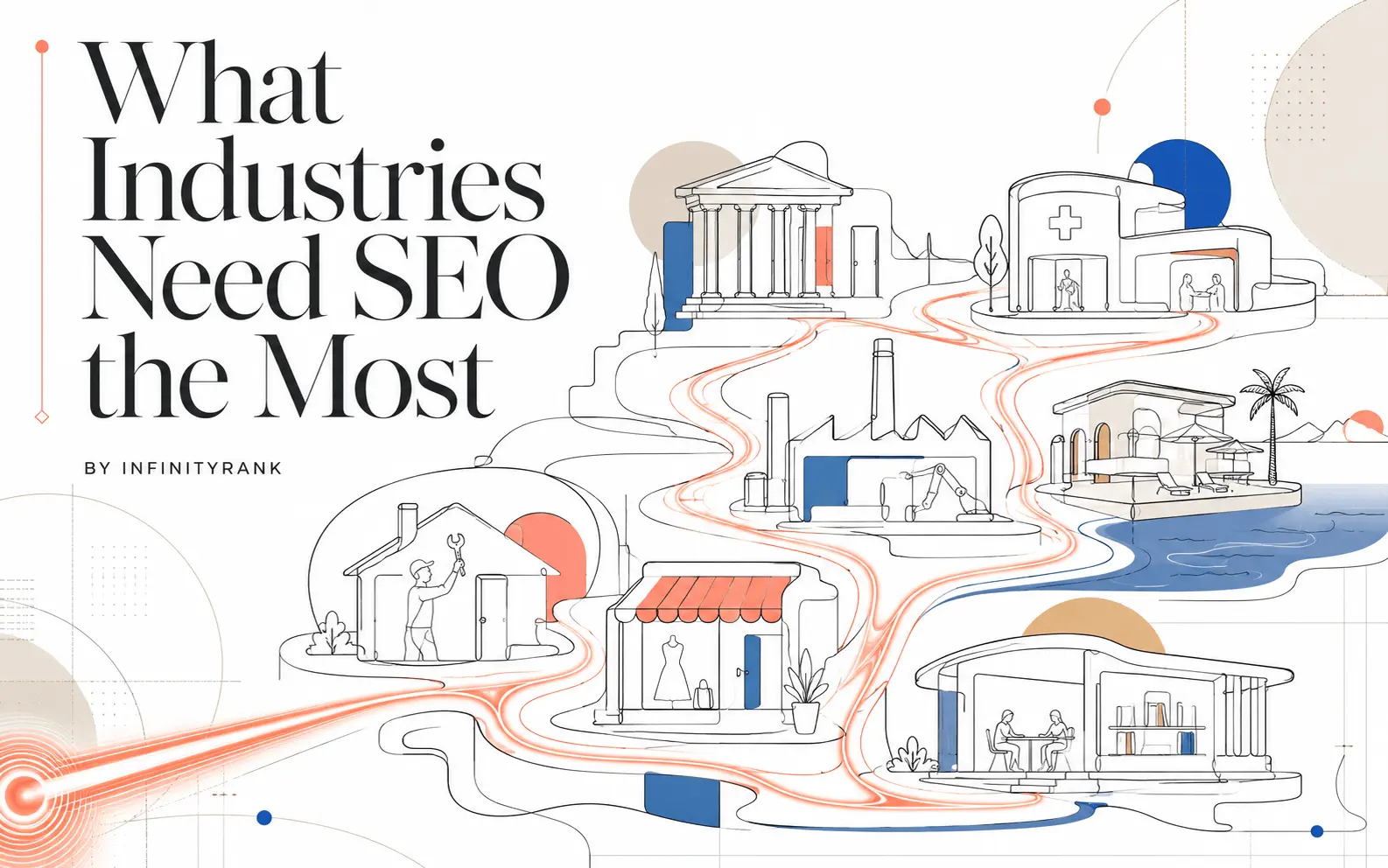
The industries that need SEO the most are home services, legal and professional services, healthcare, ecommerce, financial services, SaaS, manufacturing, real estate, hospitality, and education.
These sectors benefit disproportionately because customers regularly use search engines to compare providers, research purchases, check credibility, and decide whom to contact. Many also have high-value conversions, strong local intent, or complex buying journeys that cannot be covered adequately by one advertisement or social media post.
However, there is no universal industry ranking. A roofing company in a competitive city may have far more to gain from SEO than a national software company with almost no relevant search demand.
The ranking below is therefore a practical commercial assessment based on:
- Existing search demand
- Strength of purchasing intent
- Average customer or contract value
- Dependence on local visibility
- Amount of research conducted before purchase
- Level of competition
- Ability to create useful, differentiated pages
- Potential to generate leads or revenue repeatedly
Which Industries Benefit Most From SEO?
| Rank | Industry | Why SEO Is Important | Primary SEO Focus |
| 1 | Home services and local franchises | Urgent, location-specific searches often lead directly to calls and bookings | Local SEO, service pages, location pages and reviews |
| 2 | Legal and professional services | High-value clients research expertise and credibility before making contact | Service content, local SEO, professional profiles and authority |
| 3 | Healthcare and dental services | Patients search by treatment, condition, provider and location | Local SEO, medically reviewed content and service pages |
| 4 | Ecommerce | Search can influence product discovery, comparison and purchasing | Category pages, product SEO, structured data and technical SEO |
| 5 | Financial services and insurance | Customers conduct extensive research before making high-risk decisions | Trust, expert content, service pages and compliance |
| 6 | SaaS and B2B technology | Buyers research categories, alternatives, integrations and solutions | Commercial content, comparison pages, product-led content and links |
| 7 | Manufacturing and industrial services | Technical searches can generate valuable contracts and requests for quotes | Capability pages, technical content and international SEO |
| 8 | Real estate and property services | Buyers and sellers search by location, property type and service | Local pages, market guides, listings and agent authority |
| 9 | Hospitality and travel | Search visibility can reduce dependence on booking platforms and aggregators | Local SEO, destination content and direct-booking pages |
| 10 | Education and professional training | Prospective students compare courses, institutions, costs and outcomes | Program pages, comparison content and international SEO |
Essential SEO: Who Needs It Most?
Not every business needs to spend a massive budget on search engine optimization, but for certain fields, it is absolutely required to survive. If your customers look for you locally, compare multiple options before buying, or need to trust you completely before hiring you, staying hidden on Google will cost you business. This simple guide looks at the key signs that show which industries must use SEO to win customers and grow their sales.

Investing in search visibility is not just about getting random web traffic; it is about being right in front of people when they are ready to buy. When you focus on your market’s specific search habits, your business naturally turns clicks into steady revenue.
1. Home Services and Local Franchises
Home-service businesses are among the strongest candidates for SEO because their customers frequently search when they have an immediate problem.
Examples include:
- Plumbers
- Electricians
- HVAC contractors
- Roofers
- Pest-control companies
- Locksmiths
- Cleaning companies
- Landscapers
- Appliance-repair services
- Multi-location service franchises
Someone dealing with a leaking pipe or broken heating system is unlikely to spend weeks researching options. They search for a suitable provider nearby, review several results, and contact one that appears available and trustworthy.
This makes visibility in local organic results and Google Maps commercially important.
Google states that local results are primarily determined by relevance, distance, and prominence. Complete business information, genuine reviews, accurate categories, and a strong website can therefore contribute to local visibility, although no individual action guarantees a particular ranking.
SEO priorities for home-service businesses
- Create a dedicated page for every meaningful service.
- Build location pages only where the business genuinely operates.
- Maintain complete and consistent Google Business Profiles.
- Publish real project examples with locations, photographs and outcomes.
- Collect legitimate customer reviews without offering prohibited incentives.
- Display licenses, insurance, guarantees and service coverage clearly.
- Make phone numbers and booking actions prominent on mobile devices.
- Track qualified calls, forms and confirmed jobs rather than traffic alone.
A generic five-page website will struggle to cover the range of services and locations customers search for. The site needs enough depth to explain what the company does, where it works, and why a customer should trust it.
2. Legal and Professional Services
Law firms, accountants, consultants, architects and other professional-service businesses often compete for clients with a high potential value.
Their prospects rarely choose a provider based on one broad homepage. They search for a specific service, review the firm’s experience, assess individual professionals, read explanations of the issue, and compare several alternatives.
For example, a law firm may need separate pages for:
- Divorce and family law
- Employment disputes
- Criminal defense
- Immigration
- Personal injury
- Commercial litigation
- Estate planning
Combining all of these services into a single “What We Do” page prevents the firm from addressing the intent behind each search properly.
SEO priorities for professional services
- Create detailed pages for each core service.
- Build credible professional biography pages.
- Explain qualifications, experience and relevant specialisms.
- Publish useful answers to genuine client questions.
- Add location pages where local intent exists.
- Use case studies or representative matters where regulations permit.
- Strengthen authority through relevant editorial coverage and links.
- Review all legal, financial or technical content before publication.
Trust is especially important when content could affect a person’s finances, legal position, health or safety. Google says its systems place greater emphasis on strong experience, expertise, authoritativeness and trust for these “Your Money or Your Life” topics.
Publishing generic articles written without subject-matter review is not enough. The content must demonstrate who created it, why that person is qualified, and when professional advice is required.
3. Healthcare and Dental Services
Healthcare SEO connects patients with providers, treatments and reliable information. It is particularly important for:
- Dentists
- Physiotherapists
- Private clinics
- Therapists
- Optometrists
- Dermatologists
- Chiropractors
- Fertility clinics
- Cosmetic-treatment providers
- Multi-location medical practices
Healthcare searches often combine a service with a location, such as “emergency dentist near me” or “physiotherapy clinic in Boston.” Others involve a treatment, symptom or question that appears earlier in the patient journey.
That creates opportunities for both local service pages and educational content. It also creates substantial responsibility.
SEO priorities for healthcare providers
- Create a separate page for every treatment or clinical service.
- State which qualified professional reviewed medical content.
- Include author and reviewer credentials.
- Explain benefits, limitations, risks and suitability accurately.
- Avoid exaggerated outcomes and unsupported medical claims.
- Maintain accurate location, opening-hour and contact information.
- Publish clear pricing or insurance information where possible.
- Make appointment booking simple on mobile devices.
- Review older medical content regularly.
Healthcare businesses should not turn every symptom into a thin article designed only to capture traffic. Google recommends creating people-first content that demonstrates genuine expertise and leaves readers with enough information to achieve their goal.
The purpose of healthcare SEO should be to help patients find appropriate services and understand their options—not to replace professional diagnosis.
4. Ecommerce
Ecommerce businesses can use SEO to reach customers during product discovery, comparison and purchase.
Unlike a local service business, an online retailer may need to optimize hundreds or thousands of URLs, including:
- Product pages
- Category pages
- Subcategory pages
- Brand pages
- Buying guides
- Comparison pages
- Product-support content
The size of the website creates both opportunity and risk. Poor filters, duplicate variants, weak category pages and uncontrolled faceted navigation can produce large numbers of low-value or competing URLs.
SEO priorities for ecommerce businesses
- Build a clear category and subcategory structure.
- Target broader commercial terms with category pages.
- Write useful product descriptions rather than copying manufacturers.
- Manage product variants and canonical URLs correctly.
- Keep discontinued-product handling consistent.
- Improve internal linking between products, categories and guides.
- Optimize product images without sacrificing quality.
- Submit accurate product information through Google Merchant Center.
- Add valid product structured data.
- Earn links through useful assets, original data and digital PR.
- Measure non-brand organic revenue, not traffic alone.
Google’s product structured-data documentation explains that eligible product pages may display information such as price, availability, ratings and shipping details in richer search experiences. Structured data creates eligibility; it does not guarantee that Google will show a rich result.
Ecommerce SEO should also extend beyond product pages. Buying guides, sizing information, comparisons, care instructions and expert recommendations can answer questions that product descriptions cannot.
5. Financial Services and Insurance
Banks, lenders, insurance providers, tax advisers, mortgage brokers and financial-planning firms operate in one of the most trust-sensitive search environments.
Customers may be making decisions that affect their savings, debt, insurance coverage or long-term financial security. They therefore need accurate explanations, transparent terms and clear information about the organisation behind the content.
SEO priorities for financial businesses
- Create comprehensive pages for each service or financial product.
- Explain rates, fees, eligibility and exclusions clearly.
- Display relevant licenses, registrations and professional credentials.
- Use qualified writers and reviewers.
- Add publication and review dates where they help users.
- Provide calculators or comparison tools with clear assumptions.
- Support important claims with primary evidence.
- Avoid promising guaranteed returns or outcomes.
- Maintain strict legal and compliance review.
- Build authority through relevant, reputable publications.
A high search volume does not justify publishing financial content outside the company’s expertise. Thin definitions and generic “best investment” articles can undermine trust rather than strengthen it.
For financial SEO, accuracy and accountability are not optional quality improvements. They are fundamental requirements.
6. SaaS and B2B Technology
SaaS companies often have longer and more complex buying journeys than consumer businesses.
A potential buyer may search for:
- A software category
- A solution to a business problem
- A particular feature
- An integration
- An alternative to a competitor
- A product comparison
- Pricing information
- Implementation guidance
- Reviews or case studies
This gives SaaS companies multiple opportunities to appear before a buyer requests a demonstration or starts a trial.
SEO priorities for SaaS businesses
- Create clear product, feature and use-case pages.
- Build pages for legitimate integrations.
- Target relevant category and solution searches.
- Publish accurate comparison and alternative pages.
- Develop templates, calculators or free tools.
- Turn proprietary data into useful reports.
- Publish implementation guides and technical documentation.
- Use customer case studies to support commercial claims.
- Build relevant links through original research and digital PR.
- Connect organic traffic to trials, demos and qualified pipeline.
SaaS companies should not publish hundreds of near-identical integration or competitor pages merely to occupy more search results. Each page needs a genuine purpose, distinct information and enough detail to help a buyer make progress.
The best SaaS content connects search intent to the product. It should show how the software solves a specific problem rather than merely defining the problem.
7. Manufacturing and Industrial Services
Industrial SEO is valuable because a relatively small number of qualified searches can produce significant commercial opportunities.
Manufacturers, component suppliers, engineering firms and specialist contractors may serve narrow markets, but their customers still use search engines to identify capabilities, compare suppliers and evaluate technical fit.
Useful searches may include:
- A manufacturing process
- A material and application
- A required tolerance
- An industry certification
- A component specification
- A supplier and geographic market
- A repair or maintenance capability
SEO priorities for industrial companies
- Create a dedicated page for each genuine capability.
- Target precise technical language used by buyers and engineers.
- Include materials, tolerances, production volumes and limitations.
- Publish certification and quality-control information.
- Add specification sheets, diagrams and downloadable resources.
- Create case studies with measurable project details.
- Optimize for regional or international markets where appropriate.
- Make requests for quotes straightforward.
- Strengthen credibility through relevant industry publications.
- Track qualified RFQs and contract value rather than raw lead numbers.
Industrial businesses often have strong offline expertise but weak websites. Replacing vague claims such as “high-quality solutions” with detailed capability information can improve both search relevance and buyer confidence.
8. Real Estate and Property Services
Real estate is strongly influenced by location. Buyers, sellers, landlords and tenants search by city, neighborhood, property type, budget and service.
The sector also faces intense competition from listing portals and major property platforms. A smaller agency is unlikely to defeat these platforms for every broad property search, but it can build visibility around its specific market knowledge and services.
SEO priorities for real estate businesses
- Create useful neighborhood and area guides.
- Build pages around genuine service areas.
- Develop property-type and buyer-specific pages.
- Maintain accurate and crawlable listings.
- Create detailed agent and office profiles.
- Publish local market analysis based on real data.
- Add original photography, maps and video.
- Keep sold, rented and expired listings under control.
- Build local authority through partnerships and editorial coverage.
- Track valuation requests, viewings and qualified enquiries.
Generic articles such as “ten tips for buying a home” are unlikely to establish a meaningful advantage on their own. Local data, first-hand market experience and original property insight are far more defensible.
9. Hospitality and Travel
Hotels, tour companies, restaurants, attractions and travel providers frequently compete against booking platforms, review websites and large travel publishers.
SEO cannot eliminate those intermediaries, but it can help businesses generate more direct discovery and bookings.
SEO priorities for hospitality and travel businesses
- Optimize individual property, room, tour or experience pages.
- Maintain accurate local business information.
- Build useful destination and itinerary content.
- Answer practical questions about transport, access and facilities.
- Show current photographs and detailed amenity information.
- Improve the mobile booking experience.
- Make cancellation and booking terms easy to find.
- Develop pages around seasonal demand without creating disposable content.
- Earn links from relevant tourism, local and editorial websites.
- Track direct bookings and booking revenue.
A hotel’s destination guide should offer knowledge that a generic travel summary cannot. That may include local transport advice, realistic travel times, accessibility details and recommendations based on first-hand experience.
10. Education and Professional Training
Universities, colleges, training providers and online learning platforms serve audiences that conduct extensive research before enrolling.
Prospective students may compare:
- Course content
- Entry requirements
- Tuition and funding
- Delivery methods
- Accreditation
- Faculty
- Career outcomes
- Location
- Student support
- Alternative programs
Each of these subjects may require a dedicated, well-maintained page.
SEO priorities for education providers
- Create comprehensive program and course pages.
- Publish clear entry and eligibility requirements.
- Explain tuition, funding and additional costs.
- State accreditation accurately.
- Include faculty credentials and relevant experience.
- Provide realistic information about course outcomes.
- Develop comparison content without disparaging competitors.
- Optimize for international audiences where relevant.
- Keep application dates and course availability current.
- Track applications, enrolments and qualified enquiries.
Education providers should avoid vague promises about employment or earnings. Prospective students need evidence, context and transparent limitations before committing substantial time or money.
Other Industries That Can Benefit Strongly From SEO
The top ten are not the only worthwhile sectors. SEO can also be valuable for:
- Automotive dealers and repair businesses
- Restaurants and food-service companies
- Recruitment agencies
- Pet-care providers
- Renewable-energy installers
- Telecommunications companies
- Local retailers
- Wedding and event services
- Logistics providers
- Membership organisations
The deciding factor is not the industry label alone. It is whether the business has meaningful search demand, a commercially valuable conversion, and the resources to compete.
How to Decide Whether SEO Should Be a Priority
Score each question from zero to two:
0: No / 1: Partly / 2: Strongly
1. Do customers search for your product, service or problem?
SEO needs existing or emerging demand. It cannot reliably manufacture demand for a category nobody understands.
2. Do those searches indicate commercial intent?
A smaller number of searches from people ready to request a quote may be worth more than a large volume of broad informational traffic.
3. Is a new customer valuable enough to justify sustained investment?
Consider gross margin, repeat purchases, contract size and lifetime value—not only initial revenue.
4. Can your business create genuinely useful pages?
SEO becomes difficult when every page repeats the same generic claims as competitors.
5. Can the website convert qualified visitors?
Ranking a slow, confusing or untrustworthy website will not solve a weak conversion process.
Interpreting the score
- 8–10: SEO is likely to be a high-priority acquisition channel.
- 5–7: SEO may be valuable, but investment should target the strongest opportunities first.
- 0–4: Maintain basic search visibility, but another channel may deserve more immediate investment.
This is a decision framework, not a guaranteed ROI calculation. Competitor strength, resources, geography and website condition still matter.
What an Effective SEO Strategy Should Include
The exact work varies by industry, but most successful strategies require six connected areas.
Technical foundations
Search engines must be able to crawl, render and index the right pages. The website should also work properly on mobile devices, use HTTPS, avoid intrusive interruptions and provide a clear main experience. Google recommends assessing page experience as a combination of factors rather than pursuing one isolated score.
Search-intent mapping
Each important search should be matched to the correct type of page. A product search should not lead to a generic blog post, and a local service search should not lead to an irrelevant national page. A topical map is one of the most effective tools for getting this right before content production begins.
Useful commercial pages
Service, category, product, location and comparison pages need enough substance to help a visitor make a decision.
Expert content
Informational content should answer genuine questions, demonstrate first-hand knowledge and support the business’s commercial offering.
Authority development
Relevant links, mentions, reviews, partnerships, case studies and original research can strengthen credibility. The focus should be relevance and editorial value, not mass-produced placements. Understanding link acquisition as a structured discipline—rather than a one-off activity—is what separates sustainable authority from short-term gains.
Measurement
SEO reporting should connect visibility to business outcomes. Rankings and traffic are diagnostic metrics; they are not the final objective.
SEO Metrics to Track by Business Type
| Business Type | Primary SEO Metrics |
| Local services | Qualified calls, booking requests, confirmed jobs and revenue by location |
| Ecommerce | Non-brand organic revenue, transactions, conversion rate and category performance |
| B2B and SaaS | Qualified demos, trials, RFQs, pipeline value and assisted conversions |
| Professional services | Consultations, qualified enquiries, matter value and lead quality |
| Healthcare | Appointment requests, calls and service-page conversions |
| Hospitality | Direct bookings, booking revenue and reduced intermediary dependence |
| Education | Applications, enrolments, course enquiries and cost per acquisition |
An increase in organic traffic is not necessarily a success. Traffic that does not match the business’s services, geographic market or customer profile can consume resources without producing revenue.
When SEO Should Not Be the First Investment
SEO is not automatically the correct first channel.
Another investment may deserve priority when:
- The product category has almost no search demand.
- The offer has not been validated.
- The company requires immediate leads.
- The website cannot convert visitors.
- The business cannot handle additional enquiries.
- Customer value is too low to support the cost of competition.
- Most discovery occurs through marketplaces, communities or social platforms.
- The company lacks the expertise required to publish accurate regulated content.
Paid search may be more suitable for testing demand quickly. Social media may be more effective for visually driven products or categories people do not actively search for. Outbound sales may remain essential in narrow B2B markets.
SEO should be selected because it fits the customer journey and business economics—not because every company is expected to publish blog posts.
SEO vs Paid Advertising
SEO and paid advertising solve different problems.
Paid campaigns can generate immediate visibility and provide faster feedback on offers, keywords and landing pages. However, traffic generally stops when spending stops.
SEO takes longer to establish because pages must be created, improved, discovered and evaluated. It also requires continued investment in content, technical maintenance and authority. Strong pages can continue attracting customers without paying separately for every click, but that does not make organic traffic free.
Many businesses achieve better results by using both:
- Paid search captures immediate demand.
- SEO builds durable visibility around proven topics.
- Paid campaign data identifies valuable search terms.
- Organic landing pages improve the broader customer journey.
- Remarketing reaches visitors who discovered the business through search.
The correct comparison is not “free SEO versus expensive advertising.” It is the customer acquisition cost, lead quality, payback period and long-term value of each channel.
Final Thoughts
The industries that need SEO the most are those where customers actively search, compare alternatives and require evidence before making contact or purchasing.
Home services are particularly strong candidates because of their urgent and local search intent. Legal, healthcare and financial businesses need SEO because trust and research heavily influence selection. Ecommerce, SaaS and manufacturing companies benefit from the number of commercial and technical searches surrounding their products. Real estate, hospitality and education depend on visibility across long, competitive decision journeys.
Industry alone does not guarantee success. A business still needs a credible offer, a usable website, useful content, accurate information, appropriate authority and reliable conversion tracking.
The correct question is not simply, “Does this industry need SEO?”
It is:
Are our prospective customers searching, and are competitors capturing that demand before we do?
Frequently Asked Questions
Which industry benefits the most from SEO?
High-value local services such as HVAC, plumbing, roofing, legal services and dental care often have particularly strong SEO potential. Their customers search with clear intent, and one qualified lead can have meaningful commercial value. The best opportunity still depends on location, competition and customer economics.
Do all businesses need SEO?
Most businesses need basic search visibility so customers can find their official website, services and contact information. Not every business needs a large ongoing SEO campaign. The required investment depends on search demand and the role search plays in customer acquisition.
Do industrial and manufacturing companies need SEO?
Yes, when buyers use search engines to identify suppliers, processes, materials or technical capabilities. Industrial companies should focus on precise capability pages, technical information, case studies and qualified requests for quotes rather than broad traffic.
Can a local business survive without SEO?
Yes. Referrals, repeat customers, partnerships, directories and paid advertising can all generate business. However, ignoring organic and map visibility leaves relevant search demand available to competitors.
Is SEO better than paid advertising?
Neither channel is universally better. Paid advertising provides faster visibility, while SEO is designed to build longer-term organic discovery. The strongest strategy often uses paid campaigns for immediate demand and SEO for durable growth.
How long does SEO take to work?
There is no fixed timeframe. Results depend on the website’s current condition, competition, search demand, available resources and the scale of the changes required. Businesses should evaluate progress through qualified visibility, conversions and revenue rather than expecting a guaranteed ranking by a particular date.
Ready to Find Your Highest-Value SEO Opportunities?
Infinity Rank evaluates search demand, competitor strength, website structure, content gaps and authority before recommending a campaign.
The result is an industry-specific strategy focused on the pages, searches and conversions most likely to affect revenue—not a generic package built around traffic alone.
Book a strategy call with Infinity Rank to identify where organic search can create measurable growth.