Getting a backlink live is only half the job. If Google never discovers and indexes the page containing that link, you may wait weeks without knowing whether the placement is actually being processed by the search engine.
That is where backlink indexers come in.
For this guide to the Best Backlink Indexing Tools in 2026, we compared ten dedicated or closely related indexing platforms based on their backlink support, pricing, reporting, refund policies, automation options, public reviews, and overall transparency.
If you are looking for the fastest way to index backlinks in Google, there is an important limitation to understand first. No indexing service can force Google to keep a URL in its index. A good service can improve discovery, trigger crawling, monitor results, and retry submissions or return credits when qualifying URLs remain unindexed. Google still makes the final indexing decision.
Crawling and indexing are also not the same thing. A service may successfully get Googlebot to visit a backlink page without Google deciding to retain that page in its searchable index.
There is also some confusion around Google’s APIs. Google’s official Indexing API is documented for pages containing JobPosting or livestream BroadcastEvent structured data, not as a general-purpose API for indexing arbitrary pages or backlinks. IndexNow is useful for supported search engines, but Google is not currently listed among the participating IndexNow endpoints.
Below, you will find specialist link indexing services for SEO campaigns, high-volume pay-per-result platforms, tools with automatic credit returns, and a few products better suited to pages you actually own.
Quick Picks
Best overall: Rapid URL Indexer Good independent review signals relative to this niche, automatic credit returns, transparent reporting, and useful API, WordPress, Chrome, and Zapier integrations.
Best for budget-conscious bulk indexing: SpeedyIndex Low entry price, non-expiring tokens, pay-per-result billing, and a seven-day reporting model make it attractive when you have large backlink lists.
Best for indexing plus index checking: UltraIndexer Combines backlink submission with bulk Google index checking, drip-feed controls, CSV reporting, and API access in one platform.
Comparison Table
| Rank | Tool | Best for | Client rating (public reviews) |
| 1 | Rapid URL Indexer | Overall backlink indexing and automation | 5.0/5 on G2 — 8 reviews |
| 2 | SpeedyIndex | Low-cost pay-per-result indexing | Not confirmed publicly; G2 has 0 reviews |
| 3 | UltraIndexer | Indexing plus bulk index checking | Not confirmed publicly |
| 4 | IndexMeNow | Small batches and stubborn URLs | 3.8/5 on Trustpilot — 2 reviews |
| 5 | Omega Indexer | Drip-fed campaigns and API workflows | 2.7/5 on Trustpilot — 6 reviews |
| 6 | Backlink Indexing Tool | Straightforward backlink campaign reporting | Not confirmed publicly |
| 7 | GigaIndexer | Crawl verification and smaller premium batches | 2.9/5 on Trustpilot — 3 reviews |
| 8 | Indexing Expert | Pay-per-use backlink indexing | 2.9/5 on Trustpilot — 14 reviews |
| 9 | Indexceptional | Per-URL crawl tracking | 2.5/5 on Trustpilot — 5 reviews |
| 10 | IndexGuru | Free indexing automation for sites you own | 3.7/5 on Trustpilot — 1 review |
1.Rapid URL Indexer
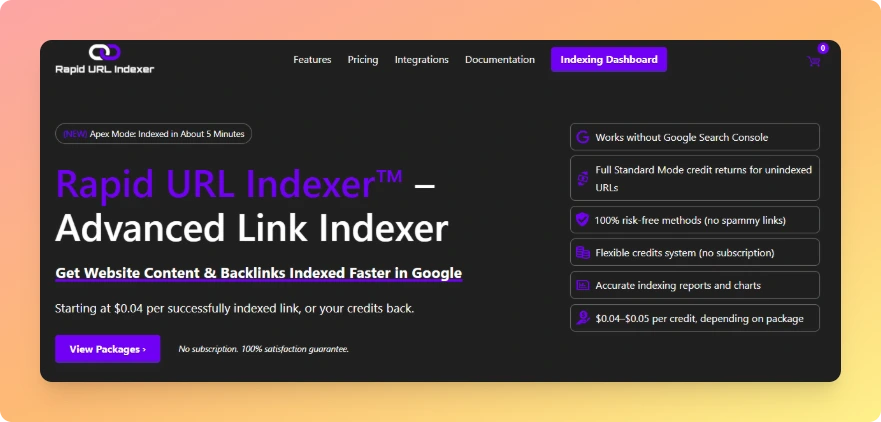
Overview: Rapid URL Indexer is our highest-ranked all-purpose option under the criteria used in this comparison. It is built for third-party backlinks, bulk campaigns, and automated workflows. Its combination of pay-as-you-go pricing, automatic credit returns, detailed reports, and integrations makes it one of the more complete specialist options here.
Realistic caveat: Standard campaigns use a 14-day final reporting window, so you may wait longer for a definitive outcome than with services using seven-day or 24-hour reporting cycles.
Snapshot:
- Best for: Agencies, link builders, and recurring backlink campaigns
- Known for: Pay-for-results indexing with automatic credit returns
- Popular services: Google backlink indexing, Apex indexing, Bing indexing, index reporting, REST API, WordPress, Chrome, and Zapier integrations
- Minimum spend/retainer bands: $25 for 500 credits; larger packs range up to about $2,000 for 50,000 credits
- Named customer testimonials: Five Channels, Authority Magnet Co., AKITA
- Years in the industry: Exact product and company timeline should be verified before publication
- Client rating: 5.0/5 on G2 from 8 reviews
Summary of online reviews: G2 reviewers generally highlight straightforward setup, pricing, reporting, and integration options. Product Hunt feedback also mentions the WordPress plugin, API, Chrome extension, and automatic credit-return model.
The public review sample is still small. Eight G2 reviews are more useful than the one- or two-review profiles seen elsewhere in this category, but they are not enough to establish broad customer consensus. Some feedback also notes that indexing still takes time and that not every submitted URL succeeds, which is normal for this type of service.
2.SpeedyIndex
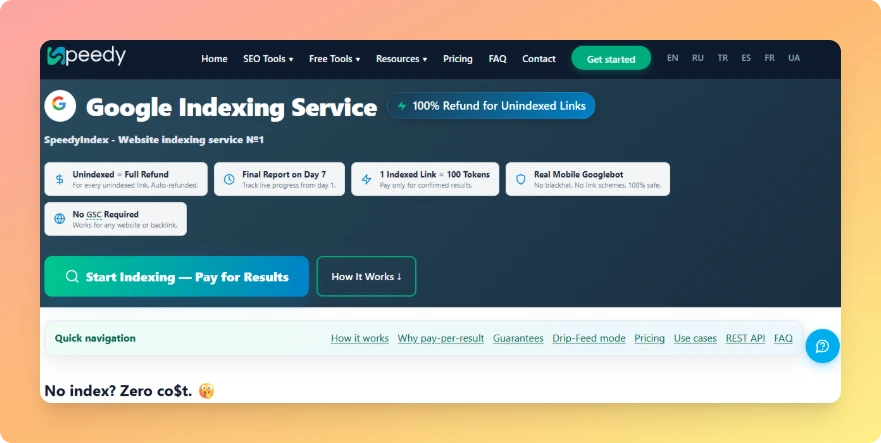
Overview: SpeedyIndex suits you when volume and cost per successful index matter more than having the most polished dashboard. Under its pay-per-result tariff, the service automatically returns tokens for qualifying URLs that are not confirmed as indexed in its seven-day report. Larger token packages reduce the effective cost per submission.
Realistic caveat: SpeedyIndex also offers pay-per-submission pricing. That tariff does not use the same indexing refund structure, so you should check which billing model you are buying before comparing it with pay-per-result competitors.
Snapshot:
- Best for: High-volume and price-sensitive SEO campaigns
- Known for: Pay-per-result Google indexing
- Popular services: Google indexing, Yandex indexing, index checking, backlink checking, API access, drip feeding
- Minimum spend/retainer bands: About $5 to $500 in one-time token packages
- Named customer testimonials: Not confirmed publicly
- Years in the industry: Not confirmed publicly
- Client rating: Not confirmed publicly; G2 currently shows 0 reviews
Summary of online reviews: G2 currently does not have customer reviews for SpeedyIndex, so there is not enough independent feedback there to establish recurring customer themes.
That absence should not be interpreted as either positive or negative evidence. The attraction comes instead from its documented pricing model, non-expiring tokens, low-cost entry point, and pay-per-result option. Its starter packages make it relatively inexpensive to test your own backlink mix before scaling.
3.UltraIndexer
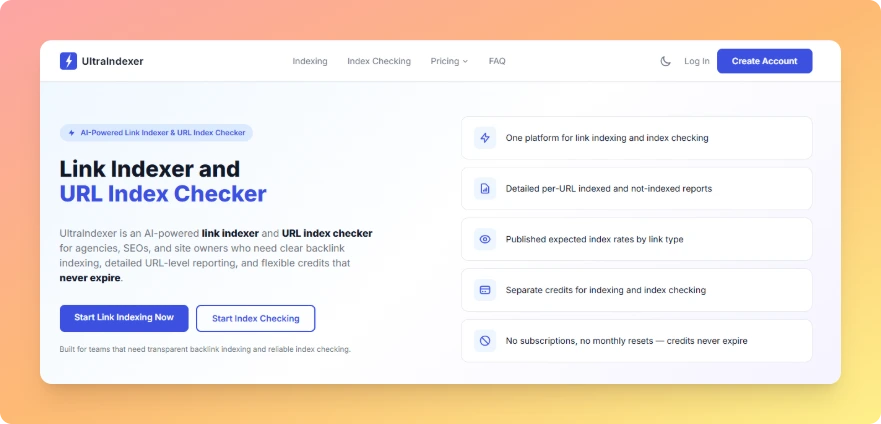
Overview: UltraIndexer is useful when you want to check backlinks first, submit unindexed URLs, and produce per-URL reports without moving between separate platforms. You also get configurable drip feeding and API access on most paid packages.
Realistic caveat: Its independent review footprint is still undeveloped, so there is not enough third-party customer feedback to make public ratings a meaningful part of the buying decision.
Snapshot:
- Best for: Agencies that need indexing and bulk index verification
- Known for: Combining backlink indexing with index checking
- Popular services: Backlink indexing, bulk index checking, drip feeding, API access, CSV reporting
- Minimum spend/retainer bands: Approximately $9 for 100 URLs to $1,349 for 50,000 URLs
- Named customer testimonials: Not confirmed publicly
- Years in the industry: Not confirmed publicly
- Client rating: No meaningful independent rating confirmed
Summary of online reviews: There is not yet enough independent customer feedback to identify reliable review themes.
UltraIndexer is therefore better judged on its workflow, pricing, reporting, and performance against your own URLs than on reputation scores. Its $9 starter package gives you a relatively low-cost way to collect campaign data before moving to larger volumes.
4.IndexMeNow
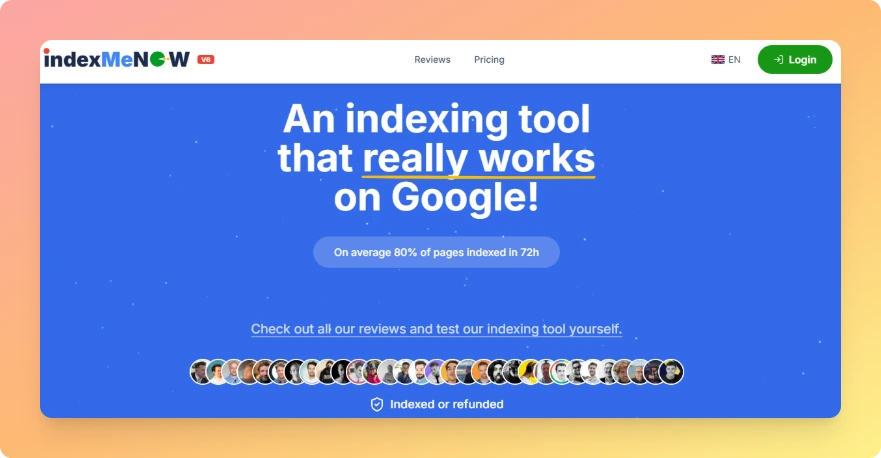
Overview: IndexMeNow is a higher-priced option that may appeal to you when you have a smaller number of valuable URLs and want automatic verification, API support, and credits returned for unsuccessful URLs.
Realistic caveat: Its price per URL is considerably higher than several bulk-focused competitors.
Snapshot:
- Best for: Smaller batches and higher-value URLs
- Known for: Frequent index checks and ten-day re-crediting
- Popular services: Google indexing, automatic checking, WordPress plugin, Chrome plugin, API access
- Minimum spend/retainer bands: Approximately $59 for 60 credits to $1,999 for 4,250 credits
- Named customer testimonials: Not confirmed publicly
- Years in the industry: Not confirmed publicly
- Client rating: 3.8/5 on Trustpilot from 2 reviews
Summary of online reviews: Trustpilot shows positive feedback around indexing speed, usability, refunds, and customer support.
The problem is sample size. The score is based on only two reviews, both dating from 2023. That makes the rating useful as a small signal, but far too limited to establish broad customer consensus. The company’s current documentation is stronger evidence for its checking and re-credit workflow than the review score alone.
5.Omega Indexer
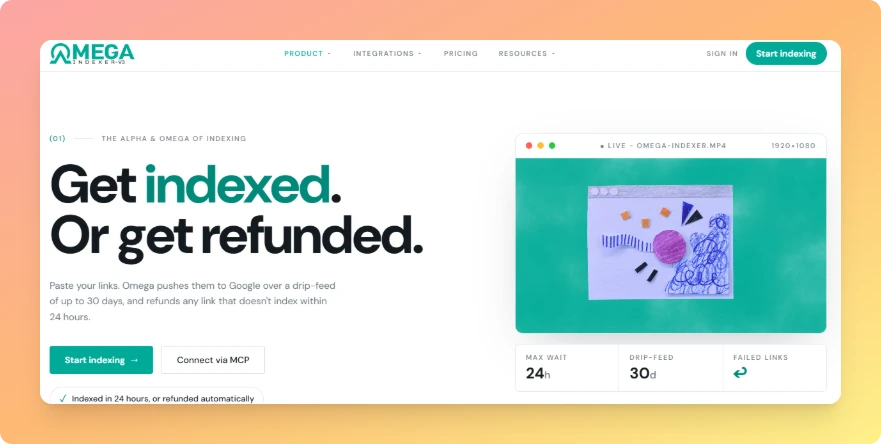
Overview: Omega Indexer gives you drip feeding, API access, MCP integration, automatic refunds, and per-URL status tracking. Its current feature set makes it particularly relevant if you want to automate recurring indexing campaigns.
Realistic caveat: Its Trustpilot profile remains weak and contains historical complaints about indexing effectiveness, customer support, and refunds.
Snapshot:
- Best for: Automated and drip-fed indexing campaigns
- Known for: 24-hour indexed-or-refunded model
- Popular services: Backlink indexing, drip feed, API, MCP integration, index tracking
- Minimum spend/retainer bands: Starts around $19/month for 190 credits; larger tiers are available
- Named customer testimonials: Not confirmed publicly
- Years in the industry: Not confirmed publicly
- Client rating: 2.7/5 on Trustpilot from 6 reviews
Summary of online reviews: Trustpilot feedback is mixed but currently leans negative, with customers reporting concerns around indexing results, support, and refunds.
One reviewer later updated an earlier complaint to five stars after reporting improvements to both the platform and customer service. A 2026 reviewer remained highly critical of indexing performance and the refund experience.
If you are comparing SpeedyIndex vs Omega Indexer, Omega currently offers a much shorter refund window, while SpeedyIndex gives you a lower one-time entry cost and non-expiring tokens.
6. Backlink Indexing Tool
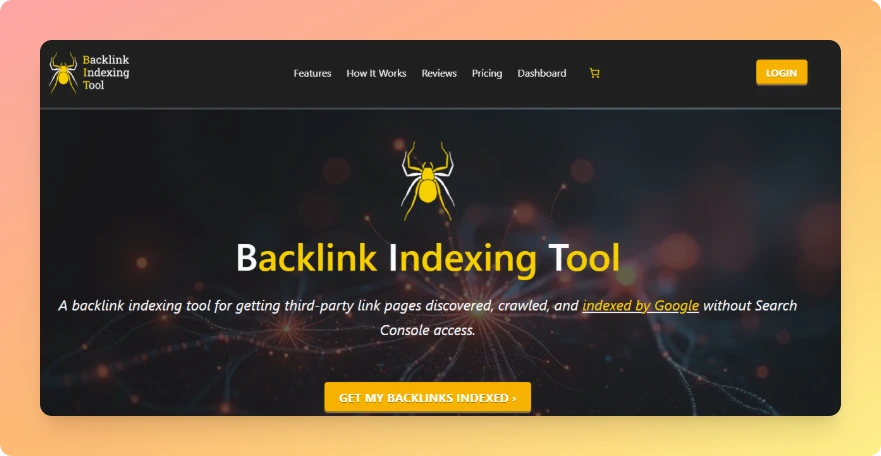
Overview: Backlink Indexing Tool gives you a simple workflow specifically for third-party backlink pages. You submit links in projects, receive preliminary and final index checks, export CSV reports, and recover credits for qualifying URLs that remain unindexed.
Realistic caveat: Independent review-site validation is currently too limited to establish a trustworthy public satisfaction score.
Snapshot:
- Best for: Straightforward link-building campaign tracking
- Known for: Backlink-specific projects and 14-day reporting
- Popular services: Backlink indexing, bulk submission, index checking, charts, CSV reporting
- Minimum spend/retainer bands: Approximately $30 for 100 credits to $510 for 2,000 credits
- Named customer testimonials: Available on the vendor’s website
- Years in the industry: Not confirmed publicly
- Client rating: Not confirmed publicly
Summary of online reviews: The company publishes several named testimonials praising speed, usability, consistency, and indexing performance.
Those testimonials appear on the product’s own website, so they should not be treated as equivalent to independently moderated G2, Capterra, or Trustpilot reviews.
We could not confirm a meaningful independent review score. The refund framework, reporting features, and your own test results are therefore more useful evaluation signals than first-party testimonials alone.
7.GigaIndexer
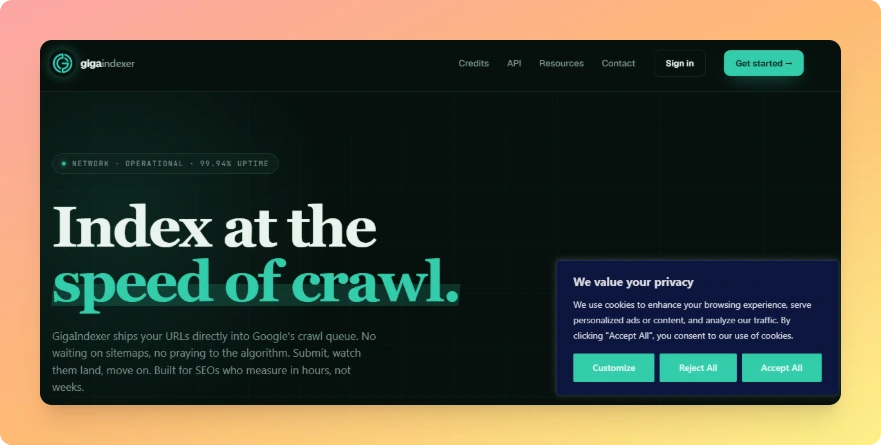
Overview: GigaIndexer focuses heavily on crawl delivery and evidence that Googlebot visited submitted URLs. You also get a REST API, bulk processing, non-expiring credits, a Chrome extension, and per-URL crawl information.
Realistic caveat: Its pricing is relatively high, and its small Trustpilot sample includes serious complaints about support and service delivery.
Snapshot:
- Best for: Smaller batches where crawl verification matters
- Known for: Per-URL Googlebot visit tracking
- Popular services: URL indexing, bulk submissions, REST API, Googlebot tracking, Chrome extension
- Minimum spend/retainer bands: Approximately $59 for 60 credits to at least $399 for 600 credits
- Named customer testimonials: Not confirmed publicly
- Years in the industry: Not confirmed publicly
- Client rating: 2.9/5 on Trustpilot from 3 reviews
Summary of online reviews: Trustpilot has only three reviews, so you should treat the 2.9 score cautiously.
One customer reported good indexing performance and prompt credit refunds. Two later reviewers complained about account access, service delivery, and unanswered support messages after payment.
The sample is too small for broad conclusions, but it creates more uncertainty than you get with products backed by larger or more consistently positive independent review samples.
8. Indexing Expert
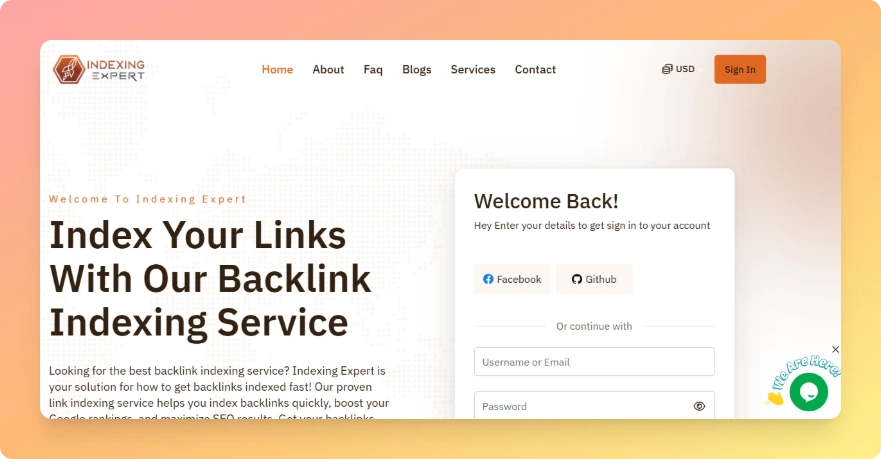
Overview: Indexing Expert is built directly around backlink indexing and offers pay-per-use credits, an index checker, campaign reporting, and multiple support channels. Its advertised per-link pricing can make it attractive for larger campaigns.
Realistic caveat: Recent independent reviews raise enough concerns about indexing results that you should test a small batch before committing significant volume.
Snapshot:
- Best for: Pay-per-use backlink indexing
- Known for: Dedicated indexing service and index checker
- Popular services: Link indexing, index checking, SEO packages, campaign reporting, support
- Minimum spend/retainer bands: Advertised from around $0.04 per link; exact minimum purchase is not confirmed publicly
- Named customer testimonials: Available on the vendor’s website
- Years in the industry: Vendor states 4+ years
- Client rating: 2.9/5 on Trustpilot from 14 reviews
Summary of online reviews: The website publishes multiple testimonials describing difficult URLs being indexed successfully, but independent Trustpilot feedback is considerably less positive.
Trustpilot currently shows a 2.9 score from 14 reviews, including two 2026 reviewers who reported unsuccessful indexing.
Because the first-party and third-party feedback point in different directions, a controlled test batch makes more sense than relying on headline success-rate claims. Public review data should also be checked again before any large purchase.
9. Indexceptional
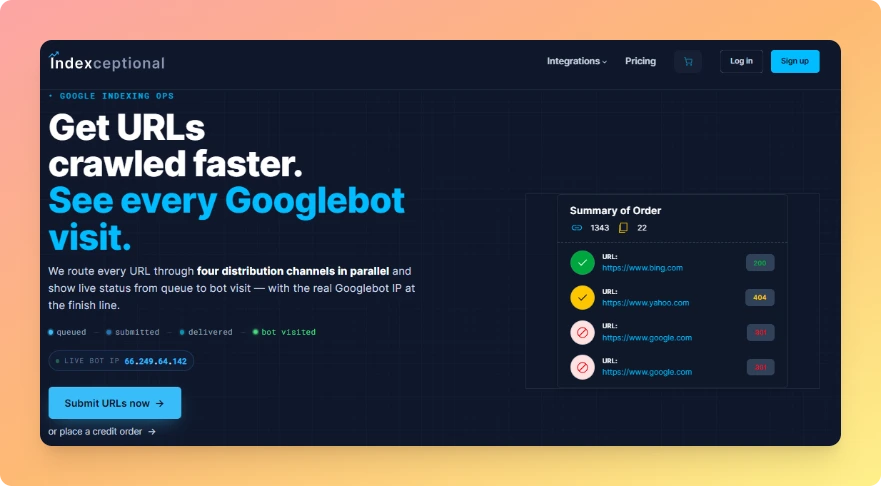
Overview: Indexceptional gives you a credit-based indexing workflow with multiple submission channels, drip and instant options, API access, and detailed per-URL stages. The platform provides more visibility into crawler activity than many basic submission tools.
Realistic caveat: Recent Trustpilot feedback is poor, particularly around delays and customer support.
Snapshot:
- Best for: Per-URL crawler tracking and flexible drip campaigns
- Known for: Multiple crawl-triggering channels and live URL status
- Popular services: Backlink indexing, instant indexing, drip indexing, API access, URL validation
- Minimum spend/retainer bands: Approximately $29 for 60 credits to $499 for 2,000 credits at current listed prices
- Named customer testimonials: Not confirmed publicly
- Years in the industry: Vendor states it was founded in July 2024
- Client rating: 2.5/5 on Trustpilot from 5 reviews
Summary of online reviews: Trustpilot currently shows a 2.5 score from five reviews.
Recent reviewers mention delayed orders, limited progress, and difficulty getting responses from customer support. That feedback conflicts with the current website’s emphasis on real-time tracking and support.
The platform offers useful technical visibility, but its recent independent review record keeps it near the bottom of this ranking.
10.IndexGuru
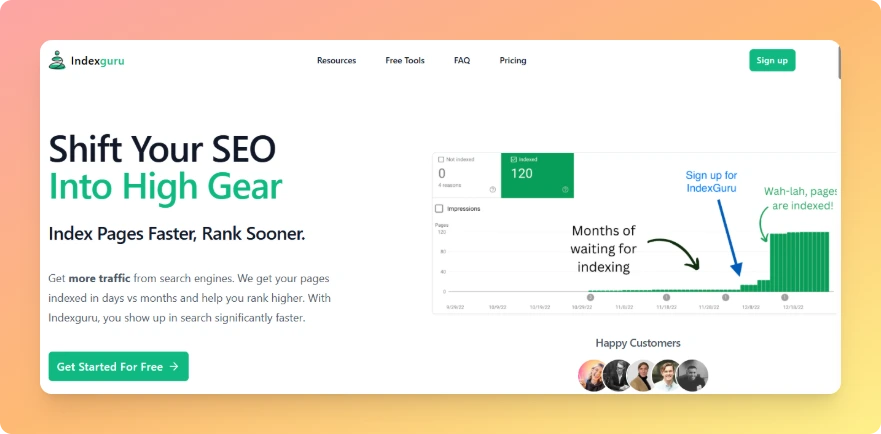
Overview: IndexGuru is better viewed as an indexing automation tool for websites you control than as a conventional third-party backlink indexer. You connect your sites, automate URL discovery, monitor indexing, and submit pages through several search-engine workflows.
Realistic caveat: IndexGuru uses Google’s Indexing API as part of its Google workflow. Google’s own documentation limits that API to eligible JobPosting and livestream BroadcastEvent pages.
That means Google’s Indexing API should not be presented as an officially supported general-purpose route for indexing ordinary pages or arbitrary third-party backlinks.
Snapshot:
- Best for: Free and automated indexing of websites you control
- Known for: Auto-indexing, Search Console integration, and multi-engine submission
- Popular services: Google submission, IndexNow submission, URL monitoring, sitemap crawling, indexing history
- Minimum spend/retainer bands: Free plan available; paid plans range from about $9 to $149/month
- Named customer testimonials: Not confirmed publicly
- Years in the industry: Vendor states 2+ years
- Client rating: 3.7/5 on Trustpilot from 1 review
Summary of online reviews: Trustpilot currently contains only one review, which praises IndexGuru’s support and results. One review is far too small a sample for broad conclusions.
Older AppSumo discussions also raised questions about using Google’s Indexing API outside the page types Google officially documents. IndexGuru itself acknowledges that Google ultimately decides whether submitted pages are indexed.
You may still find the free plan useful for websites you control, but it is not a direct replacement for backlink indexers designed to accept third-party URLs without ownership access.
Methodology: how these tools were ranked
We used a weighted editorial framework designed specifically for backlink indexing rather than general SEO software.
Because several vendors publish incomplete or non-comparable performance data, the percentages below guided the ranking rather than representing laboratory-style scores for each product.
- Backlink indexing capability and reporting: 30%. You need support for URLs on third-party domains, plus enough reporting to distinguish a submission from a crawl or confirmed indexing result.
- Pricing and refund economics: 20%. We gave more weight to non-expiring credits, low-cost testing, pay-per-result models, and automatic credit returns because indexing success varies from one link type to another.
- Speed and process transparency: 15%. Faster reporting helps, but clearly documented timelines and per-URL status information matter more than unsupported claims of instant or guaranteed indexing.
- Automation and scale: 15%. APIs, bulk uploads, drip feeding, WordPress integrations, browser extensions, and other automation become important when you are indexing backlinks for several sites or clients.
- Independent public review evidence: 15%. We considered both ratings and sample size. A 5-star rating from one reviewer does not carry the same weight as a similar score backed by a larger independent sample.
- Low-risk testing options: 5%. Free plans and inexpensive starter packs make it easier to test actual indexing performance against your own backlink mix before scaling.
These factors informed the final editorial ranking. Vendor-published indexing rates were treated as claims unless independent evidence supported them, and weak or contradictory public review data reduced confidence in a product.
Public reviews, pricing, product features, and indexing methods change over time, so the figures above reflect information available during our September 2026 research.