Link wheels were once promoted as a way to push link equity through a controlled network of websites, blogs, profiles, or Web 2.0 pages. The idea was simple: create a circle of pages, link them together, and point part of that link flow back to a target website.
That does not make link wheels a safe SEO strategy.
In modern SEO, link wheels sit close to link spam territory because they are usually built to manipulate rankings rather than help users. Google’s spam policies warn that tactics designed to manipulate search rankings can lead to lower rankings or removal from search results. Google also lists excessive link exchanges, automated links, and low-quality links created for ranking manipulation as spam risks.
This guide explains what link wheels are, how they work, why SEOs used them, where the risks are, and what to do instead.
What Is a Link Wheel?
A link wheel is a group of websites or pages arranged so that each page links to another page in the group, with one or more pages linking back to the main target website.
A basic link wheel might look like this:
- Page A links to Page B.
- Page B links to Page C.
- Page C links to Page D.
- Page D links back to Page A and also links to the target website.
The purpose is usually to create artificial link flow toward a money page, service page, affiliate page, or business website.
That is the problem.
A natural link exists because one page genuinely helps users understand another page. A link wheel usually exists because the site owner wants to control PageRank flow. That intent matters. Google’s link guidance says links help Google discover pages and understand relevance, but links should be crawlable, useful, and supported by clear anchor text that helps users and search engines understand the destination.
Link Wheels Risks and Safer SEO Paths
Setting up an interconnected web of sites to boost your search authority might sound clever, but it often triggers major algorithmic red flags. A link wheel relies on a controlled network where pages link in a rigid circle purely to manipulate search engines. Because this tactic is built entirely for rankings rather than real human readers, it leaves obvious footprints like thin pages, repeated anchor text, and highly predictable circular patterns. This simple guide breaks down why these network loops are incredibly risky and how to protect your digital presence.
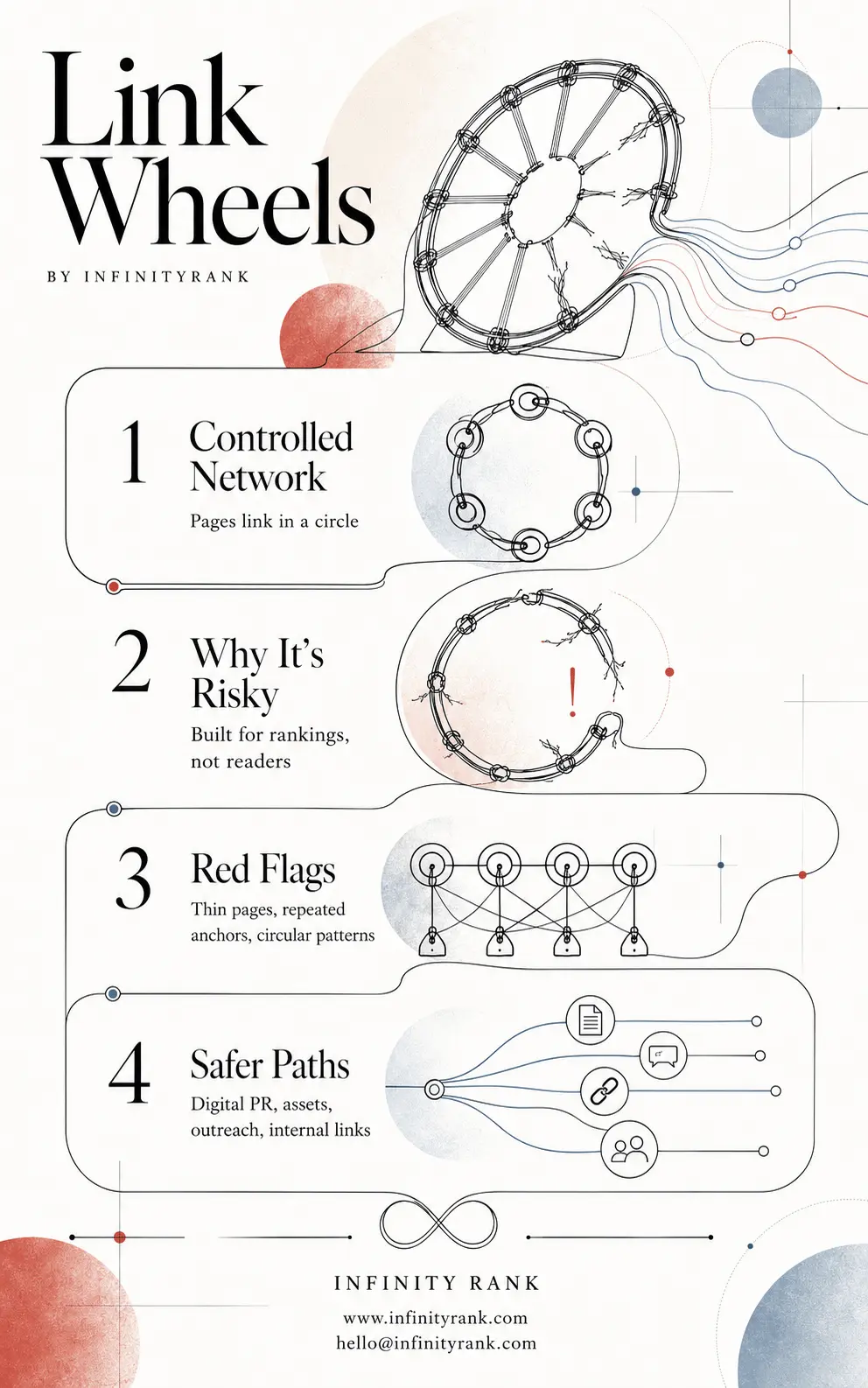
Steering clear of artificial network patterns is the only way to safeguard your website from devastating search penalties. Instead of chasing circular ranking schemes that eventually break down, you should always focus on safer paths like genuine digital PR, linkable assets, manual outreach, and proper internal linking. Use these four core pillars as your daily checklist to keep your optimization strategy clean, natural, and completely safe.
Are Link Wheels Against Google’s Guidelines?
A link wheel is not automatically a penalty just because several related properties link to each other. Real businesses often have natural cross-links between a main website, a blog, a partner site, a resource hub, a help center, and social profiles.
The risk starts when the structure is built mainly to manipulate rankings.
A link wheel becomes dangerous when it includes:
- Thin Web 2.0 pages created only for backlinks
- Exact-match anchor text repeated across the network
- Low-quality blog posts with no real audience
- Irrelevant domains linking to commercial pages
- Social profiles, forums, or directories used only as link placeholders
- Automated link creation
- Excessive cross-linking between controlled properties
- Circular linking patterns that exist only to pass SEO value
Google’s spam policies are clear: spam tactics can cause a page or entire site to rank lower or be omitted from Google Search.
So the better question is not “Can link wheels work?”
The better question is: “Is this link structure useful enough to exist if Google ignored the links?”
If the honest answer is no, it is not a strategy worth building.
How Link Wheels Work
A traditional link wheel works in three steps.
1. Multiple Pages or Properties Are Created
The builder creates several pages across different platforms. These might include free blogs, article directories, niche sites, social profiles, profile pages, or owned microsites.
In weak link wheels, these pages are thin and generic. They exist only because they can link somewhere else.
2. The Pages Link to Each Other
Each page links to another page in the group. The structure may be circular, layered, or irregular.
The goal is to make the network look less obvious than a group of pages all linking directly to the money site.
3. One or More Pages Link to the Target Website
The final step is passing link value to the target site. This is usually done with keyword-rich anchor text.
That is where the footprint becomes obvious. Repeated anchors, unnatural linking patterns, weak content, and irrelevant sources are all red flags.
Why SEOs Used Link Wheels
Link wheels became popular because they gave site owners more control over backlinks. Instead of earning links from independent websites, they could create their own link network.
That control was the appeal.
It is also the risk.
They Created Artificial Link Diversity
A link wheel can make it look like a website has links from different sources. But if those sources are thin, controlled, irrelevant, or created only for backlinks, the diversity is artificial.
Google does not need every backlink to come from a major publication. But the page linking to you should have a real reason to exist.
They Attempted to Pass Link Equity
The main purpose of a link wheel is to push link equity through a controlled structure. That is not the same as earning editorial links.
A useful editorial link says, “This page helps my reader.”
A link wheel says, “This page helps my ranking plan.”
That distinction is important.
They Gave SEOs Control Over Anchor Text
Old-school SEO relied heavily on exact-match anchors. Link wheels made it easy to repeat commercial keywords across multiple pages.
Today, that can create an obvious manipulation pattern. A natural backlink profile usually contains a mix of branded anchors, URL anchors, topical anchors, generic anchors, and occasional keyword anchors.
Common Link Wheel Patterns
These structures are still worth understanding because they appear in backlink audits.
Classic Link Wheel
A classic link wheel uses a simple circular pattern. Each property links to the next, and one or more properties link to the target website.
This is one of the easiest patterns to identify.
Multi-Layer Link Wheel
A multi-layer wheel uses several tiers. Lower-quality pages link to middle-tier pages, and middle-tier pages link to the main website.
This structure is usually built to hide the source of weak links. It is not a sign of quality.
Chain or Fence Pattern
This version connects pages in a more complex web instead of a clean circle. It may look less obvious, but the purpose is often the same: controlled link flow.
Owned Network Pattern
A business may own several domains, blogs, tools, or microsites. Cross-linking between them can be legitimate if each property has its own purpose and audience.
It becomes risky when the sites exist mainly to link to each other.
Link Wheel Risk Levels
Not every interlinked structure has the same risk.
Low Risk
This includes legitimate brand properties that link to each other because users benefit from the connection.
Examples:
- A company website linking to its help center
- A SaaS product linking to its documentation
- A brand blog linking to relevant service pages
- A parent company linking to subsidiary websites
- A local business linking to genuine location pages
These links make sense even without SEO value.
Medium Risk
This includes controlled properties that have some real value but are also used for SEO.
Examples:
- Guest posts on relevant niche blogs
- Partner pages
- Industry resource pages
- Microsites with unique content and a real audience
These can be acceptable if the content is useful, the links are editorially justified, and the anchors are not forced.
High Risk
This includes structures built mainly to manipulate search rankings.
Examples:
- Web 2.0 blogs created only for backlinks
- Thin articles spun across multiple properties
- Exact-match anchors repeated across the network
- Irrelevant domains linking to commercial pages
- Paid or automated profile links
- Circular link patterns with no user purpose
This is the category most link wheels fall into.
Should You Build Link Wheels in 2026?
No. Not as a primary SEO strategy.
A modern SEO campaign should not depend on controlled link networks, artificial link flow, or pages created only for backlinks.
That does not mean you should avoid all cross-linking. Internal links, partner links, author bios, social profiles, resource pages, and related brand properties can all be useful. But they need a real user purpose.
Google’s people-first content guidance says ranking systems are designed to prioritize helpful, reliable content created for people, not content created to manipulate search rankings.
That is the standard to use.
Before adding any backlink, ask:
- Would this link help a real reader?
- Is the linking page useful on its own?
- Is the anchor text natural?
- Is the linking site relevant?
- Would we still want this link if it passed no SEO value?
If the answer is no, the link is probably not worth building.
Safer Alternatives to Link Wheels
If the goal is to improve authority, rankings, and referral traffic, there are better options.
1. Digital PR
Digital PR earns links by giving journalists, publishers, and industry sites something worth referencing.
Examples include:
- Original data
- Surveys
- Expert commentary
- Industry reports
- Newsworthy company updates
- Visual assets
- Local market insights
This is harder than building a link wheel. It is also far more defensible.
2. Linkable Assets
A linkable asset is a page people have a reason to cite.
Examples:
- Calculators
- Statistics pages
- Templates
- Glossaries
- Comparison guides
- Original research
- Interactive tools
- Checklists
A good linkable asset earns links because it solves a problem or supports another writer’s article.
3. Editorial Outreach
Editorial outreach means finding relevant websites and pitching useful content, expert input, or a resource that fits their audience.
This works best when the pitch is specific. Generic “please link to my site” outreach is weak.
4. Unlinked Brand Mentions
If websites already reference your brand without linking to you, reclaim those unlinked brand mentions by requesting a link where it helps the reader.
This is safer than artificial link building because the mention already exists.
5. Resource Page Link Building
Many websites maintain useful resource lists. If your guide, tool, or data page genuinely belongs there, it can be a clean link opportunity.
The key is relevance. Do not force your page onto unrelated lists.
6. Internal Linking
Internal links are often ignored because they are less glamorous than backlinks. That is a mistake.
Strong internal linking helps search engines discover important pages and helps users move through your site. It also lets you support commercial pages from relevant informational content.
What to Do If You Already Built Link Wheels
Do not panic. Audit first.
Step 1: List Every Property in the Network
Document every blog, profile, domain, directory page, and social property involved.
Include:
- URL
- Owner
- Platform
- Target page
- Anchor text
- Content quality
- Relevance
- Whether the link is followed or nofollowed
Step 2: Identify the Worst Links
Prioritize links that are clearly manipulative.
Look for:
- Thin pages
- Spun content
- Exact-match anchors
- Irrelevant platforms
- Broken or abandoned properties
- Pages with no traffic or audience
- Obvious circular linking patterns
Step 3: Remove or Neutralize Risky Links
Where possible, remove the weakest links.
If you control the page, either delete the link, nofollow it, or rewrite the page so the link has a real editorial purpose.
If the page has no reason to exist, remove the page.
Step 4: Be Careful With Disavow
Disavow only when there is a serious pattern of spammy, artificial, or manipulative links and removal is not realistic. Do not disavow links just because they look imperfect.
Google’s own manual action guidance recommends identifying links that violate link spam policies, then removing them or changing them so they no longer pass PageRank.
Step 5: Replace Risk With Real Link Acquisition
Cleaning up risky links is only half the work. Build stronger assets and earn better links so the site is not dependent on old shortcuts. A structured approach to real link acquisition is more durable than any shortcut network.
Link Wheel Red Flags Checklist
Use this checklist when reviewing an existing backlink profile.
- Several linking sites use the same template
- The same author name appears across unrelated properties
- Anchor text is heavily keyword-focused
- The linking pages have thin or generic content
- The sites have no clear audience
- Links are placed in irrelevant articles
- Multiple pages link in a circular pattern
- The content exists only to host links
- The domains have no topical connection
- Most links point to commercial pages
- The network uses free blogs or expired domains with weak content
- The links were created in bulk
One or two weak signals may not matter. A repeated pattern does.
Are Link Wheels Ever Safe?
A structure that looks like a link wheel can be safe if every page has a real purpose.
For example, a company might have:
- A main website
- A research blog
- A help center
- A free tool
- A YouTube channel
- A partner directory
- A documentation hub
These properties may naturally link to each other. That is not the same as a link wheel built to manipulate rankings.
The difference is intent and usefulness.
If each property helps users independently, cross-linking can be normal. If each property exists mainly to pass link equity, it is risky.
Final Thoughts
Link wheels are not a modern SEO strategy. They are a legacy link-building tactic with clear risk.
The safest approach is simple: build pages worth linking to, earn links from relevant sources, and use internal links properly. Do not create networks of thin pages just to push authority toward your site.
If your backlink strategy depends on hiding patterns, controlling link flow, or making artificial pages look natural, the strategy is weak.
Good link building does not need a disguise.
FAQs
What is a link wheel in SEO?
A link wheel is a network of pages or websites that link to each other and point link equity toward a target website. It is usually created to influence search rankings.
Are link wheels still effective?
They may create short-term movement in some cases, but they are not a reliable or safe SEO strategy. Most link wheels are risky because they are built to manipulate link signals rather than help users.
Can link wheels cause a Google penalty?
Yes, they can contribute to ranking problems or manual action risk if the links violate Google’s link spam policies. The risk is higher when the network uses thin content, exact-match anchors, irrelevant domains, or automated links.
How many sites should be in a link wheel?
There is no safe or recommended number. The old idea that a link wheel should contain 5–10 sites is arbitrary. Quality, relevance, intent, and usefulness matter more than the number of pages.
Are Web 2.0 link wheels safe?
Usually not. Web 2.0 link wheels are often made from free blogs or profile pages with thin content. If those pages exist mainly to link to your site, they are risky.
Can I use link wheels for local SEO?
No. Local SEO should focus on a strong Google Business Profile, consistent citations, local landing pages, reviews, local PR, community mentions, and relevant local backlinks. A local link wheel built only for rankings is still risky.
What should I use instead of link wheels?
Use safer link-building methods such as digital PR, linkable assets, editorial outreach, unlinked brand mention reclamation, resource page link building, and strong internal linking.
Should I remove old link wheel links?
Audit them first. Remove or nofollow the links that are clearly artificial, irrelevant, thin, or manipulative. Be careful with disavow and use it only when there is a serious spam pattern that cannot be cleaned up manually.