
Backlinks are still one of the clearest signals that other websites trust your content. But chasing links one email at a time is slow, inconsistent, and hard to scale.
A better approach is to create linkable assets: content resources so useful, original, or reference-worthy that other websites have a real reason to cite them.
A linkable asset can be a data study, calculator, template, visual guide, statistics page, benchmark report, or deep resource that solves a specific problem better than competing pages.
This guide explains what linkable assets are, why they work, which formats earn links, and how to create, promote, and maintain them without relying on weak link-building tactics.
What Is a Linkable Asset?
A linkable asset is a piece of content designed to attract backlinks because it provides unique value to readers, publishers, bloggers, journalists, or industry professionals.
Unlike a standard blog post, a linkable asset is not only written for your target customers. It is also built for people who need sources to reference in their own content.
Good linkable assets usually have at least one of these qualities:
- Original data
- Practical utility
- Strong visual value
- Clear expert insight
- Updated information
- Better structure than competing pages
- A useful resource others do not want to recreate from scratch
Common examples include:
- Original research reports
- Industry statistics pages
- Free calculators or tools
- Templates and checklists
- In-depth guides
- Infographics and visual explainers
- Glossaries
- Benchmark reports
- Curated resource pages
- Expert roundups with real commentary
The goal is simple: create something worth citing.
Why Linkable Assets Matter for SEO
Linkable assets matter because they help earn backlinks naturally and repeatedly.
Google’s ranking systems use many signals to determine which results are useful and relevant, and Google’s own documentation explains that its systems look at signals of quality, relevance, and authoritativeness across web pages.
That does not mean every backlink is valuable. Low-quality, paid, irrelevant, or manipulative links can create risk. Google’s spam policies specifically warn against link schemes and require paid or sponsored links to use proper attributes such as rel="nofollow" or rel="sponsored".
A strong linkable asset helps because it gives relevant websites a legitimate reason to link to you.
Linkable assets can help you:
- Earn backlinks from relevant websites
- Build topical authority
- Improve referral traffic
- Support organic rankings
- Create useful resources for sales and outreach teams
- Generate brand mentions
- Reduce dependence on manual guest posting
The key is quality. Google’s guidance is clear: content should be helpful, reliable, and created for people first, not built mainly to manipulate rankings.
Linkable Assets: Pure Value or Flop?
Publishing generic, surface-level blog posts and expecting other websites to link to them naturally is a massive waste of resources. To attract premium backlinks without constantly begging for outreach placements, you must create content that serves as an undeniable reference point for your industry.
When you focus on building dedicated hubs of original data, free tools, or complex visualizations, your pages become magnetic authority drivers. This linkable asset blueprint details four critical steps to engineer, format, and promote resources that publishers naturally want to cite.
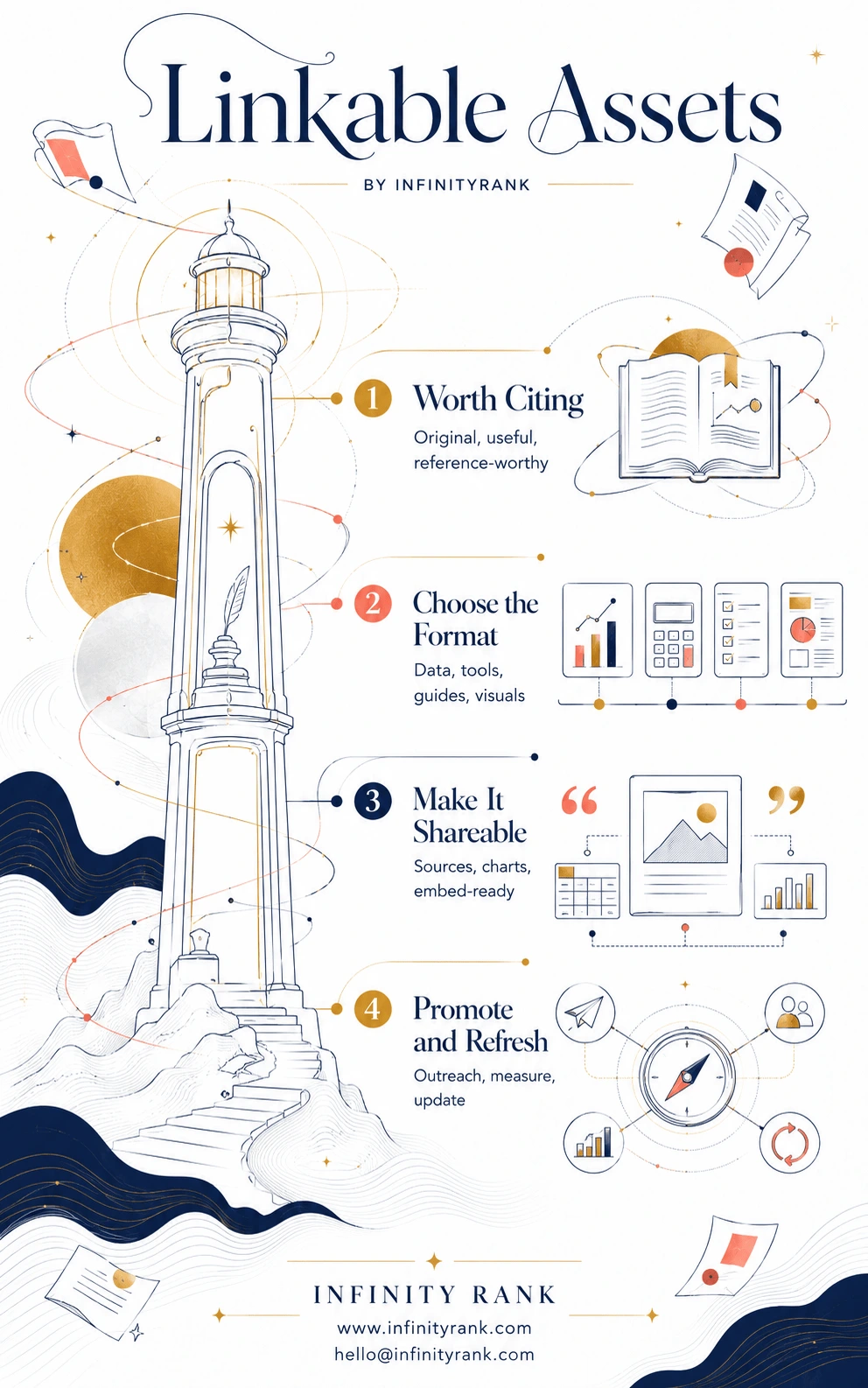
Building high-value resources is the ultimate shortcut to scaling your organic growth without triggering spam algorithms. By offering distinct research, interactive elements, or embeddable media, you turn cold outreach targets into active brand champions. Use the linkable-assets-infographic to audit your current content structure and build high-performance magnets for your next campaign.
Best Types of Linkable Assets
Not every content format attracts links equally. Some formats are naturally more useful to publishers because they provide evidence, tools, or ready-made references.
| Linkable Asset Type | Why It Earns Links | Best For |
| Original research | Provides unique data others cannot easily copy | SaaS, finance, marketing, healthcare, B2B |
| Statistics page | Gives writers quick facts to cite | Any niche with recurring data demand |
| Free tool or calculator | Solves a practical problem | Finance, real estate, SaaS, ecommerce |
| Template or checklist | Saves users time | Business, HR, legal, marketing |
| Infographic | Makes complex information easy to share | Education, health, local services |
| Benchmark report | Shows industry standards and comparisons | B2B, SaaS, agencies |
| Glossary | Defines important terms in one place | Technical, legal, medical, SEO |
| Ultimate guide | Covers a topic more completely than competitors | Competitive informational keywords |
| Curated resource list | Saves research time | Education, nonprofit, software, local niches |
The best format depends on the search intent, your audience, and what competitors already have.
Step 1: Research What People Alread y Link To
Do not guess. Before creating a linkable asset, study what already earns backlinks in your niche.
Look for pages that have earned links from relevant sites. Then ask why those pages attracted links.
Check for patterns:
- Are people linking to statistics?
- Are they citing original research?
- Are they embedding visuals?
- Are they referencing tools?
- Are they linking to templates?
- Are they mentioning expert quotes?
- Are outdated pages still earning links?
Use SEO tools like Ahrefs, Semrush, or similar backlink analysis platforms to inspect competitor pages. Focus on referring domains, not just total backlinks. One page with 80 links from 10 weak domains is less impressive than a page with 30 links from 25 relevant domains.
Your goal is not to copy competitors. Your goal is to understand what publishers in your space already consider link-worthy.
Step 2: Choose the Right Topic
A linkable asset needs a strong topic. Weak topics produce weak links.
A good topic usually meets three conditions:
- People search for it
- Publishers need to reference it
- Your brand has a reason to own it
For example, a generic article like “10 SEO Tips” is unlikely to attract many natural backlinks. A better asset would be:
- “SEO Statistics for SaaS Companies”
- “Average Backlink Cost by Industry”
- “Local SEO Checklist for Multi-Location Businesses”
- “Interactive ROI Calculator for Link Building Campaigns”
- “Digital PR Outreach Email Templates”
A topic becomes more linkable when it gives other writers something useful to cite.
Avoid topics that are too broad, too obvious, or already dominated by stronger resources.
Step 3: Pick the Best Format
Once the topic is clear, choose the format that best matches the link opportunity.
Use this rule:
- If writers need proof, create data or research.
- If users need help doing something, create a tool, checklist, or template.
- If the topic is complex, create a visual explainer or infographic.
- If the topic changes often, create a statistics or trends page.
- If the topic has many subtopics, create a pillar guide.
The format should not be chosen because it looks impressive. It should be chosen because it makes the content easier to use, cite, or share.
Step 4: Create Something Better Than Existing Results
A linkable asset must be better than what already exists. “Better” does not always mean longer. It means more useful.
You can improve an asset by making it:
- More accurate
- More current
- Easier to scan
- Better sourced
- More visual
- More practical
- More specific
- More original
- Easier to quote
- Easier to embed
For example, if competitors have a list of 25 statistics with no sources, create a list of 75 verified statistics with source links, dates, categories, and short explanations.
If competitors have generic templates, create editable versions, examples, and instructions.
If competitors have a long guide, create a clearer guide with comparison tables, decision trees, screenshots, and examples.
The asset needs a reason to exist. If it does not improve on what is already ranking or already earning links, it will be ignored.
Step 5: Build the Asset for Sharing and Citation
A linkable asset should be easy for others to reference.
Add elements that make linking natural:
- Clear statistics
- Source notes
- Charts
- Tables
- Short summaries
- Expert quotes
- Downloadable files
- Embed codes for graphics
- Jump links
- FAQ sections
- Definitions
- Original examples
Writers and editors are busy. Make the asset easy to cite without forcing them to dig through the page.
For visual assets, add an embed code below the graphic. For data studies, include methodology. For templates, include usage instructions. For statistics pages, include the year, source, and context for each stat.
Do not hide the value behind a vague copy. Make the asset immediately useful.
Step 6: Optimize the Page Befo re Promotion
Treat a linkable asset like a flagship SEO page.
Before promotion, fix the basics:
- Use a clean, short URL
- Put the primary keyword in the title and H1
- Add descriptive H2s and H3s
- Include internal links from relevant pages
- Add external citations where needed
- Compress images
- Add descriptive image alt text
- Use schema where appropriate
- Add a clear table of contents
- Make the page mobile-friendly
- Include a strong introduction
- Add a clear final takeaway
Internal linking matters. Link to the asset from related blog posts, service pages, case studies, and resource pages. This helps users and search engines understand where the asset fits within your site.
Suggested internal links for this article:
- Link Building
- Content Marketing
- Digital PR
- Manual Link Building
- Resource Page Link Building
- Backlink Audit
- Guest Posting
Step 7: Promote the Asset Strategically
Publishing is not enough. Even excellent assets need distribution.
Promote the asset through:
- Targeted outreach
- Digital PR
- Newsletter placements
- LinkedIn posts
- Industry communities
- Founder or expert accounts
- Relevant podcasts
- Resource page outreach
- Broken link building
- Internal newsletters
- Paid social testing
Start with websites that have already been linked to similar assets. They are more likely to understand the value.
Your outreach should be specific. Do not send generic “please link to us” emails. Explain why the asset is useful, what makes it different, and where it could add value to their existing content.
A simple outreach angle:
I noticed your article references [topic]. We recently published a [data study/tool/template] that adds updated information on [specific point]. It may be useful as an additional reference for your readers.
Keep it short. Make the value obvious.
Step 8: Measure Performance
A linkable asset is not successful just because it looks good. Track performance.
Measure:
- Referring domains
- Quality of linking sites
- Organic traffic
- Keyword rankings
- Referral traffic
- Assisted conversions
- Newsletter signups
- Downloads
- Outreach response rate
- Social shares
- Brand mentions
- Links earned without outreach
Do not only count backlinks. A page can attract fewer links but still drive high-value traffic and leads.
Track results monthly for the first six months. Then review quarterly.
Step 9: Refresh and Maintain the Asset
The biggest mistake is publishing a linkable asset once and leaving it untouched.
Outdated assets lose trust. They also become easier for competitors to beat.
Set a refresh schedule:
- Update statistics every 6–12 months
- Replace outdated screenshots
- Add new examples
- Remove broken links
- Improve weak sections
- Add new expert commentary
- Refresh charts and visuals
- Update the publish date only after meaningful changes
Evergreen assets stay evergreen because they are maintained.
A statistics page from 2022 is not evergreen in 2026 unless it has been updated. A guide with old screenshots, dead tools, or outdated tactics will lose value.
Common Linkable Asset Mistakes
Creating Content Without Link Intent
Some content is useful for readers but not link-worthy. Before building the asset, ask: “Who would link to this, and why?”
If you cannot answer that clearly, the topic is weak.
Copying Competitors
Copying a competitor’s asset with slightly different wording is not a strategy. You need a stronger angle, better data, clearer structure, or a more useful format.
Skipping Promotion
Even the best asset can fail without distribution. Promotion is not optional.
Making Unsupported Claims
Do not publish big claims without sources. If you say something is growing, declining, risky, expensive, or effective, support it.
Ignoring Design
A linkable asset does not need to be beautiful, but it must be easy to use. Bad formatting kills shareability.
Forgetting Internal Links
If your own site barely links to the asset, do not expect others to treat it as important.
Failing to Update It
Old data, broken links, and outdated examples make an asset less trustworthy.
Linkable Asset Examples by Industry
SEO Agency
A good linkable asset could be a backlink cost benchmark report, a link-building ROI calculator, or a list of verified SEO statistics.
Real Estate
A real estate company could create a mortgage affordability calculator, neighborhood comparison tool, or annual housing market trends report.
Healthcare
A clinic could publish a symptom checklist, treatment comparison guide, or patient-friendly visual explainer.
SaaS
A SaaS company could create a pricing benchmark report, integration checklist, or industry workflow template.
Legal
A law firm could create a state-by-state legal guide, deadline calculator, or downloadable compliance checklist.
Local Business
A local company could publish a city-specific resource guide, emergency checklist, or seasonal maintenance calendar.
The best assets are specific. Generic content rarely earns strong links.
Final Thoughts
Linkable assets are one of the most practical ways to earn high-quality backlinks without relying only on cold outreach or guest posting.
The process is straightforward:
- Research what already earns links.
- Choose a topic publishers care about.
- Pick the right format.
- Create something better than existing resources.
- Build it for sharing and citation.
- Optimize it properly.
- Promote it strategically.
- Measure results.
- Refresh it regularly.
A strong linkable asset can keep earning links, traffic, and brand visibility long after publication. But it only works when the asset is genuinely useful.
Do not create linkable assets for search engines alone. Create resources people actually want to use, cite, and share.
FAQs
What is a linkable asset?
A linkable asset is a content resource designed to attract backlinks because it provides useful, original, or reference-worthy value. Examples include research reports, statistics pages, calculators, templates, infographics, and in-depth guides.
What is the difference between a blog post and a linkable asset?
A regular blog post usually targets readers or potential customers. A linkable asset also targets publishers, bloggers, journalists, and site owners who may cite the resource in their own content.
Do linkable assets work without outreach?
Sometimes, but relying on that is risky. Most linkable assets need promotion through outreach, digital PR, internal linking, newsletters, social distribution, or partnerships before they earn consistent backlinks.
What type of linkable asset earns the most backlinks?
Original research, statistics pages, free tools, calculators, templates, and visual assets often perform well because they give other websites something useful to reference. The best format depends on the niche and search intent.
How long does it take for a linkable asset to earn backlinks?
Some assets can earn links within weeks if they are promoted well. Others take months. Evergreen assets can continue attracting links for years if they are updated and promoted regularly.
Can small businesses create linkable assets?
Yes. Small businesses do not need a huge budget. A local business can create useful assets such as checklists, calculators, city guides, pricing guides, or industry-specific templates.
Are paid links the same as linkable assets?
No. Linkable assets are designed to earn editorial links because they are useful. Paid links are different and must follow Google’s policies, including proper attributes such as rel="nofollow" or rel="sponsored" when required.