Social media backlinks are not a replacement for editorial backlinks from trusted websites. Most links from platforms like LinkedIn, X, Pinterest, YouTube, Instagram, TikTok, Reddit, and Facebook are nofollow, user-generated, redirected, or limited in how much direct SEO value they can pass.
That does not make them useless.
Social media backlinks can still support SEO by helping people discover your content, sending referral traffic, increasing brand visibility, and improving the chance that your content earns real backlinks from bloggers, journalists, publishers, and industry websites.
The mistake is treating social links as direct ranking boosters. They are better understood as content distribution assets. Used properly, they help your best content reach the people most likely to cite it, share it, search for your brand, or link to it later.
This guide explains what social media backlinks actually do, which platforms are worth using, and how to build a social backlink strategy that supports SEO without relying on myths.
What Are Social Media Backlinks?
Social media backlinks are links from social platforms that point back to your website.
They can appear in:
- Social profile bios
- LinkedIn posts and articles
- Pinterest pins
- YouTube video descriptions
- YouTube channel profiles
- X posts and threads
- Facebook posts and groups
- Reddit discussions
- Instagram bio links
- TikTok bio links
- Link-in-bio pages
- Social campaign landing pages
For example, if you publish a blog post and share the URL in a LinkedIn post, that link is a social media backlink. If someone clicks it and lands on your website, the link is sending referral traffic.
From an SEO perspective, the main value is not usually PageRank. The value comes from visibility, traffic, discovery, and the secondary backlinks that can happen when the right audience finds your content.
Social Media Links: Do They Actually Help Your SEO?
Sharing your content on social platforms does not give you direct Google ranking power, but it still plays a huge role in your search success. Instead of building raw authority, social links act as a catalyst for distribution and discovery. This simple guide breaks down five ways social media helps boost your website visibility, drive traffic, and grow your brand online.
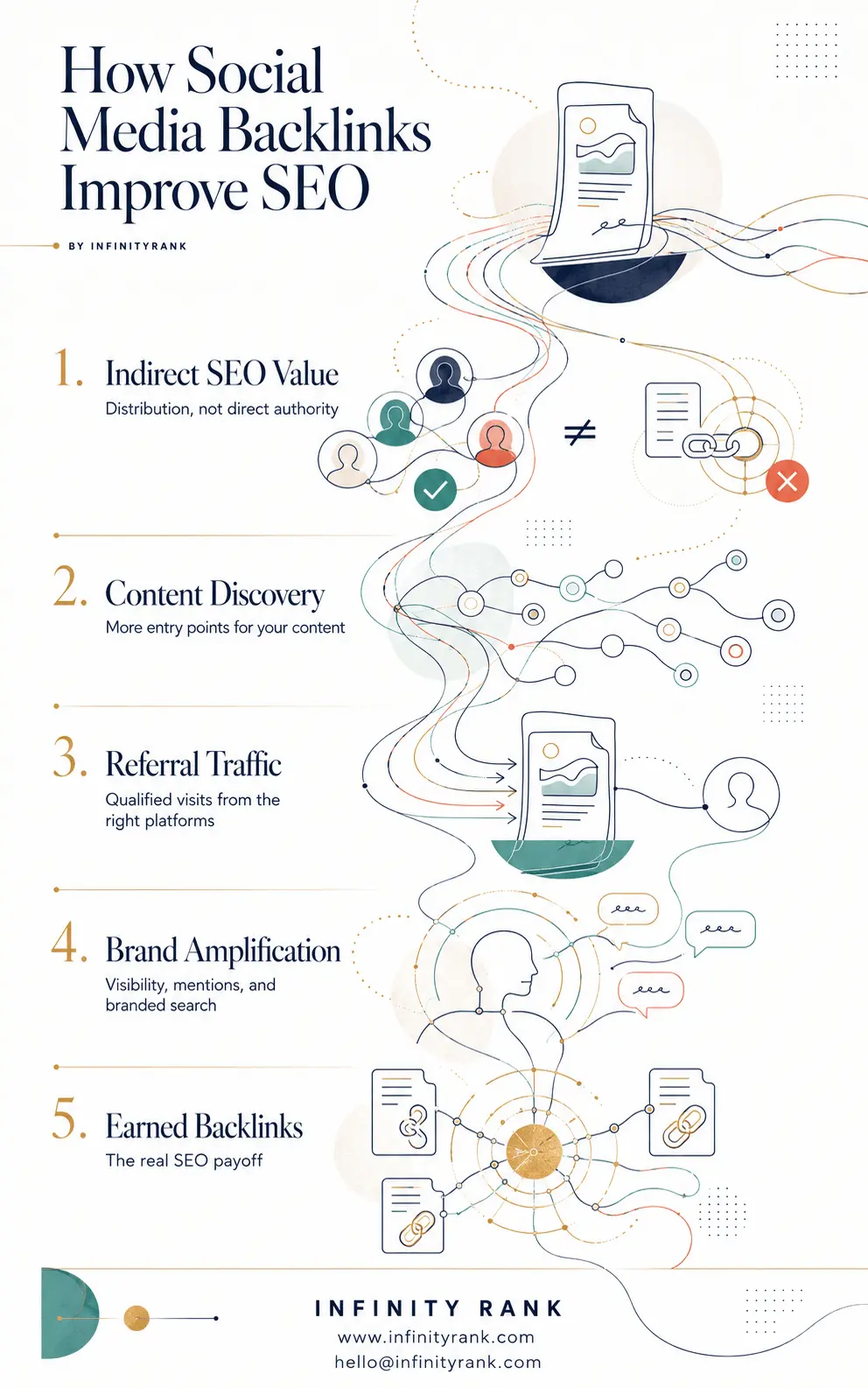
Social media might not change your authority scores overnight, but it is the perfect tool for getting your content in front of the right eyes. When you amplify your brand and get real visitors to your pages, you naturally open the door for bloggers and creators to give you real, earned backlinks. Use these five core pillars as your strategy checklist to make your social shares work much harder for your long-term search rankings.
Do Social Media Backlinks Directly Improve Rankings?
Usually, not in the same way as editorial backlinks.
Most social media links do not pass traditional link equity like a contextual backlink from a relevant article on a trusted website. Many platforms add nofollow or UGC attributes, use redirects, restrict crawlers, or place links in areas that search engines may not treat as normal editorial endorsements.
Google has stated that nofollow, sponsored, and UGC attributes are treated as hints, not strict directives, but that does not mean every social link passes ranking value. It means Google may choose how to interpret those links. You should not build an SEO strategy around the assumption that social media links directly boost rankings.
The safer, more accurate answer is this:
Social media backlinks can improve SEO indirectly by increasing content discovery, referral traffic, branded visibility, and link-earning opportunities.
That distinction matters. It keeps your strategy realistic.
Direct vs Indirect SEO Value of Social Backlinks
Before building links on social media, you need to understand what social links can and cannot do.
| SEO Function | How Social Backlinks Help | Direct Ranking Value? |
| Link equity | Usually limited because many links are nofollow, UGC, redirected, or platform-controlled | Low |
| Discovery | Public, crawlable links may help users and search engines find content faster | Possible |
| Referral traffic | Social posts can send visitors to blog posts, landing pages, tools, and case studies | Indirect |
| Content amplification | More visibility increases the chance of earning organic mentions and links | Indirect |
| Brand search | Strong social distribution can increase branded searches over time | Indirect |
| Link earning | Journalists, bloggers, and creators may discover and cite your content | High indirect value |
This is why social backlinks matter. Not because they magically pass authority, but because they help your content reach people who can create the links that do pass authority.
5 Ways Social Media Backlinks Support SEO
1. They Help Content Get Discovered
A new blog post can sit unnoticed if it only exists on your website. Sharing it across relevant social platforms gives it more entry points.
This matters most when the link is public, crawlable, and attached to content people actually engage with. A LinkedIn post, Pinterest pin, YouTube description, or Reddit discussion can expose your content to people who would not have found it through search yet.
Do not overstate this as guaranteed indexing. Social sharing can help discovery, but it does not guarantee that Google will crawl, index, or rank the page faster.
2. They Send Referral Traffic
Referral traffic is one of the clearest benefits of social backlinks.
If a LinkedIn post sends 300 targeted visitors to a B2B guide, or a Pinterest pin sends steady traffic to an evergreen tutorial, that traffic has business value even if the link itself does not pass PageRank.
The key is relevance. Random traffic from low-intent audiences will not help much. Qualified traffic from the right platform can lead to newsletter signups, leads, shares, and future backlinks.
Track this properly with UTM parameters instead of guessing.
3. They Increase Content Amplification
Search engines do not reward content just because it was posted on social media. But social media can help strong content reach more people.
That visibility can lead to:
- More mentions
- More shares
- More branded searches
- More newsletter signups
- More journalist discovery
- More natural backlinks
- More community discussion
This is especially useful for linkable assets such as original research, statistics pages, calculators, templates, infographics, comparison guides, and industry reports.
A good social campaign does not just “drop links.” It packages the content in a way that gives people a reason to click, save, cite, or share it.
4. They Help Build Brand Recognition
People rarely link to brands they do not know or trust.
Consistent social visibility can support brand recognition, especially in industries where buyers, creators, journalists, and marketers spend time on platforms like LinkedIn, X, YouTube, and Reddit.
This does not mean social engagement is automatically a ranking factor. It means stronger brand visibility can support the broader signals that make SEO easier: branded searches, repeat visits, direct traffic, citations, and natural mentions.
5. They Create Link-Earning Opportunities
This is the strongest SEO argument for social backlinks.
A journalist may find your report through X. A blogger may discover your guide on LinkedIn. A YouTuber may cite your statistics page. A niche community member may share your resource in a forum. Those secondary mentions can turn into real editorial backlinks.
That is where social media becomes useful for SEO.
The social link itself may not pass much authority. But it can put your content in front of someone who later gives you a real backlink from a website.
Best Social Media Platforms for Backlink Building
Not every platform works the same way. Some are better for referral traffic. Some are better for visibility. Some are better for link earning. Some are poor for SEO but still useful for brand awareness.
LinkedIn: Best for B2B Content Distribution
LinkedIn is one of the strongest platforms for B2B social backlinking because users are already in a professional mindset.
Use LinkedIn to share:
- Case studies
- Original research
- SEO guides
- Industry opinions
- Reports
- SaaS content
- Founder-led insights
- B2B landing pages
- Lead magnets
Where to place links:
- Company page profile
- Personal profile contact section
- Featured section
- Posts
- Comments, when relevant
- Newsletters
- Articles, when republishing carefully
Do not simply paste a blog link and expect results. Write a short native post that explains the problem, gives one useful takeaway, and then links to the full resource.
Weak approach:
“New blog is live. Read here.”
Better approach:
“Most social backlinks do not pass traditional link equity. Their real SEO value is distribution: they help content reach people who may later cite it. We broke down the direct vs indirect value here.”
Then add the link.
Pinterest: Best for Evergreen Visual Content
Pinterest works differently from most social platforms. It behaves more like a visual discovery engine. This makes it useful for evergreen content, especially in industries where visuals, tutorials, checklists, and step-by-step guides perform well.
Pinterest is useful for:
- DIY content
- Food content
- Home improvement
- Fashion
- Travel
- Wedding content
- Fitness
- Beauty
- Design
- Infographics
- Tutorials
- Checklists
- Visual explainers
Best practices:
- Create vertical pins for each major blog post.
- Use keyword-focused pin titles.
- Write natural descriptions.
- Link each pin to a relevant URL.
- Avoid linking every pin to the homepage.
- Refresh pins for evergreen content.
- Use clear text overlays that explain the benefit.
Pinterest links should be treated as referral traffic and content discovery assets. Do not treat them as traditional editorial backlinks.
YouTube: Best for Video Discovery and Referral Traffic
YouTube backlinks can support SEO by driving viewers from videos to your website.
Useful link placements include:
- Video descriptions
- Pinned comments
- Channel profile links
- Playlist descriptions
- Community posts
- Lead magnet links
- Product or service page links
YouTube works best when the video and landing page match closely. If the video explains “how to calculate link building ROI,” the description should link to a relevant guide, calculator, template, or service page.
Use verbal calls to action in the video. Do not rely only on the description.
Example:
“We’ve added the full checklist in the description if you want to use this process for your own campaign.”
That is more effective than silently placing a link below the video.
X: Best for Real-Time Distribution and Journalist Discovery
X can still be useful for SEO-related distribution, especially in industries where journalists, founders, marketers, analysts, and creators actively monitor conversations.
Use X for:
- Data-led threads
- Commentary on industry updates
- Launch announcements
- Digital PR campaigns
- Journalist outreach
- Trending-topic content
- Short expert takes
- Linkable assets
The goal is not to spam links into trending conversations. The goal is to add something useful and make the source easy to access.
Best practices:
- Turn blog posts into short threads.
- Share one strong stat or insight first.
- Add the link after context.
- Engage with relevant journalists and creators.
- Avoid repetitive link drops.
- Use screenshots or charts where useful.
- Keep links relevant to the discussion.
A strong X post can lead to secondary coverage if the content is timely, credible, and easy to cite.
Reddit: Best for Niche Discovery, Not Link Spam
Reddit can be valuable, but it is also one of the easiest platforms to misuse.
Most communities hate obvious promotion. Dropping links without context can get your post removed and damage your brand.
Use Reddit only when your content genuinely helps answer a question or solve a problem.
Good uses:
- Sharing original data in relevant communities
- Answering a technical question with a useful source
- Contributing to niche discussions
- Asking for feedback on a resource
- Explaining a process and linking only when necessary
Bad uses:
- Posting the same link across multiple subreddits
- Using fake accounts to upvote your own content
- Dropping links without context
- Pretending to be a neutral user
- Ignoring community rules
Reddit should be treated as a community channel first and a backlink channel second.
Facebook Groups: Useful Only When Relevance Is High
Facebook links are not a serious link equity strategy. However, Facebook groups can still send targeted traffic if the group is active, relevant, and well moderated.
Use Facebook groups for:
- Local business content
- Niche communities
- Event promotion
- How-to guides
- Offers with clear value
- Discussion-based content
Avoid posting links without context. Add a useful explanation, answer the question directly, and only link when the resource genuinely adds value.
Instagram and TikTok: Best for Awareness, Not Traditional Backlinks
Instagram and TikTok are not ideal for traditional backlink building because link placement is limited. Still, they can support SEO indirectly through awareness, branded search, and traffic to key pages.
Useful link placements include:
- Bio link
- Link-in-bio page
- Story links
- Creator profile links
- Campaign landing pages
- Product links
- Pinned profile content
Use these platforms when your content is visual, personality-led, or creator-driven.
For SEO, the goal is not link equity. The goal is visibility that can lead people to search your brand, visit your website, subscribe, or share your content elsewhere.
How to Build Social Backlinks Properly
A useful social backlink strategy starts with the right content. Weak content will not earn links just because you share it.
1. Promote Linkable Assets
The best content for social backlinking includes:
- Original research
- Industry statistics
- Free tools
- Templates
- Calculators
- Case studies
- Comparison guides
- Infographics
- Expert roundups
- Data visualizations
- Checklists
- Step-by-step tutorials
These assets give people a reason to cite your page.
A generic blog post can get clicks. A useful resource can get backlinks.
2. Match the Platform to the Content
Do not post every link everywhere with the same caption.
Use the platform properly:
- LinkedIn: professional insights, B2B guides, reports, case studies
- Pinterest: visual guides, evergreen tutorials, checklists, infographics
- YouTube: explainers, demos, tutorials, product education
- X: timely insights, data, opinions, journalist-facing content
- Reddit: useful answers, original research, technical discussion
- Instagram: visual summaries, brand-led content, creator campaigns
- TikTok: short explanations, awareness content, educational clips
The same article can be repurposed differently for each platform.
3. Use UTM Tracking
If you do not track social links, you are guessing.
Use UTM parameters to identify which platforms, posts, campaigns, and formats send traffic.
A simple structure:
- utm_source=linkedin
- utm_medium=social
- utm_campaign=social-backlinks-guide
- utm_content=carousel-post
Track performance in Google Analytics and compare:
- Sessions
- Engaged sessions
- Conversions
- Newsletter signups
- Assisted conversions
- Referral traffic quality
- Pages per session
- Organic backlinks earned after promotion
This helps you separate platforms that look active from platforms that actually drive useful traffic.
4. Build Distribution Into Every Content Brief
Social backlinking should not happen after publication as an afterthought.
Before creating content, decide:
- Which audience should see this?
- Which platform is best for that audience?
- What format will work there?
- What asset would make people click?
- Who might cite this later?
- What outreach angle supports it?
- What UTM campaign will track it?
A blog post without distribution is passive. A blog post with a social backlink strategy has a better chance of earning traffic, attention, and links.
5. Repurpose Instead of Reposting
Do not just paste the same URL repeatedly.
Turn one article into multiple assets:
- LinkedIn carousel
- LinkedIn text post
- X thread
- Pinterest infographic
- YouTube explainer
- Instagram carousel
- TikTok short
- Reddit discussion post
- Newsletter snippet
- Founder post
- Short data graphic
Each asset can link back to the original page where appropriate. This gives the content more chances to be discovered without looking repetitive.
Mistakes to Avoid With Social Media Backlinks
Treating Social Links Like Dofollow Backlinks
This is the biggest mistake.
Most social links should not be counted the same way as editorial backlinks. They are distribution links, not authority links.
Use them to amplify content. Do not rely on them to replace proper link building.
Posting Links Without Context
A bare URL rarely performs well.
Give people a reason to click. Explain the problem, show a useful insight, share a stat, or summarize the benefit before adding the link.
Using the Same Caption Everywhere
Each platform has its own behavior. A LinkedIn post should not read like a tweet. A Pinterest pin should not use the same copy as a Reddit post.
Adapt the message to the platform.
Ignoring Community Rules
This matters most on Reddit, Facebook Groups, Discord communities, Slack groups, and forums.
If the community does not allow self-promotion, do not force it. Answer questions, participate properly, and link only when it genuinely helps.
Measuring Only Likes and Shares
Likes are not SEO results.
Track clicks, engaged sessions, conversions, assisted conversions, referring domains, and earned links. Social engagement is useful only if it supports a real business or SEO outcome.
Linking Only to the Homepage
Homepage links are useful in profiles, but most campaign links should point to specific pages.
Link to:
- Blog posts
- Reports
- Tools
- Templates
- Case studies
- Service pages
- Product pages
- Lead magnets
- Landing pages
The more relevant the destination, the better the traffic quality.
How to Measure the SEO Impact of Social Backlinks
You cannot measure social backlink value by counting links alone. You need to measure what those links produce.
Track these metrics:
| Metric | Why It Matters |
| Referral sessions | Shows whether social links are sending traffic |
| Engaged sessions | Shows whether visitors find the page useful |
| Conversions | Shows business value from social traffic |
| Assisted conversions | Shows whether social contributes before final conversion |
| New referring domains | Shows whether promotion helped earn backlinks |
| Branded search growth | Shows whether visibility is improving brand demand |
| Indexing status | Shows whether new content is being discovered |
| Content shares | Shows whether the asset is spreading |
| Email signups | Shows whether traffic is turning into owned audience |
The most useful test is simple:
Publish a strong linkable asset. Promote it consistently across the right social platforms for 30 days. Track referral traffic, conversions, and new backlinks during and after the campaign.
If the campaign earns traffic but no links, the content may be useful but not linkable. If it earns links but little traffic, the audience may be small but highly relevant. If it earns neither, the asset or distribution angle is weak.
Best Practices for Social Media Backlinking
Use these rules:
- Prioritize content worth linking to.
- Use platform-specific captions.
- Add links where they make sense.
- Track URLs with UTM parameters.
- Avoid spammy link drops.
- Join conversations before promoting.
- Share useful insights, not just URLs.
- Repurpose content into native formats.
- Promote the same asset from multiple angles.
- Monitor which platforms drive real traffic.
- Watch for secondary backlinks after promotion.
- Keep profile links updated.
- Use relevant landing pages instead of generic homepage links.
Social backlinks work best when they are part of a broader SEO and content strategy.
Example Social Backlink Workflow
Here is a simple workflow for one blog post.
Step 1: Publish a Linkable Asset
Example: “2026 Link Building Benchmarks Report”
The content includes original data, charts, expert commentary, and quotable statistics.
Step 2: Create Platform-Specific Assets
Create:
- LinkedIn carousel with 5 key findings
- X thread with the strongest statistics
- Pinterest infographic summarizing the report
- YouTube short explaining one surprising insight
- Reddit post discussing one data point in a relevant community
- Email newsletter summary
- Founder post with a personal take
Step 3: Add Tracked Links
Use UTM links for each platform and format.
Example:
- LinkedIn carousel
- LinkedIn text post
- X thread
- Pinterest infographic
- YouTube description
- Newsletter
Step 4: Monitor Results
Track:
- Referral traffic
- Engaged sessions
- Downloads
- Leads
- Social shares
- New backlinks
- Brand mentions
- Branded searches
Step 5: Follow Up With Outreach
If people engage with the report, use that activity for link acquisition.
For example:
“We recently published original data on link building benchmarks. The LinkedIn post generated strong discussion from SEO teams, and the full report includes statistics your readers may find useful.”
This connects social distribution with real link acquisition.
Are Social Media Backlinks Worth It?
Yes, but only if you use them correctly.
Social media backlinks are worth it when they:
- Send qualified referral traffic
- Support content discovery
- Increase brand visibility
- Help linkable assets reach the right people
- Create opportunities for earned backlinks
- Support campaigns with measurable traffic and conversions
They are not worth it when they are used as spam links, mass-posted across irrelevant platforms, or counted as replacements for editorial backlinks.
The practical answer is simple:
Use social backlinks to distribute content. Use content quality and outreach to earn real backlinks.
FAQs
Do social media backlinks count as backlinks?
Yes, they are backlinks in the basic sense because they link from another platform to your website. But they should not be treated the same as editorial backlinks from relevant websites. Most social links have limited direct SEO value.
Can social media backlinks improve Google rankings?
They can support SEO indirectly, but they usually do not improve rankings by passing traditional link equity. Their main value is referral traffic, content discovery, brand visibility, and link-earning potential.
Which social platform is best for backlinks?
It depends on your content and audience. LinkedIn is strong for B2B content. Pinterest works well for evergreen visual content. YouTube is useful for tutorials and product education. X can help with journalist discovery and timely content. Reddit can work for niche communities if used carefully.
Are Pinterest backlinks good for SEO?
Pinterest backlinks can be useful for referral traffic and evergreen content discovery. They should not be treated as direct authority links, but they can send long-term traffic to visual and tutorial-based content.
Are YouTube backlinks good for SEO?
YouTube backlinks can drive referral traffic from video descriptions, pinned comments, and channel profiles. They are most useful when the video topic closely matches the page being linked.
Do Instagram and TikTok links help SEO?
Instagram and TikTok links usually have limited direct SEO value. They can still support brand awareness, referral traffic, and branded search if the content reaches the right audience.
Can too many social backlinks hurt SEO?
Normal social sharing is not a problem. Spammy, repetitive, automated link dropping across irrelevant communities can hurt your brand and may get your posts removed. Keep links relevant, natural, and platform-appropriate.
How should I track social backlink performance?
Use UTM parameters and track traffic in Google Analytics. Review sessions, engaged sessions, conversions, assisted conversions, and new referring domains. Do not rely only on likes, shares, or impressions.
Final Thoughts
Social media backlinks are not a shortcut to rankings. They are not a substitute for editorial backlinks, digital PR, strong content, or technical SEO.
Their real value is distribution.
A good social backlink strategy helps your content reach people who can click it, share it, cite it, search for your brand, or link to your website later. That makes social backlinks useful, but only when they are tied to strong content and proper measurement.
If you want better SEO results from social media, stop thinking in terms of “how many social links can we build?” Start asking better questions:
- Is this content worth sharing?
- Is this asset worth citing?
- Are we using the right platform?
- Are we tracking the traffic?
- Are we reaching people who can link to us?
- Are we turning visibility into earned backlinks?
That is how social media backlinks improve SEO.