Most content is created for readers. Link bait is created for readers and the people who publish content of their own.
That distinction matters.
A useful blog post may answer a customer’s question without giving another website a strong reason to reference it. A linkable asset provides something publishers need: original data, a practical tool, a clear visual, a definitive explanation, or a credible opinion they can cite.
Link baiting is the process of creating and promoting that type of asset.
It is not a passive alternative to link building. Strong link bait still requires research, production, distribution, and often targeted outreach. The difference is that you are promoting something with a legitimate editorial reason to earn links.
This guide explains how link baiting works, which formats perform best, how to identify viable ideas, and how to measure whether a campaign produced meaningful results.
What Is Link Baiting?
Link baiting is the practice of creating content specifically designed to attract editorial backlinks.
The content earns links because it gives other publishers something valuable to reference, such as:
- Original statistics
- A free calculator or tool
- A detailed industry guide
- A downloadable template
- A useful visualization
- Expert analysis
- A searchable database
- A timely resource
The word “bait” can make the strategy sound deceptive. It should not be.
Effective link bait delivers the value promised by its headline. The goal is not to trick people into visiting the page. The goal is to make the page useful enough that writers, journalists, researchers, businesses, and other website owners choose to cite it.
Link Baiting: Natural Authority or Cheap Trick?
Creating sensationalized, clickbait headlines might drive temporary traffic spikes, but it completely fails to earn the structural, high-authority backlinks your domain needs to rank long-term. True link baiting is an advanced content engineering strategy designed specifically to serve industry publishers, journalists, and writers who are actively looking for credible resources to cite.
When you invest in building proprietary data sets, interactive calculators, or complex asset maps, your pages naturally attract high-performance contextual links. This content valuation framework outlines five critical phases to help you conceptualize, validate, and launch authoritative link magnets that scale naturally.
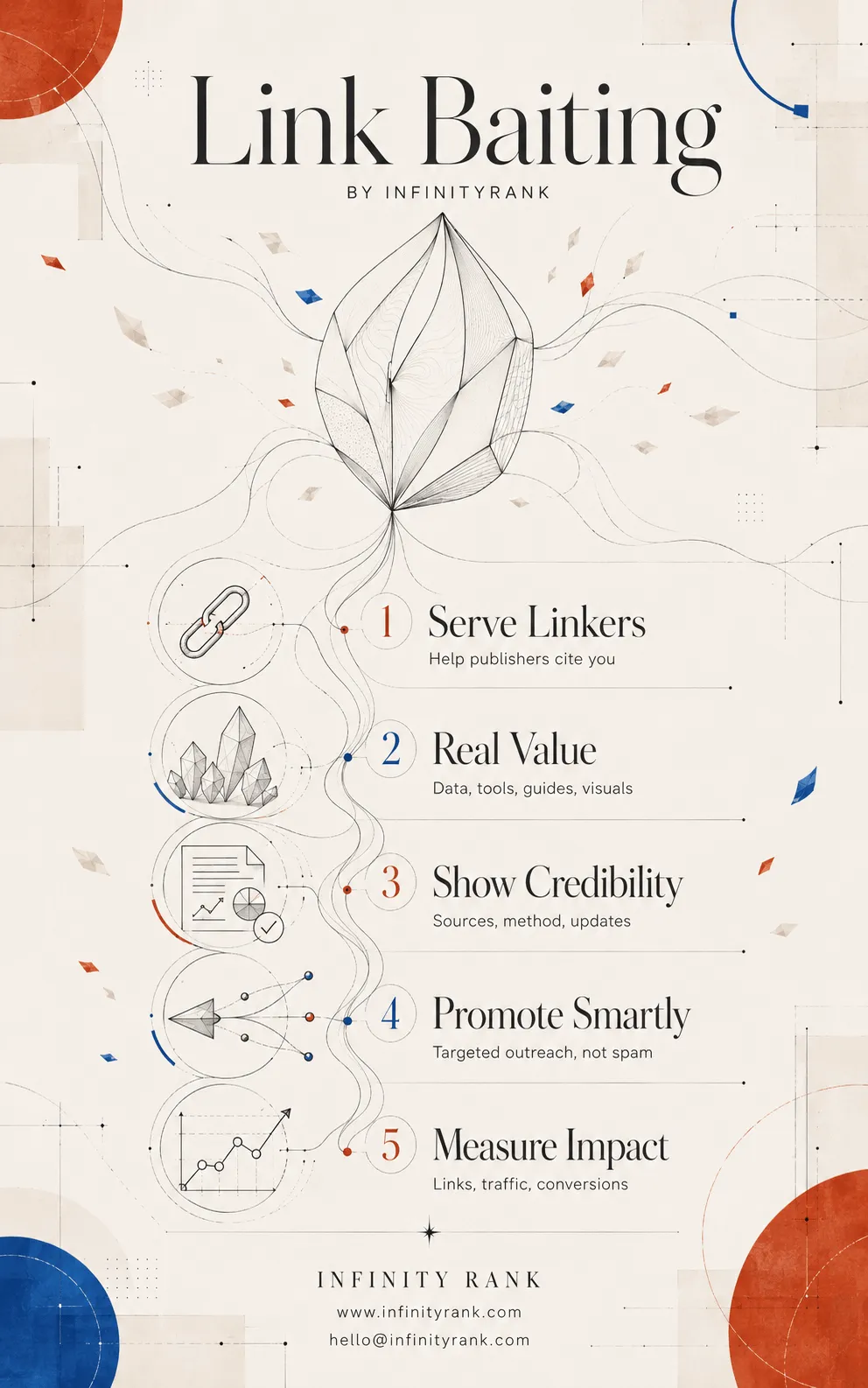
Shifting your content production away from standard informational blogs and toward highly referenceable industry assets fundamentally changes your organic trajectory.
By verifying your data methodologies, providing immediate visual utility, and executing highly precise outreach, you secure long-term editorial trust and continuous digital citations. Use the framework above as your tactical operational filter to audit your next major asset before investing in production.
Link Bait vs Clickbait
Link bait and clickbait are not the same strategy.
| Link bait | Clickbait |
| Designed to earn references and backlinks | Designed primarily to generate clicks |
| Delivers substantial value | Often overstates or withholds information |
| Targets publishers as well as readers | Primarily targets casual readers |
| Can remain useful for years | Often depends on short-lived curiosity |
| Builds trust when executed well | Can damage trust when the content disappoints |
A strong headline is still important. However, the content must support the promise.
“New Study Reveals How Long B2B Buyers Take to Choose a Vendor” could be effective link bait if it contains a credible methodology and original findings.
“SEO Experts Hate This One Weird Trick” is clickbait unless the page provides evidence substantial enough to justify the claim.
Why Link Baiting Works
Google states that it uses links to discover pages and as a signal when assessing page relevance. That does not mean every backlink has equal value, but it explains why relevant editorial links remain important to search visibility.
Link baiting improves the probability of earning those links because it starts with the publisher’s needs.
A journalist may need current statistics. A blogger may need a diagram that explains a difficult process. A business owner may want a calculator to recommend to customers. An educator may need a clear reference guide.
When your page fills that gap, linking to it becomes useful to the publisher—not merely beneficial to you.
Successful link bait can also produce benefits beyond rankings:
- Referral traffic from relevant websites
- Brand exposure among new audiences
- Citations in articles, reports, and newsletters
- Relationships with journalists and industry publishers
- Increased branded searches
- Leads or conversions from people using the asset
- Internal-link opportunities for important commercial pages
These benefits are not guaranteed. The asset must be credible, visible, and relevant to people who are capable of linking to it.
The Linker Audience Matters More Than the General Audience
One of the most common link-baiting mistakes is choosing an idea based only on what potential customers want to read.
Customers and linkers are not always the same people.
Suppose you sell accounting software. Your customers may search for:
- How to create an invoice
- How to track business expenses
- Which accounting software is best
- How to prepare for tax season
Those topics can attract traffic, but the average reader may have no website and no reason to link.
Your linker audience could include:
- Finance journalists
- Accounting firms
- Business bloggers
- Researchers
- Universities
- Small-business organizations
- Software reviewers
- Government and nonprofit resource pages
These publishers may be more interested in:
- Small-business late-payment statistics
- Average invoicing times by industry
- An interactive tax-deadline calendar
- A calculator showing the cost of overdue invoices
- Original research into bookkeeping habits
Start by asking:
Who can realistically link to this, and what would make the asset useful to their work?
If you cannot identify a credible linker audience, the idea is probably better suited to ordinary content marketing than a dedicated link-bait campaign.
What Makes Content Link-Worthy?
Linkable content usually has at least one strong reason to be cited.
Originality
The asset contains information, analysis, or functionality that is not available everywhere else.
Repeating the same ten tips already covered by competing sites gives publishers little reason to cite your version.
Utility
The content helps people complete a task.
Calculators, templates, checklists, databases, comparison tools, and interactive resources often earn links because they are useful beyond a single reading session.
Credibility
The page explains where its information came from.
Original research should include:
- Sample size
- Data source
- Collection dates
- Methodology
- Limitations
- Definitions
- Author or reviewer credentials
Unsupported numbers may attract attention, but credible publishers will hesitate to cite them.
Clarity
The information is easy to understand and reference.
Useful formatting includes:
- Descriptive headings
- Summary tables
- Downloadable charts
- Clearly labelled statistics
- Concise definitions
- Embeddable visuals
- Stable section URLs
Relevance
The asset fits naturally into the topics the target publishers already cover.
A high-quality resource aimed at the wrong audience will still struggle to earn links.
Timeliness
Some assets become linkable because they answer a current need.
Examples include:
- Annual industry benchmarks
- Updated legal or regulatory guides
- Election, budget, or policy trackers
- Seasonal planning tools
- Live pricing databases
- Newly released market research
Timely assets can earn links quickly, but they may require regular updates to remain useful.
Six Effective Types of Link Bait
There is no universally best format. Choose the format that communicates the information properly and gives your target publishers a clear reason to link.
1. Original Research and Industry Data
Original research is highly linkable because it gives publishers evidence they cannot obtain from another article.
Possible formats include:
- Customer surveys
- Analysis of anonymized product data
- Industry benchmarks
- Market studies
- Pricing reports
- Search trend analyses
- Case-study collections
- Annual reports
A small survey is not automatically credible. The required sample size depends on the population, methodology, segmentation, and conclusions you intend to make.
Do not choose an arbitrary number of respondents and present the findings as representative of an entire industry.
How to make original research stronger
- Investigate questions publishers are already asking.
- Define the population being studied.
- Explain how respondents or records were selected.
- Separate observations from conclusions.
- Include charts that publishers can reference.
- Publish the methodology on the page.
- Provide downloadable data where appropriate.
- Update the research on a predictable schedule.
Example idea
A recruitment platform could analyse anonymized hiring data to report:
- Average time to hire by industry
- Roles with the longest recruitment cycles
- Differences between remote and office-based hiring
- Changes compared with the previous year
That gives HR publications, business writers, and employers several usable angles.
2. Free Tools, Calculators, and Interactive Resources
Tools attract links because they solve a recurring problem.
Common examples include:
- Cost calculators
- Graders
- Assessment tools
- Generators
- Estimators
- Interactive maps
- Quizzes
- Comparison tools
- Planning calendars
HubSpot’s Website Grader is a well-known example. The tool gives users a free website assessment rather than merely publishing advice about website performance. HubSpot has also documented the attention the tool received from technology and marketing publishers.
A tool does not need to be technically complex. A focused calculator that answers one useful question may be more linkable than a large tool with unclear value.
How to make a tool link-worthy
- Solve a specific, recurring problem.
- Make the result understandable.
- Explain how calculations are made.
- Avoid forcing registration before showing any value.
- Ensure it works properly on mobile devices.
- Create a supporting page explaining the use case.
- Keep the tool maintained as inputs or rules change.
Example idea
A commercial cleaning company could build a calculator estimating cleaning hours based on:
- Floor area
- Property type
- Number of bathrooms
- Cleaning frequency
- Foot traffic
Facilities-management websites could link to the calculator as a planning resource.
3. Definitive Guides, Checklists, and Templates
A guide can earn links when it becomes a dependable reference—not merely because it is long.
The strongest guides usually combine:
- Clear definitions
- Step-by-step instructions
- Examples
- Expert input
- Templates
- Decision tables
- Visual explanations
- Links to primary sources
- Regular updates
The subject must also be narrow enough to cover properly.
A generic “Complete Guide to Marketing” is unlikely to be genuinely complete. A detailed guide to “Building a B2B SaaS Customer Onboarding Checklist” has a clearer audience and purpose.
Linkable supporting assets
Add something readers can use separately:
- Spreadsheet
- Checklist
- Briefing template
- Decision tree
- Printable worksheet
- Audit framework
- Policy template
- Swipe file
These additions make the page easier for other publishers to recommend.
4. Infographics, Diagrams, and Data Visualizations
Visual assets help publishers explain ideas that would otherwise require several paragraphs.
Potential formats include:
- Process diagrams
- Timelines
- Decision trees
- Maps
- Comparison charts
- Data visualizations
- System diagrams
- Annotated illustrations
Simply turning a blog post into a tall graphic is not enough. The visual must communicate something more clearly than text alone.
How to improve visual link bait
- Focus on one central idea.
- Use readable text at normal screen sizes.
- Display the source beside any statistic.
- Provide accessible alt text.
- Include an HTML explanation for users who cannot interpret the image.
- Offer a downloadable version.
- Provide clear attribution instructions.
- Avoid publishing an unverified statistic inside a polished design.
Visuals can support an image link-building strategy, but the image still needs promotion and correct attribution.
5. Reference Pages and Curated Resources
Reference pages earn links by making scattered information easier to find.
Examples include:
- Industry statistics pages
- Glossaries
- Regulation databases
- Funding directories
- Conference calendars
- Grant lists
- Salary benchmarks
- Tool directories
- Resource collections
- Public datasets
The page must add editorial value. Copying descriptions from other websites or producing an unfiltered list creates little reason to link.
Useful additions include:
- Categories
- Search and filtering
- Review dates
- Eligibility criteria
- Clear inclusion standards
- Original summaries
- Status indicators
- Source links
- Update history
A resource page can also support resource-page link building because site owners already maintaining related lists may consider adding it.
6. Expert Analysis and Defensible Contrarian Opinions
A strong opinion can attract citations and discussion when it challenges a common assumption with evidence.
A weak opinion merely uses a provocative headline.
Effective expert analysis should include:
- A clear position
- Evidence supporting that position
- Consideration of opposing arguments
- Practical consequences
- Examples
- Author expertise
- A conclusion that goes beyond repeating the headline
Avoid manufacturing controversy solely for attention. Unsupported claims may generate reactions, but they rarely build durable authority.
Example idea
Instead of publishing “Keyword Research Is Dead,” a credible article could examine:
- Which traditional keyword metrics have become less useful
- How search journeys have changed
- Where audience research now matters more
- Which keyword-research tasks remain necessary
- Evidence from actual campaigns
The argument becomes linkable because it helps other writers discuss a genuine industry change.
How to Create Link Bait Step by Step
Step 1: Define the Business Objective
Do not begin with “We need backlinks.”
Decide what the asset should support:
- A specific commercial page
- Brand authority in a topic
- Entry into a new market
- Journalist relationships
- Referral traffic
- Lead generation
- Organic visibility
- Email-list growth
The objective affects the topic, format, promotion strategy, and success metrics.
Step 2: Identify the Linker Audience
List the groups capable of publishing relevant links.
Then find:
- Websites they write for
- Topics they cover
- Resources they already cite
- Questions they repeatedly answer
- Statistics they currently use
- Weak or outdated assets they link to
This research is more useful than choosing an idea based only on search volume.
Step 3: Find a Citation Gap
A citation gap is missing or inadequate information that publishers need.
Look for:
- Old statistics repeatedly cited
- Claims that trace back to weak sources
- Processes without clear diagrams
- Tools that are outdated or expensive
- Data available only in difficult formats
- Questions with conflicting answers
- Regulations without plain-English summaries
- Resource lists that are poorly maintained
Your asset should fill the gap rather than produce another version of what already exists.
Step 4: Validate the Idea Before Production
Before investing in research, development, or design, confirm that the concept has realistic linking potential.
Check:
- Whether similar assets have earned links
- Which websites linked to them
- Whether those sites are still active
- How recently the competing assets were updated
- Whether your version will be materially better
- Whether you can reach the likely publishers
- Whether the topic connects to your business
Do not copy a competitor’s asset merely because it earned backlinks. Determine why it worked and whether the same need still exists.
Step 5: Choose the Right Format
Match the format to the problem.
| Need | Suitable format |
| Publishers need evidence | Original research or benchmark report |
| Users need an answer calculated | Calculator or interactive tool |
| A process is difficult to understand | Diagram or step-by-step guide |
| Information is scattered | Database, directory, or reference page |
| Writers need quick citations | Statistics page or research summary |
| A common belief deserves scrutiny | Evidence-led expert analysis |
| Readers need help completing a task | Template, checklist, or worksheet |
Do not choose an infographic simply because infographics are commonly described as linkable. Use one only when visual presentation improves understanding.
Step 6: Build Credibility Into the Asset
Credibility cannot be added as an afterthought.
Include:
- Named author or organization
- Reviewer details where relevant
- Original sources
- Publication and update dates
- Transparent methodology
- Defined terms
- Limitations
- Corrections policy
- Contact information
For statistics, make it easy to distinguish between:
- Your original data
- Data from an external source
- Your interpretation
- An estimate
- A proven result
Step 7: Plan Distribution Before Publishing
An asset is not link bait merely because it exists.
Create a promotion plan before production is complete.
Potential channels include:
- Direct outreach to relevant publishers
- Digital PR
- Existing email subscribers
- Industry newsletters
- Professional communities
- Expert contributors
- Partners
- Social media
- Relevant forums
- Paid distribution
- Internal links from established pages
Promotion should be specific.
“Please check out our new study” is weak outreach.
A better pitch identifies the finding that matters to the recipient’s audience and explains why it is relevant to their current coverage.
Step 8: Publish Supporting Content
One asset can support several secondary pieces.
An original report could produce:
- A methodology page
- A press summary
- Industry-specific breakdowns
- Regional analysis
- Individual charts
- Short expert commentaries
- Social posts
- Newsletter content
- A webinar
- A downloadable dataset
This expands distribution without duplicating the same article.
Step 9: Add Relevant Internal Links
Link bait often attracts backlinks to an informational page rather than directly to a service or product page.
Use relevant internal links to connect the asset to pages that matter commercially.
For example, a backlink study could link to:
- A guide to referring domains versus backlinks
- A page explaining link-building metrics
- A guide to calculating link-building ROI
- A relevant link-building service page
Do not force keyword-heavy links into unrelated sections. Internal links should help readers take the next logical step.
Step 10: Update and Relaunch the Asset
Many linkable assets lose value because their data, screenshots, prices, laws, or recommendations become outdated.
Create an update schedule based on the subject:
- Monthly for live directories or pricing databases
- Quarterly for fast-moving industries
- Annually for benchmark reports
- Immediately after major regulatory or product changes
- As needed for evergreen guides
A meaningful update also creates a new promotion opportunity.
How to Promote Link Bait Without Spamming People
Outreach works best when it targets people who have a genuine editorial use for the asset.
Build a focused prospect list
Look for publishers who:
- Cover the subject
- Link to related resources
- Have cited similar statistics
- Recently wrote about the problem
- Maintain relevant resource pages
- Serve the same audience
A list of 50 relevant prospects is usually more useful than thousands of scraped email addresses.
Give each prospect a reason to care
Useful outreach angles include:
- A finding relevant to a recent article
- New data that updates an old statistic
- A free tool their audience can use
- A corrected or improved visual
- A local or industry-specific breakdown
- Expert commentary on a current development
Do not ask for a link before explaining the value.
Make the asset easy to reference
Provide:
- A concise summary
- Direct links to relevant sections
- Downloadable charts
- Clear source information
- A quote from a named expert
- Embedding or attribution guidance
- Contact details for questions
Remove unnecessary friction.
How to Measure Link-Baiting Results
Backlink count alone is not enough.
Track the following:
| Metric | What it tells you |
| New referring domains | How many unique websites linked to the asset |
| Link relevance | Whether those websites cover related subjects |
| Linking-page quality | Whether the links appear on credible, useful pages |
| Referral sessions | Whether people visit through the earned links |
| Engagement and conversions | Whether those visitors take meaningful actions |
| Organic impressions and clicks | Whether search visibility changes |
| Ranking movement | Whether relevant pages improve for target queries |
| Assisted conversions | Whether the asset contributes to later leads or sales |
| Brand mentions | Whether the campaign increases discussion without direct links |
| Production and promotion cost | What the campaign required to execute |
| Link retention | Whether earned links remain live |
Google Search Console’s Links report can provide a sample of detected links, but Google states that it is not a complete list. Use it alongside a dedicated backlink index when link discovery is important.
Use GA4’s Traffic acquisition report to analyse sessions and engagement from referral sources.
Avoid claiming that one backlink directly caused a ranking increase unless you have evidence strong enough to isolate that effect. SEO performance is influenced by multiple changes, including content, internal links, technical issues, competition, and search-result changes.
How Much Does Link Bait Cost?
Costs depend on the format.
A checklist created by an in-house expert may require little direct spending. An interactive calculator or national survey may require development, data collection, design, legal review, and promotion.
Common cost areas include:
- Research
- Survey respondents
- Data licensing
- Writing
- Expert review
- Design
- Development
- Testing
- Outreach
- Digital PR
- Paid promotion
- Maintenance
Judge the investment against the likely business value—not against a fixed cost per backlink.
A campaign that earns ten relevant links, qualified referral traffic, media mentions, and leads may be more valuable than one that earns 100 low-quality links with no measurable audience impact.
Why Link-Bait Campaigns Fail
The idea is not original
A longer version of an existing article is not automatically more linkable.
The asset targets readers but not linkers
The content may generate traffic while earning few links because its audience does not publish content.
The methodology is weak
Publishers will avoid citing research that lacks transparent sourcing or makes claims the data cannot support.
The asset has no promotion plan
Publishing is not distribution.
The topic is unrelated to the business
A viral asset may earn links without strengthening the site’s topical authority or attracting useful visitors.
The page is difficult to use
Poor mobile performance, intrusive forms, broken tools, illegible charts, and slow loading can undermine a good concept.
The content becomes outdated
Statistics and reference pages lose citation value when they are not maintained.
Success is measured only by link volume
A campaign can generate many irrelevant or low-value links while producing no business result.
Link-Bait Campaign Checklist
Before publishing, confirm that:
- The asset serves a defined business objective.
- A clear linker audience exists.
- The idea fills a real information or utility gap.
- The format suits the subject.
- Claims are supported by reliable evidence.
- Original research includes a methodology.
- The page has a named author or responsible organization.
- Visuals include sources and useful alt text.
- The asset works on mobile devices.
- Internal links connect it to relevant pages.
- A targeted promotion list is ready.
- Tracking is configured.
- An update schedule has been assigned.
Final Thoughts
Link baiting is not a shortcut that removes the need for outreach or promotion.
It is a more defensible foundation for link acquisition.
Instead of asking publishers to link to an ordinary page because your business wants better rankings, you create an asset that improves their article, supports their argument, helps their readers, or gives them credible information to cite.
The strongest campaigns combine three elements:
- A genuine information or utility gap
- A resource built with credibility and clear value
- Focused distribution to publishers who can use it
Get those elements right, and one asset can continue earning links, traffic, mentions, and business value long after its initial launch.
Frequently Asked Questions
What is link baiting in SEO?
Link baiting is the process of creating and promoting content intended to attract editorial backlinks because it offers useful information, original data, practical functionality, or another clear reason to be cited.
Is link baiting the same as clickbait?
No. Clickbait focuses on attracting clicks, often through exaggerated or incomplete headlines. Link bait must deliver substantial value because publishers need a credible reason to reference it.
Does link bait work without outreach?
It can earn links without direct outreach when a site already has a large audience or strong search visibility. Most new assets still need deliberate promotion before relevant publishers discover them.
What are good link-bait examples for small businesses?
Practical options include local surveys, cost calculators, industry checklists, original pricing reports, regulatory guides, interactive maps, templates, and carefully maintained local resource directories.
How long does link bait take to earn backlinks?
There is no fixed timeframe. Timely research may earn links shortly after publication, while evergreen tools and guides can acquire links gradually over months or years. Results depend on the asset, market, promotion, and existing brand visibility.
How do you measure link-baiting success?
Measure new referring domains, relevance and quality of linking pages, referral traffic, conversions, organic visibility, brand mentions, link retention, and the campaign’s total production and promotion cost.
Is link bait against Google’s guidelines?
Creating useful content that publishers voluntarily choose to reference is not inherently against Google’s guidelines. Problems arise when links are bought, exchanged, automated, or otherwise created primarily to manipulate rankings rather than serve users. Google recommends creating helpful, reliable, people-first content and warns against practices covered by its spam policies.