Wikipedia backlinks get hyped far beyond reality. They are not a magic ranking shortcut, and they are not a clean “authority transfer” play. Most Wikipedia links are nofollow, and Google says nofollow is treated as a hint that it will generally handle much like before, meaning not something to rely on for ranking credit.
That does not make Wikipedia links worthless. It means their value is usually indirect: referral traffic, discovery, trust with human readers, and the possibility that your source gets noticed and cited elsewhere.
If you want a Wikipedia backlink that actually sticks, stop thinking like a link builder and start thinking like an editor. Wikipedia is built around neutrality, verifiability, and reliable sourcing. Links that exist mainly to promote a site are exactly the kind of thing editors remove.l uncover the strategies you need to secure a Wikipedia backlink and why it could be the game-changer your SEO needs.
Do Wikipedia Backlinks Help SEO?
Yes, but not in the lazy way people claim.
A Wikipedia backlink can help if it sends qualified referral traffic, exposes your content to journalists and researchers, or strengthens the visibility of a genuinely useful source. What it usually does not do is function like a standard editorial dofollow backlink that passes obvious ranking value.
Google’s own guidance is clear: nofollow, sponsored, and UGC attributes are treated as hints, and in most cases Google says it will generally treat nofollow links as it did before and not consider them for ranking purposes.
So the real answer is simple: a Wikipedia link can be useful, but if your whole reason for pursuing it is “PageRank from a high-authority domain,” your premise is weak.
What Makes a Wikipedia Link Worth Adding?
Your page needs to be useful as a source, not just relevant to your business.
That usually means the page is:
- factual and specific
- supported by evidence
- written in a neutral tone
- directly relevant to the claim being cited
- not just a commercial landing page trying to rank or sell
A strong candidate might be an original dataset, a detailed research summary, a technical explainer with citations, or a genuinely useful reference page. A weak candidate is a service page, homepage, sales post, or vague blog article stuffed with opinion and marketing language.
Wikipedia expects material to be verifiable and based on reliable sources, and it explicitly warns against promotional content and spam.
How Wikipedia Handles External Links
This is where most bad advice falls apart.
Wikipedia allows external links, but it says they normally should not appear in the body of an article. With limited exceptions, external links belong in citations or in a tightly controlled external links section, and those links should be kept to a minimum. A small number of external links is normal. “There aren’t enough links here” is not a valid reason to add yours.
That matters because many people try to force their URL into an article as if Wikipedia were a directory. It is not. If your page is not supporting a specific claim, date, number, or statement in the article, it probably does not belong there.
Wikipedia Backlinks: Key SEO Insights Explained
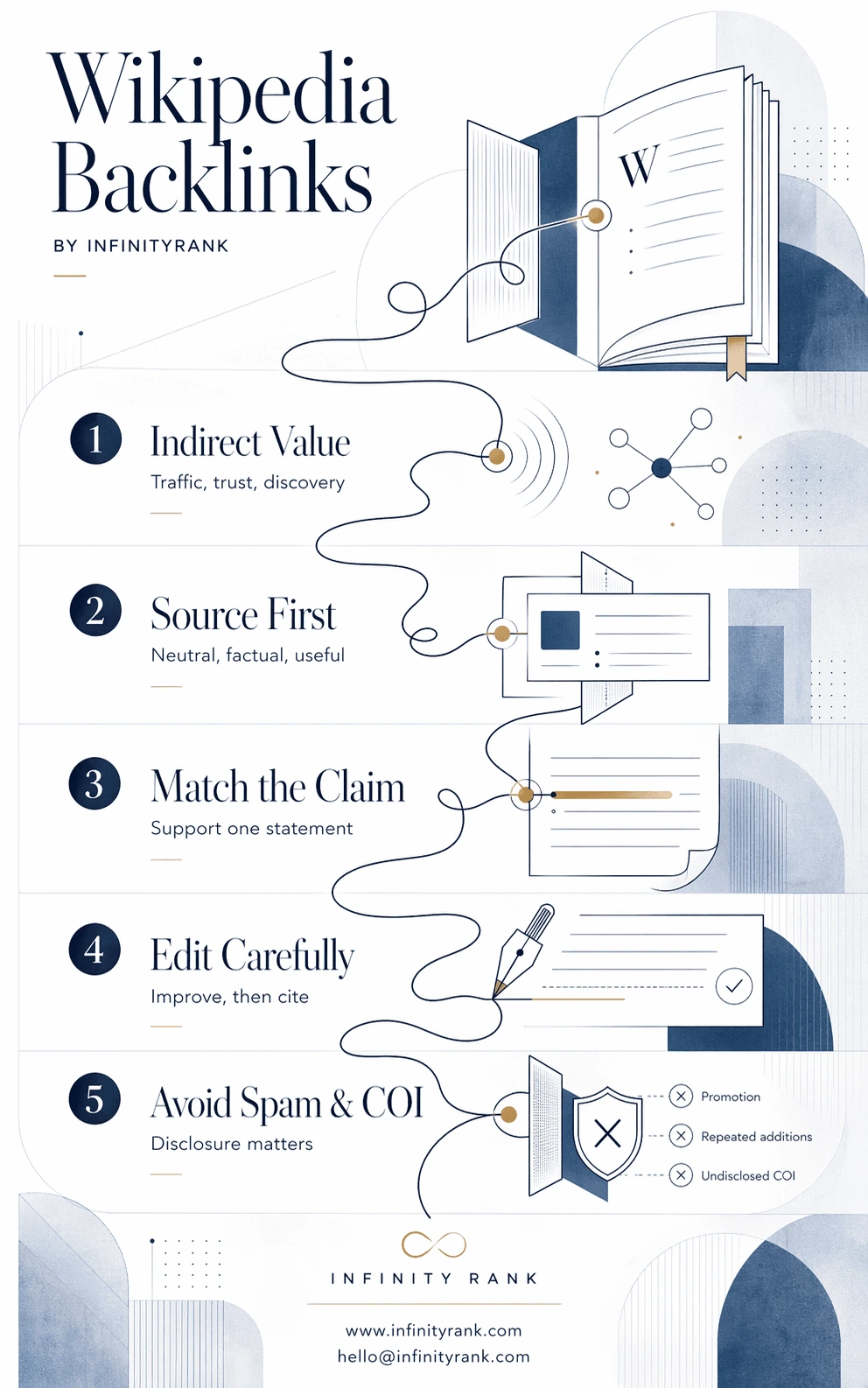
How to Get Wikipedia Backlinks Without Spamming
1. Create something citation-worthy first
Do not start on Wikipedia. Start on your own site.
Build a page that earns citation on its own merits. That means original data, a useful primary source, a clear expert explainer, or a highly specific reference page. Strip out fluff, popups, hype, and sales-heavy copy.
If the page looks like it exists mainly to capture leads, editors will smell it instantly. Wikipedia’s sourcing standards are stricter than most marketers want to admit.
2. Find pages where your source genuinely supports a claim
Look for a Wikipedia article where your source improves verification, not visibility.
Good opportunities include:
- outdated citations
- dead links that need replacement
- claims with weak sourcing
- specific statements your source documents better than what is there now
Bad opportunities include:
- broad topic pages where your brand is irrelevant
- inserting your site because the topic is “close enough”
- adding the same domain to multiple articles just to scale the tactic
Wikipedia’s spam guidance specifically flags repeated addition of the same website across multiple articles as suspicious, and it also warns about “reference spamming” when citations are added mainly to promote the source rather than support the article.
3. Understand who should edit
You do not always need an account to edit Wikipedia. Wikipedia’s editing help says anyone can edit almost any page and that registration is not required for many edits. But that does not mean every page is open.
Some pages are protected, and different protection levels can block unregistered or newer users from editing directly. In those cases, changes can be proposed on the article talk page or through an edit request.
In practice, creating an account is still smarter. It gives you a history, makes collaboration easier, and looks less disposable than drive-by IP edits. But the original claim that a registered account is always required is flatly wrong.
4. Add the citation carefully
If your source supports one sentence, cite that sentence. Do not use one source to prop up half a section. Do not rewrite the article around your URL. Do not drop your homepage into an external links section because you want exposure.
The cleaner move is usually to improve the article first, then attach your citation only where it directly verifies a claim. That approach fits Wikipedia’s editorial norms far better than obvious link insertion.
5. Expect review, reverts, or removal
Wikipedia is heavily monitored by volunteer editors, bots, and protection systems. If your edit looks promotional, weakly sourced, repetitive, or self-serving, it can be reverted fast. And if a domain is abused repeatedly, Wikipedia has a spam blacklist system that can block blacklisted URLs from being added at all.
That is why “just keep trying until it sticks” is terrible advice. Repeated forcing of the same domain can make the problem worse, not better.
Conflict of Interest: The Part Most SEO Articles Dodge
If you work for the company being linked, represent the client being linked, or are being paid to place or suggest the link, you have a conflict of interest.
Wikipedia’s conflict-of-interest guidance says editors with a COI, including paid editors, are expected to disclose it. It also says COI editors are strongly discouraged from directly editing affected articles and should propose changes on talk pages instead. Wikimedia’s Terms of Use separately require disclosure for paid contributions.
So no, “professional Wikipedia backlink services” should not be pitched like a manual link-building service. That framing is sloppy at best and risky at worst. If money is involved, disclosure rules apply, and promotional editing can get challenged, reverted, or treated as spam.
Common Reasons Wikipedia Removes Your Link
Your link is likely to get removed if:
- the page is promotional
- the source is weak, self-serving, or not reliable enough
- the citation does not directly support the claim
- you add the same domain repeatedly across articles
- you try to use Wikipedia like a link placement platform
- you ignore COI or paid-editing disclosure expectations
That is the actual filter. Relevance alone is not enough. Plenty of “relevant” links still get removed because they fail the editorial test.
A Better Goal Than “Get a Wikipedia Backlink”
The smarter goal is not “land a link from Wikipedia.” It is “publish something neutral, useful, and verifiable enough that a Wikipedia citation would make sense.”
That shift matters. It forces you to produce assets that can help in multiple places:
- journalist research
- expert roundups
- industry resource pages
- academic or nonprofit citations
- organic editorial links outside Wikipedia
In other words, build citation-worthy content first. Wikipedia becomes a possible byproduct, not the strategy itself. That is a much healthier approach for both SEO and credibility.
Final Take
Wikipedia backlinks are real, but most of the advice around them is junk.
They can help indirectly. They can drive traffic. They can put your source in front of the right people. But they are not a loophole for easy rankings, and they are absolutely not a place for careless promotion. If your content is genuinely useful, neutral, and source-worthy, you may earn a citation that sticks. If it is self-serving, salesy, or forced, expect it to disappear.
FAQs
Are Wikipedia backlinks dofollow?
Usually no. Wikipedia links are generally nofollow-style links, and Google says it generally treats such links much as it did before, usually not considering them for ranking purposes.
Can anyone edit Wikipedia?
Anyone can edit almost any page, and registration is not required for many edits. But some pages are protected, and certain protection levels restrict edits from unregistered or newer users.
Can I pay someone to add my link to Wikipedia?
You can hire someone to help you navigate Wikipedia, but paid contributions require disclosure, and COI editors are strongly discouraged from directly editing affected articles. Treat this as a compliance issue, not a shortcut.
What kind of page is most likely to earn a Wikipedia citation?
A page with neutral, verifiable, genuinely useful information tied to a specific claim. Not a homepage. Not a sales page. Not a generic blog post written to fish for links.
What happens if my link keeps getting removed?
That usually means editors do not think the link belongs, the source is not strong enough, or the pattern looks promotional. Re-adding it without fixing the underlying problem is how you drift into spam territory.