Beautiful photos are not enough. If couples cannot find your website when they search for a wedding photographer in your city, at their venue, or in their preferred photography style, they will book someone else.
SEO for wedding photographers is not about stuffing keywords into a homepage. It is about building a website that helps search engines understand where you work, what you shoot, which venues you know, and why couples should trust you.
This guide breaks down the SEO work that matters: local keyword targeting, venue pages, image optimization, Google Business Profile, reviews, backlinks, technical SEO, and conversion tracking.
1. Target City, Venue, and Style Keywords
Most wedding photography SEO starts too broad. Ranking for “wedding photographer” nationally is unrealistic and usually pointless. You need searches from couples who can actually hire you.
Start with keywords tied to:
- Your city or region
- Wedding venues you shoot at
- Your photography style
- Your package types
- Nearby destination wedding locations
Examples:
Austin wedding photographerBrooklyn documentary wedding photographerLake Como elopement photographerwedding photographer at [venue name]luxury wedding photographer in [city]engagement photos in [city]intimate wedding photographer [region]
Map each keyword to the right page. Do not force every keyword onto your homepage.
| Page Type | Best Keyword Target |
| Homepage | Main city/service keyword |
| Wedding photography service page | Core commercial keyword |
| Venue page | [venue name] wedding photographer |
| Blog post | Planning, location, or inspiration keyword |
| Gallery page | Wedding style, venue, city, and season |
| About page | Brand, trust, and photographer name searches |
Bad keyword targeting creates weak pages. Good keyword targeting gives every page a clear job.
The Photographer’s Roadmap to Dominating Local Search
You’ve spent years mastering the art of the perfect shot, but in the digital world, even the most breathtaking portfolio can stay hidden if it isn’t optimized for discovery. In the high-stakes wedding industry, being “good” isn’t enough—you have to be found. Instead of getting lost in technical jargon or chasing every social media trend, you need a clear, visual path to follow.
This visual guide to wedding photography SEO maps out the five essential milestones you need to hit to move beyond the “starving artist” phase and start filling your calendar with dream clients.
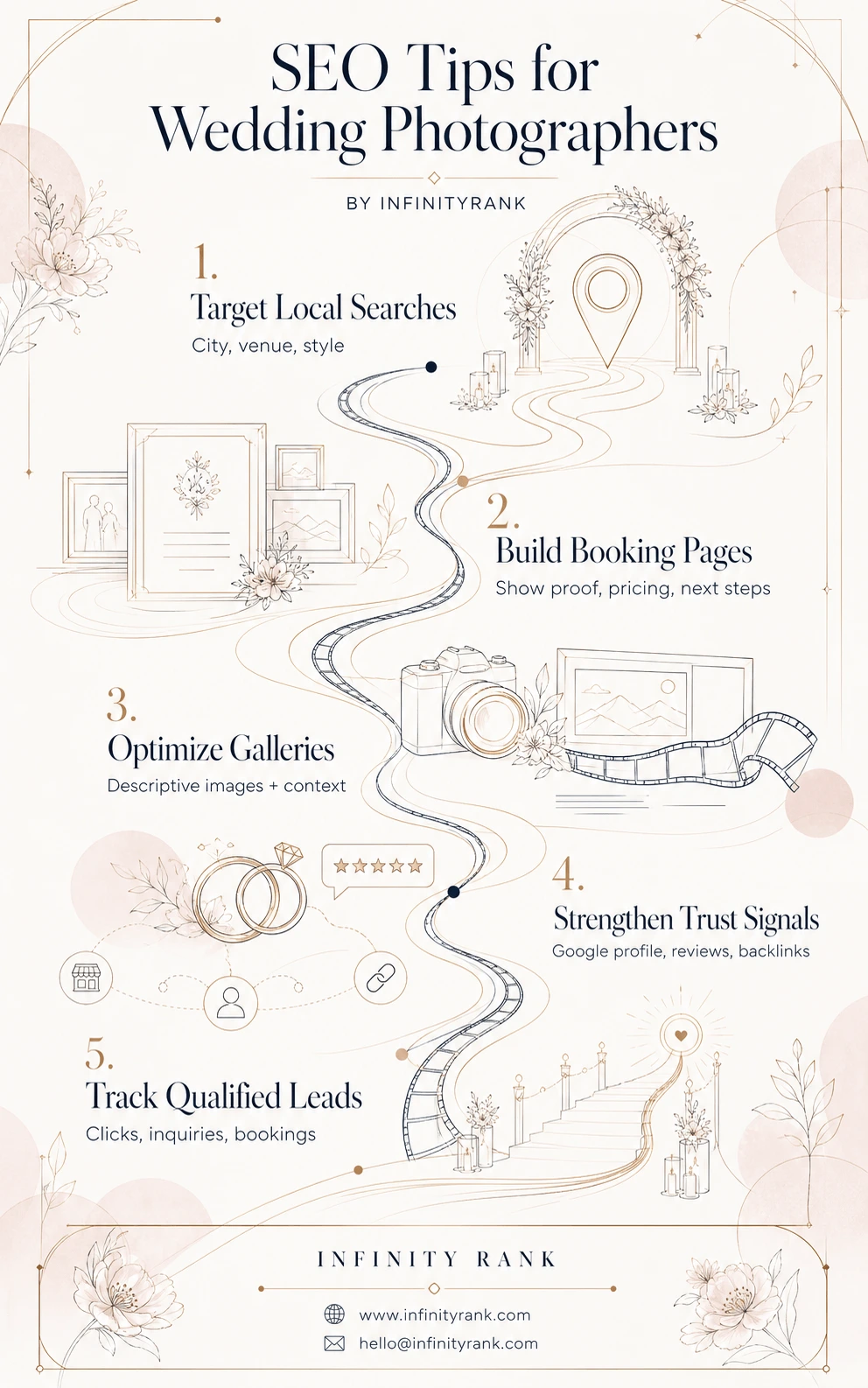
By following this framework, you’re not just fixing a few keywords; you’re building a sustainable brand that search engines trust and couples adore.
2. Build Pages That Match Booking Intent
Your homepage should not be your entire SEO strategy. Couples searching for a wedding photographer want proof, pricing direction, location clarity, and easy next steps.
Your core wedding photography page should include:
- Your city or region
- Your photography style
- Real wedding examples
- Package or pricing guidance
- Reviews or testimonials
- FAQs
- Clear inquiry button
- Internal links to galleries, venue pages, and blog posts
Use a clear title tag. Google may use page titles, headings, and other prominent text when creating title links in search results, so your page title and main heading should not fight each other.
Weak title tag:Home | Jane Smith
Better title tag:Austin Wedding Photographer | Jane Smith Photography
Better meta description:Austin wedding photographer specializing in candid, emotional wedding galleries. View packages, venues, real weddings, and availability.
Every important page needs a clear purpose. If a page does not answer a real search query or move a couple closer to booking, it is probably dead weight.
3. Create Venue-Specific Landing Pages
Venue SEO is one of the biggest missed opportunities for wedding photographers.
Couples often search for photographers who have experience at their venue. A page targeting [venue name] wedding photographer can rank, build trust, and convert better than a generic blog post.
A strong venue page should include:
- Venue name
- City and region
- A real gallery from that venue
- Best photo locations at the venue
- Lighting notes
- Seasonal considerations
- Timeline advice
- Vendor credits
- Internal links to related galleries
- A clear inquiry CTA
Example structure:
H1: [Venue Name] Wedding Photographer
Intro: Explain your experience photographing weddings at the venue.
H2: Real Wedding Photos at [Venue Name]
H2: Best Photo Locations at [Venue Name]
H2: Wedding Photography Tips for [Venue Name]
H2: Planning a Wedding at [Venue Name]?
CTA: Check availability for your wedding date.
Do not create fake venue pages for places you have never photographed unless you can add genuinely useful information. Thin venue pages are obvious and low-value.
4. Optimize Image-Heavy Galleries
Photography sites often fail because galleries are beautiful but invisible to search engines. A page with 80 images and almost no text gives Google very little context.
Google recommends using descriptive filenames, titles, alt text, captions, and relevant surrounding text for images.
Use filenames like:
austin-summer-wedding-bride-groom-portrait.webpvilla-terrace-wedding-ceremony-florence.webpbrooklyn-wedding-reception-candid-dancefloor.webp
Avoid filenames like:
IMG_4829.jpgDSC0034.jpgfinal-edit-7.jpg
Good alt text describes the image. It does not stuff keywords.
Bad alt text:wedding photographer wedding photography Austin wedding photographer
Better alt text:Bride and groom walking through the garden at an Austin summer wedding.
Bad alt text:SEO Tips
Better alt text:Wedding photographer reviewing local SEO keyword research on a laptop.
For gallery pages, add 300–600 words of useful context:
- Where the wedding happened
- What season it was
- What style the couple wanted
- What made the venue challenging or photogenic
- Which vendors were involved
- Links to related galleries or venue pages
Image SEO is not optional for wedding photographers. Your images are your product. Treat them like searchable assets.
5. Improve Your Google Business Profile
For local wedding photography searches, your Google Business Profile matters. Google says local results are based mainly on relevance, distance, and prominence, and review count and rating can affect local ranking.
Fix the basics first:
- Use the correct business name
- Choose the most accurate primary category
- Add service areas
- Add wedding photography services
- Upload high-quality photos
- Add your website URL
- Keep phone number and business details consistent
- Ask clients for reviews
- Respond to reviews
- Use updates/posts when relevant
Do not keyword-stuff your business name. If your real business name is “Jane Smith Photography,” do not change it to “Jane Smith Austin Wedding Photographer Luxury Elopement Photographer.” That looks spammy and can create listing problems.
Your profile should link to the most relevant page. For most photographers, that is the main wedding photography page, not a generic homepage with weak local content.
6. Collect and Use Reviews Properly
Reviews help couples trust you. They also support local SEO when they appear on your Google Business Profile and across reputable platforms.
Ask every happy couple for a review soon after delivery, while the experience is still fresh.
Use reviews in three places:
- Google Business Profile
- Key service pages
- Venue or gallery pages where relevant
Do not rely only on screenshots. Screenshots are less accessible, harder to verify, and weaker than properly formatted text. Use short testimonial excerpts on the page and link to live review sources where possible.
Good testimonial placement:
- Near the inquiry form
- Under pricing or package information
- On venue pages
- On the homepage
- Inside real wedding case studies
Avoid dumping 30 testimonials onto one page with no structure. Use reviews where they reduce hesitation.
7. Build Relevant Wedding-Industry Backlinks
Backlinks can help SEO, but only if they are relevant and credible. Random link packages are a waste of money and can create risk.
For wedding photographers, good backlink sources include:
- Wedding venues
- Wedding planners
- Florists
- Bridal boutiques
- Makeup artists
- Local wedding blogs
- Real wedding publications
- Chamber of commerce pages
- Vendor directory profiles
- Charity or event sponsorship pages
Ask venues and planners to link to your gallery when they use your photos. Submit real weddings to relevant publications. Build vendor relationships that produce natural mentions.
Avoid:
- Spam directories
- Irrelevant guest posts
- Paid link farms
- Exact-match anchor text abuse
- Private blog network links
- Low-quality “write for us” sites
Google uses links to discover pages and understand relevance, so internal and external links should be crawlable and descriptive.
Good anchor text:View this Austin garden wedding gallery
Bad anchor text:click here
8. Fix Technical SEO Issues
Wedding photography websites are usually image-heavy. That makes technical SEO more important, not less.
Check these items:
- Compress images before upload
- Use modern image formats such as WebP where possible
- Resize images to the actual display size
- Enable lazy loading
- Use a fast host or CDN
- Fix broken links
- Submit an XML sitemap
- Make sure key pages are indexable
- Use clean URLs
- Avoid duplicate gallery pages
- Test important pages in PageSpeed Insights
- Check Google Search Console for indexing errors
A beautiful gallery that takes too long to load will lose impatient visitors. It can also hurt organic performance because users bounce before seeing your work.
Your site should be fast enough for mobile users. Most couples will check photographers on phones before they ever submit an inquiry.
9. Use Structured Data
Structured data helps search engines understand your business and content. It is not a magic ranking button, but it can improve clarity and eligibility for certain search features.
For a wedding photography business, consider:
LocalBusinessor a more specific local business subtype where appropriateBreadcrumbListImageObjectArticlefor blog postsFAQPagefor visible FAQ content when eligible
Google’s LocalBusiness structured data documentation explains that businesses can mark up information such as business hours, departments, and other business details. Google also recommends JSON-LD as a supported structured data format and says pages must follow structured data guidelines to be eligible for rich results.
At minimum, your local business markup should match the visible information on your site:
- Business name
- Website URL
- Phone number
- Address or service area, depending on your business model
- Images
- Business type
- SameAs links to social profiles
- Opening hours, if relevant
Do not mark up fake reviews, hidden FAQs, or information that users cannot see on the page.
10. Track Rankings, Traffic, and Inquiries
SEO is not finished when you publish the page. You need to track whether it produces business.
Monitor:
- Google Search Console queries
- Organic clicks
- Impressions
- Average ranking position
- Top landing pages
- Google Business Profile calls and website clicks
- Contact form submissions
- Venue page performance
- Blog post traffic
- Inquiry-to-booking conversion rate
Do not obsess over rankings alone. A page that ranks for a low-intent keyword but brings no inquiries is not doing its job.
Track the keywords that matter:
[city] wedding photographer[venue name] wedding photographer[style] wedding photographer [city]engagement photographer [city]elopement photographer [destination]
The goal is not traffic. The goal is qualified inquiries from couples who are likely to book.
Wedding Photographer SEO Checklist
Use this before publishing or updating a page:
- Primary keyword appears in the title tag
- H1 clearly matches the page topic
- Page targets one main search intent
- Copy mentions city, venue, style, and service naturally
- Images have descriptive filenames
- Images have useful alt text
- Page loads quickly on mobile
- Internal links point to related galleries and services
- CTA is visible above and below the main content
- Testimonials are placed near decision points
- Schema matches visible page content
- Page is indexable
- URL is short and descriptive
- Meta description is written for clicks
- Page is submitted in the XML sitemap
FAQs About SEO for Wedding Photographers
How long does SEO take for wedding photographers?
Most photographers should expect several months before seeing meaningful organic growth. Local competition, website quality, content depth, backlinks, and technical performance all affect timing. SEO is slower than ads, but the traffic can compound.
Should wedding photographers blog?
Yes, but only if the posts target useful searches. Random posts like “A Beautiful Day with Sarah and Mark” are weak unless they include venue, city, style, and planning context.
Better blog topics include:
- Best wedding venues in your city
- Real wedding at a specific venue
- Engagement photo locations in your area
- Wedding photography timeline tips
- Rainy wedding photo ideas
- Elopement planning guide for your region
Should I create pages for every city I serve?
Create city pages only when you can make them useful. A thin page that swaps out the city name is not enough. Add real galleries, local venue information, travel details, reviews from that area, and region-specific advice.
How should photographers write image alt text?
Describe the actual image in plain language. Include location, venue, season, or event type when relevant. Do not repeat the same keyword on every image.
Example:Bride and groom sharing a first look under oak trees at a Charleston wedding venue.
Do backlinks still matter for wedding photographers?
Yes, but quality matters more than quantity. A link from a venue, planner, local wedding blog, or real wedding feature is far more useful than a link from an unrelated directory.
What is the biggest SEO mistake wedding photographers make?
Relying on a pretty homepage and ignoring search intent. Couples search by city, venue, style, and problem. Your site needs pages that answer those searches directly.
Final Thoughts
SEO for wedding photographers is simple in concept but demanding in execution. You need clear local targeting, useful venue pages, optimized galleries, strong reviews, relevant backlinks, and a fast website.
Do not chase hacks. Build pages that help couples choose you.
If your site only says you take beautiful photos, it is not enough. Show where you work, what you know, who trusts you, and how couples can book you.