A press release shares a complete news announcement. A media advisory invites journalists to cover an upcoming event.
That is the core difference.
Both are public relations tools, but they do not serve the same purpose. A press release gives reporters the full story: what happened, why it matters, who is involved, and what details they can use in coverage. A media advisory is shorter and more direct. It tells journalists that something is happening soon and gives them the basic information they need to attend, cover, photograph, or interview someone at the event.
Choosing the wrong format can weaken your pitch. Send a long press release when a reporter only needs event logistics, and you create friction. Send a short advisory when the news needs context, quotes, and background, and you leave the journalist with too little to work with.
This guide explains the difference between a press release and a media advisory, when to use each one, what to include, and how to decide which format fits your announcement.
Quick Answer: Press Release vs Media Advisory
Use a press release when you have a complete news story to announce.
Use a media advisory when you want journalists to attend or cover an upcoming event.
A press release is best for product launches, company news, executive appointments, funding announcements, partnerships, research findings, awards, and major updates.
A media advisory is best for press conferences, ribbon cuttings, public events, charity events, protests, community announcements, photo opportunities, and media briefings.
Press Release vs Media Advisory Comparison Table
| Element | Press Release | Media Advisory |
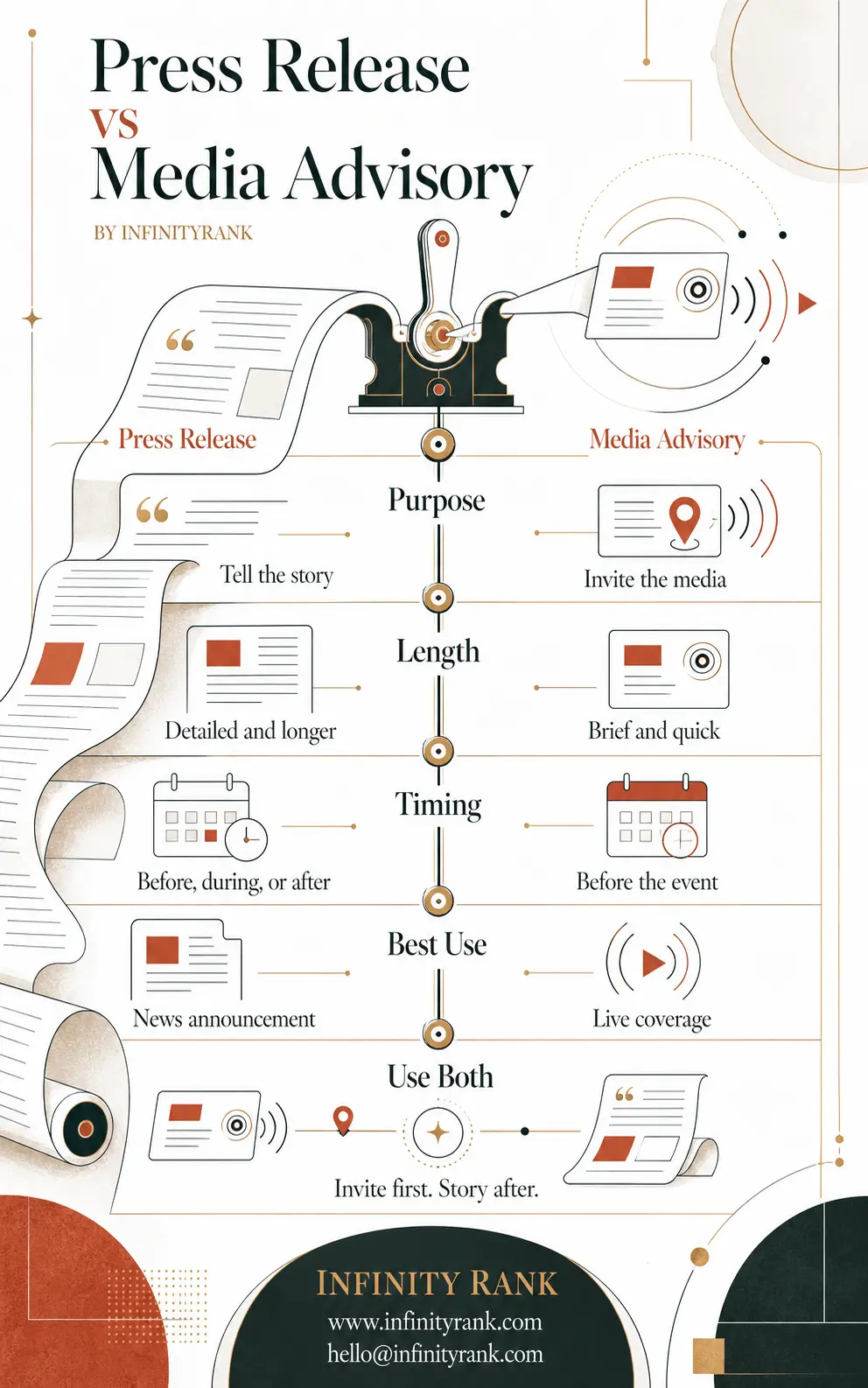
| Main purpose | Announce news and provide a complete story | Invite media to cover an upcoming event |
| Timing | Before, during, or after the announcement | Before the event |
| Length | Usually longer, often 400–700 words | Usually short, often 100–250 words |
| Format | Headline, dateline, lead, body, quote, boilerplate, contact | Who, what, when, where, why, media contact |
| Audience | Journalists, editors, bloggers, industry publications, sometimes customers | Journalists, assignment editors, local media, photographers, TV crews |
| Best for | News announcements | Event coverage |
| Includes quotes? | Usually yes | Usually no, unless very brief |
| Includes full background? | Yes | No, only essential context |
| Goal | Get coverage of the story | Get media attendance or event coverage |
| Example | “Company launches new AI SEO platform” | “Media invited to attend AI SEO platform launch event” |
Press Release vs. Media Advisory: Which One Do You Need?
If you have big news to share, the last thing you want to do is send the wrong signal to a busy journalist. Many people use “Press Release” and “Media Advisory” interchangeably, but in the world of PR, they serve two completely different masters. Sending a full-blown story when you just need to invite cameras to an event—or sending a tiny invitation when you have a massive announcement—is a surefire way to get ignored. We’ve mapped out the key differences in purpose, timing, and length so you can choose the right tool for the job and actually get the coverage you deserve.
What Is a Press Release?
A press release is an official written announcement sent to journalists, editors, media outlets, bloggers, and other relevant publishers. Its job is to communicate news clearly enough that a reporter can understand the story, decide whether it matters, and use the details in coverage.
A good press release answers the basic news questions:
- Who is involved?
- What happened?
- When did it happen?
- Where is it happening or relevant?
- Why does it matter?
- How does it affect customers, the industry, or the public?
A press release is not just a promotional article. It should be written like a news announcement, not a sales page. The strongest press releases lead with the most important information, include a relevant quote, provide useful background, and make it easy for journalists to contact the right person.
Common Reasons to Send a Press Release
You should use a press release when the announcement has enough substance to stand on its own as a news story.
Common examples include:
- Launching a new product or service
- Announcing a merger, acquisition, or partnership
- Sharing company funding news
- Hiring a new executive
- Publishing original research or industry data
- Opening a new office or location
- Winning a major award
- Hosting a major campaign or initiative
- Announcing a rebrand
- Responding to a crisis or public issue
- Sharing post-event results or milestones
For example, if your company launches a new SEO software platform, a press release can explain what the tool does, who it is for, why it matters, and how it fits into the market.
What to Include in a Press Release
A complete press release usually includes these elements:
1. Headline
The headline should summarize the news clearly. Avoid vague, clever, or overhyped wording.
Weak headline:
Company Announces Exciting New Solution
Better headline:
Infinity Rank Launches AI-Powered SEO Content Platform for Agencies
2. Subheadline
The subheadline adds useful context. It should support the headline, not repeat it.
Example:
The new platform helps agencies plan, optimize, and scale search-focused content workflows.
3. Dateline
The dateline shows where and when the announcement is being issued.
Example:
New York, NY — May 1, 2026
4. Lead Paragraph
The first paragraph should give the full news angle quickly. Do not bury the point.
Example:
Infinity Rank today announced the launch of its AI-powered SEO content platform, designed to help agencies create optimized content strategies, identify ranking opportunities, and improve organic search performance.
5. Body Copy
The body explains the announcement in more detail. This is where you add the problem, solution, market context, product details, or company background.
6. Quote
Include one strong quote from an executive, founder, customer, partner, or expert. The quote should add insight, not repeat the announcement.
Weak quote:
“We are excited to launch this new product.”
Better quote:
“Agencies are under pressure to produce content faster without sacrificing quality. This platform gives teams a more structured way to turn search data into useful, publish-ready content.”
7. Boilerplate
The boilerplate is a short “About the company” section. Keep it factual and concise.
8. Media Contact
Always include the contact person, email address, phone number if appropriate, and company website.
What Is a Media Advisory?
A media advisory, sometimes called a media alert, is a short notice sent to journalists before an event. Its purpose is not to tell the full story. Its purpose is to get the right media people to show up or assign coverage.
A media advisory is usually brief, structured, and easy to scan. It gives journalists the event logistics and explains why the event is worth covering.
Think of it as an invitation for the press.
A media advisory is especially useful when there is a visual element, interview opportunity, public interest angle, or live announcement. Local TV stations, newspapers, photographers, and assignment editors often rely on this type of format because they need quick answers: what is happening, when, where, and why should they care?
Common Reasons to Send a Media Advisory
You should use a media advisory when you want media attendance or live coverage.
Common examples include:
- Press conferences
- Ribbon cuttings
- Charity events
- Community events
- Political events
- Public demonstrations
- Product launch events
- Grand openings
- Award ceremonies
- Expert panels
- Photo opportunities
- Media briefings
- Local business events
- Nonprofit campaigns
For example, if your company is opening a new office and hosting a ribbon cutting with local leaders, a media advisory should go out before the event. After the event, you may also send a press release with photos, quotes, attendance details, and the broader story.
What to Include in a Media Advisory
A media advisory should make the event easy to understand and easy to cover.
Use a simple structure like this:
Media Advisory Label
Start with a clear label:
MEDIA ADVISORY
This immediately tells journalists what type of document they are reading.
Headline
The headline should identify the event and news angle.
Example:
Local Business Leaders to Attend Grand Opening of New Infinity Rank Office
Date and Contact Information
Include the date of distribution and the contact person for media questions.
Who
List the people, company, organization, speakers, officials, or guests involved.
What
Describe the event in one or two clear sentences.
When
Include the exact date and time. Add the time zone if the event is virtual or relevant to a wider audience.
Where
Include the full address, venue name, room number, parking details, livestream link, or check-in instructions.
Why
Explain why the event matters. Keep this short.
Media Opportunities
Mention what journalists can capture or access, such as:
- Interviews
- Photos
- Video footage
- Product demos
- Live remarks
- Community reactions
- Behind-the-scenes access
RSVP or Contact Instructions
Tell journalists whether they need to RSVP, where to check in, and whom to contact for interviews.
Press Release Example Outline
Here is a simple press release structure:
FOR IMMEDIATE RELEASE
Headline:
Company Announces Main News Clearly
Subheadline:
One sentence adding context or benefit.
Dateline:
City, State — Date
Lead paragraph:
State the announcement clearly. Include who, what, when, where, why, and how.
Body paragraph:
Explain the problem, context, or reason the news matters.
Quote:
Add a useful quote from a relevant person.
Supporting paragraph:
Include details, features, numbers, event results, or background.
Boilerplate:
Brief company description.
Media Contact:
Name
Email
Phone
Website
Media Advisory Example Outline
Here is a simple media advisory structure:
MEDIA ADVISORY
Headline:
Media Invited to Attend [Event Name]
Date:
Month Day, Year
Media Contact:
Name
Email
Phone
Who:
List speakers, organization, guests, or officials.
What:
Briefly describe the event.
When:
Date and time.
Where:
Venue name, address, room, parking, or livestream link.
Why:
Explain the news value or public relevance.
Media Opportunities:
Interviews, photos, video, demonstrations, or remarks.
RSVP:
Tell reporters how to confirm attendance.
When Should You Send a Press Release?
Send a press release when the news is ready to be announced publicly.
The timing depends on the type of announcement. Some press releases are sent under embargo before the announcement date. Others go out on the day of the announcement. Some are sent after an event to summarize what happened and provide quotes, photos, or results.
Use a press release when journalists need more than logistics. If they need context, quotes, background, data, or a complete story angle, a press release is the better format.
When Should You Send a Media Advisory?
Send a media advisory before the event.
For many events, sending it a few days in advance gives journalists and assignment editors time to plan. For important or local events, it is also common to send a short reminder closer to the event.
A practical schedule looks like this:
- Send the first media advisory several days before the event.
- Send a reminder the day before or the morning of the event.
- Follow up with a press release after the event if there is a larger story to share.
The key is timing. A media advisory sent too late may not give reporters enough time to assign coverage. A media advisory sent too early may be forgotten unless you follow up.
Can You Use Both?
Yes. In many cases, using both is the smartest approach.
Use a media advisory before the event to invite journalists.
Use a press release after the event to share the full story, quotes, photos, attendance numbers, outcomes, and next steps.
Example:
A nonprofit is hosting a fundraising event.
Before the event, it sends a media advisory with the date, time, location, interview opportunities, and why the fundraiser matters.
After the event, it sends a press release announcing the amount raised, who attended, what the funds will support, and quotes from organizers or beneficiaries.
That is the right use of both formats.
How to Choose the Right Format
Use these questions:
Do you want journalists to attend something?
Use a media advisory.
Do you want journalists to write about an announcement?
Use a press release.
Is the event happening in the future?
Use a media advisory first.
Has the news already happened?
Use a press release.
Do you need to include quotes, background, and details?
Use a press release.
Do you only need to share event logistics?
Use a media advisory.
Is there a visual or interview opportunity?
Use a media advisory.
Is there a complete story angle?
Use a press release.
Common Mistakes to Avoid
Sending a Press Release When You Only Need an Advisory
If you are inviting journalists to an event, do not bury the event details inside a long press release. Assignment editors need fast information.
Use a media advisory with clear “who, what, when, where, why” details.
Sending a Media Advisory Without a News Angle
A media advisory still needs a reason for coverage. “We are hosting an event” is not enough.
Explain why the event matters, who will be there, and what media can capture.
Making the Press Release Too Promotional
A press release should sound like news, not an advertisement. Avoid exaggerated language like “game-changing,” “revolutionary,” or “world-class” unless you can prove it.
Forgetting the Media Contact
This is basic, but it happens. If a journalist cannot quickly find the right contact person, your chance of coverage drops.
Hiding the Date, Time, or Location
For a media advisory, event details must be impossible to miss. Put them in a clear format, not buried in paragraphs.
Using Weak Quotes
Quotes should add perspective. Do not waste them on empty statements like “We are thrilled.”
Press Release vs Media Advisory: Practical Examples
Product Launch
Best format: Press release
A product launch usually needs context, details, quotes, and positioning. Use a press release to explain what the product does, who it helps, and why it matters.
Ribbon Cutting
Best format: Both
Send a media advisory before the ribbon cutting to invite local journalists. Send a press release after the event with photos, quotes, and key details.
Executive Hire
Best format: Press release
An executive hire is a company announcement, not an event invitation. Use a press release to explain the person’s role, background, and strategic importance.
Press Conference
Best format: Media advisory first
A press conference needs media attendance. Send a media advisory before the event. Afterward, send a press release summarizing the announcement.
Charity Fundraiser
Best format: Both
Use a media advisory before the fundraiser to attract local coverage. Use a press release after the event to announce results, funds raised, and impact.
FAQs About Press Releases and Media Advisories
Is a media advisory the same as a press release?
No. A media advisory is a short invitation for journalists to attend or cover an event. A press release is a complete news announcement with more detail, context, and quotes.
Which is shorter: a press release or a media advisory?
A media advisory is usually shorter. It focuses on essential event details. A press release is longer because it explains the full news story.
Can a media advisory include quotes?
Usually, no. A media advisory should stay brief and focused on event logistics. If a quote is necessary, keep it very short. Save full quotes for the press release.
Should I send a media advisory or press release first?
If there is an upcoming event, send the media advisory first. After the event, send a press release if there is a larger story to report.
Can a press release promote an event?
Yes, but if your main goal is to get journalists to attend the event, a media advisory is usually better. A press release can support the broader announcement, but a media advisory is clearer for event coverage.
How far in advance should I send a media advisory?
For most events, send it several days before the event and follow up with a reminder closer to the date. For larger events, give journalists more lead time.
What is another name for a media advisory?
A media advisory is sometimes called a media alert or press advisory. The purpose is the same: notify journalists about an upcoming event or media opportunity.
Final Verdict: Which One Should You Use?
The difference between a press release and a media advisory comes down to purpose.
A press release tells the full story. Use it when you have news to announce and want journalists to understand the context, quote the right people, and cover the announcement accurately.
A media advisory gets journalists to an event. Use it when you need reporters, photographers, TV crews, or editors to know when and where something is happening.
For many campaigns, you may need both. Send the media advisory before the event. Send the press release after the event or when the full announcement is ready.
The mistake is treating them as interchangeable. They are not. A press release gives the story. A media advisory opens the door for coverage.