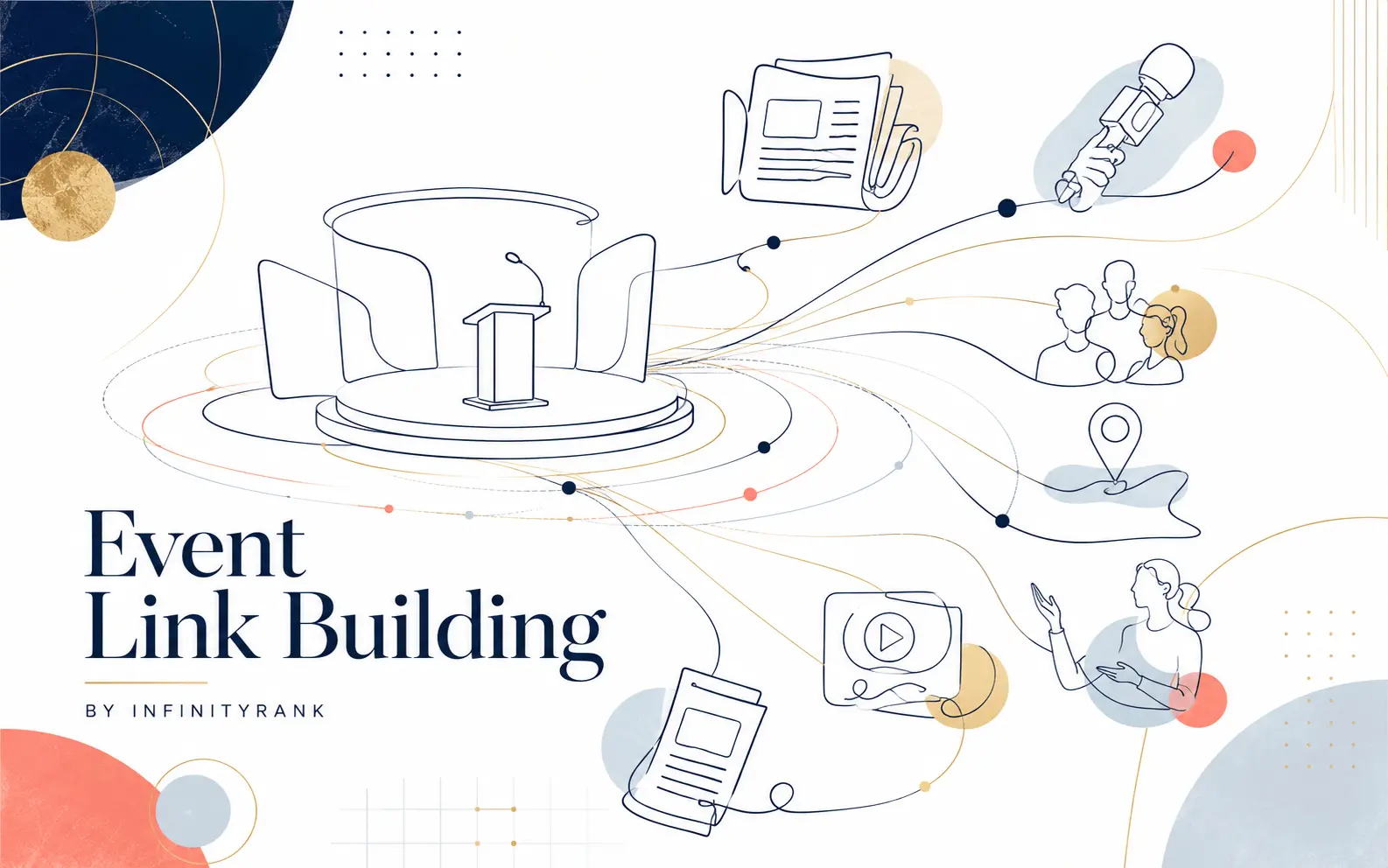
Events can generate more than registrations and brand exposure. A well-planned conference, webinar, workshop, product launch, or community event can also create legitimate reasons for other websites to mention and link to your business.
That does not mean every event listing or sponsorship automatically produces a valuable backlink. Strong event link building depends on three things:
An event people genuinely care about Useful assets worth referencing Relevant promotion before and after the event
This guide explains how to build an event campaign that earns editorial links, referral traffic, media coverage, and measurable business results without relying on spammy directories or paid links that violate Google’s policies.
What Is Event Link Building?
Event link building is the process of earning or acquiring website links by organizing, promoting, participating in, or sponsoring an event.
Potential link sources include:
Industry publications Local news websites Community calendars Professional associations Speakers and participating companies Event listing platforms Universities and nonprofit organizations Sponsors and commercial partners Bloggers, podcasters, and newsletter publishers Post-event resources and media coverage
The strongest event backlinks are usually editorial. A journalist may link to an event page when covering an industry announcement, or a speaker may reference the event from a relevant resources page.
Other links, such as those included in paid sponsorship packages, should be treated differently. They can still generate referral traffic and visibility, but they must be qualified correctly because payment was involved.
Why Events Create Link Opportunities
Most conventional outreach campaigns ask publishers to link to an existing service page or blog post. Events create a new reason to cover your organization.
An event may be newsworthy because it includes:
Original research or survey findings Recognized speakers A new industry initiative A significant partnership A local community benefit A charitable programme A product or service launch Practical education for a specific audience Access to data, experts, or resources
Events also produce multiple assets. A single webinar can generate a landing page, speaker profiles, presentation slides, a recording, a transcript, short video clips, original quotations, and a post-event report.
Each asset creates a different promotion and outreach opportunity.
However, the event itself is not enough. A generic webinar with no distinctive insight will not suddenly attract editorial coverage because it has a registration page. The campaign needs a clear audience, a credible topic, and something useful enough to reference.
Event Link Building: Earn High-Value Local and Industry Links
Hosting or sponsoring an event is a powerful way to get high-quality backlinks to your website. When you give people a great reason to share your event, local blogs, newspapers, and industry sites will naturally want to talk about you. To make this work, you need to set up a permanent page on your own site and choose the right places to share it. This simple guide breaks down five easy steps to turn your next event into a major link magnet.
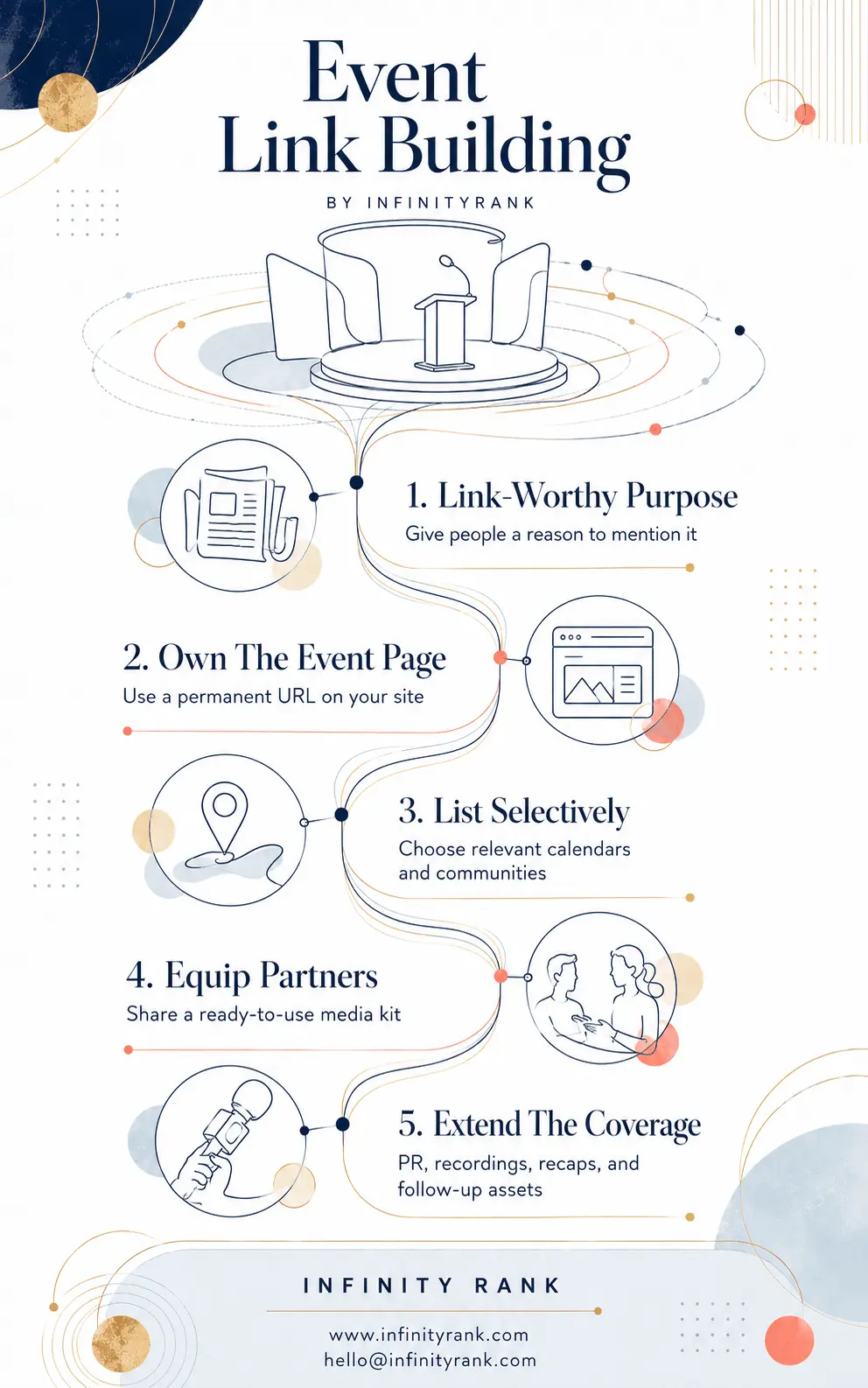
Getting backlinks from events takes some planning, but the search authority you build can last for years. By giving your partners a ready-to-use media kit and keeping the coverage going with post-event recaps, you keep earning citations long after the day is over. Use these five simple steps as your strategy checklist to make your next business event a massive SEO success.
Earned Event Links vs Paid Event Links
Not all event links should be evaluated in the same way.
Earned editorial links
These are links that another publisher chooses to add because the event, announcement, or resource is relevant to its audience.
Examples include:
A trade publication covering your research presentation A local newspaper mentioning a community workshop A university department listing a relevant public lecture A speaker linking to the event from their website A blogger citing statistics from your post-event report
These links are not guaranteed. They must be earned through relevance, relationships, useful content, or legitimate news value.
Paid sponsorship links
A sponsorship package may include your logo and website link on an organizer’s website. Because you paid for the placement, it should not be presented as an independent editorial endorsement.
Google recommends marking paid placements with rel="sponsored". The older nofollow value remains acceptable, although sponsored is the preferred option.
A qualified sponsorship link can still deliver:
Referral traffic Registrations Brand visibility Partnership opportunities Commercial leads
Do not purchase sponsorship solely to obtain an unqualified followed link.
1. Give the Event a Link-Worthy Purpose
Before creating a landing page, identify why another website would mention the event.
“Join our upcoming webinar” is not a strong editorial proposition by itself.
A more compelling event might offer:
New research about the industry A panel discussing a significant regulatory change Free training for a local business community Expert analysis of an emerging problem A live demonstration of a new process A downloadable report or dataset Access to several specialists in one session
Write the central value proposition in one sentence:
This event helps [specific audience] understand or solve [specific problem] by providing [distinctive information or access].
That statement should guide the event page, speaker selection, media pitch, listings, and promotional materials.
2. Create a Permanent Event Landing Page
The event landing page should be the campaign’s primary destination.
Do not rely entirely on a third-party ticketing platform. You need a page on your own domain that publishers, partners, and attendees can reference.
Include:
A clear event title A concise explanation of who the event is for Date, start time, end time, and time zone Physical venue or online attendance details Registration or ticket information Agenda and session descriptions Speaker names and biographies Organizer information Accessibility details Relevant images Frequently asked questions Press and partnership contact information A clear registration call to action
Avoid padding the page to reach an arbitrary word count. Include enough information for an attendee, journalist, partner, or search engine to understand the event.
Use a unique URL for each event
Each individual event should have its own indexable URL rather than existing only inside a page that lists several events.
Google’s event documentation states that each event must have a unique URL and that the page should focus on one event.
For a recurring annual conference, use separate URLs such as:
/events/marketing-summit-2026//events/marketing-summit-2027/
You can also maintain a permanent conference hub that links to each annual event.
Keep the page after the event
Do not delete the URL immediately after the event finishes.
Update it with:
A recording Presentation slides A written summary Speaker quotations Photographs Statistics or findings Related resources Details of the next event
Keeping the page useful protects existing links and extends the campaign’s value.
3. Add Event Structured Data
Add Event structured data to the landing page where appropriate.
Useful properties include:
Event name Start and end dates Event status Venue or virtual location Organizer Performer or speaker Image Ticket availability Ticket price and currency Registration URL
Structured data does not guarantee enhanced search visibility, but valid markup can make an eligible event page easier for Google to understand.
The information in the markup must match what visitors can see on the page. Google also requires event pages to describe the event’s name, date, and location accurately.
A simplified example looks like this:
<script type="application/ld+json">
{
  "@context": "https://schema.org",
  "@type": "Event",
  "name": "B2B Organic Growth Workshop",
  "startDate": "2026-10-15T10:00:00+01:00",
  "endDate": "2026-10-15T15:00:00+01:00",
  "eventStatus": "https://schema.org/EventScheduled",
  "eventAttendanceMode": "https://schema.org/MixedEventAttendanceMode",
  "location": {
    "@type": "Place",
    "name": "Central Conference Centre",
    "address": {
      "@type": "PostalAddress",
      "addressLocality": "Manchester",
      "addressCountry": "GB"
    }
  },
  "image": [
    "https://example.com/images/b2b-growth-workshop.jpg"
  ],
  "description": "A practical workshop for B2B marketing teams developing sustainable organic growth campaigns.",
  "organizer": {
    "@type": "Organization",
    "name": "Example Company",
    "url": "https://example.com/"
  },
  "offers": {
    "@type": "Offer",
    "url": "https://example.com/events/b2b-growth-workshop/",
    "price": "49",
    "priceCurrency": "GBP",
    "availability": "https://schema.org/InStock"
  }
}
</script>
Validate the markup before publishing.
If an event is postponed, cancelled, or rescheduled, update the eventStatus property rather than deleting the original event information. Google provides separate values for cancelled, postponed, rescheduled, and scheduled events.
4. Submit the Event to Relevant Listing Websites
Event listing websites can help people discover the event. Some listings may also contain crawlable links, although link attributes and indexing vary by platform.
Potential options include:
Eventbrite Meetup Industry association calendars Local chambers of commerce University event calendars Professional membership organizations Municipal and community calendars Relevant conference directories Local business publications
Do not submit the event to hundreds of generic directories.
Google’s spam policies specifically identify low-quality directory links as a potential form of link spam.
Evaluate each listing opportunity based on:
Relevance to the event Relevance to the target audience Editorial moderation Whether current events receive engagement Whether event pages are indexed Whether the platform can generate registrations or referral traffic Whether the website appears active and trustworthy
Write each description for prospective attendees. Do not insert awkward keyword variations simply to influence rankings.
Keep the event name, date, venue, and destination URL consistent across listings.
5. Make Promotion Easy for Speakers and Partners
Speakers, sponsors, exhibitors, and community partners can extend the event’s reach. They are more likely to help when you provide ready-to-use materials.
Create a partner media kit containing:
The official event URL A short event description A longer event description Speaker and organizer biographies Square and landscape images Suggested social posts Newsletter copy Key dates Approved logos Contact information
Ask partners to share the event where it is genuinely relevant. Do not require a followed backlink or prescribe keyword-rich anchor text.
A useful outreach message could be:
We have added your profile to the event page and prepared a small promotional pack containing the event URL, images, and newsletter copy. Please share it with your audience where relevant.
Follow up once if the partner has agreed to promote the event but has not yet done so. Repeated reminders will damage the relationship.
6. Build a Digital PR Campaign Around the Event
A routine event announcement is rarely enough to earn substantial media coverage.
Journalists and specialist publishers need a story that matters to their readers.
Strong angles may include:
Exclusive research being presented at the event A new report containing original data A major speaker or partnership announcement An industry forecast A local economic or social impact A response to a recent regulatory development A charitable or educational initiative A significant product demonstration
Create a focused media list. Prioritize journalists, editors, newsletter operators, podcasters, and trade publications that already cover the subject.
Your pitch should explain:
What has happened Why it matters now Why it matters to that publication’s audience What evidence or expert access you can provide Where the publisher can obtain more information
Do not send the same generic press release to hundreds of unrelated contacts.
Use press releases carefully
A press release can provide journalists with verified facts, quotations, dates, and contact details. It is not a substitute for a newsworthy story or direct media outreach.
Do not use optimized anchor text in press releases distributed across multiple websites. Google explicitly lists optimized links in distributed press releases among its examples of link spam.
The objective should be independent editorial coverage, not mass-produced syndicated links.
7. Handle Event Sponsorship Links Correctly
Sponsoring or co-hosting an event can be commercially valuable even when the website link does not pass ranking credit.
Before committing to a sponsorship, assess:
Audience relevance Expected attendance Organizer credibility Speaking or exhibition opportunities Newsletter exposure Referral traffic potential Lead-generation opportunities Access to event content Post-event promotion Partnership value
Any link provided because of payment, goods, services, or another commercial arrangement should be qualified appropriately.
Example:
<a href="https://example.com/" rel="sponsored">Example Company</a>
Do not negotiate an unqualified followed backlink as part of the sponsorship contract. Evaluate the package based on the audience and business value, not an assumed SEO benefit.
8. Create Assets People Can Reference
Event promotion should not stop with the registration page.
Create useful materials before, during, and after the event.
Before the event
Potential assets include:
Original research Interview excerpts Speaker Q&As Industry statistics Preparation checklists Reading lists Event previews
During the event
Collect:
Speaker quotations Session notes Photographs Video clips Audience questions Poll results Demonstration materials
Obtain the necessary permissions before publishing attendee photographs, quotations, or personal information.
After the event
Publish:
A detailed event recap Session recordings Presentation slides Transcripts Key findings Downloadable templates Expert roundups Original datasets A post-event report
Do not merely upload a recording and expect links to appear. Package the material around a specific audience need.
For example, turn a 60-minute panel into:
A concise summary article Five expert quotations A downloadable checklist Three short videos A presentation deck A page containing the panel’s original data
These assets give publishers more specific reasons to cite the event.
9. Reclaim Unlinked Event Mentions
After the event, search for organizations and publications that mentioned it without linking to the official page.
Potential sources include:
Speaker biographies Partner announcements News articles Event roundups Podcast show notes Community newsletters Image credits Attendee recaps
Contact the publisher only when adding the link would help readers.
Example:
Thank you for mentioning the workshop in your roundup. Would you consider linking the event name to the official recap? It contains the recording, speaker slides, and resources referenced in the article.
Do not demand a link or send automated messages to every unlinked brand mention.
Also check for:
Links pointing to incorrect URLs Broken registration URLs Links to temporary tracking pages Misspelled event names Links lost when a partner updates its website
Redirect obsolete URLs where appropriate, but preserve the permanent event page whenever it still provides value.
10. Measure Traffic, Links, Registrations, and Leads
Counting backlinks alone does not show whether the campaign worked.
Track performance across four areas.
| Area | Metrics |
| Link acquisition | New referring domains, linked mentions, unlinked mentions, lost links |
| Traffic | Referral sessions, engaged sessions, landing-page visits, traffic by partner |
| Event performance | Registrations, attendance rate, ticket sales, cost per registration |
| Business impact | Qualified leads, assisted conversions, meetings, revenue, partnership opportunities |
Use Google Search Console to monitor organic clicks and queries associated with the event page.
Use a backlink analysis platform to identify newly discovered referring pages and lost links.
Use consistent UTM parameters for links distributed through speakers, partners, newsletters, paid campaigns, and social channels. Google Analytics uses these parameters to identify which campaigns referred traffic; they do not measure the authority or SEO value of a backlink.
For example:
https://example.com/events/growth-workshop/?utm_source=partner-name&utm_medium=referral&utm_campaign=growth-workshop-2026
Keep naming conventions consistent. Partner, partner, and partner-name may be reported separately.
Evaluate link quality, not just quantity
Review each significant link based on:
Topical relevance Editorial context Audience overlap Referral traffic Placement on the page Whether the page is indexed Whether the link remains live Whether it contributed to registrations or leads
A relevant industry article that sends qualified visitors is usually more useful than dozens of directory links that receive no traffic.
Common Event Link-Building Mistakes
Treating the event as a backlink scheme
The event must provide genuine value. A thin webinar created solely to generate listings is unlikely to earn meaningful coverage.
Publishing a weak landing page
Missing dates, speaker details, agenda information, or registration instructions make the page difficult to promote and reference.
Using the same description everywhere
Repeated boilerplate gives publishers no reason to create original coverage. Adapt the angle and details to each audience.
Paying for followed sponsorship links
Paid links should be qualified. Do not make unqualified backlinks a condition of a sponsorship agreement.
Using keyword-rich anchors in press releases
This creates unnecessary compliance risk and adds little value for readers.
Submitting to irrelevant directories
Focus on active platforms serving the event’s audience. More listings do not automatically mean better results.
Failing to prepare partners
Speakers and sponsors may intend to promote the event but lack usable copy, images, or URLs.
Removing the event page
Deleting the page can waste existing links and leave visitors on an error page. Retain it as an archive or resource.
Ignoring post-event opportunities
Recordings, findings, quotations, transcripts, and templates can continue attracting attention after registration closes.
Measuring only third-party authority scores
Metrics such as Domain Authority or Domain Rating can help compare prospects, but they do not represent Google scores or prove that a link generated business value.
Event Link-Building Checklist
Before launch:
Define the event’s audience and distinctive value Create a permanent event URL Publish complete event information Add and validate event structured data Build a relevant media and listing database Prepare speaker and partner materials Set up analytics and UTM conventions
During promotion:
Submit to relevant event calendars Equip speakers and partners Pitch genuine news angles Track coverage and correct inaccurate listings Avoid paid or manipulative link arrangements
After the event:
Update the event page Publish recordings and useful resources Contact relevant attendees and publishers Reclaim useful unlinked mentions Fix broken or incorrect links Measure referral traffic, registrations, leads, and link retention
Final Thoughts
Event link building works when the event gives people a legitimate reason to talk about, promote, or reference your organization.
The best campaigns do not chase every available listing. They create a strong event page, target relevant communities, support speakers and partners, develop a credible media angle, publish useful assets, and measure commercial outcomes.
Start with the audience and the value of the event. The links should follow from the quality of the campaign—not the other way around.
Frequently Asked Questions
How do you build backlinks through events?
Create a permanent event page, promote it through relevant listings, support speakers and partners, pitch legitimate stories to journalists, publish useful event assets, and reclaim relevant unlinked mentions after the event.
Is event link building only suitable for large conferences?
No. Webinars, workshops, local meetups, training sessions, public lectures, and community events can all create link opportunities when they serve a defined audience and offer useful information.
Do links from Eventbrite and Meetup help SEO?
Link attributes, indexing, and page visibility can change, so do not assume that every listing passes ranking credit. Use these platforms primarily for event discovery, registrations, and referral traffic. Evaluate any backlink separately.
Should an event page stay live after the event?
Yes, provided the page is updated and remains useful. Add recordings, slides, summaries, photographs, findings, and links to future events. Keeping the page live also preserves existing backlinks.
Are sponsorship links safe?
Sponsorship links are acceptable when they are qualified correctly. Google recommends using rel="sponsored" for links created through paid placements.
Should I use a paid press-release distribution service?
Only when distribution supports a legitimate communications objective and the announcement has real news value. Do not buy press-release distribution primarily to obtain followed backlinks.
What is the best tool for tracking event backlinks?
Use a backlink analysis platform to discover referring pages, Google Search Console to monitor organic performance, and Google Analytics with consistent UTM parameters to measure referral traffic and conversions.
Can virtual events earn backlinks?
Yes. Virtual events can earn links from speakers, partners, industry publications, newsletters, associations, and publishers that reference recordings, research, transcripts, or other post-event resources.