Investing in SEO can help your business reach potential customers while they are actively searching for the products, services, or information you provide.
Unlike advertising, SEO does not buy a temporary position in the search results. It improves your website’s ability to be discovered, understood, and selected over time.
That does not mean SEO is automatically the right investment for every business. It works best when:
- Customers use search during the buying process.
- There is measurable demand for what you offer.
- Your website can support useful, competitive content.
- You are prepared to improve the site consistently.
- You can wait for results rather than needing immediate traffic.
When those conditions are present, SEO can become a sustainable customer acquisition channel rather than another short-term marketing expense.
Is SEO Worth the Investment?
SEO is worth investing in when organic search can influence revenue, lead generation, customer acquisition, or brand discovery.
Google defines SEO as the process of helping search engines understand your content and helping users find your website and decide whether to visit it. Effective SEO therefore involves more than rankings. It includes technical accessibility, content quality, website structure, authority, usability, and conversion performance.
The commercial case for SEO usually comes down to seven benefits:
| Reason to invest in SEO | Potential business impact | Primary measurement |
| Capture active demand | More qualified website visitors | Organic leads or sales |
| Build durable visibility | Less dependence on temporary campaigns | Non-branded clicks |
| Improve acquisition efficiency | Lower cost per acquisition over time | Organic CPA and ROI |
| Compete for market share | Greater visibility than competitors | Share of search |
| Improve the website | Better usability and conversion performance | Engagement and conversion rate |
| Reduce avoidable risk | Fewer technical and policy-related problems | Indexing and visibility |
| Prepare for changing search experiences | Visibility across traditional and AI-assisted search | Search impressions and conversions |
Why Invest in SEO: Real Growth or Waste of Money?
Spending money on marketing can feel like a gamble if you do not see fast results. Many businesses rely entirely on paid ads that stop bringing in leads the exact second you stop paying for them. Search engine optimization is different because it builds lasting value, helps you reach buyers who are already looking for your services, and makes your website much easier to use. This simple guide breaks down seven clear reasons why investing in search is the smartest move for your long-term business growth.
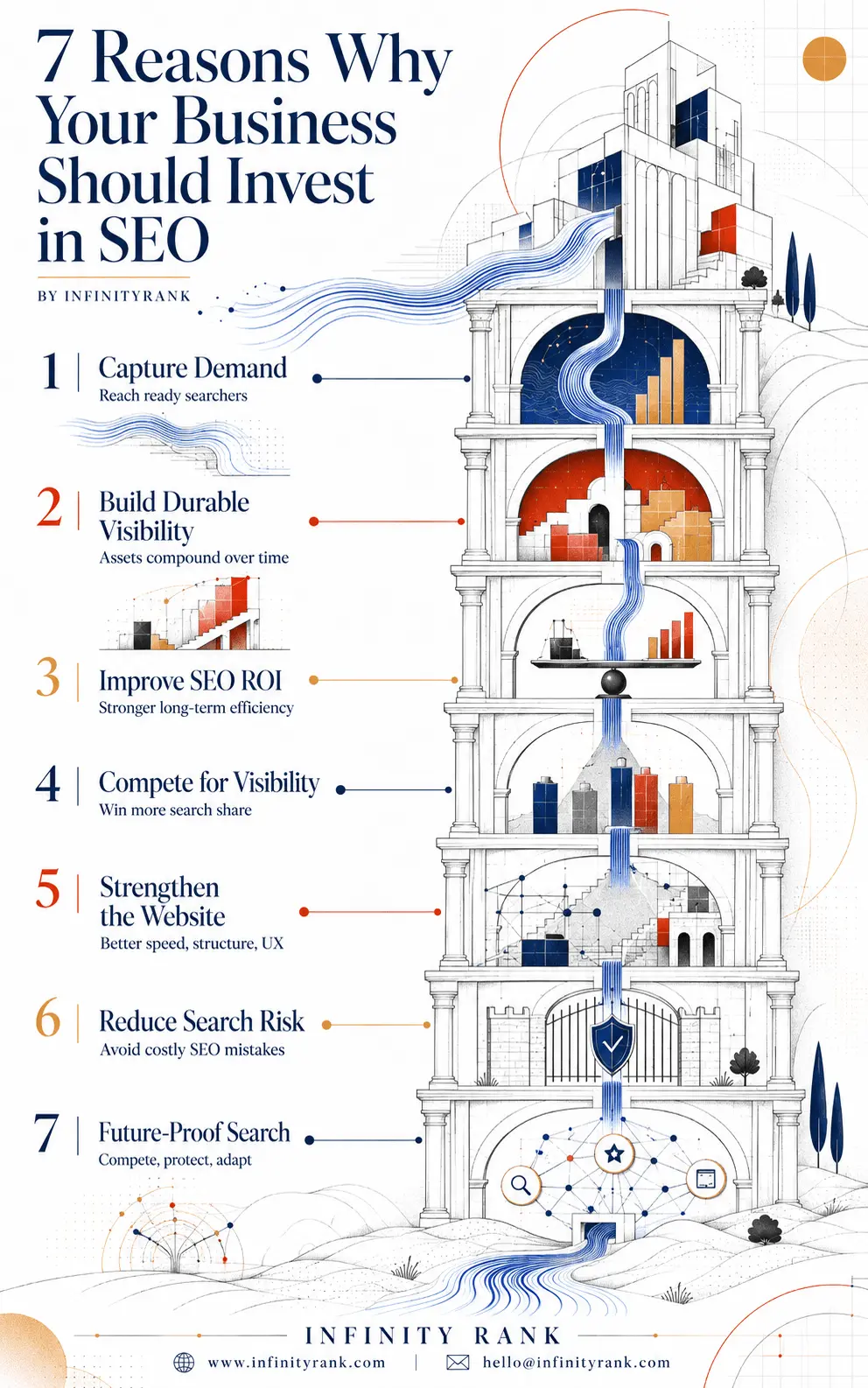
Building a strong online presence does not happen overnight, but the results keep compounding month after month. By focusing on a clean search strategy, you can beat your competitors, lower your digital marketing risks, and protect your business from future algorithm shifts. Use these core pillars as a quick checklist to review how search authority helps your business succeed over time.
1. SEO Helps You Capture Existing Demand
Many marketing channels interrupt people who are doing something else. Search works differently.
Someone searching for:
- “emergency plumber near me”
- “accounting software for small businesses”
- “commercial roofing company”
- “best CRM for recruitment agencies”
is already expressing a need.
SEO helps your business appear during that research or buying process. The visitor may not purchase immediately, but the business does not have to manufacture interest from nothing. The search itself indicates that interest already exists.
This is particularly valuable for businesses with products or services that customers deliberately research before buying.
For example, a commercial law firm does not need to attract every person browsing social media. It needs to be visible when a relevant decision-maker searches for legal support, contract advice, regulatory guidance, or representation.
The purpose of SEO is not therefore to attract the highest possible number of visitors. It is to attract relevant visitors whose needs match what the business provides.
How to measure this benefit
Track:
- Organic enquiries
- Online purchases from organic traffic
- Booked consultations
- Calls from organic landing pages
- Demo requests
- Quote requests
- Conversion rates by landing page
- Revenue attributed or assisted by organic search
Traffic alone is not enough. Ten qualified enquiries are more valuable than 10,000 irrelevant visits.
2. SEO Builds Visibility That Can Continue Producing Results
Paid advertising can generate traffic quickly, but the visibility normally ends when the campaign or budget stops.
SEO works differently. A useful service page, comparison guide, resource, local landing page, or product category page can continue attracting visitors after its initial publication.
That does not make organic visibility permanent. Rankings can change because of competition, search demand, website problems, content quality, and changes to search systems. Pages also need to be maintained.
However, a strong organic presence can create reusable business assets:
- Informational content that answers customer questions
- Service pages that generate enquiries
- Product and category pages that attract buyers
- Location pages that support local discovery
- Research that earns citations and links
- Guides that assist both sales and customer service teams
Over time, these assets can produce value across several channels. A well-researched guide may rank in search, support email campaigns, provide material for sales conversations, earn backlinks, and strengthen the business’s reputation.
That is a more durable outcome than paying for a single impression or click.
3. SEO Can Improve Customer Acquisition Efficiency
SEO is not free.
A serious campaign may require investment in:
- Research
- Technical work
- Content
- Design
- Development
- Digital PR
- Link acquisition
- Analytics
- Conversion optimisation
- Ongoing maintenance
The financial advantage is that organic traffic is not normally charged on a per-click basis. Once a page performs well, additional visits do not create a direct media cost in the same way that paid search clicks do.
This can improve acquisition efficiency over time, particularly when a business operates in an advertising market with expensive clicks.
The correct comparison is not simply:
SEO is free, while advertising costs money.
That is false.
The better comparison is:
Advertising purchases immediate distribution. SEO invests in a website’s ability to earn visibility.
Paid search may deliver a faster return. SEO may produce a stronger cumulative return. The right balance depends on the business model, margins, competition, customer lifetime value, and need for immediate results.
How to calculate SEO return
A basic SEO return calculation is:
SEO ROI = (Organic profit attributable to SEO − SEO cost) ÷ SEO cost × 100
For lead-generation businesses, calculate the value using:
- Number of qualified organic leads
- Lead-to-customer conversion rate
- Average customer value
- Gross profit margin
- Total SEO expenditure
Do not assign the full value of every organic conversion to SEO without checking attribution. Some customers interact with several channels before converting. Google Analytics can report conversions across paid and organic channels, while Search Console provides data on search visibility and clicks.
4. SEO Helps You Compete for Sea rch Visibility
Search results are competitive.
When another business appears for valuable searches and yours does not, that competitor has an opportunity to earn the visit, enquiry, or sale before the customer reaches your website.
SEO allows you to compete across different stages of the buying journey.
A business can target:
- Awareness searches: Questions about a problem
- Consideration searches: Comparisons and possible solutions
- Commercial searches: Product, service, and provider research
- Transactional searches: Queries indicating readiness to act
- Branded searches: Searches for the company, products, or reputation
This matters because competitors may already be building content and authority around the subjects your customers research.
An SEO competitor analysis can identify:
- Keywords competitors rank for
- Topics your website does not cover
- Weak competitor pages that can be improved upon
- Websites linking to competing businesses
- Important product or service categories
- Local search gaps
- Search features appearing for priority queries
The objective is not to copy competitors. It is to understand where they are capturing demand and determine whether your business can provide a better result.
5. SEO Encourages a Better Website Experience
SEO and website usability are not identical, but they frequently overlap.
A site that is difficult for users and search engines to navigate may have:
- Slow pages
- Poor mobile layouts
- Confusing menus
- Broken internal links
- Duplicate pages
- Weak page titles
- Thin service descriptions
- Unclear calls to action
- Missing product information
- Important pages that cannot be indexed
Correcting these problems can improve both organic visibility and the customer experience.
Google recommends that websites be secure, fast, accessible, and functional across devices. Its Core Web Vitals measure loading performance, responsiveness, and visual stability. Google also makes clear that good scores alone do not guarantee high rankings; they are part of a much larger set of signals.
This distinction matters.
A faster site will not compensate for irrelevant or unhelpful content. Likewise, strong content may underperform if technical problems prevent it from being discovered or used properly.
A complete SEO programme addresses both.
Website improvements commonly driven by SEO
SEO work may lead to:
- Clearer site architecture
- Faster page loading
- Better mobile usability
- More descriptive navigation
- Stronger internal linking
- More useful product and service information
- Improved accessibility
- Better conversion tracking
- Fewer broken or duplicated pages
- More relevant calls to action
These improvements benefit visitors regardless of whether they arrive through organic search, advertising, email, referrals, or social media.
6. SEO Reduces the Risk of Costly Search Problems
Poor SEO decisions can damage a website’s visibility.
Common problems include:
- Blocking important pages from search engines
- Deleting or moving pages without redirects
- Publishing large amounts of duplicate content
- Creating conflicting canonical tags
- Allowing staging websites to be indexed
- Buying manipulative backlinks
- Using automated content without proper review
- Stuffing pages with keywords
- Changing URLs during a redesign without migration planning
- Failing to track organic leads or sales
Some problems produce an immediate decline. Others quietly restrict growth for months or years.
Google’s spam policies specifically prohibit practices such as keyword stuffing and creating links primarily to manipulate rankings. Violations may be detected algorithmically or through human review and can result in ranking losses or manual actions.
A responsible SEO strategy does not promise to “beat the algorithm.” It creates a website that is technically accessible, commercially useful, and defensible over the long term.
That includes documenting changes, monitoring performance, reviewing backlinks carefully, and avoiding tactics that create short-term gains at the expense of future stability.
7. SEO Supports Visibility as Search Evolves
Search is no longer limited to a list of traditional blue links.
Users may encounter:
- Local map results
- Product results
- Featured snippets
- Images and videos
- AI-generated summaries
- Discussion results
- Knowledge panels
- Other specialised search features
This does not mean businesses need a completely separate strategy for every new search format.
Google states that the established fundamentals of SEO remain relevant to its AI search features, including AI Overviews and AI Mode. Those fundamentals include creating useful content, making pages technically accessible, using clear internal links, and ensuring that important information is available in text.
The practical response is not to chase every new acronym. It is to build a reliable information base that search systems can understand and users can trust.
That means:
- Answering genuine customer questions
- Demonstrating first-hand expertise
- Supporting claims with evidence
- Keeping important information accurate
- Using descriptive headings
- Providing clear authorship where relevant
- Building a recognisable brand
- Earning legitimate mentions and links
- Making products and services easy to understand
SEO cannot make a business immune to changes in search. It can, however, make the website more adaptable when search behaviour and presentation change.
When Is SEO a Good Investment?
SEO is likely to deserve serious investment when most of the following are true:
- Customers search for your products, services, or expertise.
- A sale or lead is valuable enough to justify acquisition costs.
- Competitors already receive meaningful organic visibility.
- Your website has technical, content, or authority gaps.
- The business can publish genuinely useful material.
- You can measure enquiries, sales, calls, bookings, or other outcomes.
- You can support the campaign for long enough to evaluate it properly.
- Organic visibility would reduce excessive dependence on paid advertising.
SEO is particularly useful for businesses with longer customer journeys because content can support prospects during research, comparison, and final selection.
When Should SEO Not Be Your First Priority?
SEO should not automatically receive the first portion of every marketing budget.
It may not be the immediate priority when:
- The business needs sales within days rather than months.
- There is little or no search demand for a new category.
- The website or product is not ready for customers.
- The business cannot fulfil additional demand.
- Tracking and conversion processes are missing.
- The offer has not been validated.
- A short-lived event or promotion requires immediate exposure.
- The company cannot maintain content or implement technical changes.
In these cases, paid advertising, direct outreach, partnerships, customer research, conversion work, or product improvements may need to come first.
This is not an argument against SEO. It is an argument against funding it without a commercial reason.
SEO vs Paid Search
SEO and paid search solve different problems.
| SEO | Paid search |
| Usually requires more time to gain traction | Can generate visibility almost immediately |
| Does not charge for each organic click | Usually charges for clicks or impressions |
| Builds content and website assets | Purchases temporary distribution |
| Offers less control over exact placement | Offers greater control over targeting and budget |
| Performance can fluctuate | Performance depends heavily on active spend |
| Useful for cumulative growth | Useful for launches, testing, and immediate demand |
Many businesses should use both.
Paid search can test offers, landing pages, messaging, and keywords while SEO work develops. SEO can later reduce dependence on paid traffic for queries where the business earns strong organic visibility.
The correct allocation depends on urgency, budget, margins, competition, and the buying journey.
How Should You Measure an SEO Investment?
Rankings are useful diagnostic indicators, but they are not the final business objective.
A proper SEO report should connect search performance with commercial outcomes.
Search visibility metrics
Use Google Search Console to track:
- Impressions
- Clicks
- Click-through rate
- Search queries
- Landing pages
- Average position
- Device and country performance
Search Console’s Performance report provides query, page, country, click, and impression data that can help identify which parts of the site are gaining or losing visibility.
Business performance metrics
Track:
- Qualified leads
- Sales
- Revenue
- Gross profit
- Bookings
- Phone calls
- Demo requests
- Cost per acquisition
- Lead quality
- Customer lifetime value
- Assisted conversions
You should also separate branded and non-branded search where possible. Branded traffic often comes from people who already know the business. Non-branded traffic provides a clearer view of how the website is reaching new searchers.
Operational metrics
Monitor:
- Indexed pages
- Crawling errors
- Core Web Vitals
- Broken links
- Conversion tracking accuracy
- Content production
- Implementation progress
- Backlink quality
- Technical issues
SEO results should be evaluated against an agreed baseline. Without one, normal fluctuations can be mistaken for growth.
How Long Does SEO Take?
There is no universal SEO timeline.
Some technical corrections can affect crawling or indexing relatively quickly. Competitive content and authority-building campaigns may take considerably longer.
Google notes that it can take a few weeks to notice new websites or changes to existing ones. Broader improvements may take days or several months to produce a visible effect as its systems reassess the site.
The timeline depends on:
- The website’s current condition
- The severity of technical problems
- Competition
- Search demand
- Content quality
- Website authority
- Available budget and resources
- Implementation speed
- The age and history of the site
- How often competitors improve their own websites
Be suspicious of anyone guaranteeing a specific ranking by a fixed date. Google does not accept payment for higher organic rankings, and no legitimate provider controls its results.
Frequently Asked Questions
Why should a small business invest in SEO?
SEO can help a small business appear when local or specialist customers search for its services. It can be particularly valuable when the business serves a defined location or niche and does not have the advertising budget of larger competitors.
Results still depend on demand, competition, website quality, reviews, location, and execution. Small businesses do not automatically rank faster simply because they are small.
Does SEO work without paid advertising?
Yes. SEO does not require an active advertising campaign.
However, paid advertising can provide immediate traffic and useful testing data while organic visibility develops. The two channels can support each other without being dependent on each other.
Is SEO better than social media?
Neither channel is universally better.
SEO is generally stronger for capturing existing search demand. Social media can be better for generating awareness, building a community, distributing visual material, and reaching audiences who are not actively searching.
The right choice depends on where customers discover and evaluate businesses in your market.
Can SEO guarantee first-page rankings?
No.
Search rankings are controlled by search engines and can change. A provider can improve the website, content, authority, and strategy, but cannot legitimately guarantee a particular organic position.
Do referrals make SEO unnecessary?
No. Referrals and SEO reach customers in different ways.
Referrals depend on existing relationships and recommendations. SEO can reach people who need what you provide but have not previously encountered the business.
A company with strong referrals may use SEO to diversify acquisition rather than replace them.
What is the difference between good SEO and bad SEO?
Good SEO improves a website for users while making its content easier for search engines to crawl, understand, and present.
Bad SEO relies on manipulation, mass-produced low-value pages, keyword stuffing, deceptive redirects, or spam links. These practices create unnecessary risk and rarely build lasting business value.
How much should a business invest in SEO?
There is no useful universal figure.
The budget should reflect:
- Commercial opportunity
- Competition
- Website size
- Technical condition
- Content requirements
- Geographic reach
- Required expertise
- Expected customer value
- The speed at which work must be completed
The correct question is not, “What is the cheapest SEO package?” It is, “What level of investment is required to compete for commercially valuable searches?”
Final Thoughts
Your business should invest in SEO when customers use search, the opportunity can be measured, and organic visibility supports a clear commercial objective.
A properly planned SEO strategy can:
- Attract people with relevant needs
- Build durable website assets
- Improve acquisition efficiency
- Strengthen competitive visibility
- Improve website usability
- Reduce technical and policy-related risks
- Support visibility as search formats change
SEO is not an instant solution, a guaranteed ranking system, or a substitute for a strong product and website.
It is a long-term investment in making your business easier to discover, understand, and choose.