Sponsored links are paid placements that help businesses get visibility in search results, websites, apps, and advertising networks.
The term has two common meanings:
- Paid search ads — ads that appear on Google, Bing, Yahoo, and other search engines.
- Paid or sponsored website links — links placed in articles, reviews, directories, or partner content in exchange for money, products, or another benefit.
Both can be useful. Both can also cause problems if used badly.
For paid search, the risk is wasting budget on weak targeting, poor landing pages, or irrelevant clicks. For SEO, the risk is violating search engine guidelines by using paid links to manipulate rankings.
This guide explains both meanings clearly.
What Are Sponsored Links?
A sponsored link is a paid link or ad placement. It usually appears because an advertiser paid for visibility, not because the page earned its position organically.
Sponsored links can appear in:
- Google Search results
- Bing search results
- Shopping results
- Display ad networks
- Sponsored blog posts
- Affiliate reviews
- Native ads
- Social media feeds
- Partner websites
- Online directories
In search results, sponsored links are usually marked with labels such as “Sponsored” or grouped under “Sponsored results.”
In SEO, a sponsored link usually means a paid backlink or commercial link that should be marked with the correct link attribute, such as:
<a href="https://example.com" rel="sponsored">Example anchor text</a>
That tells search engines the link is commercial and should not be treated like a normal editorial backlink.
Sponsored Links vs Organic Results
Sponsored links are paid placements. Organic results are earned rankings.
| Feature | Sponsored Links | Organic Search Results |
| Placement | Paid | Earned through SEO |
| Speed | Immediate once approved | Slower, often months |
| Cost | Pay per click, impression, lead, or placement | SEO costs time/resources but not per click |
| Label | Usually marked as sponsored/ad | No ad label |
| Longevity | Stops when budget stops | Can keep generating traffic |
| Trust | Lower if ad looks generic | Often higher if ranking is strong |
| Control | High control over targeting and copy | Less control over exact rankings |
A strong strategy usually uses both. Sponsored links can drive immediate traffic. SEO builds long-term visibility.
Navigating the World of Sponsored Links Safely
Paid visibility can be a powerful shortcut to growth, but only if you play by the rules that keep your site’s reputation intact. There is often a lot of confusion around what actually constitutes a “sponsored” link and how to handle them without triggering a red flag from search engines.
This strategic overview of sponsored links breaks down the essential differences between paid and organic traffic, ensuring you can leverage immediate visibility while staying fully compliant with modern SEO standards.
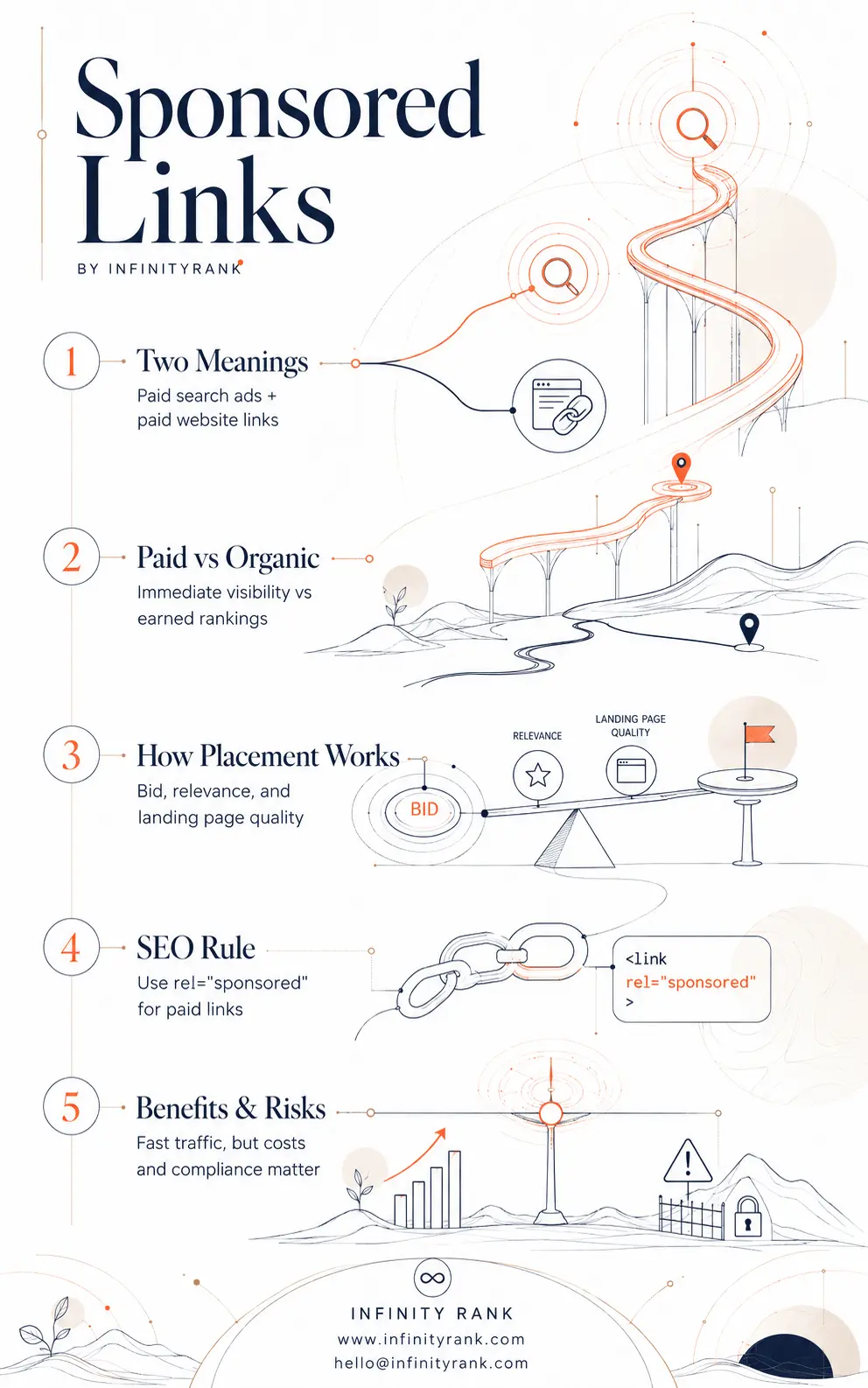
Success with paid links comes down to transparency and balance—fast traffic is great, but long-term authority is built on following the right protocols.
By using the framework outlined in this guide, you can confidently invest in your site’s growth without the fear of manual penalties or lost trust. Let’s dive deeper into the technical "rel=sponsored" rules and how to maximize your ROI while staying safe.
How Sponsored Search Links Work
Sponsored search links are paid ads that appear when someone searches for a keyword.
Example:
A law firm might bid on:
- “personal injury lawyer near me”
- “car accident attorney”
- “truck accident lawyer in Dallas”
When a user searches one of those terms, the search engine runs an ad auction. Eligible ads compete for placement.
The winner is not always the highest bidder.
Google Ads uses Ad Rank, which considers factors such as:
- Bid amount
- Auction-time ad quality
- Expected click-through rate
- Ad relevance
- Landing page experience
- Ad Rank thresholds
- Auction competitiveness
- User search context
- Expected impact of ad assets and formats
This means a better ad with a stronger landing page can sometimes outperform a higher bid.
Quality Score: What It Actually Means
Quality Score is often misunderstood.
It is not the same thing as Ad Rank. It is also not a direct real-time auction score.
Quality Score is a diagnostic metric in Google Ads. It helps advertisers understand whether their keyword, ad, and landing page are relevant to users.
It is based on three main areas:
- Expected click-through rate
- Ad relevance
- Landing page experience
A higher Quality Score can indicate that your ad experience is stronger. Improving these areas can help improve auction-time ad quality, which may lead to better ad positions and lower costs.
Do not treat Quality Score as the only performance metric. A keyword can have a decent Quality Score and still lose money if it does not convert.
Types of Sponsored Links
1. Paid Search Ads
These appear in search engine results when users search specific keywords.
Best for:
- Lead generation
- Local services
- Ecommerce sales
- High-intent keywords
- New product launches
Example:
A dentist runs ads for “emergency dentist near me” and sends users to a booking page.
2. Shopping Ads
Shopping ads show products directly in search results with images, prices, store names, and offers.
Best for:
- Ecommerce
- Retail products
- Price-sensitive searches
- Product comparison searches
Example:
A shoe store advertises running shoes with product images and prices.
3. Display Ads
Display ads appear on websites, apps, and video platforms.
Best for:
- Brand awareness
- Retargeting
- Visual products
- Audience-based campaigns
Display ads usually have lower intent than search ads because users are not always actively searching for the product.
4. Native Ads
Native ads match the look and feel of the website or platform where they appear.
Best for:
- Content promotion
- Sponsored articles
- Lead magnets
- Brand education
Native ads must be clearly disclosed. If users cannot tell it is paid content, that is a trust problem.
5. Sponsored Blog Links
These are links placed inside paid articles, reviews, guest posts, or brand collaborations.
Best for:
- Referral traffic
- Brand exposure
- Influencer partnerships
- Product awareness
SEO warning: if the link was paid for, it should use rel="sponsored" or rel="nofollow".
6. Affiliate Links
Affiliate links pay a commission when users click or buy.
Best for:
- Product reviews
- Comparison content
- Buyer guides
- Influencer content
Affiliate links should be disclosed to users and qualified properly for search engines.
Sponsored Links in SEO: What rel="sponsored"Means
In SEO, sponsored links need careful handling.
If you pay for a link, exchange products for a link, sponsor content, or compensate someone for a placement, that link should not pass ranking signals like a normal editorial link.
Use:
rel="sponsored"
Example:
<a href="https://example.com" rel="sponsored">Project management software</a>
You can also use:
rel="nofollow"
But rel="sponsored" is more specific for paid or commercial links.
Use rel="sponsored" for:
- Paid guest posts
- Sponsored reviews
- Affiliate links
- Paid directory placements
- Influencer links
- Product-for-review links
- Sponsored resource page links
- Advertorials
Do not buy links for the purpose of manipulating rankings. That can create a link spam risk.
Are Sponsored Links Safe?
Sponsored links are not automatically safe.
Legitimate sponsored links can help businesses drive traffic and sales. But bad sponsored links can waste money, damage trust, or create SEO problems.
Risks include:
- Fake or misleading ads
- Low-quality landing pages
- Brand impersonation
- Malware or scam offers
- Irrelevant paid traffic
- Inflated CPC costs
- Paid backlinks that violate search guidelines
- Poor disclosure on sponsored content
For users, the safest approach is to check the domain, brand, offer, and landing page before clicking or buying.
For businesses, the safest approach is to use transparent advertising, accurate claims, clean tracking, and proper link attributes.
How Much Do Sponsored Links Cost?
Sponsored link costs depend on the platform and pricing model.
Common models include:
| Pricing Model | Meaning | Common Use |
| CPC | Cost per click | Search ads, shopping ads |
| CPM | Cost per thousand impressions | Display ads, awareness campaigns |
| CPA | Cost per acquisition/action | Affiliate and performance campaigns |
| Flat fee | Fixed placement cost | Sponsored posts, newsletters, directories |
| Revenue share | Commission-based | Affiliate marketing |
For paid search, costs depend on:
- Keyword competition
- Industry
- Location
- Search intent
- Bid strategy
- Landing page quality
- Conversion rate
- Device targeting
- Time of day
- Competitor activity
High-intent industries like legal, finance, insurance, and home services often have expensive clicks because one lead can be very valuable.
Cheap clicks are not always better. A $2 click that never converts is worse than a $30 click that becomes a profitable customer.
Benefits of Sponsored Links
Sponsored links can be useful when used correctly.
Immediate Visibility
SEO takes time. Sponsored links can put your business in front of users quickly.
This is useful for:
- New websites
- Product launches
- Seasonal campaigns
- Local promotions
- Competitive keywords
High-Intent Traffic
Search ads can target people who are actively looking for a product or service.
Example:
Someone searching “emergency plumber open now” has strong buying intent.
Better Targeting
Paid platforms let advertisers target by:
- Keyword
- Location
- Device
- Audience
- Time of day
- Demographics
- Interests
- Remarketing lists
Measurable Performance
Sponsored campaigns can track:
- Clicks
- Impressions
- Conversions
- Cost per lead
- Revenue
- Return on ad spend
- Conversion rate
- Customer acquisition cost
This makes paid advertising easier to measure than many traditional marketing channels.
Useful Testing Data
Paid ads can test:
- Headlines
- Offers
- Landing pages
- Calls to action
- Keyword intent
- Audience segments
Winning ad copy can also inform SEO titles, meta descriptions, and content strategy.
Disadvantages of Sponsored Links
Sponsored links are not a magic fix.
Traffic Stops When Budget Stops
Paid ads work only while you keep paying. Once the campaign pauses, traffic usually stops.
Costs Can Rise Quickly
Competitive keywords can become expensive. Poor targeting can burn budget fast.
Clicks Do Not Equal Customers
Traffic is useless if the landing page does not convert.
A campaign can fail because of:
- Weak offer
- Slow page speed
- Bad form design
- Poor trust signals
- Generic copy
- No clear call to action
- Mismatch between ad and landing page
Sponsored Backlinks Can Hurt SEO
Paid links used to manipulate rankings can create search engine penalties or ranking suppression.
If the link is paid, qualify it properly.
Best Practices for Sponsored Search Links
1. Match the Keyword to the Landing Page
Do not send every click to the homepage.
Use dedicated landing pages for major campaigns.
Bad:
- Ad keyword: “emergency roof repair”
- Landing page: generic homepage
Better:
- Ad keyword: “emergency roof repair”
- Landing page: emergency roof repair service page with phone number, location, proof, and quote form
2. Use Negative Keywords
Negative keywords stop your ads from showing for irrelevant searches.
Example:
A paid legal consultation service might exclude:
- free
- template
- jobs
- salary
- definition
This protects the budget.
3. Track Conversions
Do not judge campaigns only by clicks.
Track:
- Form submissions
- Calls
- Purchases
- Bookings
- Quote requests
- Demo requests
- Newsletter signups
Without conversion tracking, you are guessing.
4. Test Ad Copy
Test different versions of:
- Headlines
- Descriptions
- Calls to action
- Offers
- Proof points
- Pricing language
Small copy changes can have a major effect on click-through rate and conversion rate.
5. Improve Landing Page Experience
Your landing page should be:
- Fast
- Mobile-friendly
- Relevant to the ad
- Easy to scan
- Clear about the offer
- Trustworthy
- Focused on one main action
Add proof where possible:
- Reviews
- Case studies
- Certifications
- Guarantees
- Client logos
- Before/after examples
- Clear contact details
6. Separate Brand and Non-Brand Campaigns
Brand searches usually perform differently from non-brand searches.
Keep them separate so reporting is clean.
Example:
- Brand campaign: “Infinity Rank”
- Non-brand campaign: “SEO agency for ecommerce”
Mixing them makes performance look better than it really is.
Best Practices for Sponsored SEO Links
1. Use rel="sponsored"for Paid Links
If money, products, discounts, or services were exchanged for the link, mark it properly.
Example:
<a href="https://example.com" rel="sponsored">Visit our sponsor</a>
2. Disclose Sponsored Content
Users should know when content is paid.
Use clear labels such as:
- Sponsored
- Advertisement
- Paid partnership
- Affiliate disclosure
Do not hide disclosures in vague footer text.
3. Do Not Sell Followed Links for SEO
Selling followed links that pass ranking signals is risky.
If you sell placements, qualify the links.
4. Avoid Exact-Match Anchor Abuse
This looks manipulative:
<a href="https://example.com" rel="sponsored">best cheap personal injury lawyer Chicago</a>
Use natural anchor text instead:
<a href="https://example.com" rel="sponsored">Smith & Lee Law Firm</a>
5. Keep Sponsored Content Useful
A sponsored post should still help readers.
Weak sponsored content usually has:
- Thin copy
- Generic claims
- No examples
- No disclosure
- Over-optimized anchor text
- Too many promotional links
Good sponsored content explains the product, use case, limitations, and who it is actually for.
Sponsored Links Examples
Example 1: Google Search Ad
A user searches:
“best CRM for small business”
A CRM company runs a paid search ad linking to a comparison landing page.
This is a sponsored search link.
Example 2: Shopping Ad
A user searches:
“wireless noise cancelling headphones”
An ecommerce store appears with a product image, price, and rating.
This is a sponsored shopping link.
Example 3: Sponsored Blog Review
A software company pays a blog to review its tool.
The article links to the company’s website.
That link should use rel="sponsored".
Example 4: Affiliate Buyer Guide
A website publishes:
“Best Standing Desks for Home Offices”
The article includes affiliate links to products.
Those links should be disclosed and qualified.
Example 5: Native Ad
A finance brand pays to promote an article on a news site.
The article appears in a recommended content block.
This is a native sponsored link.
Sponsored Links and SEO: Do They Help Rankings?
Sponsored links can help SEO indirectly, but they should not be used to pass PageRank.
They may help by:
- Driving referral traffic
- Increasing brand searches
- Getting content seen by more people
- Creating awareness that later earns natural links
- Supporting product launches
- Retargeting users who visited your site
But paid links should not be treated as organic backlinks.
If your goal is long-term SEO, focus on earning editorial links through useful content, data, tools, digital PR, and strong brand visibility.
When Should You Use Sponsored Links?
Use sponsored links when you need:
- Fast visibility
- Lead generation
- Product promotion
- Local service inquiries
- Retargeting
- Keyword testing
- New landing page testing
- Seasonal campaign traffic
- Competitive search presence
Avoid sponsored links when:
- You cannot track conversions
- Your landing page is weak
- Your offer is unclear
- You are trying to buy rankings
- You cannot afford testing
- You do not know your target audience
- You are relying on paid traffic as your only channel
Sponsored links work best when they are part of a broader marketing strategy that includes SEO, content, conversion optimization, and analytics.
Sponsored Links Checklist
Before running sponsored links, check the following:
- The campaign has a clear goal.
- Conversion tracking is installed.
- The landing page matches the keyword.
- The offer is specific.
- Negative keywords are added.
- Ad copy is being tested.
- Budget limits are set.
- Performance is reviewed regularly.
- Paid SEO links use rel=”sponsored”.
- Sponsored content is clearly disclosed.
- Affiliate links are properly marked.
- Reporting separates brand and non-brand traffic.
Final Thoughts
Sponsored links can drive fast traffic, leads, and sales. They can also waste money or create SEO risk if handled carelessly.
For paid search, success depends on targeting, ad quality, landing page experience, and conversion tracking.
For SEO, the rule is simple: if a link is paid or sponsored, disclose it and qualify it with the right attribute.
Used correctly, sponsored links are a practical part of digital marketing. Used badly, they become expensive noise.