Backlinks still matter. But bad link building does not just waste money — it can weaken your site’s authority, distort your backlink profile, and create avoidable SEO risk.
The mistake most businesses make is simple: they chase more links instead of better links. They buy cheap placements, repeat the same anchor text, ignore relevance, and treat link building like a one-time campaign.
That approach does not work anymore.
Google’s link spam policies are clear: links intended to manipulate rankings may be treated as spam. Paid, sponsored, or affiliate-style links should also be qualified properly with attributes such as rel="sponsored" or rel="nofollow" where appropriate.
This guide breaks down the most common link building mistakes, why they damage SEO, and how to fix them without relying on risky shortcuts.
Link Building Errors: Avoiding Costly Pitfalls
Earning authority is a marathon, but one wrong move can set your progress back by months. Many SEOs fall into the trap of chasing volume and metrics while ignoring the signals that actually matter to search engines.
To protect your site from penalties and wasted budget, you need to recognize which habits are helping and which are quietly sabotaging your rankings. This summary of common link-building mistakes highlights the five critical guardrails you need to stay within to ensure your growth remains steady and safe.
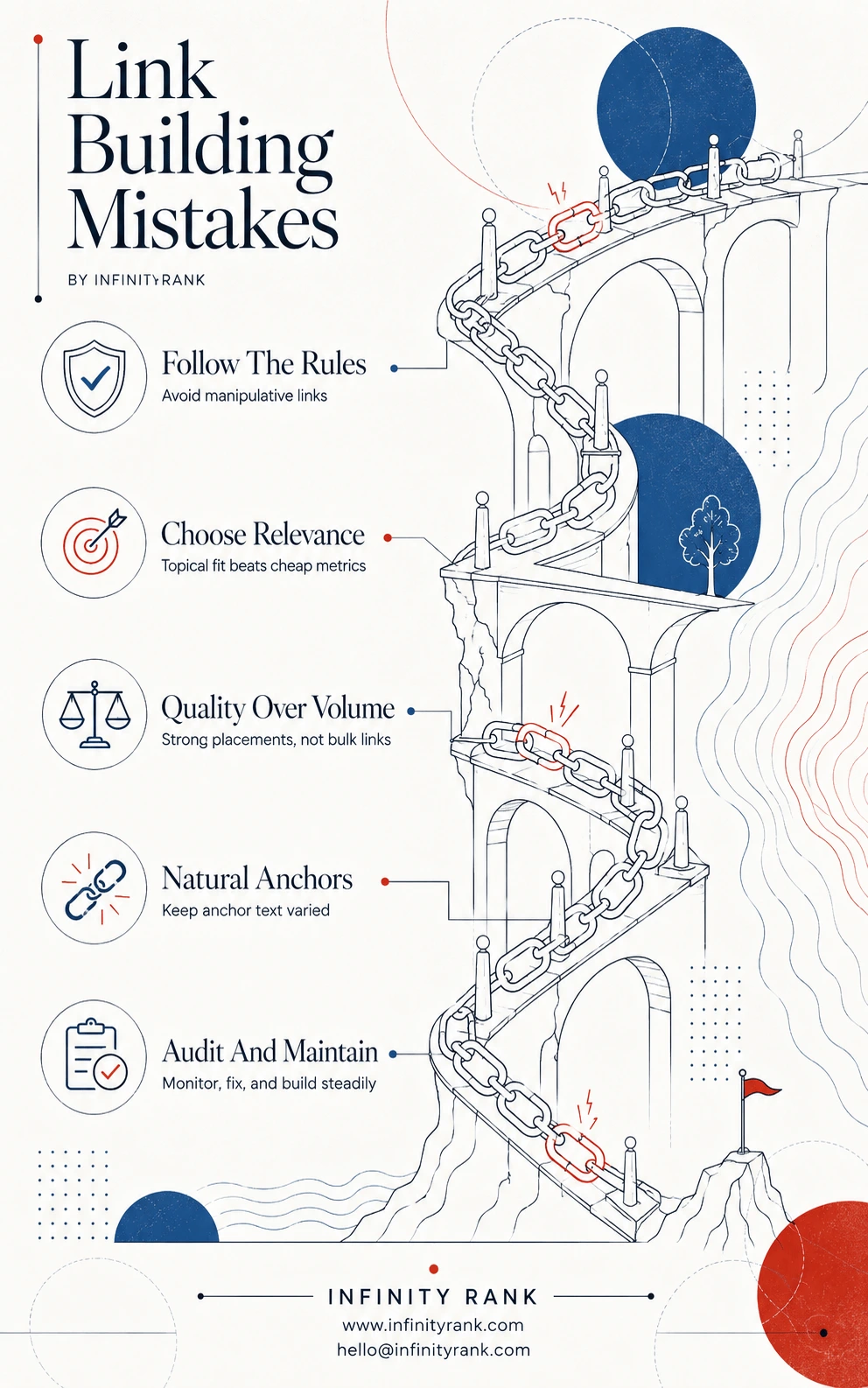
Building a resilient backlink profile is about discipline,choosing the right fit over the easy win every single time. By keeping these five principles at the forefront of your strategy, you can build a site that not only ranks higher but stays there regardless of algorithm updates.
Use the link-building-mistakes-infographic as your roadmap for your next audit to catch potential issues before they become permanent problems.
1. Ignoring Google’s Link Spam Policies
The fastest way to turn link building into a liability is to ignore Google’s rules.
Google does not ban every commercial relationship involving links. The problem starts when links are created mainly to manipulate rankings and pass ranking value artificially. That includes paid links without proper qualification, large-scale guest posting schemes, link exchanges, automated links, private blog networks, and keyword-stuffed anchor text placed unnaturally across the web.
Why this matters
Google can ignore, devalue, or take manual action against manipulative links. Even when there is no direct penalty, bad links can waste budget and give you a false sense of SEO progress.
Example mistake
You pay for guest posts on irrelevant blogs and require every article to link back with the exact anchor text “best SEO agency.”
That is not a strategy. That is a footprint.
The fix
Build links that make editorial and topical sense.
Prioritize placements where:
- The linking site has real content and real readers.
- The link is relevant to the topic of the page.
- The anchor text reads naturally.
- Paid or sponsored placements use the correct link attributes.
- The page would still make sense even if SEO did not exist.
Use Google’s link spam policies as the baseline, not as an afterthought.
2. Relying Too Heavily on Sitewide Backlinks
A sitewide backlink appears across many pages of another website, usually in a footer, sidebar, template, or navigation area.
One branded link from a legitimate partner site is not automatically a problem. But dozens or hundreds of repeated links from the same domain can look unnatural, especially when the anchor text is commercial.
Why this matters
Sitewide links create an obvious pattern. If they are paid, irrelevant, or keyword-heavy, they can look manipulative. They also rarely provide the same value as strong contextual links placed inside relevant content.
Example mistake
A company buys a footer link on a blog network, and that link appears on 700 pages using the anchor text “best link building services.”
The fix
Use sitewide links sparingly.
Better options include:
- Contextual links inside relevant articles.
- Branded partner links where the relationship is legitimate.
- Resource-page links where your content genuinely helps the reader.
- Digital PR mentions from relevant publications.
- Editorial links from industry blogs and niche publications.
When a sitewide link exists for sponsorship, advertising, or partnership reasons, keep it branded and properly qualified if needed.
3. Building Too Many Low-Quality Links Too Fast
Fast link growth is not always bad. A brand can earn many links quickly after a product launch, news story, study, or viral campaign.
The problem is fast growth from weak sources.
If your site suddenly gains hundreds of links from directories, comment sections, scraper sites, low-quality guest posts, or irrelevant foreign domains, that pattern does not look like real authority.
Why this matters
Search engines evaluate patterns. Sudden backlink spikes from poor sources can signal manipulation, especially when the anchors are repetitive and the linking pages have no real editorial value.
Example mistake
You buy a package promising “500 high DA backlinks in 7 days.”
That is a red flag. Real link building does not work like bulk email spam.
The fix
Aim for consistent, defensible link acquisition.
Track:
- Referring domain growth.
- Link source quality.
- Anchor text distribution.
- Topical relevance.
- Link placement.
- New lost links.
- Ratio of branded to commercial anchors.
Tools like Google Search Console, Ahrefs, Semrush, or Majestic can help you monitor patterns. But tools do not replace judgment. A link is only useful if it comes from a relevant, trustworthy source.
4. Chasing Quantity Over Quality
More backlinks do not automatically mean better rankings.
A single relevant link from a respected industry publication can be more useful than dozens of weak links from thin directories, expired domains, or generic blogs with no audience.
Why this matters
Low-quality links inflate reports. They do not build trust.
The number of backlinks looks impressive in a dashboard, but it does not mean those links are helping your pages rank, attract referral traffic, or strengthen topical authority.
Example mistake
A SaaS company submits its homepage to hundreds of free directories just to increase backlink count.
Most of those links are irrelevant. Many will never send traffic. Some may create cleanup problems later.
The fix
Judge links by quality, not volume.
A good backlink usually has these traits:
- The linking site is indexed and active.
- The page has real content, not spun filler.
- The link is topically relevant.
- The placement is editorial, not forced.
- The anchor text is natural.
- The site has visible editorial standards.
- The link has a realistic chance of being clicked.
Do not ask, “How many links did we build?”
Ask, “Would this link make sense to a real reader?”
5. Ignoring Topical Relevance
Relevance is non-negotiable.
A backlink from a high-authority site can still be weak if the page has nothing to do with your industry, audience, product, or topic.
Why this matters
Links help search engines understand relationships between pages. If your backlink profile is filled with irrelevant placements, it sends a messy signal.
A fitness brand getting links from health, nutrition, sports, wellness, and lifestyle sites makes sense.
A fitness brand getting links from crypto blogs, casino sites, coupon farms, and random tech directories does not.
Example mistake
A local bakery buys backlinks from finance and cryptocurrency blogs because the links are cheap and the sites have high third-party authority metrics.
That is lazy link building.
The fix
Build links from sites that are directly or indirectly relevant.
Strong relevance sources include:
- Industry publications.
- Local media.
- Trade associations.
- Partner businesses.
- Niche blogs.
- Resource pages.
- Podcasts.
- Expert roundups.
- Digital PR campaigns tied to your market.
Relevance does not have to be exact, but it must be defensible.
For example, a cybersecurity company could reasonably earn links from technology, SaaS, compliance, insurance, and business publications. It should not be chasing links from pet blogs or recipe sites.
6. Over-Optimizing Anchor Text
Anchor text is the clickable text in a hyperlink.
It helps users and search engines understand the page being linked to. Google recommends writing anchor text that is descriptive, concise, and relevant to both the source page and destination page.
The problem starts when anchor text becomes repetitive and unnatural.
Why this matters
If too many backlinks use the same exact-match commercial keyword, your backlink profile starts to look engineered.
Natural backlink profiles contain variety.
You should expect to see:
- Branded anchors.
- URL anchors.
- Partial-match anchors.
- Descriptive anchors.
- Generic anchors.
- Long-tail natural phrases.
- Image links.
- Naked URLs.
Example mistake
Dozens of different websites link to the same page using “best cheap SEO services” as the anchor.
That does not look organic. It looks controlled.
The fix
Use natural anchor text variation.
Good anchor examples:
Infinity RankInfinity Rank’s link building servicesthis guide to backlink auditsethical link building strategylearn more about digital PRhttps://infinityrank.com/
Risky anchor examples:
best cheap SEO agencybuy backlinks nowtop link building service USAcheap link building packages- Repeated exact-match anchors across unrelated sites
Do not force keyword anchors. Let the sentence determine the anchor, not the keyword spreadsheet.
7. Buying Links Without Proper Vetting
Many businesses buy links. Pretending otherwise is useless.
The real issue is risk management.
Paid links that pass ranking value can violate Google’s spam policies if they are intended to manipulate search rankings. Sponsored placements should be handled transparently and qualified properly.
Why this matters
Cheap paid links often come from:
- Link farms.
- Private blog networks.
- Expired domains.
- AI-generated content sites.
- Irrelevant guest post farms.
- Sites with no organic traffic.
- Sites selling links to every niche imaginable.
These links are easy to spot and easy to waste money on.
Example mistake
You spend $200 on a package promising “50 high-authority dofollow backlinks” from random blogs.
That offer is not a bargain. It is a cleanup bill waiting to happen.
The fix
Vet every site before pursuing a placement.
Check:
- Does the site have real organic traffic?
- Is the content original and useful?
- Is the site relevant to your niche?
- Does the site clearly sell links to every industry?
- Are outbound links excessive or spammy?
- Does the page have editorial standards?
- Would the link still make sense without SEO value?
- Is the link properly attributed if sponsored?
Better alternatives include digital PR, original research, expert commentary, useful tools, statistics pages, resource assets, and relationship-based outreach.
8. Forgetting Internal Linking
Backlinks are not the only links that matter.
Internal links are the links you control. They help users move through your site and help search engines discover, crawl, and understand your pages.
Google’s link best practices specifically call out internal links and descriptive anchor text as useful for helping users and Google understand connected pages.
Why this matters
A site with weak internal linking wastes authority.
You may earn strong backlinks to a blog post, but if that post does not link to related service pages, guides, or conversion pages, you leave value trapped on one URL.
Example mistake
You publish 50 blog posts, but none of them link to your main service pages or related educational content.
That creates orphaned pages and weak topical clusters.
The fix
Build internal links intentionally.
Do this:
- Link from blog posts to relevant service pages.
- Link from old articles to new articles.
- Link supporting content to pillar pages.
- Use descriptive anchor text.
- Add links where they genuinely help the reader.
- Fix orphaned pages.
- Update internal links during content refreshes.
Example:
Instead of writing “click here,” write “review our link building services” or “read our guide to disavowing toxic backlinks.”
That is clearer for users and search engines.
9. Misusing the Disavow Tool
Bad links can appear even if you do nothing wrong.
Scraper sites, spam domains, automated directories, hacked pages, and negative SEO attempts can create ugly links pointing to your site.
But that does not mean you should disavow every suspicious backlink.
Google’s own guidance says most sites do not need to use the Disavow Tool. You should usually only disavow when there are a considerable number of spammy, artificial, or low-quality links and those links have caused, or are likely to cause, a manual action.
Why this matters
Overusing the disavow tool can remove signals that were not actually hurting you. It can also waste time that would be better spent earning better links and improving content.
Example mistake
You export every backlink with a low third-party “toxicity score” and disavow all of them without manual review.
That is reckless.
The fix
Use a cautious process.
Before disavowing, ask:
- Is the link clearly spammy, artificial, or manipulative?
- Is there a pattern across many links or domains?
- Did you or a past vendor build these links intentionally?
- Is there a manual action in Google Search Console?
- Could this link simply be ignored by Google already?
- Have you tried removal for links you directly control?
Use disavow only when the risk is clear. Do not treat it as routine maintenance for every ugly backlink.
10. Treating Link Building as a One-Off Task
Link building is not something you finish.
Competitors keep publishing content, earning mentions, launching PR campaigns, and building partnerships. If you stop completely, your authority gap can widen over time.
Why this matters
SEO compounds. So does neglect.
A one-month campaign may create a temporary boost, but durable authority requires ongoing link acquisition, content improvement, and relationship building.
Example mistake
A business runs one guest-posting campaign, gets a few links, then ignores backlinks for the next year.
Meanwhile, competitors continue earning links from podcasts, reports, industry blogs, and news mentions.
The fix
Make link building part of your ongoing SEO system.
A sustainable strategy includes:
- Monthly backlink monitoring.
- Quarterly backlink audits.
- Ongoing content promotion.
- Digital PR campaigns.
- Expert quotes and thought leadership.
- Linkable assets.
- Strategic partnerships.
- Internal link updates.
- Competitor backlink analysis.
The goal is not to build links forever for the sake of volume. The goal is to keep earning relevant authority while protecting your site from low-quality tactics.
How to Audit Your Backlink Profile
Do not wait until rankings drop to inspect your backlinks.
Use this simple audit process.
Step 1: Export backlink data
Start with Google Search Console. Then compare with tools like Ahrefs, Semrush, or Majestic if available.
Pull:
- Referring domains.
- Linked pages.
- Anchor text.
- First seen date.
- Link type.
- Lost links.
- Top linked pages.
Step 2: Group links by domain
Do not review every URL in isolation first. Group by referring domain so you can spot patterns faster.
Look for:
- Sitewide links.
- Repeated anchors.
- Foreign-language spam.
- Irrelevant niches.
- Obvious link farms.
- Domains with thin content.
- Networks using the same templates.
Step 3: Review anchor text
Flag anchors that are:
- Overly commercial.
- Repeated too often.
- Grammatically unnatural.
- Irrelevant to the destination page.
- Exact-match across many unrelated domains.
A healthy anchor profile should look mixed, not engineered.
Step 4: Check relevance and placement
Ask whether each link makes sense in context.
A good link usually appears inside useful content and points to a page that helps the reader.
A bad link often appears in:
- Random author bios.
- Link lists.
- Footers.
- Spam comments.
- Thin guest posts.
- Irrelevant articles.
- Auto-generated pages.
Step 5: Decide what to do
Use four categories:
- Keep: Relevant, natural, useful links.
- Ignore: Low-value links that are not clearly manipulative.
- Remove: Links you control or can reasonably request removal for.
- Disavow: Clear spam or manipulative patterns that create manual-action risk.
Do not panic over every weak link. Focus on patterns.
Final Thoughts
The biggest link building mistake is treating backlinks like a numbers game.
More links do not automatically mean better SEO. Better links do.
A strong backlink profile is relevant, natural, diverse, and defensible. It supports your content instead of trying to trick search engines into trusting it.
Avoid shortcuts. Vet every placement. Use natural anchors. Build internal links. Audit regularly. Be careful with disavow. And stop buying links that only look good in a spreadsheet.
That is how you build authority that lasts.
Frequently Asked Questions
Should I remove old backlinks that look suspicious?
Not automatically. First, review whether the links are clearly spammy, artificial, irrelevant, or manipulative. If you control the links, remove them. If you do not control them and there is a serious pattern that could create manual-action risk, consider using Google’s Disavow Tool cautiously. Most sites do not need to disavow links.
How do I know if my backlink profile is healthy?
A healthy backlink profile usually has relevant referring domains, natural anchor text variety, steady link growth, and links from pages that make editorial sense. Use Google Search Console and third-party SEO tools to review referring domains, anchors, linked pages, and suspicious patterns.
Can I recover from bad link building?
Yes, but recovery depends on the severity of the problem. Start by identifying manipulative links, removing links you control, documenting cleanup efforts, and disavowing only when the risk is serious. Then rebuild authority with better content, digital PR, and relevant outreach.
How many backlinks do I need to rank?
There is no fixed number. It depends on the keyword, competition, content quality, search intent, site authority, and the strength of competing pages. Focus on earning relevant links from trusted sources instead of chasing a backlink count.
Should I disavow every low-quality link?
No. That is a bad practice. Google says most sites do not need the Disavow Tool because Google can often assess which links to trust without extra guidance. Use disavow only for a considerable number of spammy, artificial, or low-quality links that have caused, or are likely to cause, a manual action.